Sebae Anemone
Heteractis crispa
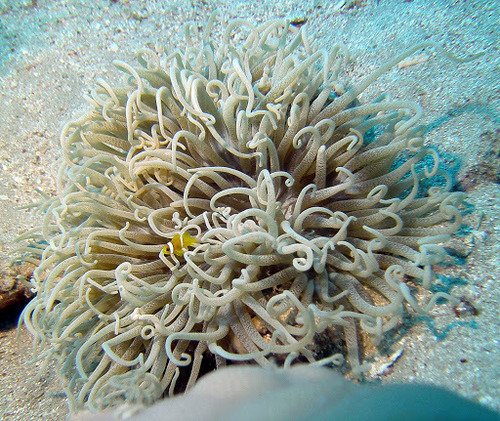
Care facts
- Difficulty
- Moderate
- Reef Safe
- With Caution
- Aggression
- Semi-aggressive
- Diet
- Carnivore
- Tank Size
- 55 gallons
- Placement
- Bottom
Gallery
The Sebae Anemone, Heteractis crispa, is a large host anemone of the family Stichodactylidae, also sold as the Leathery Sea Anemone, the Leathery Sebae, the Long Tentacle Anemone and the Purple Tip Anemone. It is widespread across the tropical Indo-Pacific, from the Red Sea and the east African coast through the Indian Ocean to Japan, Australia and the Pacific islands, on lagoon and seaward reefs from shallow water down to about 40 metres. In the wild it lives with its column buried or wedged at the junction of sand and rock — in a sand pocket, a rock crevice or under a ledge — with only the oral disc and tentacles spread above the substrate. That buried-foot habit is the single most useful thing to copy in a tank.
Trade names: two "Sebae" anemones
Trade names need care with this animal. Two different species are sold as \u201cSebae.\u201d Heteractis crispa is the leathery one covered here: a tough, leathery column, and long, tapering tentacles that end in rounded, often magenta or purple tips. Heteractis malu, the other \u201cSebae,\u201d is a predominantly sand-dwelling anemone with noticeably shorter, stubbier tentacles of uneven length, often ringed or banded. The two are confused in shops and on care sheets, and advice written for one is routinely applied to the other, which is part of why published care ratings for \u201cSebae\u201d range from easy to difficult. Older literature also places this species in Radianthus, so Heteractis crispa and Radianthus crispa in a source are the same animal.
Healthy colour
A healthy crispa is not white. The oral disc and tentacles in a settled, well-lit animal are tan, brown, grey-green, green, mauve or purple-brown, the colour of the symbiotic algae (zooxanthellae) living in its tissues showing through, usually with contrasting purple, blue or magenta tentacle tips. The flared disc can reach about 50 cm (roughly 20 inches) across in a large adult, with tentacles several centimetres long — commonly described up to about 15 cm — spread in dense concentric rings around a central mouth. The column itself, grey, white or violet-tinged and distinctly leathery, is normally hidden in the substrate. A snow-white or very pale cream animal with purple tips, the look most shoppers first meet, has expelled its zooxanthellae. That bleached state is covered in the field notes below, because it changes what the anemone needs from its keeper.
Reading the care ratings
The entry rates this anemone Moderate for difficulty, Semi-aggressive, Carnivore by diet, Bottom for placement, a 55-gallon tank, and Reef Safe With Caution, and those ratings sit in the middle of a genuinely divided published record. Some care references list crispa as difficult and delicate, stressing failed acclimation in new or unstable tanks; others list it as moderate and, once acclimated and eating, quite hardy. Both descriptions are describing a different phase of the same animal's life in captivity: the first weeks are the dangerous part, and a specimen that settles, anchors and feeds is a different proposition from the same specimen on import day. Semi-aggressive and With Caution are not about hunting. This is a mobile animal with a potent sting, delivered by nematocysts in the tentacles, that will damage or kill corals it rests against and can catch small, unwary fish; it needs open room to expand to its full disc size, and neighbouring corals need to be placed for the anemone it will become, not the one that arrived in the bag.
Feeding
Feeding is carnivory plus light. Like other host anemones, crispa draws much of its energy from its zooxanthellae in strong light, and supplements it by capturing meaty food. In the wild it takes small fish and invertebrates that blunder into the tentacles. In a tank it should be offered small pieces of shrimp, clam, krill, mysis or silverside, placed on the tentacles near the mouth, two to three times a week as the existing entry advises — and more often, in smaller meals, while a bleached animal is recovering, because a bleached animal has lost the algal income that normally pays most of its bills. Food should be in pieces the animal can actually ingest; a meal that is repeatedly taken and then expelled whole was too large, whatever the keeper intended. Uneaten food must not be left to rot in the tentacles, and food needs defending from shrimp, crabs and the anemone's own clownfish long enough for the slow feeding response to finish.
Clownfish hosting
In nature crispa is one of the great host anemones. Published host lists credit it with as many as fourteen clownfish species, among them Clark's, the Blue-striped, the Orange Skunk, the Saddleback, the Red Sea two-banded and Barber's anemonefish, and juveniles of the Threespot Dascyllus also shelter in it. In a tank it will accept a wider range of clownfish than its natural partners, though acceptance is never a promise on a timetable: some pairs move in within hours and some fish ignore a perfectly suitable anemone for weeks. The relationship is mutual in the wild — the fish gain protection from predators, the anemone gains food scraps, waste nutrients and a defender that drives off polyp-eating fish — and a settled pair is the sight most keepers who buy this species are buying it for.
Field notes — what keepers report
Field notes: the white-anemone question
The white-anemone question dominates keeper reports, and keepers divide less on the facts than on what to do about them. There is broad agreement that most pale white, purple-tipped sebaes in shops are bleached, not a white colour form: they have lost their zooxanthellae to collection, shipping or holding conditions, arrive with little photosynthetic income, and need deliberate feeding precisely because of that loss. Keeper accounts that follow such animals through recovery describe the same sequence — with stable water, strong light and regular small meaty feedings, a pinkish, tan or brown colour creeps back into the tentacles over weeks to months, feeding response quickens, and the animal starts to behave like a settled host anemone. Against that, other keepers report white specimens that never coloured up despite feeding and good light, shrinking a little each month until they failed, and warn that a deeply bleached import is a rescue project with uncertain odds rather than a routine purchase. The useful middle that experience points to is blunt: pay for the brown or tan animal with the tight mouth and the foot already holding, not for the prettiest white one, and if a white one is bought, buy it knowing it must be fed as a non-photosynthetic animal until colour returns.
Field notes: feeding size
Feeding size is the second long-running split. One body of keeper experience feeds whole krill or whole small silversides and reports no ill effects over years, sometimes noting that resident clownfish — maroon clowns in more than one account — take food from the keeper's fingers and deliver it to the anemone themselves before eating. Another body of experience, including anemone-care references, argues that large chunks are poorly digested, are liable to be expelled hours later, and foul the water in the process, and recommends only finely cut or pea-sized pieces, several times a week, and daily-to-alternate-day small meals for a bleached animal being nursed back. Both sides agree on the diagnostic, even where they disagree on the ration: an anemone that consistently expels a meal is telling its keeper that the meal, not the schedule, is wrong.
Field notes: wandering
Wandering reports also come in two registers, and tank layout seems to decide which one a keeper meets. This species has a reputation as a notorious wanderer that stings everything in its path, and that picture is well documented in unsettled animals — a new crispa that cannot bury its foot, dislikes its light or flow, or is hungry will roam, and a roaming anemone that reaches a powerhead or overflow can be shredded and, in a small volume, can take the tank with it, which is why experienced keepers screen every intake before the anemone goes in, not after its first walk. The counterweight reports come from keepers who provided a sand-and-rock junction in moderate, turbulent flow and strong light from the start: their animals anchored, in the words of one wholesaler account buried the column into a crevice and never let go, expanded in place, grew rapidly, and were notably less prone to wander than a Magnificent Sea Anemone in the same kind of system. A crispa on the move is therefore best read as a review of the spot it left, not as a character trait — light, flow, footing and food are the four dials keepers adjust before blaming the animal.
Field notes: clownfish and settling
Clownfish get credited, in keeper accounts, with more than decoration. A frequently repeated observation is that a hosted crispa acclimates more easily — the fish's movement, waste and feeding visits appear to stimulate and provision the anemone, and some wholesaler and reference guidance explicitly recommends introducing a suitable clownfish to aid acclimation. The other side of that coin also appears in reports: very large or boisterous clownfish, big maroon females in particular, can buffet a small or weakened anemone hard enough to keep it closed, and keepers who have watched that pairing separate the fish until the anemone is anchored, coloured and feeding strongly. Size-matching the partners, in other words, matters as much as species-matching them.
Field notes: a tank-maturity test
Finally, keepers are consistent that this anemone is a tank-maturity test. Guidance gathered from long-running care sources converges on a well-established system — six months is the common floor, up to a year in the stricter accounts — with near-seawater specific gravity around 1.023 to 1.026, pH about 8.1 to 8.4, no detectable ammonia or nitrite, strong skimming and light bright enough for the zooxanthellae to work, and changes made gradually through water changes rather than by dosing corrections straight onto the animal. Keepers describe a settled crispa, in that kind of system, as an early-warning instrument: it deflates, gapes or starts to move before test kits show a slide, and they learn to treat a previously settled animal's unrest as a prompt to test everything first and touch nothing in a panic. That sensitivity is why the difficulty ratings for this species will probably always disagree — in an established, stable reef the animal behind them is, by most long-term accounts, a large, long-lived and remarkably tolerant host; in a young tank, it is unforgiving of exactly the instability that young tanks have.
