Magenta Dottyback
Pictichromis porphyrea
Reef Safe

Gallery
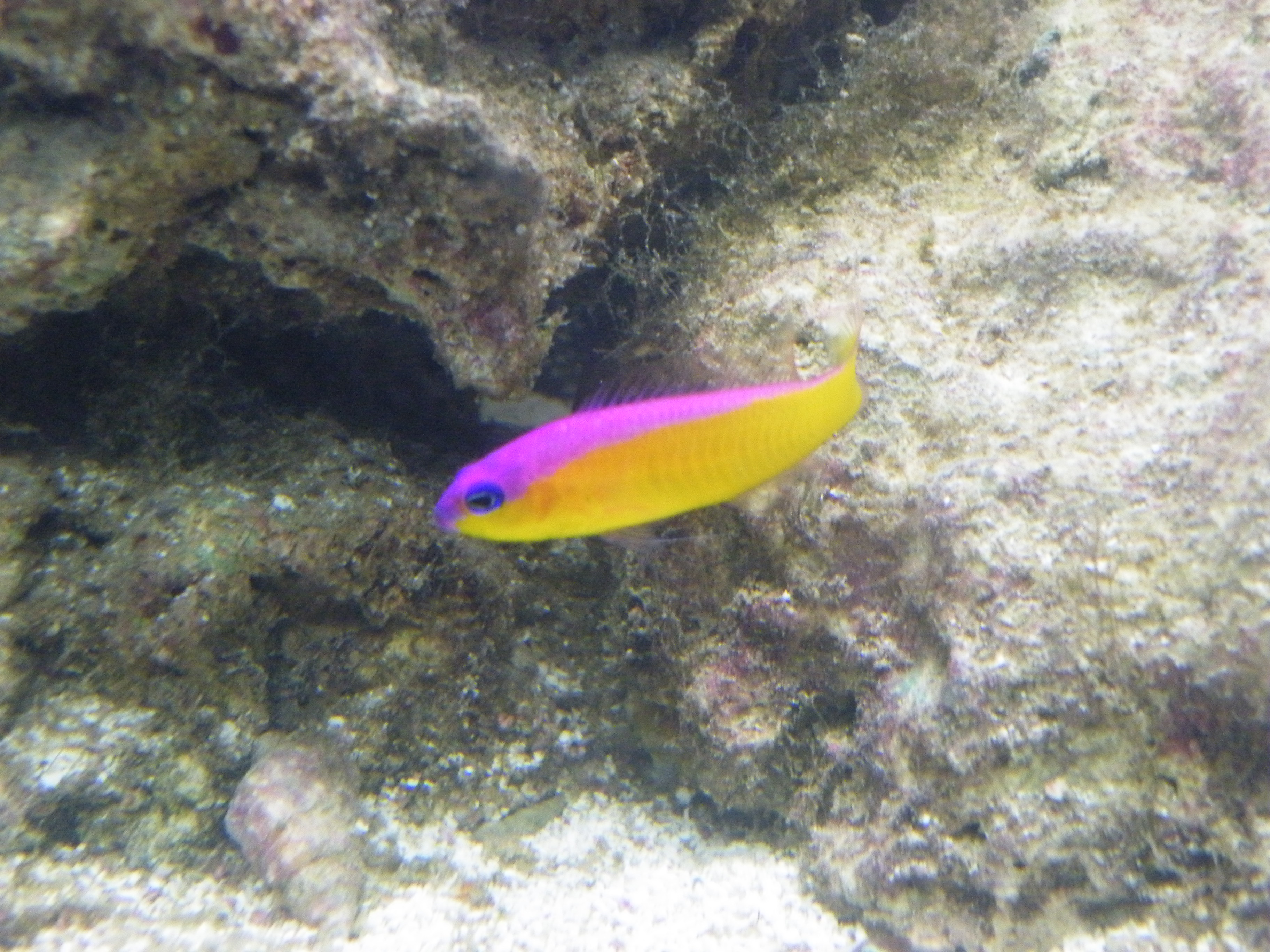
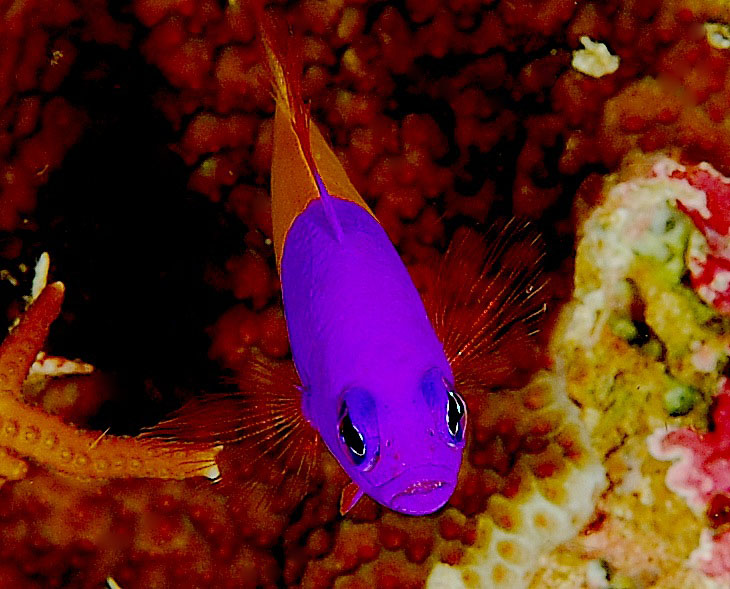
The Magenta Dottyback, Pictichromis porphyrea, is the small purple fish that teaches a hard lesson about scale: at barely two and a half inches it carries a territory, a temper and a hunting instinct entirely out of proportion to its size. The original short entry in this database got the commercial facts right: it is one of the most affordable and reliably available dottybacks, its solid magenta-purple colour photographs exceptionally well in reef lighting, it takes frozen mysis and enriched frozen foods within the first day in most cases and is not a picky eater, singletons are strongly recommended because two dottybacks in a small system will fight constantly and one will almost always be bullied to death, and it is a smart pick for high visual impact from a small fish without serious money. Every one of those points survives checking. What the short entry could not hold is the rest of the record: that the fish sold as peaceful in a bare dealer tank commonly becomes a cave-defending territorialist two to four weeks after it settles, that its reef safety is unanimous for corals and genuinely divided for small shrimp, that it is one of the few dottybacks with field-confirmed bidirectional sex change, and that it is routinely confused with the rarer, calmer Orchid Dottyback, a confusion the clear fins and the missing eye stripe settle in seconds once a buyer knows to look. This is a beginner-hardy fish whose stocking consequences are not beginner-simple, and the sections below keep those two facts separate.
A small fish with a large claim
Pictichromis porphyrea was described by Lubbock and Goldman in 1974, originally as Pseudochromis porphyreus, and sits in the dottyback family Pseudochromidae. The genus name joins the Latin for painted or coloured with Chromis, a nod to the bright live colouration of its members, and the species name points at purple. Common names in the trade are plural and overlapping: Magenta Dottyback is the name this entry files, Strawberry Dottyback and Purple Dottyback are the same fish in other listings, and Purple Pseudochromis appears in older retail copy. The formal maximum in FishBase is 6.0 centimetres total length, about 2.4 inches, which makes it one of the smallest fish in this database sold as a centrepiece rather than as a background fish. Other treatments give larger figures, 8 centimetres in one species lexicon and a flat 3 inches in retail summaries, and that spread, 6 to 8 centimetres, is recorded whole in the field notes rather than averaged: under any figure the adult is a two-to-three-inch fish, and the planning question is never its bulk but the radius it defends. The species is assessed as Least Concern and is a regular aquarium-trade fish, not a rarity: its story is behaviour, not scarcity.
Identification, and the Orchid problem
The adult is a single, saturated colour: an elongated, compressed body in solid magenta-purple from nose to tail, with fins that are clear rather than coloured, and no dark stripe through the eye. FishBase's identification note adds the lighting fact the original entry's photography remark rests on: the bright purple looks bright blue in sunlit underwater conditions, so the same fish reads magenta under aquarium light, violet in a photograph and almost blue in shallow sunlit water, and colour alone, judged from a single photo, is a weak identification. Fin counts for the record are three dorsal spines with 21 to 22 dorsal soft rays and three anal spines with 10 to 12 anal soft rays. The confusion that matters commercially is with the Orchid Dottyback, Pseudochromis fridmani, a Red Sea species that is rarer and considerably calmer and therefore often the fish a buyer thought they were getting. The separators are quick and visual: the Magenta has clear fins, the Orchid's fins carry colour; the Orchid shows a black stripe through the eye, the Magenta does not. A second confusion is internal to the name pile: Strawberry, Magenta and Purple Dottyback listings with a clear-finned, stripe-less purple fish are this species under three labels, and a buyer comparing prices across those names is comparing the same animal. Sexes are not reliably separated by eye in the shop: in natural populations males run larger than females, but there is no dependable colour split to sex a single fish at purchase, which is one reason the pairing section below treats pair formation as a managed process rather than a shopping choice. Condition in the shop reads plainly: a bold fish hovering at the front of its rockwork, colour saturated, taking food, is the normal healthy presentation of a species described across sources as not shy; a pale, corner-pressed fish that will not eat is off its baseline in a way that should be understood before purchase.
Reading the care ratings
This entry rates the Magenta Dottyback Beginner for difficulty, Aggressive for temperament, Carnivore, Nano for tank size, Mid for swimming zone and Yes for reef safety, and the honest reading is that the husbandry ratings are easy while two of the social ratings need the qualifications the text supplies. Beginner is a hardiness verdict and it holds: the species lexicon grades the fish Hardy, feeding is seldom a challenge in the specialist account, and the family's general record is of durable fish that adapt quickly to captive food and water. Beginner is not a temperament verdict, and a first-time keeper who reads it as one will meet the Aggressive filing unprepared. Aggressive, unusually, is not an exaggeration to soften: the lexicon calls the species aggressive toward other species and capable of extreme aggression, the family literature describes dottybacks bullying tankmates including larger fish, and the original entry's singleton rule is the same fact at tank scale. The filing is kept at full strength, and the temperament section explains the conditions that decide how much of it a given tank sees. Carnivore is exact: the wild diet is small benthic crustaceans and zooplankton, and the captive ration in the feeding section is meaty throughout. Nano, the tank-size field, is the floor of a wide published spread recorded whole in the tank section and the field notes: a fish that stays near one refuge needs little swimming room, and needs considerably more social room, so the gallons question is really a tankmate question. Mid describes the hovering working position above coral and rubble around the refuge, with the understanding that the fish's world is the rockwork face and the water immediately in front of it, not the open column. Yes for reef safety is a coral verdict and it holds unanimously: no source used here accuses this fish of harming corals or other sessile invertebrates, and one specialist account calls it totally inoffensive to them. The caution that other sources file, reef safe with caution, is about small mobile crustaceans the fish is built to eat, and the reef-safety section keeps that distinction explicit rather than downgrading a correct Yes into a vague warning.
In the wild
The formal distribution is the western Pacific: from the Philippines to Samoa, north to the Ryukyu Islands and south to the Moluccas and Admiralty Islands, in a tropical band roughly 30 degrees north to 15 degrees south. It is reef-associated from the surface to 65 metres, usually in the top 15 metres, and the habitat summary is specific about the shape of its home: it hovers above coral or rubble and inhabits steep outer reef slopes and outer channel walls, solitary or in small, loosely scattered groups at the base of steep drop-offs. That picture explains the aquarium fish almost completely. A drop-off base is a wall of holes: the fish holds a station in front of a chosen crevice, picks small crustaceans from the benthos and the drift, and disappears into the wall when a predator passes. The loose scattering of wild groups is not shoaling and not pair life; it is neighbouring territory holders spread along a wall, each at its own hole, which is exactly the social geometry a long, well-rocked tank can offer two fish and a small cube cannot. Diurnal in the behaviour summaries, it works by day and sleeps in the crevice by night. Nothing in the wild record suggests a fish that needs current, depth or open water in captivity; everything in it suggests a fish that needs a wall with a hole it can own, and a keeper who provides vertical, broken rockwork with real caves is reproducing the drop-off base in miniature.
Feeding
Feeding is the easy contract the original entry promised, and the wider record confirms it with unusual unanimity. The natural diet is small benthic crustaceans first, with zooplankton taken from the water in front of the refuge, and the captive translation is direct: frozen mysis, enriched brine shrimp, krill and finely chopped seafoods, frozen carnivore preparations, and suitably sized pellets, offered in small meals. The original entry's first-day claim, that the fish takes frozen mysis and enriched foods within the first day in most cases, matches the specialist verdict that feeding is seldom a challenge, and a Magenta Dottyback that refuses food past the first day or two is giving information about health or social stress, not about pickiness. Two qualifications complete the section. The first is colour: species accounts note that the magenta can go matte in captivity and that pigment-rich, varied, high-quality food is the recorded remedy, so the saturated fish in the original entry's photograph is a fed fish, and a fading fish is first a diet review. The second is predation management: a varied meaty ration is also the tool keepers use to lower the fish's interest in ornamental shrimp, with retail guidance noting that a well-fed dottyback is less likely to trouble cleaner shrimp, a mitigation recorded honestly as likelihood, not guarantee, because the same mouth that takes mysis is built for exactly that size of crustacean. Frequency follows the small-stomach rule for the family: small meals, once or twice daily, rather than a single gorge, and food delivered near the fish's station will be defended as territory, so in a community tank the shy fish should be fed away from the dottyback's cave rather than through it.
Tank and water
Record the tank-size spread whole, because the sources measure different things and each figure is honest about the thing it measures. This database files the species Nano. One species lexicon gives a minimum of 70 litres, about 18 gallons. A specialist overview puts suitable housing at 20 to 30 gallons, with the explicit warning that the smaller the tank, and therefore the more compressed the territory, the harder the fish is to keep with other species, and that in a nano system it would likely need to be the lone fish occupant. Retail listings give 30 gallons as a minimum. None of these figures is about swimming: a station-holding fish uses a few feet of rockwork its whole life. They are about how much of the tank falls inside the defended radius, which experienced keepers put at roughly 12 to 18 inches around the chosen cave, and whether tankmates have anywhere that is not that radius. The working synthesis used here is: a nano is a legitimate home for this fish alone or as the clear territorial dominant with only robust, rock-distant companions; a community that includes shy, bottom-oriented or similarly shaped fish belongs at the larger end of the spread, with rockwork broken into separated structures so a second territory, and an escape from the first, both exist. Aquascaping is not decoration for this species: ample live rock with caves and crevices at several heights, at least one cave the fish can fully claim, and refuges its tankmates can reach without crossing its station. Water is ordinary stable tropical marine across the sources: temperature roughly 72 to 79 degrees Fahrenheit, the coolest published band running 22.2 to 25.6 degrees Celsius, specific gravity 1.020 to 1.025, pH 8.1 to 8.4, with stability valued over any chased point inside those bands. A tight lid is a stated requirement in the species accounts, which list jumping from open aquaria among the known behaviours: a small, startled, crevice-diving fish goes up when the crevice route is blocked, and the lid is the cheap answer.
Temperament and tankmates
This is the section the purchase turns on, and the record is unusually candid once its timing is understood. The pattern experienced keepers describe, and a detailed care guide names directly, is delayed territoriality: in a bare retail tank the fish has no territory and behaves as the peaceful misconception describes, and two to four weeks after introduction, once it has claimed a cave system, the defence begins. The defence itself is systematic rather than random: fish that venture near the established territory are harassed, similarly shaped and similarly coloured fish are read as rivals wherever they are, and conspecifics are the worst case of all, which is the mechanism under the original entry's rule that two dottybacks in a small system fight constantly until one is bullied to death. The family literature generalises the point in strong terms, dottybacks bullying tankmates and even chasing and nipping larger fish, and a long-running advisory record for the family describes attacks on firefish, gobies and royal grammas, fish of similar body type, with individual dottybacks known to injure fish larger than themselves. Against that file stands a magazine survey's softer placement of Pictichromis among the comparatively civil dottybacks that often get along in mixed company, and a forum record in which some magenta dottybacks are described as pretty tame. Both sides are used in this entry the way keepers reconcile them: the capacity is constant, the expression depends on territory, tankmates and the individual, and a tame specimen is a fortunate draw, not a species trait that can be ordered. Practical stocking follows. Add the dottyback late, after peaceful fish hold their own stations. Choose tankmates that are larger, faster or robust and that work away from the rock face: dwarf angels, tangs and wrasses in tanks of suitable size, squirrelfish and rabbitfish in the family guidance, are the recurring compatible shapes. Avoid the named poor matches: firefish, small gobies, jawfish, blennies, small cardinals, seahorses and pipefish, other dottybacks and pseudochromids generally, royal grammas and anything purple and elongated. And plan the exit before it is needed: a settled dottyback is quick, slim and crevice-committed, and removing one can require removing rock, which is why experienced advice treats the addition as a decision to live with rather than an experiment to reverse.
Reef safety and crustaceans
The Yes filing and the caution filing are both correct, about different animals, and this section is where they are separated. For corals and sessile invertebrates the record is unanimous: the fish is totally inoffensive to corals in the specialist account, generally ignores corals and invertebrates in the family care literature, and no source used here reports coral nipping, polyp eating or clam harassment. A Magenta Dottyback can be placed in a reef on the coral question without a reservation. For small mobile crustaceans the record points the other way with equal consistency: the natural diet is small benthic crustaceans, the species lexicon flags a threat to relatively small shrimp and crabs, multiple accounts warn that small ornamental crustaceans are at risk of becoming lunch, and retail copy advises that varied meaty feeding may deter, not prevent, an attack on cleaner shrimp. The size gradient is the practical rule keepers converge on: tiny shrimp, small hermits and porcelain-type crabs are prey-shaped; large cleaner shrimp established before the fish, in a well-fed tank, are the combination most often reported to coexist, with the first weeks watched. Sexy shrimp and other deliberately tiny ornamental crustaceans should be treated as food offered slowly. None of this revises the filing: reef safe for the reef, a predator for the smallest members of the cleanup crew, and a keeper choosing between a magenta dottyback and a collection of tiny shrimp is choosing, whether they frame it that way or not.
Pairs, sex change and breeding
The reproductive biology is the most scientifically distinctive part of this species' file. The species is a sequential hermaphrodite in the standard accounts, changing sex from female to male when a male is needed, and the field research on this exact species goes further: bidirectional sex change, change in either direction as the social situation requires, has been confirmed in the field for the first time in the dottyback family in Pictichromis porphyrea. In natural populations the sex ratio is often female-dominated, males are typically larger, and the change is socially controlled and functional, the changed fish producing the gametes of its new sex. That biology is why pairs can be formed from two unsexed fish at all: given space and time, the larger or more dominant individual takes the male role. It is also why pair formation must be managed rather than assumed, because the sorting process is the aggression of the temperament section conducted at closest range, and in a small tank the subordinate may be killed before the roles settle, the same outcome the original entry warns of for two dottybacks generally. Established pairs are reported to breed in captivity, and the species is listed as bred in captivity, with tank-bred specimens worth asking for, though a detailed care account notes captive-bred fish are not commonly available commercially. Spawning follows the family pattern in the summaries: eggs laid as an oviparous clutch on a hidden substrate, in a cave or crevice, guarded and tended, the guarding role assigned to the male in the general dottyback account, until hatching. Larvae are planktonic and, as with most small reef fish in this database, raising them is a dedicated larviculture project, not a display-tank event. For most keepers the practical meaning of the whole section is simpler: buy one fish unless the tank is large, the rockwork offers two stations, and a formed pair is the explicit project, because the biology that makes pairing possible makes casual doubling dangerous.
Choosing a specimen
Buy the temperament future, not just the colour in the bag. The first check is identity, using the identification section's two-second test: clear fins and no black eye stripe for this species; coloured fins and an eye stripe mean the Orchid Dottyback, a different fish with a different temperament and usually a different price, and either mistake, paying Orchid money for a Magenta or bracing for Magenta aggression from an Orchid, is avoidable at the glass. The second check is presentation: this is a bold species, and the healthy shop fish hovers at its rockwork, colour saturated, fins intact, and feeds; the original entry's first-day feeding expectation is a fair shop test, and a fish that will not take frozen mysis in the store should be passed over for one that will. Ask whether the fish is captive-bred: the species can be bred in captivity and tank-bred dottybacks are worth preferring where they exist, with the honest caveat from the care literature that they are not commonly available, so most fish offered will be wild-caught and should be judged on condition accordingly. Size choice is a social choice in miniature: a small fish settles under the radar of an existing community more easily than a full-size adult arriving with a full claim, and any fish added to a tank that already holds a dottyback, a gramma or a similarly shaped fish should be treated as the introduction problem the temperament section describes, whatever its size. Quarantine follows the ordinary small-fish logic, observation and feeding in isolation being especially useful for a species whose two commonest early problems, social stress in the destination tank and a fish that has not yet switched to prepared foods, are both easier to solve before the fish has a cave to defend.
Warning signs
The healthy baseline is conspicuous and should be learned first: a settled fish out at its station by day, hovering over the rubble in front of its cave, colour saturated magenta, feeding boldly, retreating into the crevice when startled and re-emerging within minutes. Most problems announce themselves against that baseline in one of four ways. A fish that hides continuously past the first days, or that re-emerges only to be driven back, is living under social pressure, from a tankmate in a community tank or from the hierarchy sorting inside a would-be pair, and the remedy is structural, separation or a second station, not patience. A fish that stops feeding is off the species' easiest contract and should be checked for the ordinary small-fish causes, water, parasites and bullying at feeding, in that order of likelihood for a fish whose appetite is normally immediate. Colour loss, the matte magenta the accounts describe, is first a diet and condition signal, answered with the pigment-rich varied ration of the feeding section before it is treated as disease, though a fish that is pale, thin and off food together is a health case, not a colour case. And the tank-level warning sign belongs to the tankmates: a shy fish that begins hiding all day, loses condition or shows nipped fins two to four weeks after the dottyback arrived is showing the delayed territoriality of the temperament section arriving on schedule, and the decision it calls for, rehome one of the two fish, gets harder the longer the rockwork has to come apart to make it, which is the final reason this entry treats the purchase itself as the commitment.
Field notes — what keepers report
On temperament, the reports divide by time and by tank, and both sides describe the same fish honestly. One side is the retail and first-weeks record: a bold, confident fish that does not shy from larger tankmates, darts out to challenge the feeding hand, and in some keepers' tanks settles as, in one forum phrase, pretty tame, with a magazine survey placing Pictichromis among the more civil dottybacks for mixed company. The other side is the settled record: territorial establishment two to four weeks in, a defended radius of roughly a foot to a foot and a half around the cave, systematic harassment of peaceful fish that cross it, attacks on similarly shaped fish regardless of territory, and family advisory accounts of dottybacks injuring and even killing fish larger than themselves. Keepers reconcile the two by the calendar and the stock list rather than by doubting either: the fish is manageable with robust, dissimilar tankmates in adequate rockwork, and a recurring disaster with shy, similar or bottom-bound fish, and the variable is almost never the species' nature, which is constant. On how many, the original entry's rule and the wider record agree in direction and differ only in the size of the exception. Singletons are strongly recommended in this database's entry, in retail copy that says housed singly, and in family guidance that warns against two dottybacks together even in large, heavily aquascaped systems. The exception in the record is real but narrow: formed pairs exist, pairs have bred in captivity, and large tanks with separated rock structures are where keepers report two-fish arrangements surviving, which is a breeding project with a managed introduction, not a relaxation of the rule for ordinary community tanks. On adult size, the figures are recorded whole: 6.0 centimetres in FishBase, about 2.5 inches in the specialist overview, 8 centimetres in a second species lexicon, and 3 inches in retail summaries. Captive fish in keeper reports sit at the small end of that spread, and no report used here describes a fish that outgrows the two-to-three-inch planning picture; the disagreement is about centimetres, not about kind. On tank size, the published spread is recorded whole: Nano in this database's filing, 70 litres in the species lexicon, 20 to 30 gallons in the specialist overview, and 30 gallons in retail listings. Keeper experience explains the spread rather than settling it: the same fish is a nano fish alone and a 30-gallon problem in a community of shy fish, because the gallons are buying distance from its cave, and reports of trouble concentrate predictably in the smallest tanks with the most vulnerable tankmates. On shrimp, the reports split by size and by feeding, and the split is the finding: small ornamental shrimp and tiny crabs are eaten, consistently enough that the risk is stated as diet rather than possibility; large cleaner shrimp are reported coexisting by many keepers, especially when established first and when the fish is well fed on meaty foods, and reported taken by others, so the honest summary is that a cleaner shrimp is a gamble weighted by size, order and feeding, and a sexy shrimp is not a gamble at all. On reef safety, there is no split to record for corals: every account used here, including the ones that file the species reef safe with caution, locates the caution entirely in the crustacean question and none in coral behaviour, which is why this entry keeps its Yes filing and explains it rather than hedging it. On colour, keepers and the formal record agree once lighting and diet are named: magenta under reef light, bluer in sunlit shallow water per the identification literature, and matte in captivity on a monotonous diet, recovering saturation on pigment-rich varied food in the species accounts. The fish whose colour disappoints is usually telling a feeding story. On lifespan, the figures in the record are estimates and are reported as such: about five years in one species sheet and in wild-life expectancy estimates, five to eight years in a detailed care guide, and seven years or more in a well-maintained aquarium in another account. No figure here is a promise; the direction they share is that a settled, well-fed fish is a multi-year commitment well beyond its price, which was the original entry's quiet point about value from the start.