Pinkbar Goby
Amblyeleotris aurora
Reef Safe

Gallery
Some shrimp gobies are camouflage with fins. The pinkbar is the opposite: a white fish crossed by pink bars, with a yellow tail, that spends its day sitting in the open at the mouth of a hole in the sand, watching the tank. It can afford to be conspicuous because the hole is never more than a body-length away and because the hole comes with staff — a nearly blind pistol shrimp that digs and maintains the burrow the two of them live in, while the goby stands sentry over both of them. That partnership is the reason to keep this fish, and this entry is written around it: what the pinkbar actually is, how to tell it from the barred relatives it is sold beside, what the sand bed has to look like before either partner can work, and where the care-sheet numbers genuinely disagree.
Reading the fish
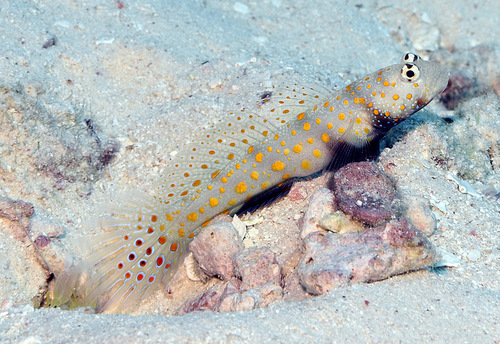
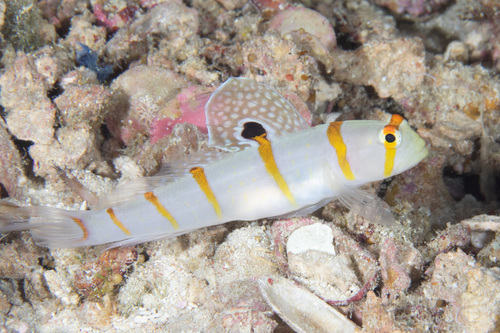
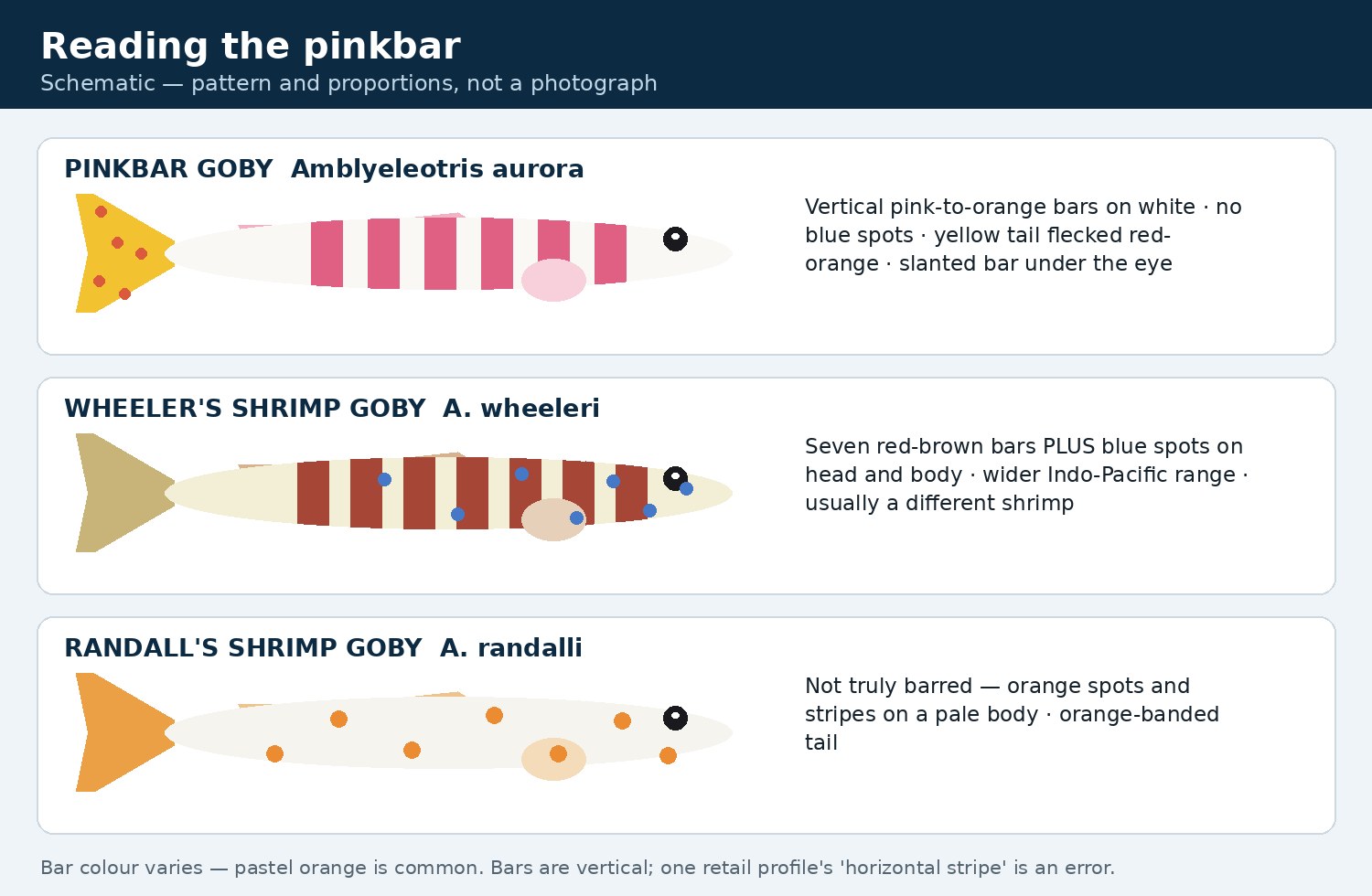
Start with the bars, because the name is the bars. An adult pinkbar carries a series of vertical bars — pink in the classic Maldives-type fish, running from reddish-pink to a softer rose — across a clean white to very pale body. The first dorsal fin is tall and sail-like, often raised and flicked as a signal flag. The tail is the second field mark: bright yellow, flecked with orange to reddish spots, a combination no other common shrimp goby wears. A slanted pink bar beneath the eye is the detail one specialist guide singles out as separating this species from the other barred shrimp gobies it is most often confused with.
Two honest complications belong in the identification. The first is colour: the wholesaler record points out that many pinkbars are actually a pastel orange barred fish that can be vertically striped in soft pink — the pink of the name is a variable, not a guarantee, and at least one major retailer sells this exact species under the name Orange Banded Prawn Goby on the strength of it. Bar colour alone, pink versus orange, does not move a fish into another species. The second complication is a piece of copy that needs correcting wherever it appears: one retail profile describes this fish as carrying "a bold pink horizontal stripe running from head to tail." There is no such stripe. The bars are vertical. A barred shrimp goby whose pattern really does run horizontally is a different fish.
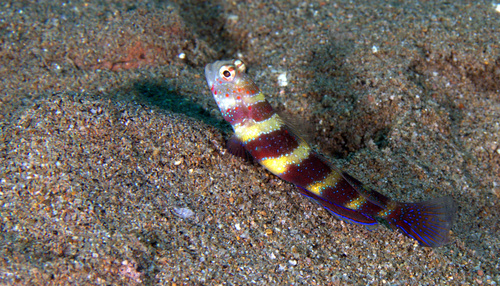
The confusion species that matters is Wheeler's shrimp goby, Amblyeleotris wheeleri — described by the same authors, in the same year, and barred in the same general way. FishBase separates it cleanly: wheeleri carries seven reddish-brown to red bars and, decisively, blue spots scattered over the head and body and sometimes onto the fins, with red spots on the head including at the corner of the mouth. The pinkbar has no blue spotting. Wheeler's also ranges far wider — across the Indo-Pacific to Fiji, Japan and the Great Barrier Reef — and most often partners a different shrimp, Alpheus ochrostriatus. Randall's shrimp goby, the other regular mix-up, is not really barred at all: it is a paler fish patterned with orange spots and stripes. So the working diagnosis for aurora is: vertical pink-to-orange bars without blue spots, a yellow tail with reddish flecks, the slanted bar under the eye, and a tall first dorsal.
Where it comes from
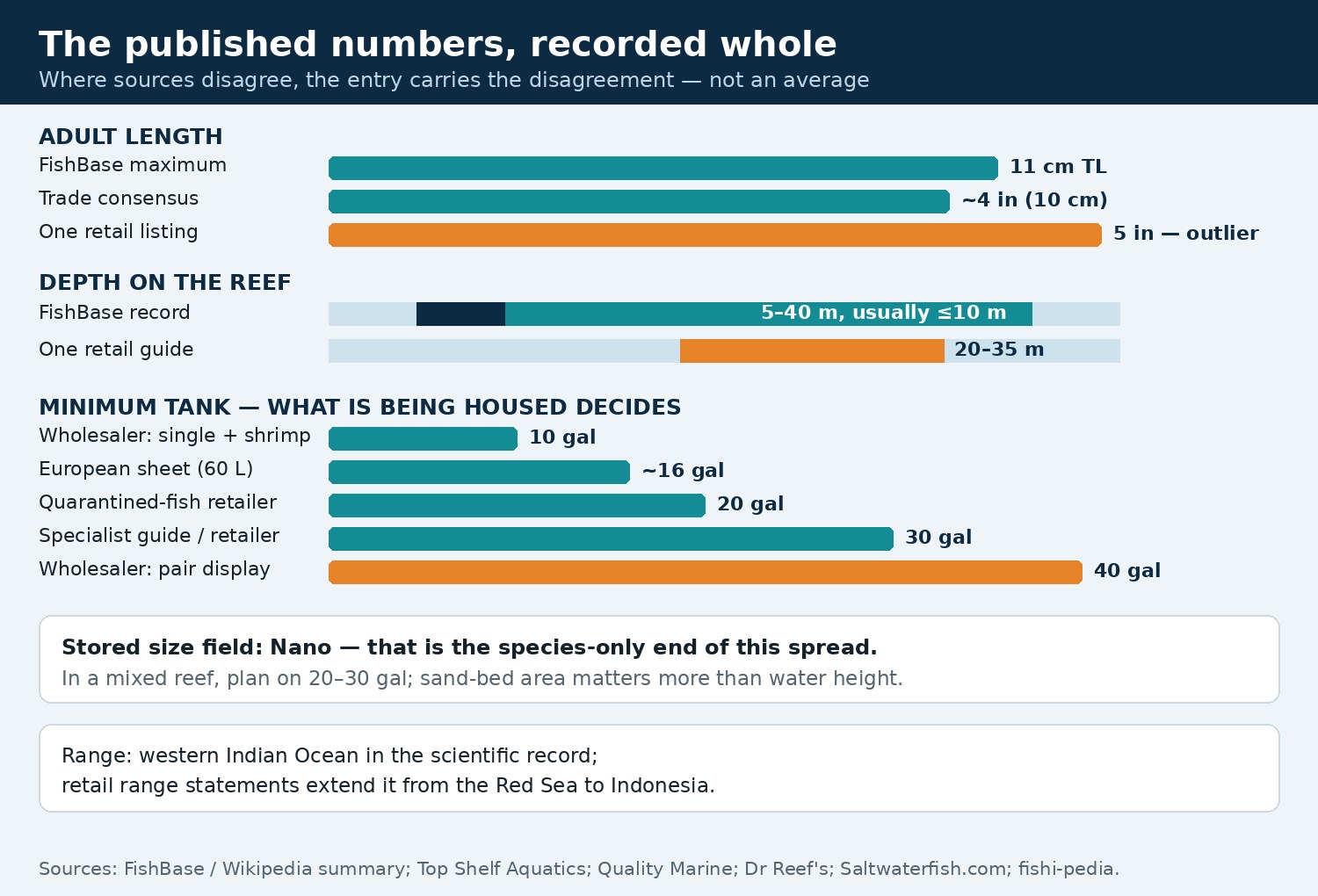
Amblyeleotris aurora was described by Polunin and Lubbock in 1977, originally placed in Cryptocentrus, and its scientific home is the western Indian Ocean — the East African coast and the island groups, with the Maldives producing the classic photographs of the species, including the one at the top of this entry. Retail range statements run wider, from the Red Sea and East Africa through to Indonesia; that wider version should be read as the trade's supply map rather than the tighter scientific distribution, and the entry records both rather than splitting the difference silently.
Depth is the other number the sources argue about, and the argument is recorded whole below in the ranges panel. The FishBase summary puts the species at 5 to 40 metres but usually no deeper than 10 — a shallow sand-flat fish. One specialist retail guide instead places it at about 20 to 35 metres on clear coastal and outer-reef flats. Those cannot both describe the typical animal; what they agree on is the habitat itself, which matters more for the keeper: open sand and rubble flats beside reefs, not the reef rock itself, always at a burrow in the sand shared with a pistol shrimp. It is listed as Least Concern.
The partnership
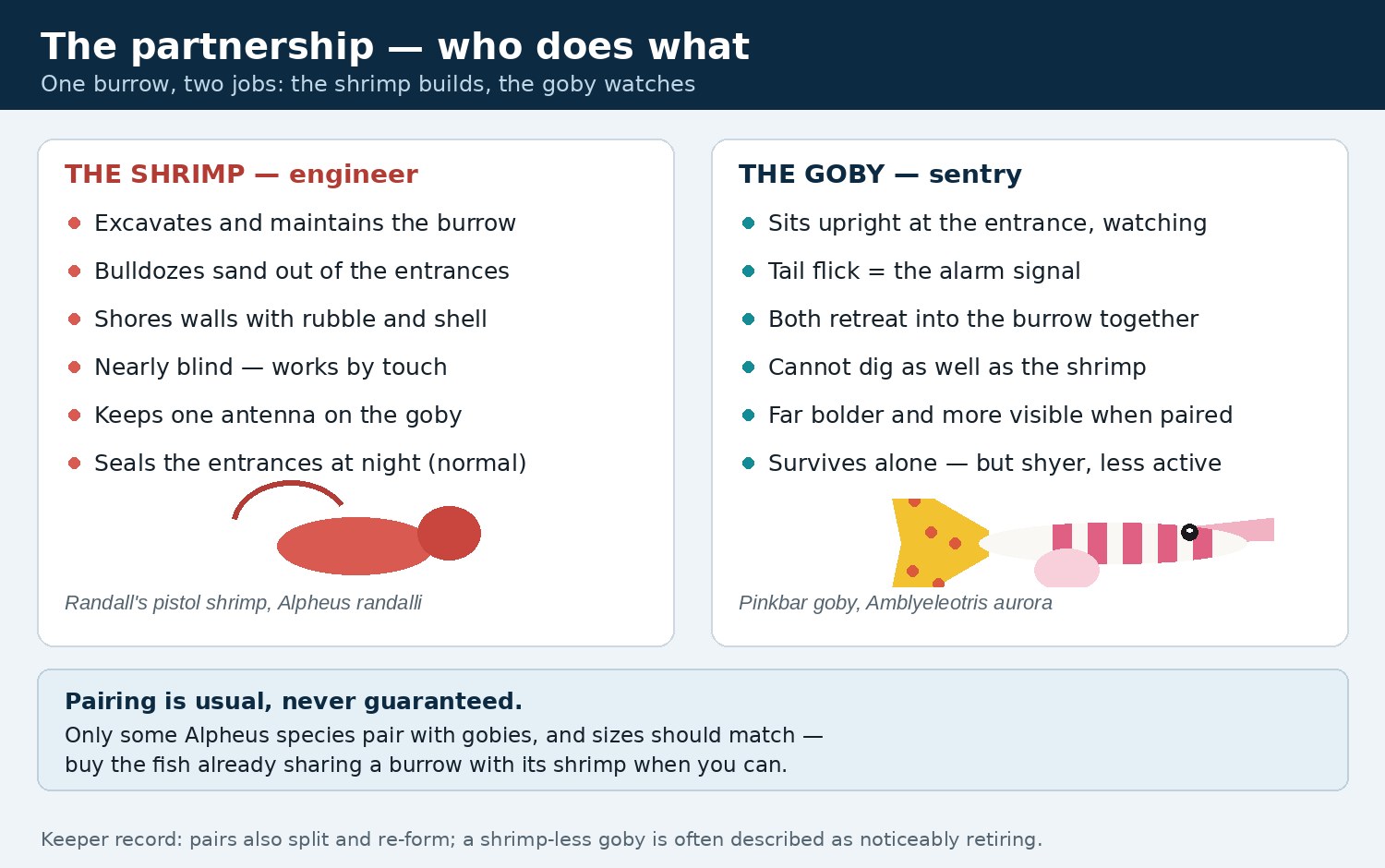
Every fish in this genus is called a shrimp goby for the same reason: it shares a burrow with an alpheid pistol shrimp, and the division of labour is total. The shrimp is the engineer. It excavates the tunnel, maintains it against constant collapse, bulldozes sand out of the entrances, and shores the walls with rubble and shell — and it does all of this nearly blind, which is the fact the whole arrangement turns on. The goby is the security system. It sits at the entrance in the open, upright and watching, in physical contact with the shrimp's antennae when the shrimp is working outside; a flick of the goby's tail is the alarm signal, and at a real threat the goby darts backwards into the burrow and the shrimp vanishes with it. Whether the relationship is best labelled commensalism or mutualism is a genuine debate in the wholesaler literature — the shrimp plainly gains a guard, the goby plainly gains a maintained burrow it cannot dig as well itself — and the entry takes no side beyond noting that both animals behave as if the deal is worth keeping.
The pinkbar's named wild partner is Randall's pistol shrimp, Alpheus randalli, the small red-banded species, and that is the pairing to ask for first. Other appropriately sized Alpheus species are accepted in practice — the genus-level keeper record includes tiger and candy-cane pistols pairing readily with shrimp gobies — but two qualifications from that same record deserve their weight: only some Alpheus species pair with gobies at all (rock-dwelling hitchhiker pistols generally do not), and the sizes should match, with neither partner dwarfing the other. A shrimp is not strictly required for the goby to live — every care source used for this entry agrees on that, and unpaired pinkbars feed, hold a burrow of their own shallow digging, and persist. What the sources also agree on, and what the keeper reports below sharpen, is that the unpaired fish is a shyer, less visible version of the paired one.
The burrow is the tank
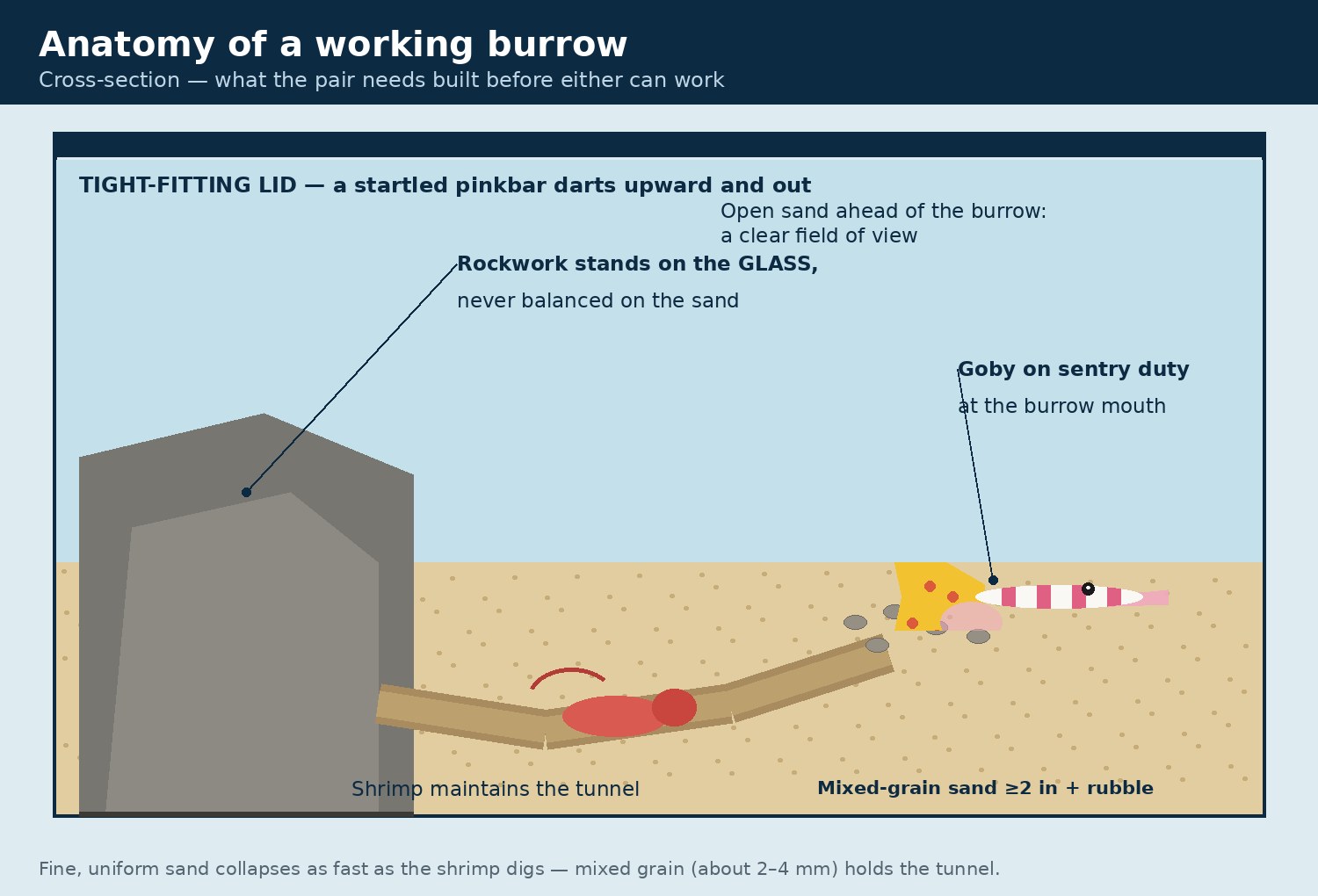
More pinkbar setups fail on sand than on water. The pair needs a bed at least two inches deep — deeper is workable if it is maintained — and it needs the right grain. One specialist guide asks for fine sand with scattered rubble; the wholesaler account disagrees on the fine point, and its reasoning is mechanical: sand that is too fine and too uniform collapses on itself as fast as the shrimp digs, so the working recipe is a mixed grain with a minimum around two to four millimetres, plus thumbnail-sized bits of rock and shell the shrimp can use as shoring. Crushed coral can work if the shrimp is large enough to move it. The compromise reading, and the one this entry recommends, is a mixed-grain aragonite bed rather than sugar-fine sand, with a deliberate scattering of rubble near the intended burrow site — the shrimp will relocate all of it anyway, but it builds faster with materials at hand.
The rockwork rule is absolute and comes from the same wholesaler source: rock sits on the tank bottom, on the glass, never balanced on the sand. A pistol shrimp excavates under whatever is above its burrow, and rock that starts on sand ends up settling, shifting, or toppling into the tunnel system. Build the structure first, on the glass, and leave generous open sand in front of it — the pair wants its burrow at the edge of the rock with a clear field of view, and a largely sedentary fish that hovers at its front door values visible open sand far more than swimming room. A burrow long enough for the fish to disappear completely — one guide sizes it at least one and a half times the fish's length — is the finished product to expect.
Then close the top. Every source used here, without exception, calls for a tight-fitting lid, and the wholesaler account explains the mechanics: a startled pinkbar darts at high speed, and if the dart is not toward the burrow it is upward, out of the water. This is a fish that can leave through any gap a feeding hatch or cable leaves open, and it will do so at the one moment the keeper is doing something else in the tank.
How big a tank, honestly
The stored size field on this entry is Nano, and the published minimums show what that label does and does not cover. At the small end, the wholesaler account holds that a single goby with its shrimp can live in a tank as small as 10 gallons, provided the filtration is strong and there are no other fish — a species-only burrow display. A European care sheet puts community keeping at about 60 litres, a quarantined-fish retailer sets 20 gallons, and the specialist guide and a large general retailer both land on 30 gallons for an adult in a community. The same wholesaler that allows the 10-gallon species tank calls a 40-gallon, two-fish display "much more compelling," which is the honest shape of the spread: the fish's own footprint is tiny because it barely travels, but the community around it is what actually sizes the tank. Read Nano as the species-only end of that range. In a mixed reef, 20 to 30 gallons is the defensible planning band, and the sand bed's area matters more than the water column's height at every step of it.
Feeding a bottom carnivore
The pinkbar is a carnivore of the sand surface: small crustaceans, worms and zooplankton picked from the sand and from the water immediately above it. It does not graze algae, it does not sift sand for a living the way the true sand-sifting gobies do, and it will not chase food into the upper water column. The captive translation is meaty food, in pieces sized for a small mouth, delivered so that some of it actually reaches the bottom in the goby's sight — frozen mysis and enriched brine, finely chopped seafood, and small sinking pellets all fit. One or two feedings a day is the published rhythm, twice daily in the specialist guide, and the condition attached to it everywhere is competition: faster mid-water fish will intercept a broadcast feeding before a bottom fish has left its doorway, so target-feeding near the burrow, or feeding the goby's corner deliberately, is standard practice rather than fussiness. A pinkbar that is thin behind the head in a tank full of well-fed swimmers is usually not a sick fish; it is an out-competed one, and the fix is delivery, not medication.
Reef safety and tankmates
The stored rating is Reef Safe: Yes, and for once the label needs no footnote in the appetite sense — the species leaves corals, clams and other sessile invertebrates alone, and the specialist record explicitly extends the safety to other shrimp, crabs and snails: the pinkbar does not hunt its own partner's relatives. The tankmate cautions are behavioural, not dietary. Toward unrelated fish it is peaceful to the point of vulnerability, and it should not be housed with anything large or predatory enough to treat a four-inch bottom fish as food, nor with boisterous species whose constant traffic over the burrow keeps it underground. Night-active diggers — sand-sleeping wrasses are the example one guide names — can unsettle it in smaller volumes by working the same sand it lives in. And the one direction in which a pinkbar is not peaceful is toward its own: see the next section.
One, two, or a pair
Unless a pair is a confirmed mated pair, the rule in the specialist record is one pinkbar per tank. Two unpaired individuals will fight, and the territorial streak extends beyond the species: the general-retail record warns of friction with other blennies, gobies and dartfish in smaller tanks, and the wholesaler record gives other Amblyeleotris gobies the same warning. In a large system, widely separated burrow territories are the only version of a second shrimp goby that the sources entertain. Keepers who want two pinkbars do what the wholesaler advises: buy them already paired, from a tank where they are sharing a burrow, because introducing two strangers and hoping is the version that fails. On sexing, this entry reports an absence honestly: none of the scientific, wholesaler or retail sources used gives a reliable external character for telling a male pinkbar from a female, so any fish sold as a guaranteed single sex should be treated as a guess wearing a label.
Breeding sits at the far edge of the possible. Mated pairs are reported to spawn inside the shared burrow, the male tending the eggs, but the larvae are planktonic and, in the words of more than one source, very difficult to the point of impractical to rear in home systems; a quarantined-fish retailer's summary is blunter, calling successful breeding very rare because of the delicacy of the eggs and larvae. No captive-bred supply is claimed for this species in the sources used, so a pinkbar in a shop should be assumed wild-caught, with the acclimation care that implies.
Buying and settling in
Buy the partnership, not just the fish, when it is offered: a pinkbar already sharing a burrow with a Randall's pistol shrimp in the shop has cleared the one negotiation a keeper cannot conduct for it. Inspect any individual as you would any wild-caught bottom fish — full belly, clean mouth and fins, alert at its station rather than gasping in a corner — and acclimate slowly; one retailer specifies a long, three-plus-hour acclimation for its African shipments of this species, and drip acclimation protects the shrimp partner, which is the more parameter-sensitive of the two, at least as much as the fish. Then expect the vanishing act. New pinkbars hide, sometimes for days, and stress — new tankmates, heavy activity around the glass — can send a settled fish back underground for stretches. A fish that has found the burrow and is taking food delivered to it is settling normally even if it is rarely seen; a fish that has not eaten in a week, in a tank where food demonstrably reaches the bottom, is the one to investigate. And keep the lid on during all of it, including maintenance, because settling-in is precisely when the upward dart happens.
Field notes — what keepers report
The sand question is the one prospective keepers ask first, and the forum record answers it consistently: is this a sand-sifter that will snowstorm the tank and bury the corals? Keepers who have lived with the fish say no on both counts. It mouths sand around its burrow digging, spits it back at bed level rather than into the water column, and leaves the rest of the bed alone; the excavation stories attach to the shrimp, not the fish. On the shrimp's earthmoving, reports split by degree rather than kind — one side warns of perpetual mounds and asks for fairly coarse substrate, the other counters that the mounds are small, ordinary aragonite works, and the digging stays at the burrow — with both sides agreeing the shrimp needs rubble and shell bits to build with, and one keeper recording its panic when a piece of its burrow lining walked away, the shell having been a hermit crab.
Pairing reliability draws the widest spread of reports in the genus generally, and pinkbar keepers inherit all of it. Same-day pairing is the common story: shrimp and goby released near the same rock are sharing a burrow within hours. But the record also holds pairs that drift apart and re-form — two Randall's shrimp in one keeper's 90-gallon paired and separated on their own schedule, and a watchman goby in another account abandoned its pistol entirely after moving in with a different goby whose burrow it preferred. The behaviour most often mistaken for a problem is the sealed door: pistol shrimp routinely push sand over both burrow entrances at night with both animals inside, and new keepers repeatedly ask whether the goby is trapped; experienced answers are unanimous that the entrances are remade by morning and the sand should be left alone. On the shrimp-less question, the reports lean one way: the fish survives perfectly well alone, but more than one keeper describes an unpaired goby as noticeably lost or retiring, and one describes his fish re-bonding with a replacement shrimp instantly after its partner died. A single contrary data point deserves its place: a newly paired goby found dead on day three with a beaten-up, pale mouth had keepers debating causes in its thread, and the consensus there was prior injury or health, not the shrimp — the same respondents noting a pistol is not built to kill a goby even in defence.
Shyness reports divide by individual and by week rather than by side. The species is described in the trade as sedentary and quick to vanish at movement, and keepers confirm long underground stretches after arrival or after any disturbance — and just as plainly describe settled, paired fish that sit out in full view all day and hand-feed at the burrow mouth. The through-line in the reports is that the paired fish in a quiet tank is the bold one, and the lone fish in a busy tank is the ghost; both are the same species behaving as its circumstances dictate. On jumping there is no split at all: keeper and trade accounts alike treat the lid question as settled, and the genus record includes fish lost through the slightest gap. Finally, colour in person draws one consistent remark worth passing on — the bars read pinker in photographs than in many living fish, where pastel orange is common — which is a lighting-and-individual variation keepers learn to expect, not a sign of a mislabelled fish.