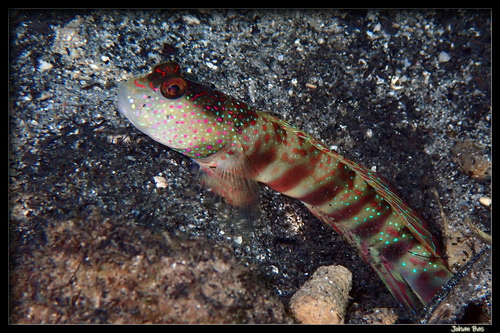
Yellow Prawn Goby
Cryptocentrus cinctus
Reef Safe

Gallery
The Yellow Prawn Goby, Cryptocentrus cinctus, is the fish most reef keepers mean when they say watchman goby: a small, big-eyed bottom dweller that posts itself at the mouth of a burrow like a sentry and, paired with an alpheid pistol shrimp, performs one of the most famous partnerships in the sea in full view on the sand bed. The original short entry in this database praised it as a legitimately cheerful fish — a solid lemon-yellow that pops against any substrate and does not need actinic lighting to look good, openly perched at its burrow entrance for much of the day, and a strong first goby that is almost never a bad choice for a reef system. The fuller record below keeps that verdict for the settled fish, but it adds the two qualifications the short entry had no room for. The first is colour: the lemon-yellow is real, but it is not guaranteed for life — a substantial body of keeper and breeder experience records individuals fading to grey or brown with age, and nobody has fully settled why. The second is temperament at home: peaceful toward the rest of the tank, this species can be fiercely intolerant of its own kind. The species was first formally described by Albert Herre in 1936, originally as Smilogobius cinctus, and it also answers to Yellow Watchman Goby, Yellow Shrimp Goby, Spotted Watchman Goby and Sulphur Goby — the watchman name coming from exactly the sentry behaviour the original entry described.

Identification
The build is classic shrimp-goby: a torpedo-shaped, subcylindrical body, two distinct dorsal fins, a rounded tail fin, and the fused pelvic fins of the goby family, which the fish uses as a suction disc to perch on rock, sand and even glass. The head carries the character — high-set, bulbous eyes placed for scanning the water column while the body stays low, and a large, down-turned, frog-like mouth that gives the species its permanently grumpy expression in keeper photographs. Maximum size is consistently given as about 10 cm standard length, roughly 4 inches, with aquarium accounts more often seeing a finished fish near 3 inches. The one marking that survives every colour phase is the spotting: small, bright blue to white-blue dots clustered over the head, the front half of the body and through the dorsal fins. Those jewel-like blue spots are the reliable field mark — body colour, as the next section shows, is not.

The colour question
No fact about this species is argued over more than its colour, because the species genuinely wears several. The brilliant yellow form that fills the shops is real and is the form in this entry's photograph. Alongside it, the scientific and field literature records grey and brown forms and combinations of each, and the grey pattern carries a feature the yellow one hides: five dark vertical bands along the flank, visible only in the grey phase, with the tiny intense-blue eyespots present in both. A long-term breeder's account is the most systematic record available: all three of his breeding pairs began in the yellow pattern and, from about a year and a half of age, shifted — at different rates, months apart between individuals — into the grey pattern, while each captive-bred generation produced a mixture of yellow and grey young with grey tending to dominate. Layered over the age story is a sex story, treated fully in the field notes: more than one experienced source holds that the species is sexually dichromatic, males bright yellow and females greyish, both carrying the blue dots — a breeder quoted in the hobby literature adds the honest complication that she has seen individuals change colour in both directions and does not know whether that means they are also changing sex. And layered over both is a short-term effect every keeper can test: a stressed, newly shipped or frightened fish pales or mottles to grey-brown and can flush back to yellow within minutes of feeling safe. The practical reading is that three different processes — temporary stress colour, a possible sex difference, and a slow age-related shift — all push this fish between yellow and grey, which is why single-cause explanations keep failing and why a grey watchman is not, by itself, a sick watchman or a mislabelled one.

Reading the care ratings
The entry rates this fish Beginner for care, Peaceful, Carnivore, a Nano tank, a bottom swimmer, and Reef Safe Yes, and the ratings hold up well with two qualifiers. Beginner is earned: the species is hardy, accepts a wide range of meaty foods, tolerates the small parameter wobbles of a new keeper's tank better than most small reef fish, and captive-bred specimens are available from commercial marine hatcheries, which removes even the acclimation hurdle for those fish. Peaceful is accurate toward everything except its own species and, occasionally, other burrow-claiming gobies near its hole — the conspecific exception is large enough to deserve its own section below. Carnivore is exact: this is a picker of small crustaceans and zooplankton, not an algae grazer and not a true sand-sifter in the Valenciennea sense, a distinction the feeding section keeps. Nano is the rating that needs its number spelled out, because published minimums spread from 20 to 30 gallons; the database's Nano label should be read as the 20-gallon end of that spread, suitable for a single fish, with the 30-gallon figures aimed at a pair or a fish-and-shrimp household with more sand to work. Reef Safe Yes is unanimous: no source consulted accuses this species of harming corals, clams or ornamental invertebrates.
In the wild
The species is a Western Pacific fish, extending into the eastern Indian Ocean, recorded from India across to New Caledonia and the Great Barrier Reef, in shallow coastal water from about 1 to 25 metres deep. The habitat is soft bottom, not reef crest: sandy substrates in protected coastal bays and lagoons and in seagrass beds, where the fish lives in a burrow it almost never digs for itself. The burrow belongs to an alpheid pistol shrimp, and the sharing of it is the species' defining ecology. The fish is assessed as Least Concern, with wild collection for the aquarium trade noted but not considered a threat to the population, and captive-bred supply now exists alongside the wild-caught trade.
The shrimp partnership
The partnership is a true mutualism with a division of labour. The pistol shrimp — in the hobby most often the Tiger Pistol Shrimp, Alpheus bellulus — is the engineer: it excavates and continuously maintains the burrow system, bulldozing sand even though its eyesight is very poor. The goby is the security system: it stations itself at the entrance, watching, while the shrimp works with at least one antenna kept in contact with the goby's body, reading its posture. A flick of the goby's tail is the alarm signal; on it, both animals vanish down the burrow, the nearly blind shrimp retreating on the goby's warning, and the goby gaining a maintained shelter it could never dig so well itself. The excavating shrimp also turns up small prey organisms from the sand, a food subsidy both partners share. Kept alone, the goby is perfectly viable — it will occupy a cave or dig a modest burrow of its own and perch as usual — but the paired household is measurably more confident and more visible, which is why the original entry called the pairing one of the most reliably interesting behavioural setups in the hobby at its price. The field notes record the honest counterweight: pairing in a glass box is usual but not automatic, and a minority of combinations simply never take.
Tank and substrate
Two physical requirements are not negotiable. The first is sand: a bed of sand or fine gravel deep enough to burrow in, with pieces of live rock and loose rubble under which a burrow can be roofed, and every rock seated firmly on the glass or braced, because a tunnelling household will undermine anything merely resting on the sand and a rockslide can bury the burrow and its occupants. The second is a lid. This species is a proven, repeated jumper, and a tight-fitting cover with no gap at the overflow or cable cut-outs is repeatedly named the difference between keeping this fish and losing an otherwise undemanding one — several care sources call the uncovered tank the most common cause of loss for the species. Published minimum sizes, recorded whole, run from 20 gallons for a single fish to 30 gallons as the common recommendation for a single with room to burrow, and 30 gallons again where a mated pair is the plan. Beyond size, the fish asks for a mature, stable system, moderate flow, shelter in the form of caves and overhangs it does not have to share, and time: new fish are shy, and a burrow placed where the keeper can see the entrance is what turns a hiding fish into the perched sentry of the photographs.
Feeding
In the wild the fish picks tiny crustaceans and zooplankton from the sand and the water immediately above its burrow, and takes what the shrimp's digging exposes. In the aquarium it is a straightforward, willing carnivore: frozen or live mysis and brine shrimp, finely chopped seafood and table shrimp, copepods, and quality sinking pellets or flakes made for small carnivores all belong in the rotation, with captive-bred fish in particular reported to transition to frozen and prepared foods with little fuss. One or two feedings a day is the usual published range, with two or three small portions suiting the fish well in some accounts. The husbandry point that matters more than the menu is delivery: this is a deliberate, slow feeder holding a post at the bottom of the tank, and fast mid-water fish will intercept most of a broadcast feeding before it ever reaches the burrow. Target food toward the substrate near the burrow entrance, and judge the fish's condition at the burrow, not at the surface. A note on sand-sifting belongs here because the expectation is common: the fish mouths and moves some sand while foraging and shifts plenty while housekeeping with its shrimp, but it does not process the bed mouthful by mouthful like a Diamond Goby, and a keeper buying it as a sand-cleaning crew will be disappointed — that is a different genus's job.
Temperament and tankmates
Toward the community, the record is consistent: a shy, peaceful fish that ignores corals and invertebrates, coexists with clownfish, dartfish, firefish, blennies and other peaceful tankmates, and should itself be protected from large or aggressive species that would pin it in its burrow or outcompete it at feeding. Toward its own kind, the record is equally consistent in the opposite direction. The species is territorial over its burrow, and non-paired conspecifics fight, with rivalry intensifying as the fish mature. The starkest record is again the breeder's: an attempt to let a pair form naturally from a group of six young fish of assorted sizes in a 150-litre aquarium collapsed in under three days, one dominant specimen wounding the others until they had to be evacuated. The standard plan follows from that record — one fish, or one established mated pair, per tank, with multiples reserved for genuinely large systems where simultaneous introduction and widely separated burrow territories give each fish its own ground; even then the field notes carry a keeper counter-example of two coexisting at opposite ends of a tank, recorded as the exception it is rather than the plan to copy.
Reef safety
The shortest verdict in this entry: fully reef safe on a unanimous record. The fish does not nip corals, does not molest clams or ornamental shrimp and crabs, and its burrowing is a sand-bed-scale disturbance rather than a reef-structure one. The only reef-keeping cautions are architectural, not behavioural — sand contours around the burrow will shift as the tunnel network expands, so corals or fixtures placed loose on the sand near the burrow zone can be undermined or buried in excavated sand, and anchoring them is the keeper's job, not a change in the fish.
Breeding
The species has been bred in captivity, commercially and by hobbyist breeders, and mated pairs are reported to spawn readily and frequently once established — which makes the home-aquarium verdicts that call breeding very rare a statement about larviculture, not about spawning. The documented biology: eggs are adhesive and demersal, stuck to a substrate inside the burrow by adhesive filaments, averaging about 1.66 mm in a hatchery study; at 27 to 29 degrees Celsius the embryonic period ran about 107 and a half hours — a little over four days — matching the roughly four-day incubation quoted in aquarium breeding accounts. Hatched larvae are tiny, about 2.3 mm, and the recorded rearing sequence moves from small-strain rotifers in the first two weeks to larger rotifers and then newly hatched brine shrimp at about four weeks. Sexing the pair to start all this remains the genuinely hard part, for the colour reasons above: the working belief in the breeding literature is that males are the yellow fish and females the grey ones, held with the explicit caveat that individuals have been watched changing colour in both directions, so no colour-based sexing of this species should be treated as settled.
Choosing a specimen
Buy on condition and behaviour rather than on colour alone. The fish to take home is out at a burrow or perched in the open in the shop tank, alert, with clear eyes, an unpinched belly and its blue spotting bright; a fish that has already paired with a shrimp in the dealer's tank, or a captive-bred specimen, has cleared the two hurdles — settling and feeding — that account for most early losses. Colour deserves a deliberate decision rather than a disappointment later: a brilliant yellow juvenile may stay yellow for years or may grey with age, and a grey fish may be a female, an older fish, a stressed yellow fish still settling, or simply a grey-form individual — all of them the same species and the same pet. If a shrimp partner is part of the plan, the usual advice is to give the shrimp the tank first or introduce the two together near the same rock, so the burrow and the sentry arrive at the same address. Check the fins and body for the ordinary small-fish risks, confirm the fish is taking food at the bottom rather than only snapping at the surface, and size the purchase for the 4-inch adult, not the inch-long juvenile in the bag.
Warning signs
The warnings worth acting on are specific to a burrow fish. A fish that stops perching and vanishes for days in a tank where it was previously visible daily has usually been displaced, is being harassed, or is ill — all three need finding, not waiting. Persistent pale, banded stress colour in a settled fish, as opposed to a passing flash of it, is a recognised stress signal in the keeper literature, and the prescribed first response is unglamorous: check the water — pH, ammonia, nitrite, nitrate and salinity — then check that the fish still owns a hiding place no other fish uses. A thinning body behind the head or a sunken belly means the target-feeding has failed against faster tankmates, the most fixable problem on this list. Sand or rock collapse over the burrow entrance needs clearing the same day. And the species is named in care sources as susceptible to the standard marine parasites, ich and velvet among them, which is the argument for quarantining a wild-caught fish before it joins the display rather than after it shows spots. A fish posted at its burrow mouth, blue spots bright, flicking its tail at shadows and vanishing and reappearing all day, is showing the healthy repertoire — sentinel duty is what wellness looks like in this species.
Field notes — what keepers report
- The colour change is the report that defines keeper experience with this fish, and it genuinely splits, so both sides are recorded whole. On one side: keepers whose fish greyed — a breeder whose three pairs all shifted from yellow to grey from about eighteen months of age, a keeper whose fish turned grey after about a year and a half, another whose vibrant yellow dulled over two years, and reports of fish near eight years old wearing the brownish, banded end-state, still healthy. On the other side: keepers whose fish never changed — one reporting a fish bought as a baby still bright yellow after four and a half years, another calling himself lucky that his old fish is still bright yellow, and at least one grey juvenile that travelled the other way, turning yellow three weeks before its keeper reported it after five to six months grey. The explanations keepers reach for — age, sex, stress, diet, nutrition and water quality — are all represented in the threads, usually with a counterexample in the next post, and the honest summary the discussions converge on is that sometimes these fish just turn grey and nobody yet knows the whole of why.
- The sex-colour hypothesis sits inside that argument as its most testable claim. Two independent experienced voices — a tropical-fish reference describing males as bright yellow and females greyish, and a breeder quoted in the hobby press describing every pair she had seen the same way — support males-yellow, females-grey. Against tidy confidence stands that same breeder's own observation of individuals changing colour in both directions, which she herself flags as unexplained, and the keeper reports of grey juveniles yellowing and yellow adults greying make a fixed sex colour hard to defend as a rule. Keepers planning a pair increasingly treat colour as a hint and behaviour as the evidence.
- The shrimp pairing is reported as reliable often enough to justify its reputation and unreliable often enough to justify a warning. The success reports are vivid: pairs that found each other within a day of introduction, a goby that took up watching duty as soon as it realised a shrimp was present, and long-term households where the shrimp visibly keeps an antenna on the fish. The counter-report is a considered one from a general watchman-goby guide: in captivity the partnership is rare and unpredictable, many combinations ignore each other entirely, and some shrimp are eaten by other tankmates before any partnership forms — with the practical advice to introduce the shrimp first so a burrow exists before the goby arrives. The reconciling detail is that the failures cluster in tanks where the two were added far apart in space or time, or where the shrimp had competition or predators; released together at the same rock, the pairing is the norm keepers describe.
- Shyness reports split by week, not by fish. New arrivals are widely described as lethargic, sideways-lying, barely moving unless the shrimp physically pushes them, and invisible for days — reports that read as alarming and resolve as ordinary acclimation. Settled fish split again by individual: some become semi-tame over weeks to months, approaching the glass and taking food from a hand, while others remain permanently skittish and prefer distance, showing their natural behaviour only when shelter and food security are complete. The original entry's picture of a fish perched openly all day is the settled, secure version of the species — keepers agree it is earned by cover and calm rather than guaranteed on day one.
- Sand-sifting expectations produce a quieter split. Some keeper-facing sources credit the species with constant sand work — hours spent moving mouthfuls and reshaping the substrate, aerating the bed as it goes — while care guides drawing the comparison explicitly say this species does not sift as frequently as a Diamond Goby and works the sand mainly around its burrow. Both descriptions fit the same behaviour seen at different scales: a paired household with an excavating shrimp moves a great deal of sand, a lone goby rather less, and neither performs the whole-bed processing that Valenciennea keepers mean by sifting.
- The two-gobies question carries one clear counter-example against a strong consensus. The consensus — one fish or a mated pair, with the breeder's six-fish group collapsing into bullying inside three days as its cautionary tale — is repeated across care sources. The counter-example is a keeper who ran two individuals first in a seahorse tank and then in a reef, reporting only occasional chasing, each fish holding the opposite end of the tank and sometimes sitting close together. It is recorded here because it happened, with its own conditions attached: large separation, no shared burrow, and a keeper watching for the escalation the consensus predicts.