 ▶ Video
Care facts
- Care
- Intermediate
- Light
- Medium
- Flow
- Medium
- Place
- Bottom
- Space
- Aggressive
- Growth Rate
- Slow
Gallery
Videos
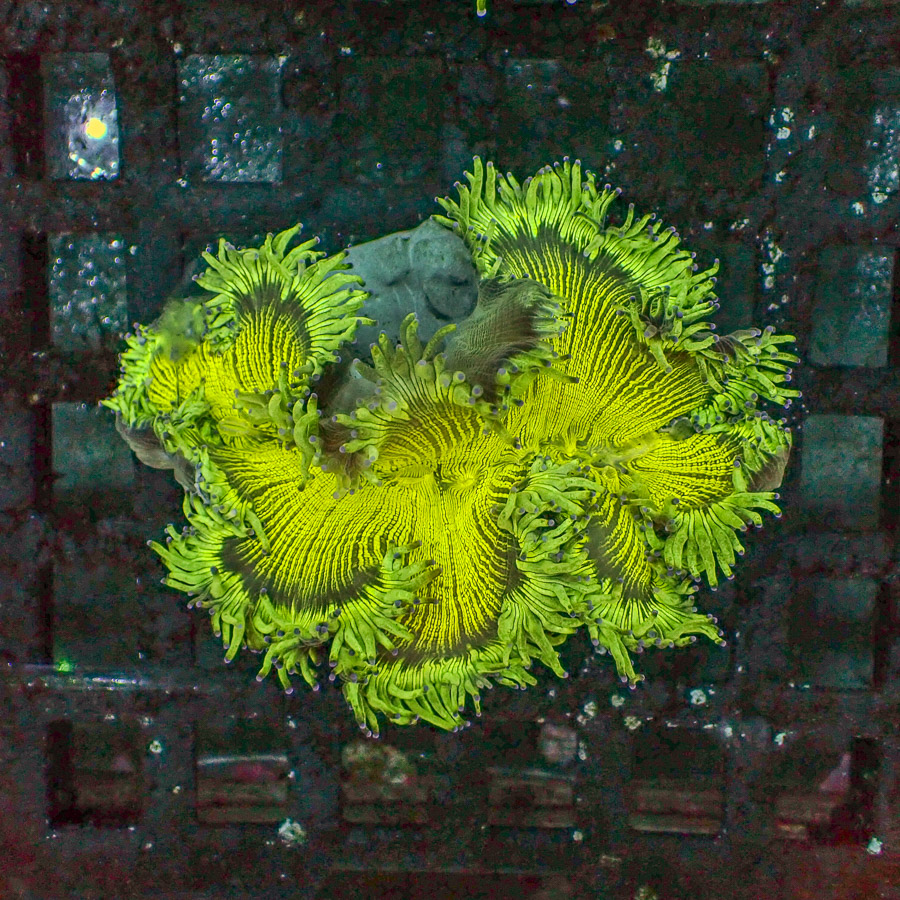
An established Elegance Coral dominates its corner of a tank. From a cone-shaped skeleton buried in the substrate rises a crown of long, flowing tentacles tipped in pink, purple, or green, each tentacle ending in a small rounded knob. A large specimen can stretch its tentacles a foot across, swaying as one body, with the fleshy oral disc at the center colored in stripes of cream, green, and violet. Viewed from above, few LPS corals match it.
Catalaphyllia jardinei lives free on soft, silty bottoms in sheltered Indo-Pacific lagoons, never anchored to the reef wall. That habitat explains most of its aquarium care. The skeleton evolved to sit buried in mud and sand, and the huge polyp evolved to lie low and drift in gentle lagoon current. Elegance corals carried a reputation for slow decline for years; the pattern that emerges from the tanks that keep them long-term is placement. Rock-mounted elegance in hard flow withers, while a sand-bed specimen fed regularly expands and grows.
Set the skeleton into a pocket in the sand bed with the tissue rim clear of the grains, on the tank floor in medium light and medium, indirect flow. The tentacles should sway lazily; tissue pinned flat against the skeleton or whipped hard means the current is wrong. Give it a wide berth in every direction — the sting is strong, rated aggressive on this entry, and it reaches as far as the tentacles do. Hold standard reef parameters: 77–79°F, salinity near 35 ppt, alkalinity 8–10 dKH, calcium 400–450 ppm, and keep those numbers steady rather than chasing perfection.
Feeding separates the specimens that merely survive from the ones that grow. Offer meaty foods — mysis, chopped shrimp, small pieces of silverside — directly onto the extended tentacles two to three times a week, and turn the pumps down while it eats. Watch new arrivals closely for the first weeks: tissue that recedes at the rim or develops brown jelly needs a dip and a quieter spot, fast. Growth is slow, measured in new skeleton laid down under the tissue over months, and a settled elegance that opens wide every day is already telling you the routine is right.
Field notes — what keepers report
- Older keepers describe a coral that used to be a hardy staple and now humbles almost everyone. The classic report runs the same way: a new elegance opens beautifully for days or weeks, then the body swells, the tentacles shrivel, and the coral wastes away. One keeper in a long-running thread lost four in a row bought from different stores; another counts one survivor against two losses, with dips and feeding making no difference.
- Keepers and experts openly disagree about the cause, and the argument has run for years. One camp, argued forcefully by Julian Sprung in forum posts, holds that a bacterial problem arrived with newer imports and that multi-day antibiotic baths (nitrofurazone or doxycycline) cure corals caught early. Another camp blames light and heat stress before the coral ever reaches the shop. WetWebMedia contributors add a third theory: the trade shifted toward deep-water, mud-dwelling specimens that arrive poorly suited to bright reef tanks.
- Placement lessons show up again and again in keeper mail. Free-living elegance corals collected from sediment have conical skeletons and reportedly decline when perched on rockwork, where expanding tissue abrades against the rock; keepers advise checking the base of the skeleton and seating mud-collected pieces in the sand. A fall onto the substrate can tear tissue and start a decline even when the coral opens fully the next day.
- Keepers warn that a sick elegance can take a healthy one down with it, so the two are never housed together during treatment, and one thread tells the cautionary tale of a coral beauty angelfish that went rogue and destroyed a prized pink-tip elegance.
Field Notes
Related species
Branching Frogspawn
Fimbriaphyllia paradivisa
Similar care · LPS
Cotton candy torch
Similar care · LPS
Dragon soul torch
Euphyllia glabrescens
Similar care · LPS
Dragon tamer torch
Similar care · LPS
Evergreen galaxea
Galaxea fascicularis
Similar care · LPS

Galaxy Coral
Galaxea fascicularis
Similar care · LPS
Green bubble coral
Plerogyra sinuosa
Similar care · LPS

Gumby Hammer
Similar care · LPS