
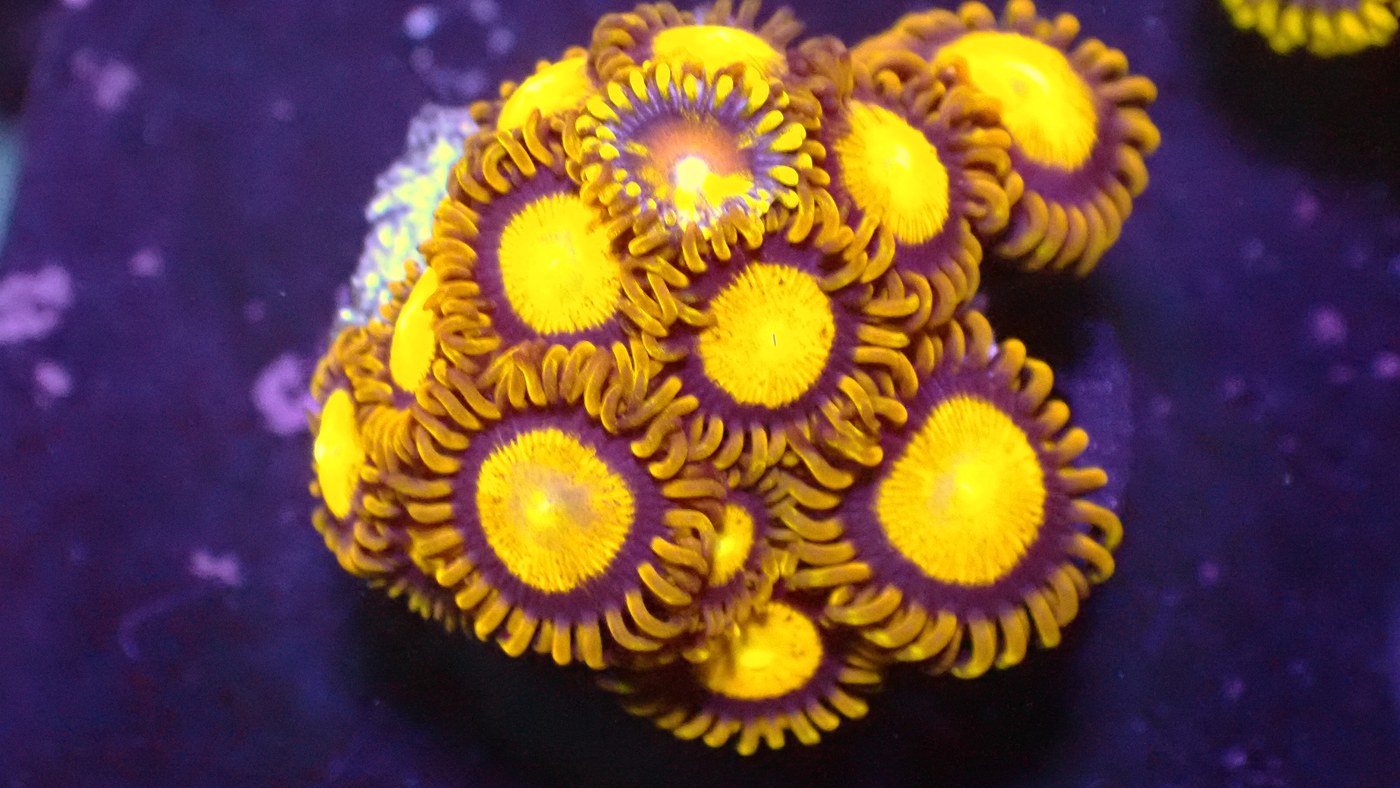
King Midas zoas
Zoanthus sp.
What this coral is
King Midas is a named color morph of Zoanthus, the sea-mat zoanthids. Each polyp is a small anemone relative with no skeleton at all: a wide oral disc ringed by a skirt of short tentacles, joined to its neighbors at the base by a fleshy mat called the coenenchyme. The colony grows by spreading that mat across rock and budding new polyps along its edge, so a settled piece carpets whatever it is mounted on.

The polyps run large for a zoanthid, roughly half an inch to an inch across when fully open, and the colony is photosynthetic. Symbiotic algae in the tissue cover the baseline energy budget, and the polyps also take dissolved organics and fine particles straight from the water.
Reef To Go sells this morph as cut frags from grown-out farm colonies, in the 1-inch frag format and as a Buy It Now listing. It is one of the morphs in the farm's Zoa Garden pack, which gives a fair picture of where it sits in the lineup: a hardy, fast-covering gold that anchors a mixed zoa garden.
The name story
Midas was the Phrygian king of the Greek myth who wished that everything he touched would turn to gold, then learned the cost when his food, his drink, and in some tellings his own daughter turned with it. He washed the gift away in the river Pactolus, which was said to run with gold dust ever after.

The coral earns the name on sight. A healthy colony reads as a pile of gold coins poured over the rock, and the name has stuck to this pattern across the trade for years. Like every zoa trade name, it describes a color pattern rather than a species. No scientific name comes with the morph, and Zoanthus species cannot be separated reliably by eye or from photographs, which is why this entry carries the honest label Zoanthus sp.
Identification — reading the gold
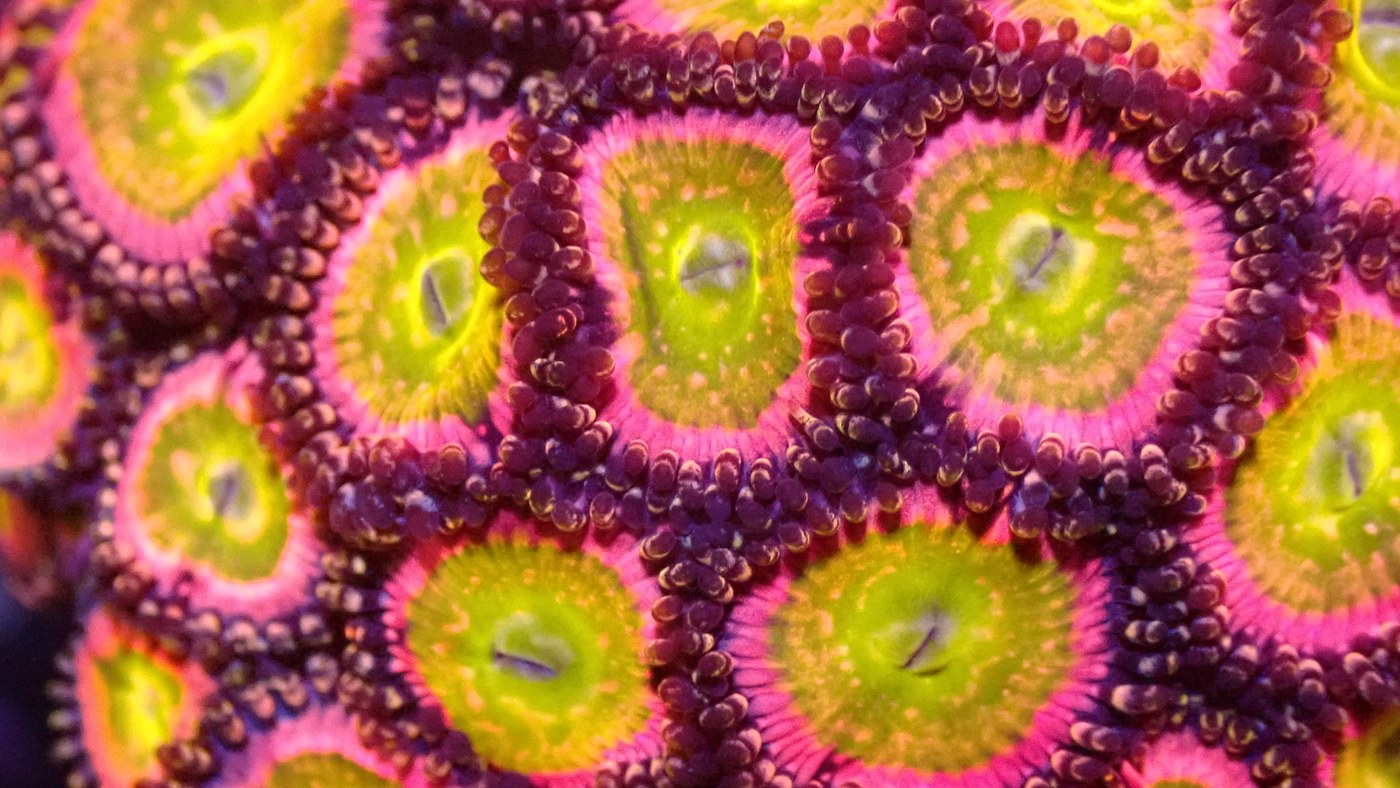
Read the polyp in three bands, working outward. The oral disc is a saturated yellow-gold with a fine radial texture and a small, paler mouth at the center. Around the disc sits the tell: a clean ring band of deep violet, dark enough to read almost purple-brown in shadow. Outside the ring, the skirt is a full fringe of shorter tentacles in gold-to-olive tones.

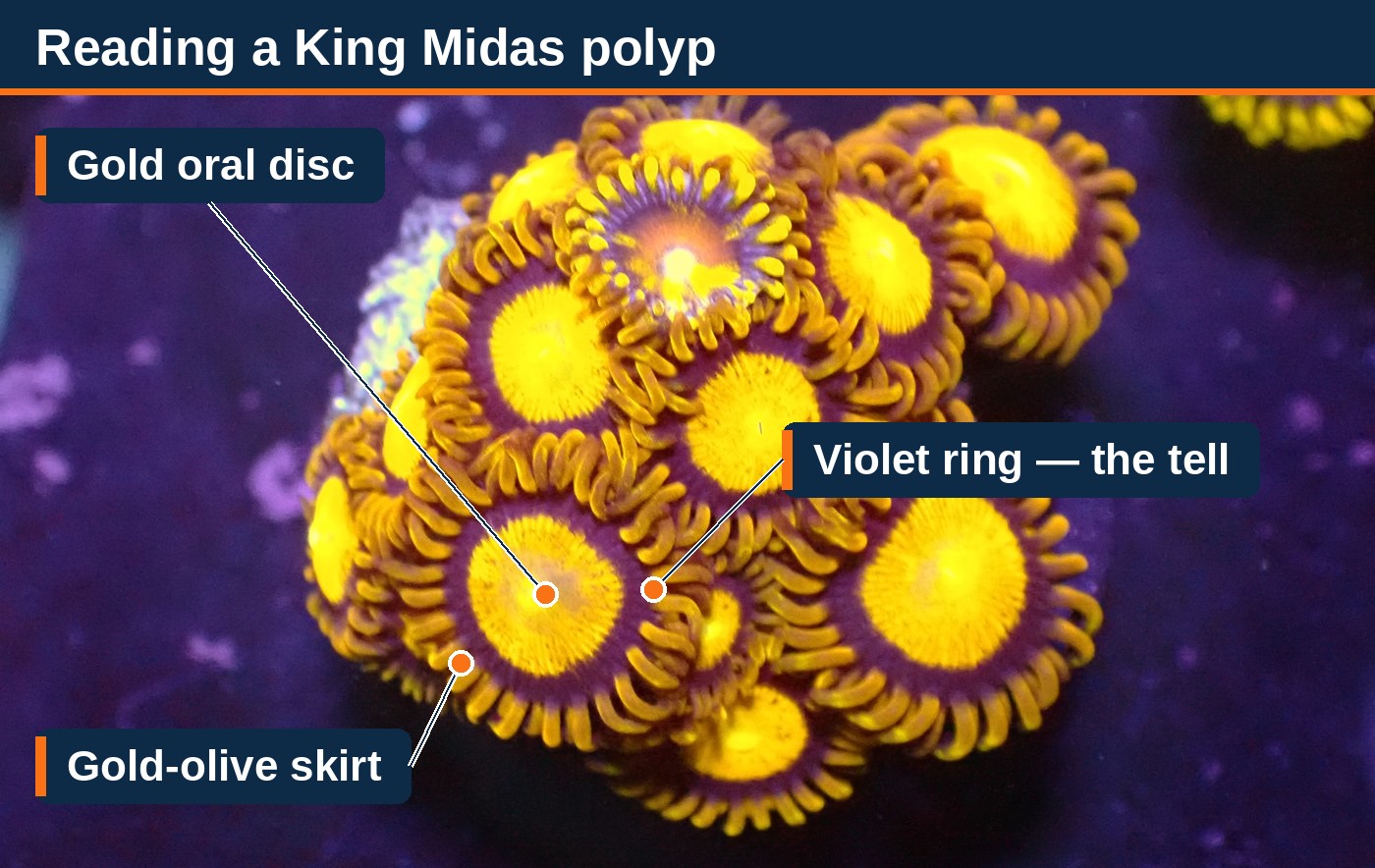
That violet ring is what separates King Midas from the run of plain gold and yellow zoanthids, which carry their color straight out to the skirt with no dark band. If the ring is missing, it is a different morph wearing a similar name.
Light changes the read. Under blue-heavy reef light the disc fluoresces toward lemon-gold and the violet ring deepens, which is how the farm's own photo at the top of this entry was shot. Under a whiter daylight spectrum the whole polyp settles into a deeper, more uniform gold and the ring softens. Judge the pattern under roughly the spectrum you plan to keep it in. Closed down, the colony reads as a cluster of dark violet-brown buttons, and new buds at the mat's edge show the gold disc and ring early, well before they reach full size.
Color and light
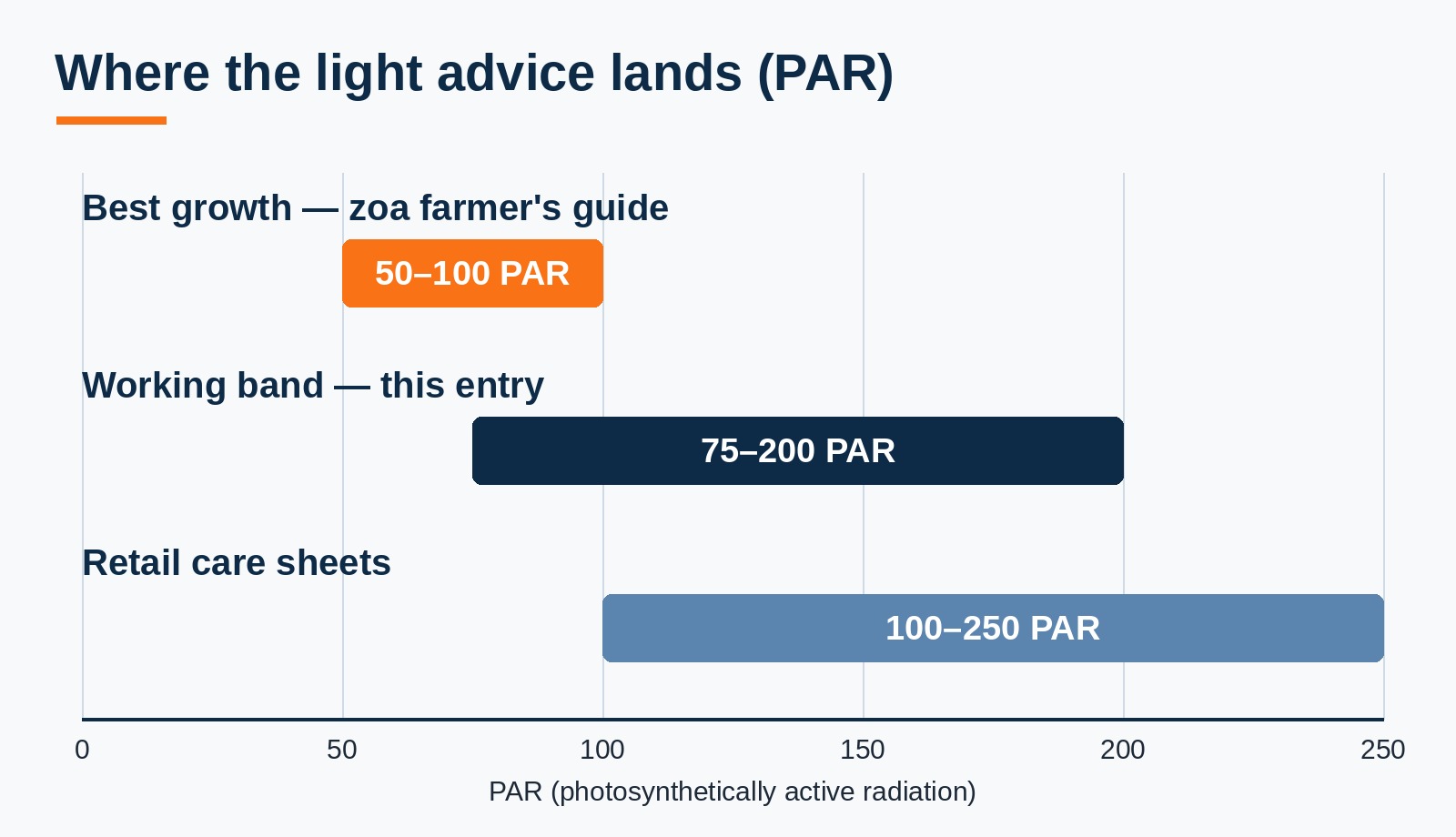
The care card rates this morph Moderate for light, and the middle of the published range backs that up. Retail care sheets for King Midas cluster around 100 to 250 PAR, while a zoa-farming guide reports its best growth lower, at 50 to 100 PAR. Put together, the honest working band is roughly 75 to 200 PAR: bright enough to hold the gold, short of the intensity that bleaches a zoanthid.
Too little light shows quickly. Stalks stretch upward reaching for it, skirts stay thin, and the disc dulls from gold toward olive-brown. Too much light, too fast, does the opposite damage: polyps shrink tight against the mat, the disc pales, and a colony moved straight under a strong LED can bleach before it acclimates. Move it up in steps over a week or two instead.
Spectrum shapes the display more than the health. Blue-heavy light is the show light for this morph, driving the fluorescence that makes the disc glow and the ring go near-black violet. A 14–20K look is what most sellers photograph it under, and what most keepers end up running it under at home.
Flow, placement, and neighbors
Flow is rated Moderate, and its job is housekeeping. A gentle, indirect, shifting current keeps detritus from settling into the mat, where trapped waste is the start of most zoa trouble. Polyps should sway slightly and stay open. A direct jet from a powerhead keeps them slammed shut, and a dead-still corner lets the mat film over.
Placement is Middle on the card, bottom-to-middle on rockwork in practice. Give this morph its own rock or a defined island with a moat of sand or bare glass around it. It spreads by carpeting, steadily and without asking, and a colony that touches shared rockwork will be growing on the far side of the seam within a season.
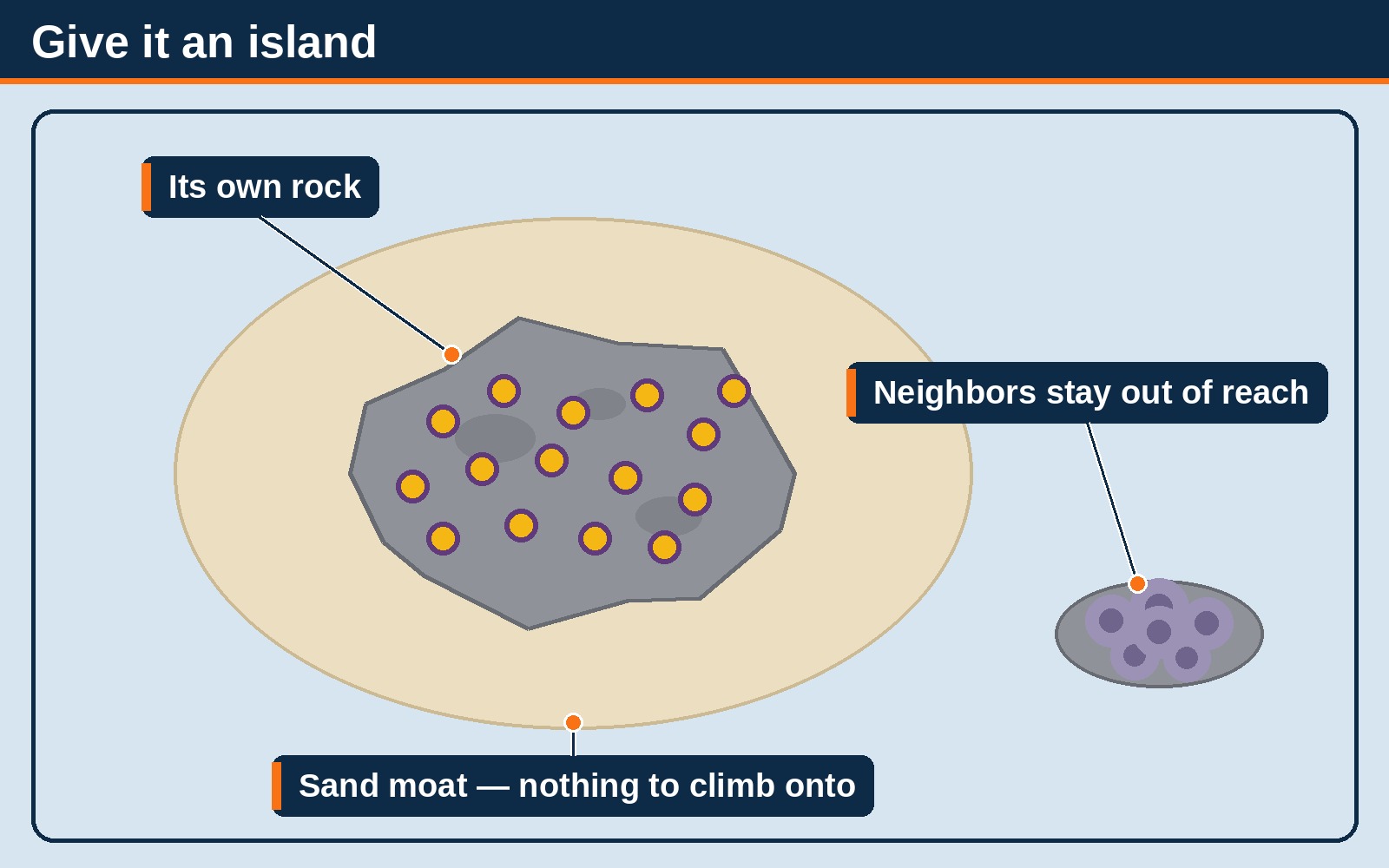
The Moderate aggression rating is about contact, not weapons. Zoanthids grow no sweeper tentacles. What they do is outgrow things: a King Midas mat will climb over slower zoas, shade the edge of a neighbor's colony, and win shared rock by simple coverage, with mild chemical competition on top. Keep a working gap between it and any prized morph you would hate to see wearing a gold fringe.
Feeding and water chemistry
Photosynthesis covers the baseline, and this morph grows on light alone in a fed fish system. Feeding is a growth lever rather than a requirement. In a lean tank, target feeding once or twice a week with a fine powdered coral food, rotifer-sized fare, or an amino supplement can visibly speed up budding along the mat's edge. In a heavily fed system most keepers skip it and lose nothing.
There is no skeleton, so the colony draws no calcium or alkalinity of its own, but stability still runs the show. Standard reef parameters with a steady alkalinity, in the 8 to 10 dKH band many zoa keepers target, keeps polyps open and growing. Swings close colonies faster than any single value being slightly off.
Nutrients deserve a plain word. This genus consistently does better with measurable nitrate and a trace of phosphate in the water than in stripped, ultra-low-nutrient systems. Zoas that sit closed and stalled in a zero-nutrient tank, then open and start budding once nutrients register again, are one of the most repeated stories in the hobby, and King Midas follows the family pattern.
Growth and fragging
Growth is rated Moderate, and a settled colony makes steady progress: new polyps bud from the mat's edge, the carpet thickens, and bare rock disappears under it. Growth comes in pulses tied to stability. A colony left in one spot with steady water will outgrow a prettier colony that gets moved every month.
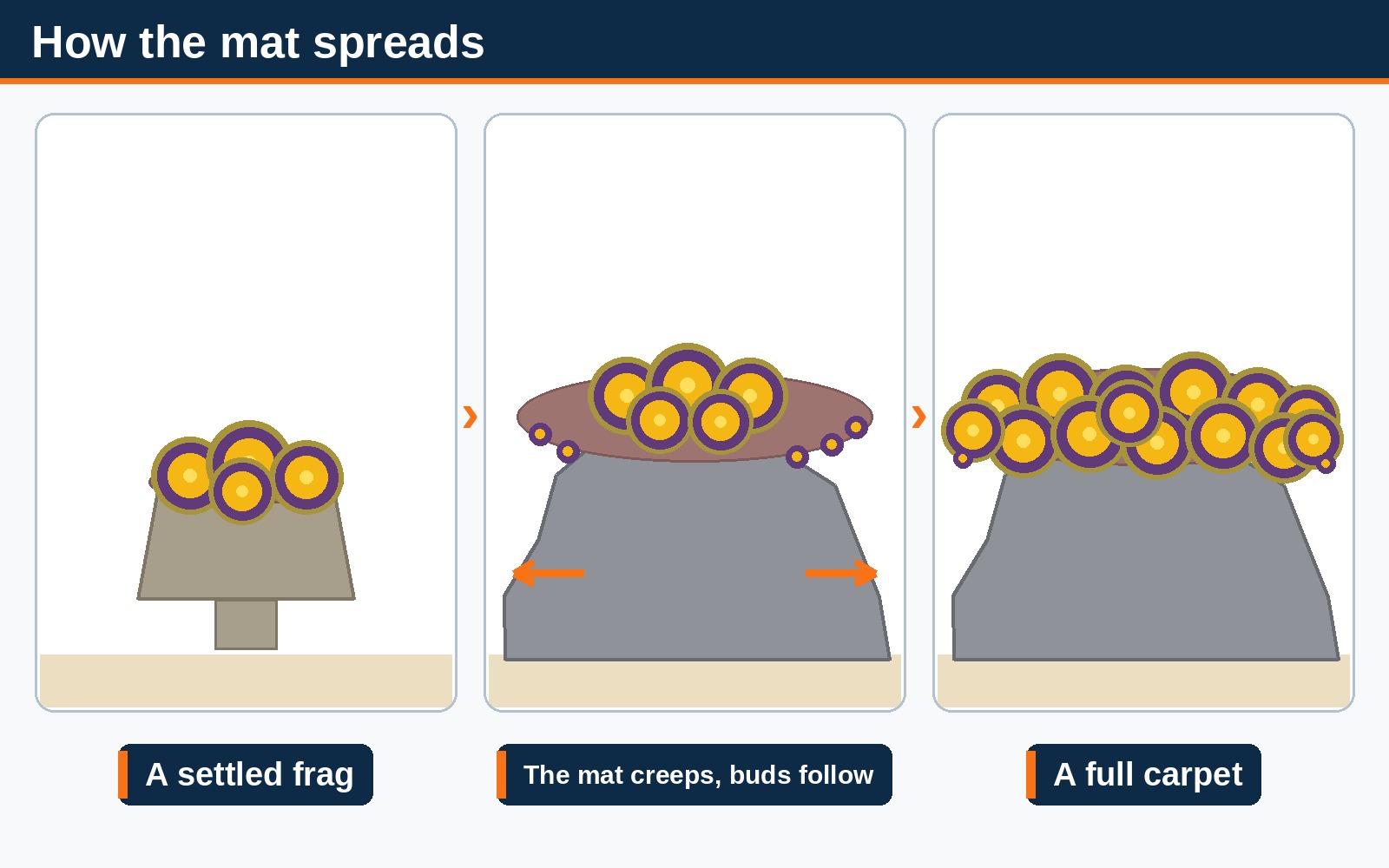
Fragging is straightforward mat work. Slide a sharp scalpel under the mat and cut between polyps, or cut through the rock or plug beneath a section of mat, then fix the piece to a fresh plug or rubble with a drop of gel glue. Keep cut pieces in moderate flow while the edges heal, and give them about a week before shipping or other stress.
Do the cutting gloved and wearing eye protection, every time. The reason is the next section, and it applies to the smallest frag as much as to a full colony.
Handling and pitfalls
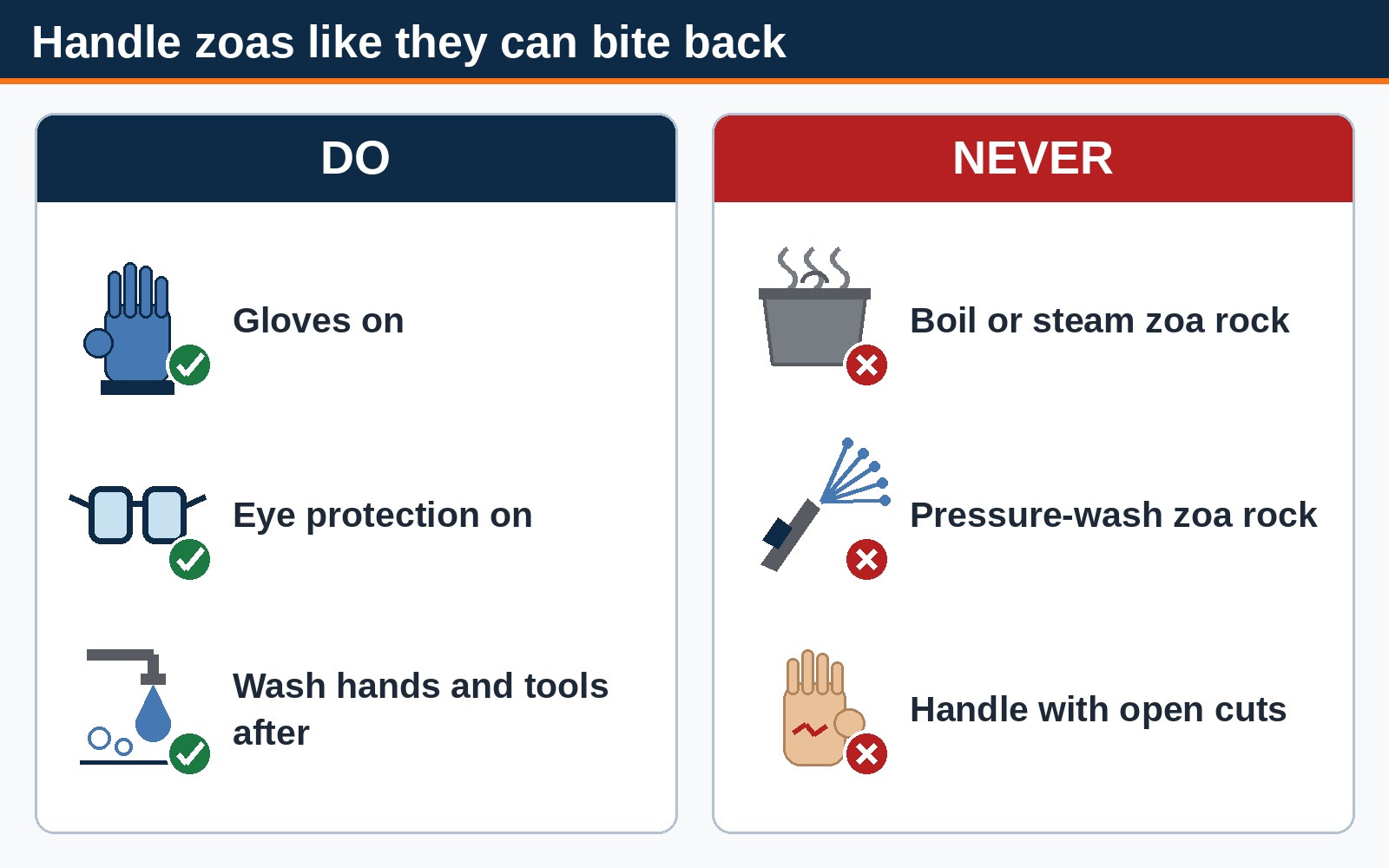
Treat every zoanthid as a possible palytoxin carrier, this one included. Palytoxin is documented most often in this family of corals, and it is a genuinely dangerous toxin rather than a paperwork warning. Wear gloves and eye protection when handling, cutting, or scrubbing around the colony. Never boil, steam, or pressure-wash rock that carries zoanthids, since heating or aerosolizing the tissue is how the worst exposures happen. Wash hands and tools after, keep the work away from open cuts, and if you feel ill after working with zoas, with a metallic taste or trouble breathing among the reported symptoms, seek medical care promptly and name palytoxin.
The everyday killers are smaller. Zoa-eating nudibranchs arrive on new frags, tiny and colored to match the polyps they eat; look for their spiral egg coils on the polyp stalks, because the dips that kill the adults miss the eggs. Sundial snails, with a checkered cone-shaped shell, graze zoa mats at night. Dip and inspect every incoming frag whatever its source, and quarantine when you can.
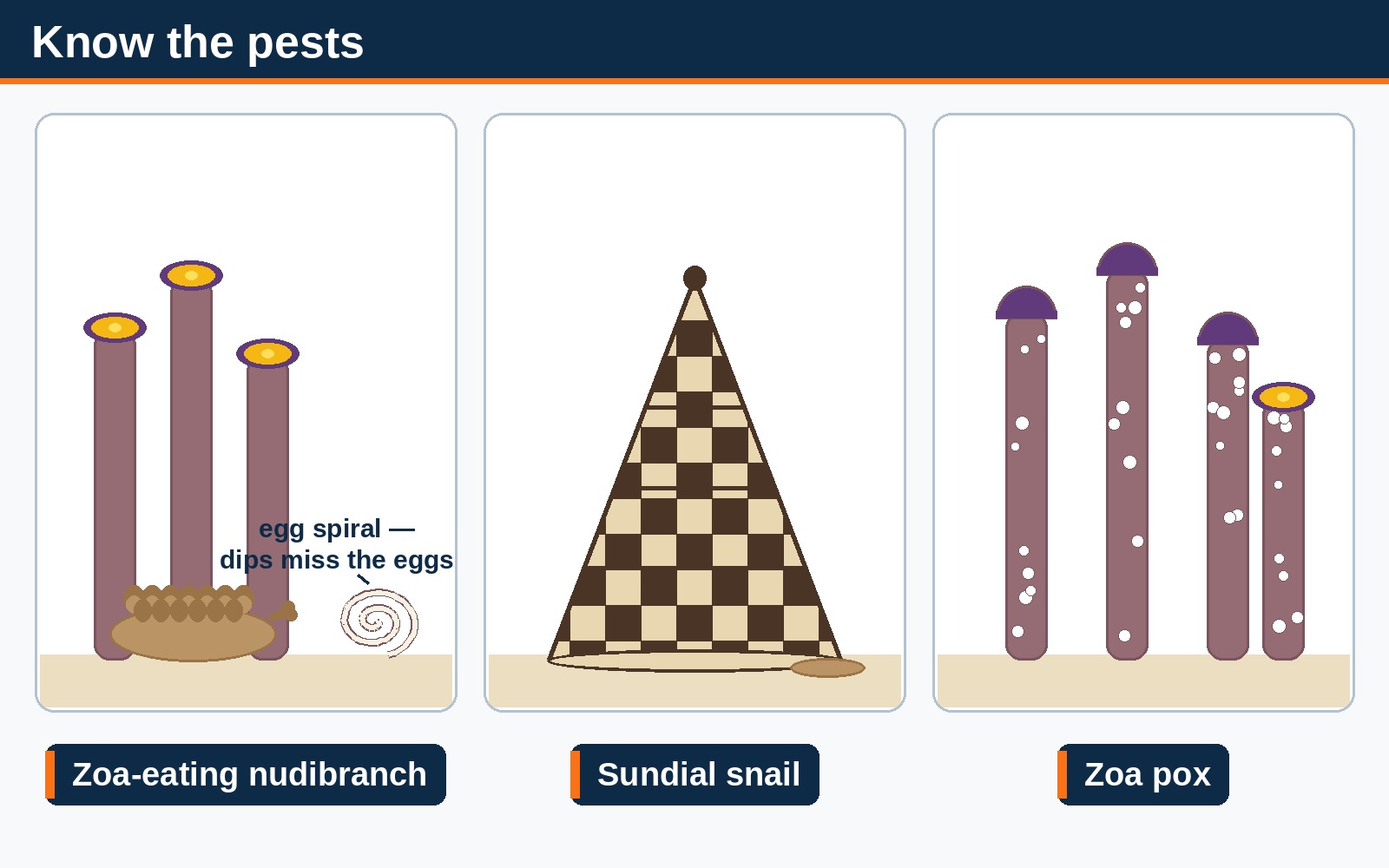
Zoa pox shows as small white pustules on polyps that stay pinched and closed; antibiotic dips are the standard keeper response, paired with stable water until the colony opens again. The slow failure is filth: detritus and algae film settling into the mat smother a colony polyp by polyp, and a weekly puff from a turkey baster prevents most of it. A colony closed for more than a few days wants a check in this order: pests first, then parameters, then any recent change in flow or light.
Field notes — what keepers report
Light reports split, and both camps keep the gold. Keepers running this morph at the low end, around 50 to 100 PAR, report larger, looser polyps on longer stalks. Keepers running it hotter, up toward 200 PAR and beyond, report smaller, tighter polyps with a harder metallic shine to the disc. The card's Moderate rating and mid-rock placement sit in the middle of that range, which is where the farm keeps its colonies.
Feeding reports divide by system. Target feeders in lean tanks swear feeding doubles the budding rate. Keepers with well-fed fish populations report no visible difference and cleaner water for skipping it. Both reports are probably honest; the variable is what the water already carries.
The nutrient report is the closest thing to consensus this genus has. Keeper after keeper describes zoas sulking at zero nitrate and phosphate and perking up once nutrients are measurable, and King Midas colonies feature in those stories as often as any morph.
Spread reports agree too. On shared rockwork, keepers report this morph carpeting across seams and crowding slower zoanthids within a season. On island rock with a sand moat, the same keepers report no trouble at all. Placement, more than temperament, decides which story you get.
Color reports carry one caution. The violet ring photographs stronger than it looks in person under daylight; under blue evening light it deepens again and the whole colony glows. Photos of this morph, this entry's included, are usually taken under the blue light that flatters it most.
Field Notes
Related species

Mystique zoas
Zoanthus sp.
Same genus
Rainbow incinerator zoas
Zoanthus sp.
Same genus
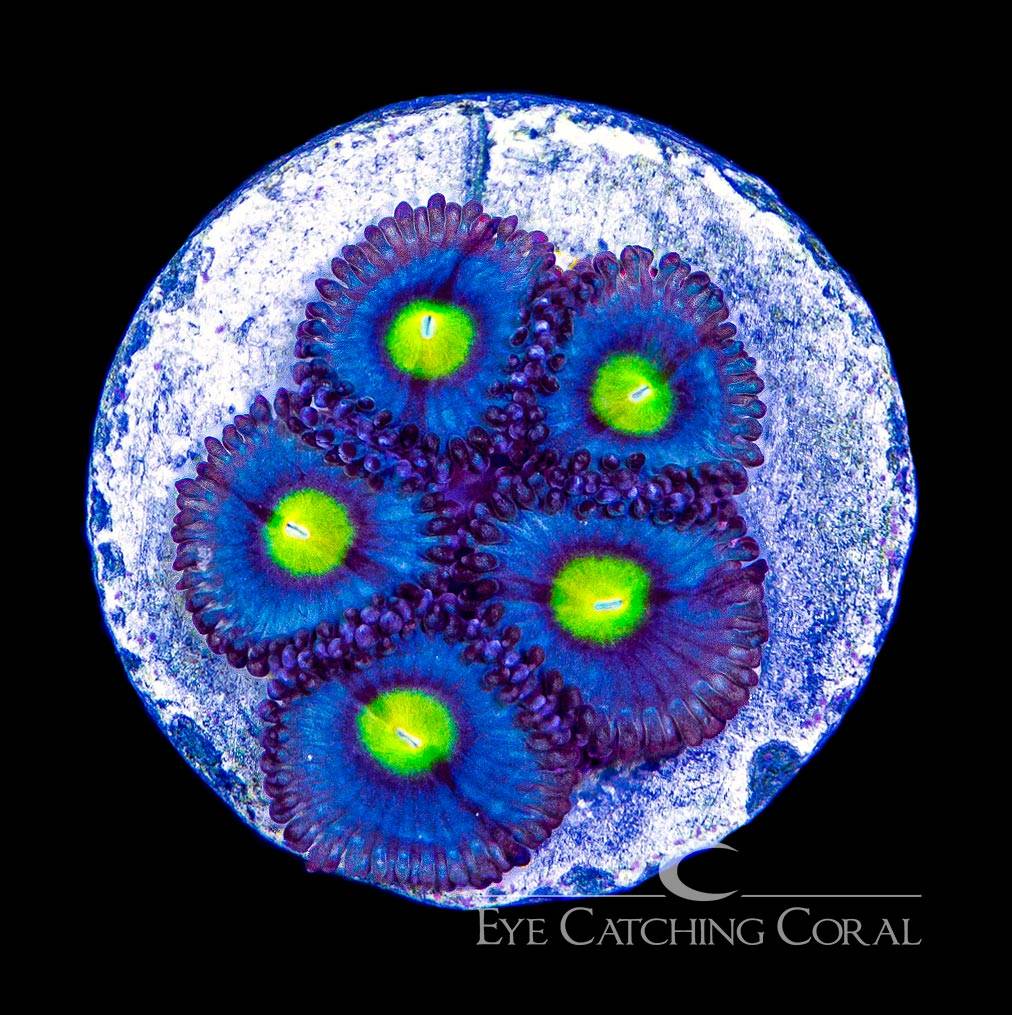
Alien Eye zoas
Zoanthus sp
Same genus
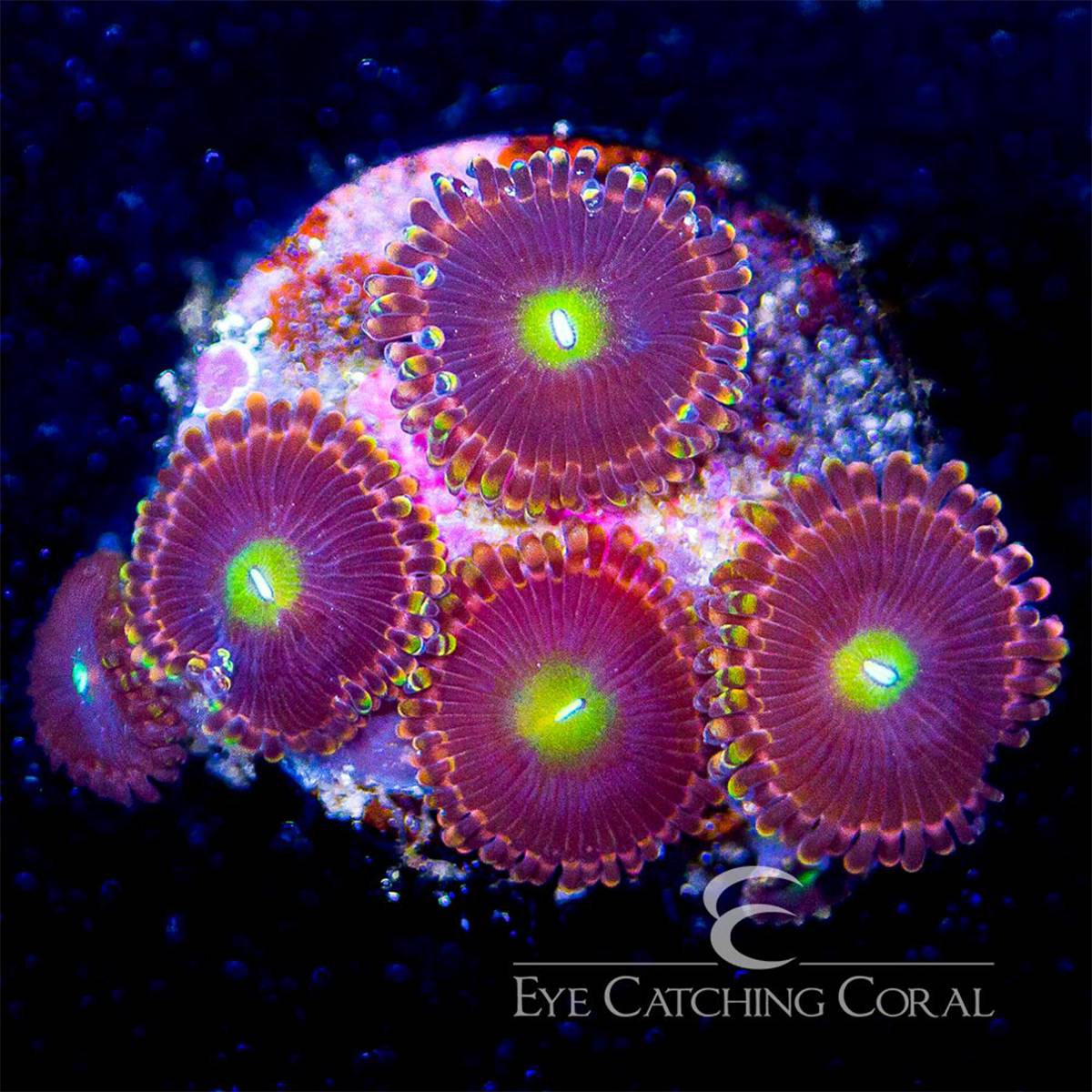
Antimatter zoas
Zoanthus sp
Same genus
Aphrodite
Zoanthus sp.
Same genus
Armageddon
Zoanthus sp.
Same genus
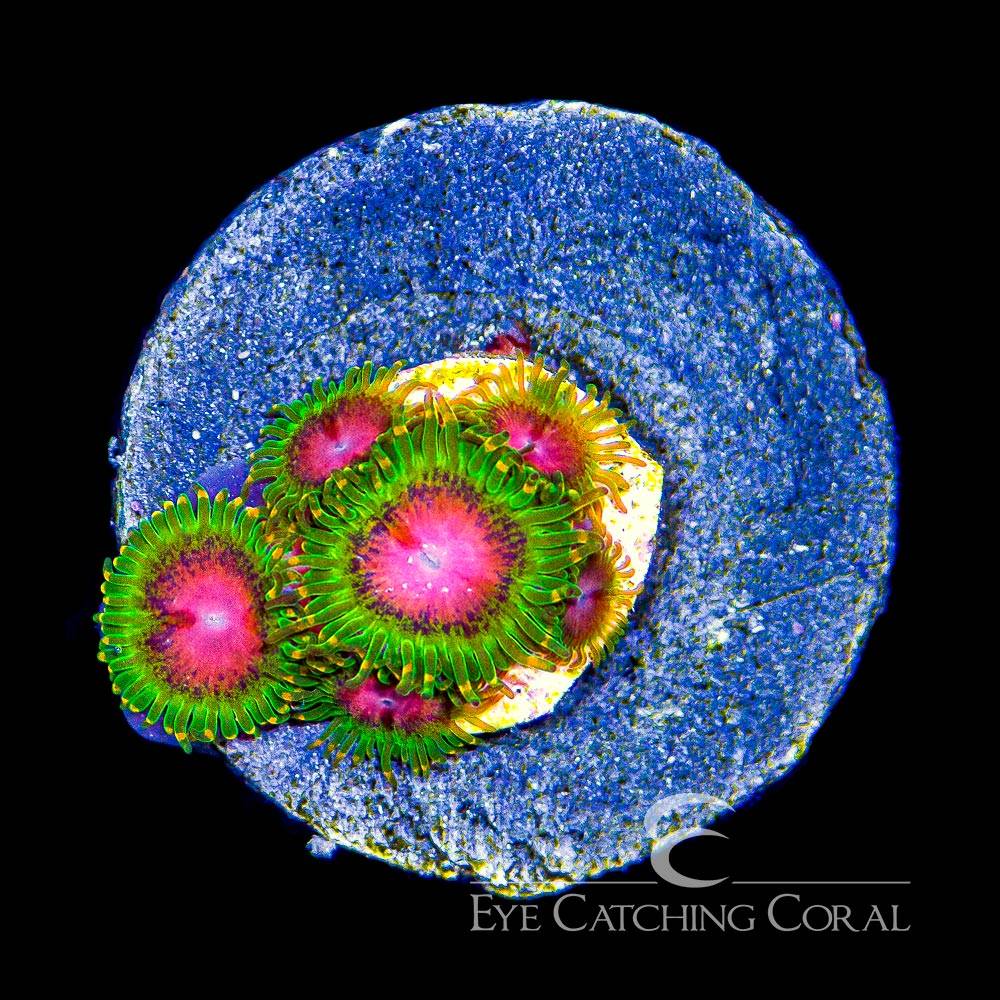
Awesome Blossom zoas
Zoanthus sp
Same genus
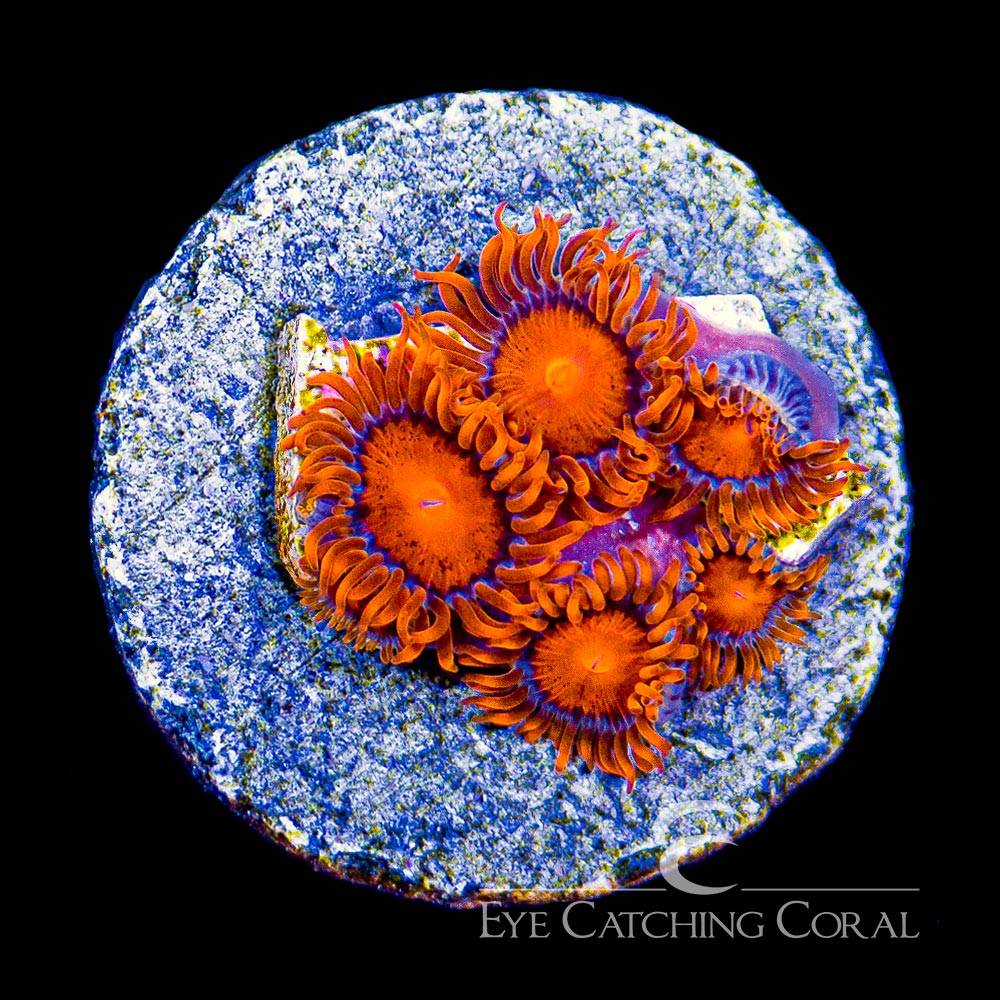
Bam Bam zoas
Zoanthus sp
Same genus
In the shop now

Similar picks from the shop


Love this species? No tank needed.
Reef art from the shop — for the wall, not the tank.


Get notified when Reef To Go has King Midas zoas in stock or up for auction. One email when it's in — no spam.