Alien Eye zoas
Zoanthus sp
Palytoxin safety
Some zoanthids and palythoas can contain a potent toxin. Wear sturdy waterproof gloves and eye protection, minimize handling, and keep colonies submerged when possible. Never boil, steam, pressure-wash or scrub colonized rock under running water. Keep other people and pets away during handling. If exposure is suspected, seek urgent medical advice and tell the clinician about possible palytoxin exposure.
Sources: CDC: palytoxin exposure · OATA: avoiding palytoxin poisoning
Gallery
What it is
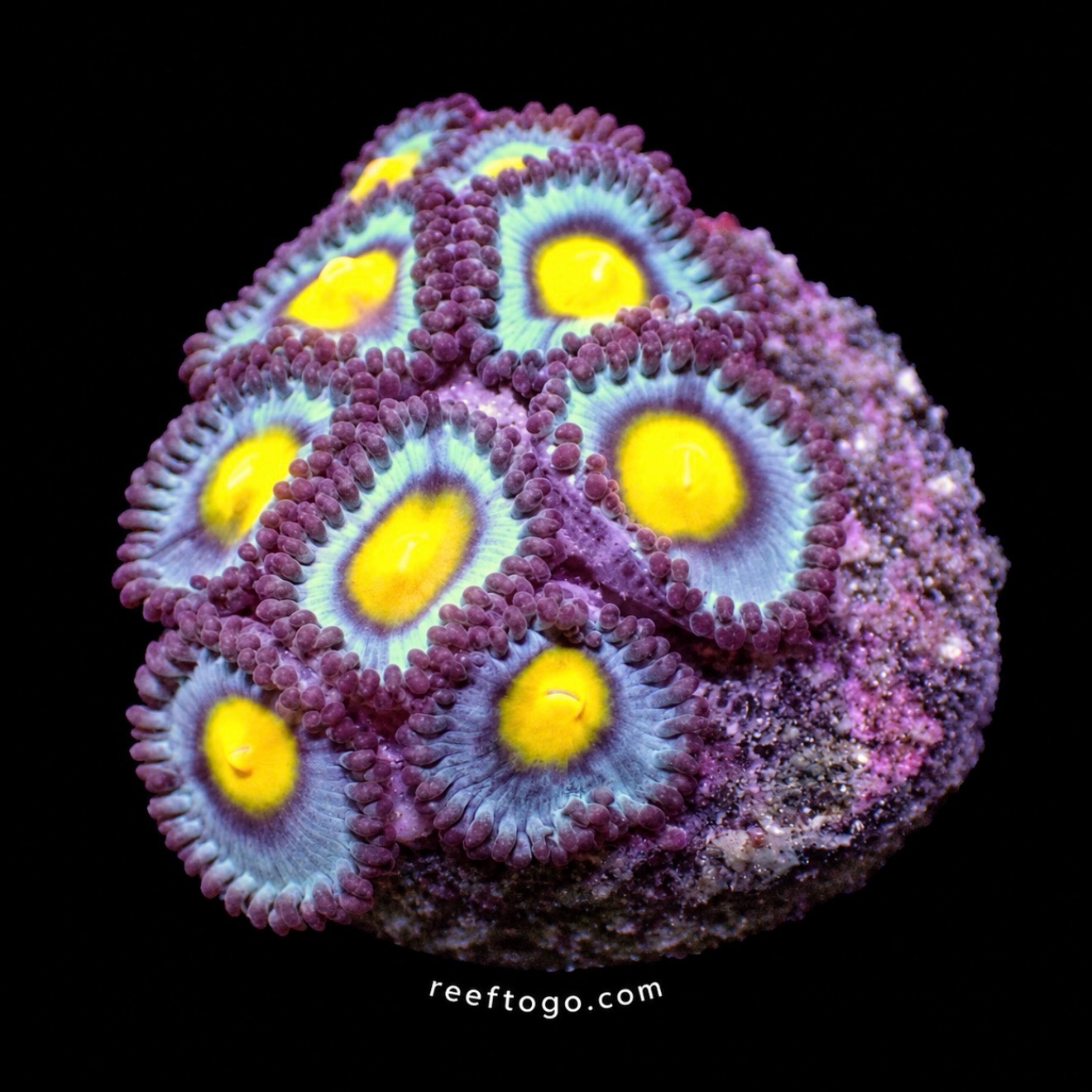
Alien Eye is a named colour morph of Zoanthus, the sea-mat zoanthids. Each polyp is a small anemone relative with no skeleton at all: a wide oral disc ringed by a skirt of short tentacles, joined to its neighbours at the base by a fleshy mat called the coenenchyme. The colony grows by spreading that mat across rock and budding new polyps along its edge, so a settled piece carpets whatever it is mounted on.
Zoanthus polyps in the aquarium trade run small, with oral discs commonly in the 6 to 10 millimetre range for the species most often collected, and the colony is photosynthetic. Symbiotic algae in the tissue cover the baseline energy budget, and the polyps also take dissolved organics and fine particles straight from the water.
This entry is filed as Zoanthus sp., and that filing is deliberate. Zoanthus species show wide colour variation inside a single species, colour morphs of the same species can look very different, and species-level identification from a photograph is unreliable. A colour morph gets a genus-level name here rather than a species name guessed from its colours.
Reading the Alien Eye
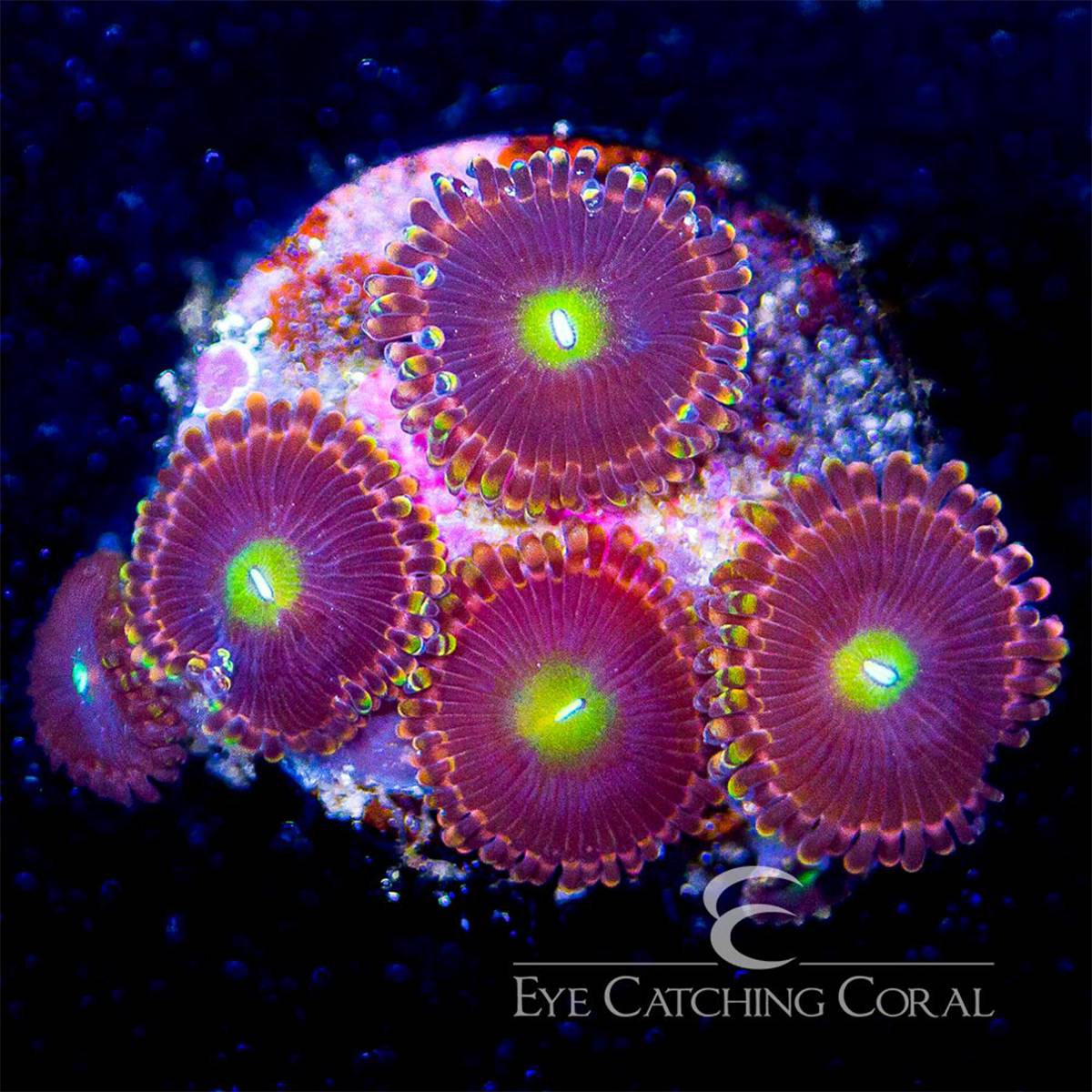
Read the polyp from the centre out. The centre is a solid disc of neon green, almost yellow-green at its brightest, wrapped around a small white slit mouth. That glowing dot is the eye the name points at, and it sits on a wide oral disc of royal blue. A thin dark ring separates the green centre from the blue disc. Outside the disc, the skirt is a full fringe of short tentacles in deep purple.
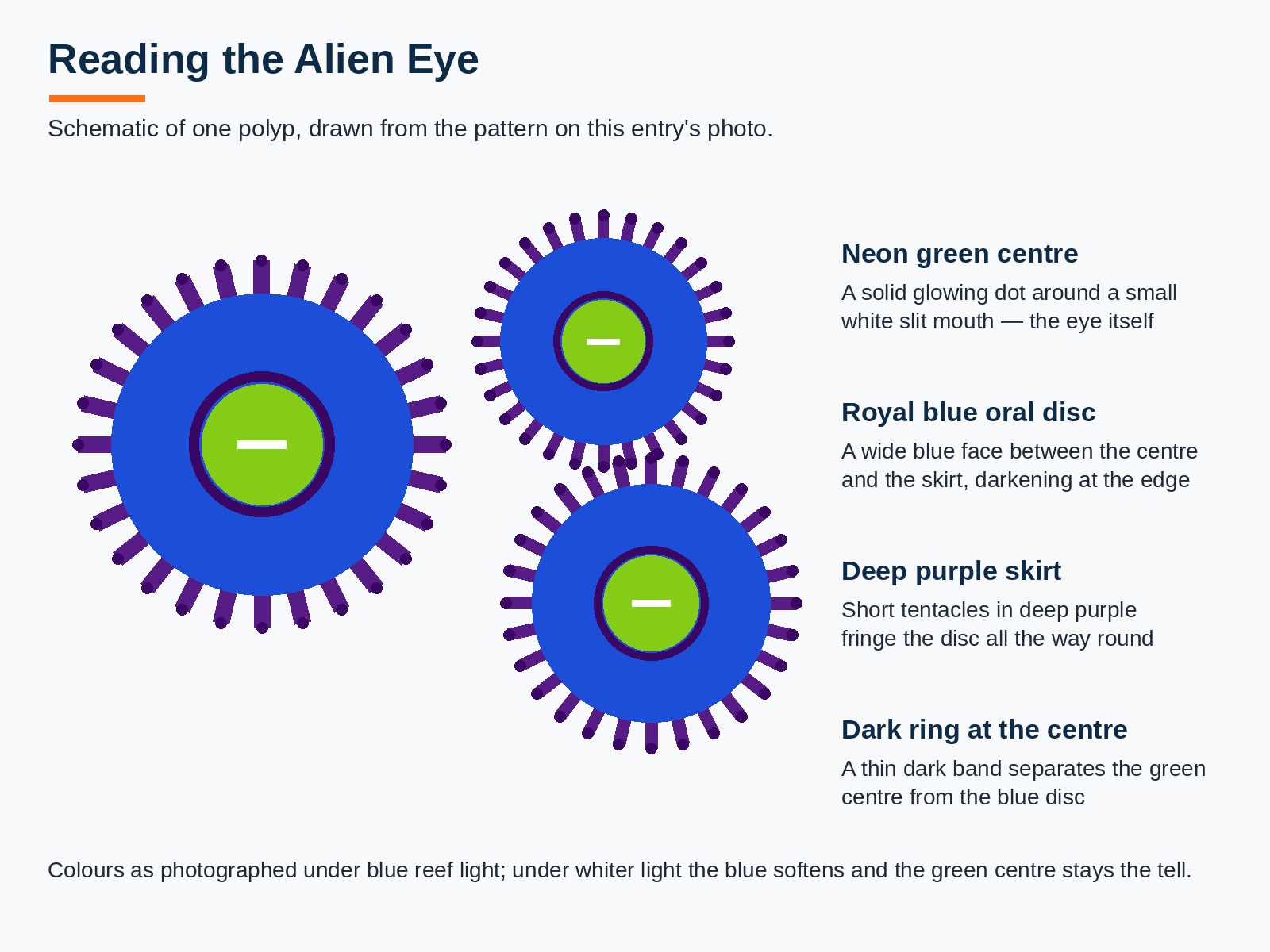
The centre separates this morph from its closest named relatives in the older trade naming. Eagle Eye types carry their bright colour as a ring on the disc. Alien Eye types carry it as a solid dot at the centre, with the rest of the disc reading blue. A polyp with a bright ring and a dark centre belongs to a different morph, however blue its disc looks.
Colour needs one caution. This entry's photo was taken under blue-heavy reef light, and blue light drives the fluorescence that makes the centre glow and the disc read royal blue. Under a whiter daylight spectrum the disc softens toward a duller blue and the skirt reads browner, while the green centre stays bright. Judge a new frag by open polyps, clean mat and new buds first, and give its colour a week or two to settle before judging that at all.
The name story
The eye names in zoanthids go back to the first wave of trade naming in the early 2000s, when keepers separating the new People Eater types needed a shorthand for patterns. The naming history recorded by early collectors runs: eagle eyes for the ring pattern, alien eyes for the dot centre. The alien half of the name is the science-fiction read of that dot: a single glowing eye on an otherwise plain face, in colours no reef animal was supposed to wear.
The name has travelled loosely since then. Older hobby lists also apply Alien Eye to a green-rimmed zoa with a purple ring and a pink centre, a pattern this entry's photo does not show. Two frags sold as Alien Eye from different sources may share the dot-centre pattern, or may share only the name. No naming announcement, origin record or collection locality for this morph was found in a diligent search, so none is claimed here. The checkable identity of this entry is the pattern above: blue disc, solid neon centre, dark ring, purple skirt.
Where it comes from
Wild Zoanthus range across tropical and subtropical reefs, with the aquarium trade drawing most heavily on the Indo-Pacific. Colonies carpet rock, rubble and reef flats in shallow water, in places covering areas measured in square metres, and commonly traded species occur from the intertidal zone down through the shallow reef.
The shared habitat thread is hard surface, moving water and light. Aquarium care that works for this genus copies that setting at reef-tank scale: a rock surface to encrust, moderate indirect flow, and light in the low to medium band this entry's care card records.
Colour and light
The care card rates this morph Low to Medium for light. Published Zoanthus bands split around that rating. A practical care guide puts the wide band at 50 to 150 PAR, a retail guide calls 75 to 150 PAR ideal, and a third guide publishes a higher 100 to 250 PAR band. Put together, the honest working range for this morph is the lower half of that spread: start a new frag around 50 to 100 PAR on mid rockwork, watch it for a week, and step it up slowly only if the stalks stretch upward reaching for light.
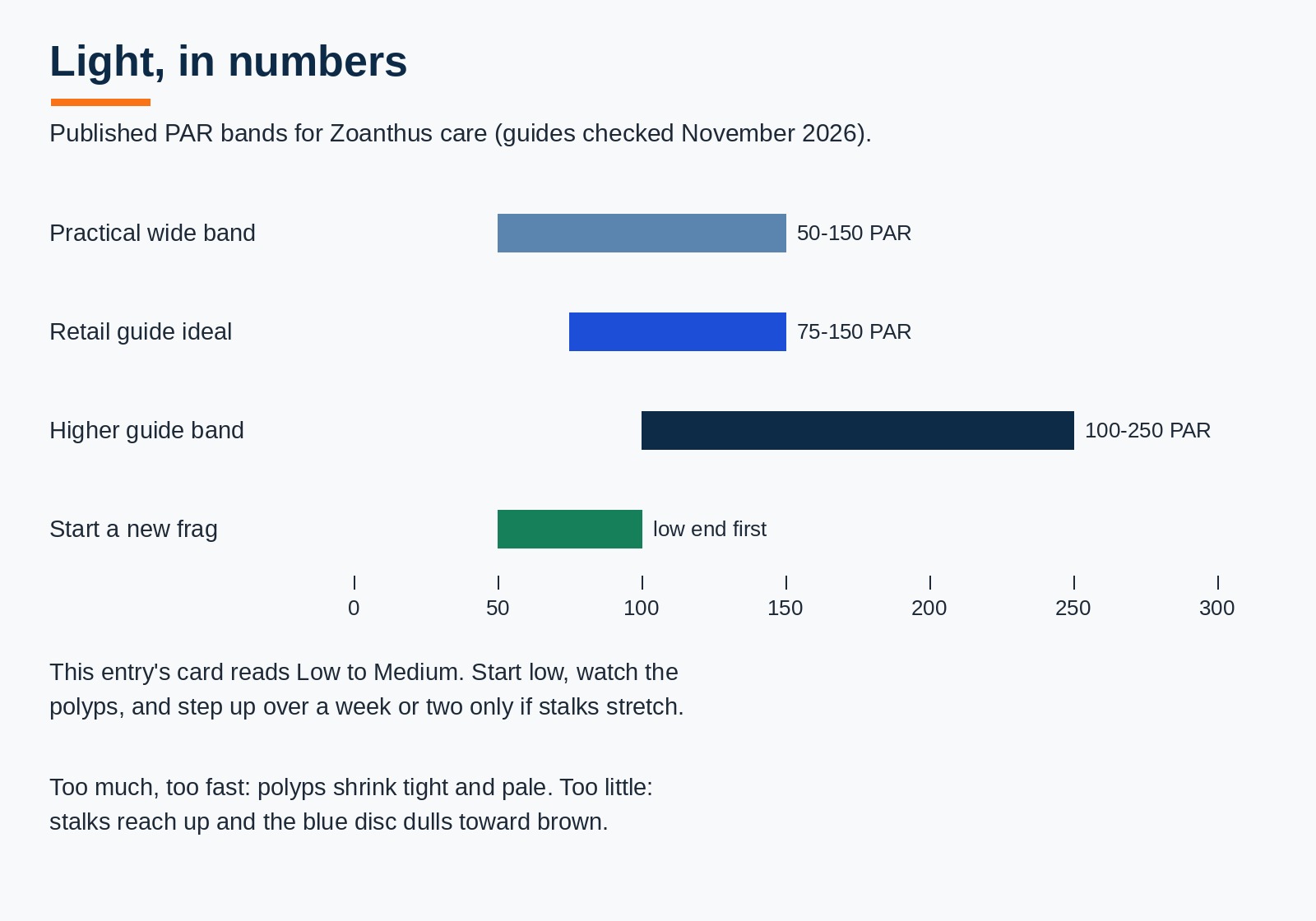
Too little light shows in the shape first. Stalks lengthen, polyps open wide and flat, and the blue disc dulls toward brown while the centre keeps its green. Too much light, moved up too fast, does the opposite damage: polyps shrink tight against the mat, colours pale, and a colony can bleach at the centre of the disc. Acclimation in steps over a week or two avoids both ends.
Spectrum shapes the display. Blue-heavy light is the show light for this morph, driving the fluorescence in the centre and the depth in the blue disc. The same colony under daylight spectrum reads plainer and more honest. Both readings are the same animal; the light is the variable.
Flow, placement and neighbours
Flow is rated Medium, and its job is housekeeping. A gentle, indirect, shifting current keeps detritus from settling into the mat, where trapped waste starts most zoa trouble. Polyps should sway slightly and stay open. A direct jet keeps them shut, and a dead-still corner lets film and algae settle between polyps.
Placement is Middle on the card, mid rockwork in practice, with 2 inches of clear space around the colony. Give this morph its own rock or a defined island with a moat of sand or bare glass around it. Growth is rated Fast, the mat spreads steadily, and a colony that touches shared rockwork will be growing across the seam within a season.
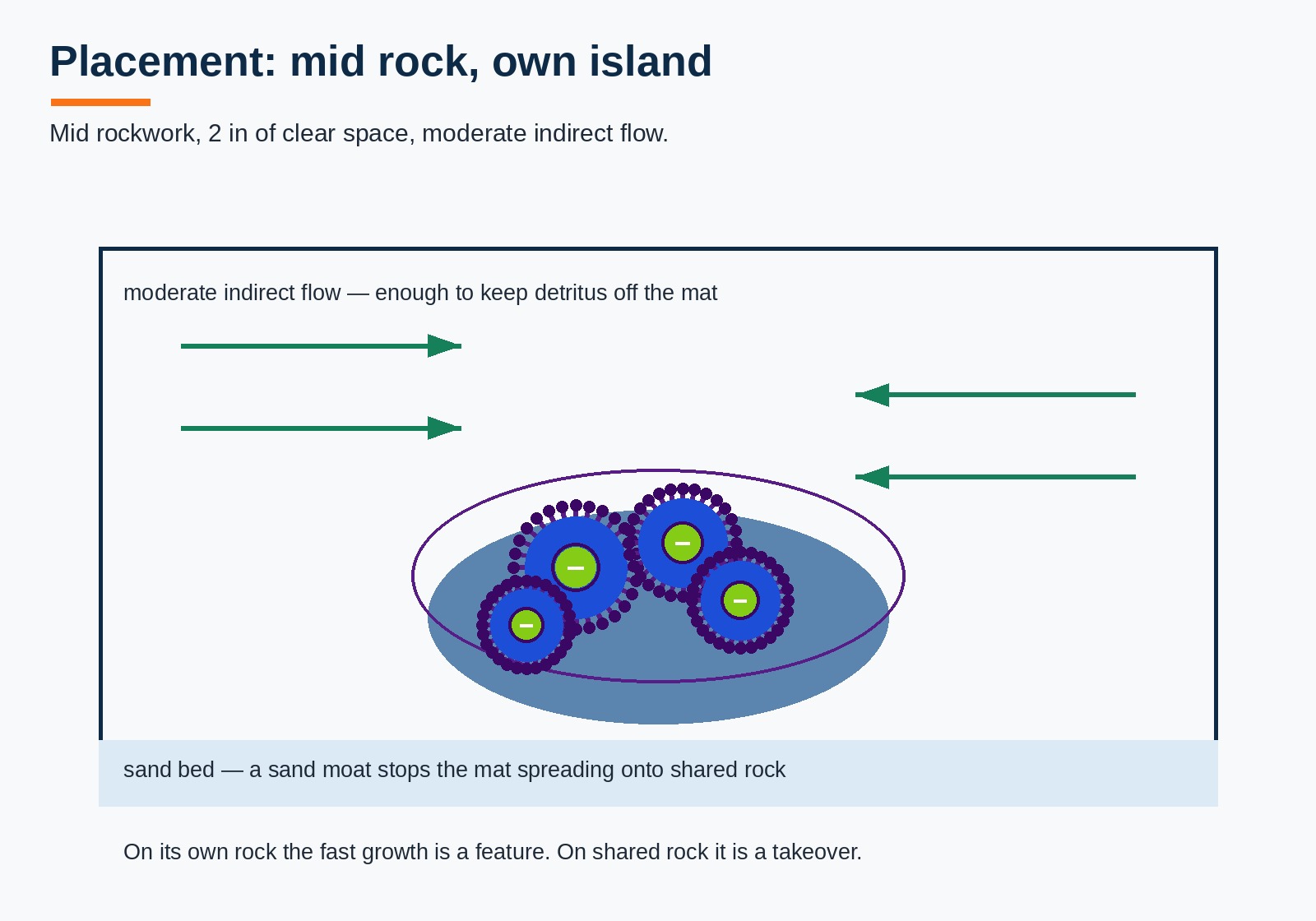
The Moderate aggression rating is about contact and coverage. Zoanthids grow no sweeper tentacles. A fast Alien Eye mat climbs over slower zoas, shades the edge of a neighbour's colony, and wins shared rock by simple coverage, with mild chemical competition on top. Keep the working gap between it and any prized morph you would hate to see wearing a blue and green fringe.
Feeding and water chemistry
Photosynthesis covers the baseline, and this morph grows on light alone in a fed fish system. Feeding is a growth lever rather than a requirement. In a lean tank, target feeding once or twice a week with a fine powdered coral food or rotifer-sized fare can visibly speed up budding along the mat's edge. In a heavily fed system most keepers skip it and lose nothing.
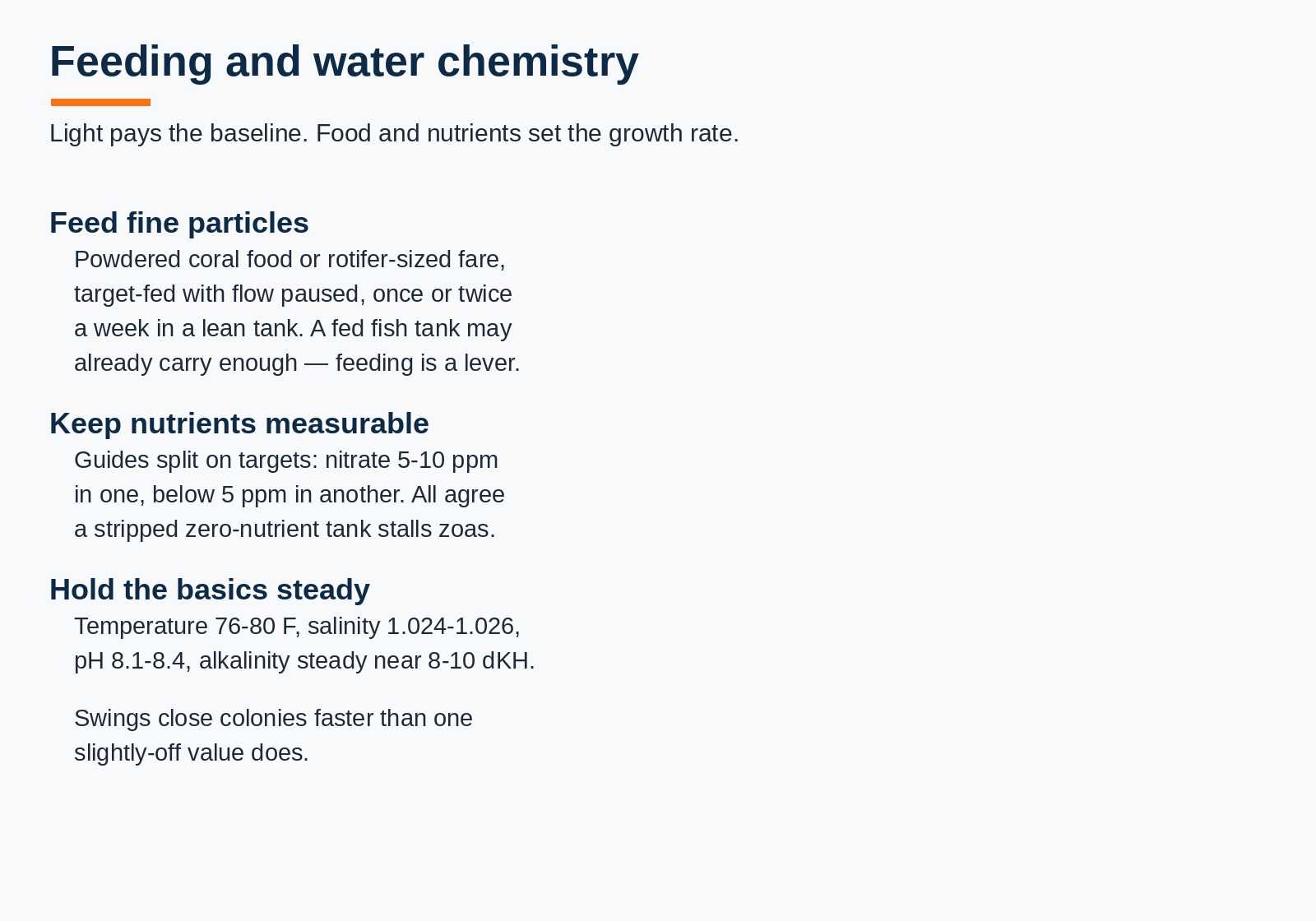
The colony builds no skeleton, so it draws no calcium or alkalinity of its own, but stability still runs the show. Working ranges from the care guides: temperature 76 to 80 degrees Fahrenheit, salinity 1.024 to 1.026, pH 8.1 to 8.4, and alkalinity held steady in the 8 to 10 dKH band many zoa keepers target. Swings close colonies faster than any single value sitting slightly off.
Nutrient targets split in the guides, and the split is recorded in the field notes below. Every guide agrees on the floor: this genus stalls in stripped, ultra-low-nutrient water, and measurable nitrate with a trace of phosphate suits it better than zeros across the test kit.
Growth and fragging
Growth is rated Fast, and a settled colony makes quick progress for a zoanthid: new polyps bud from the mat's edge, the carpet thickens, and bare rock disappears under blue discs and green centres. Growth comes in pulses tied to stability. A colony left in one spot with steady water outgrows a prettier colony that gets moved every month.
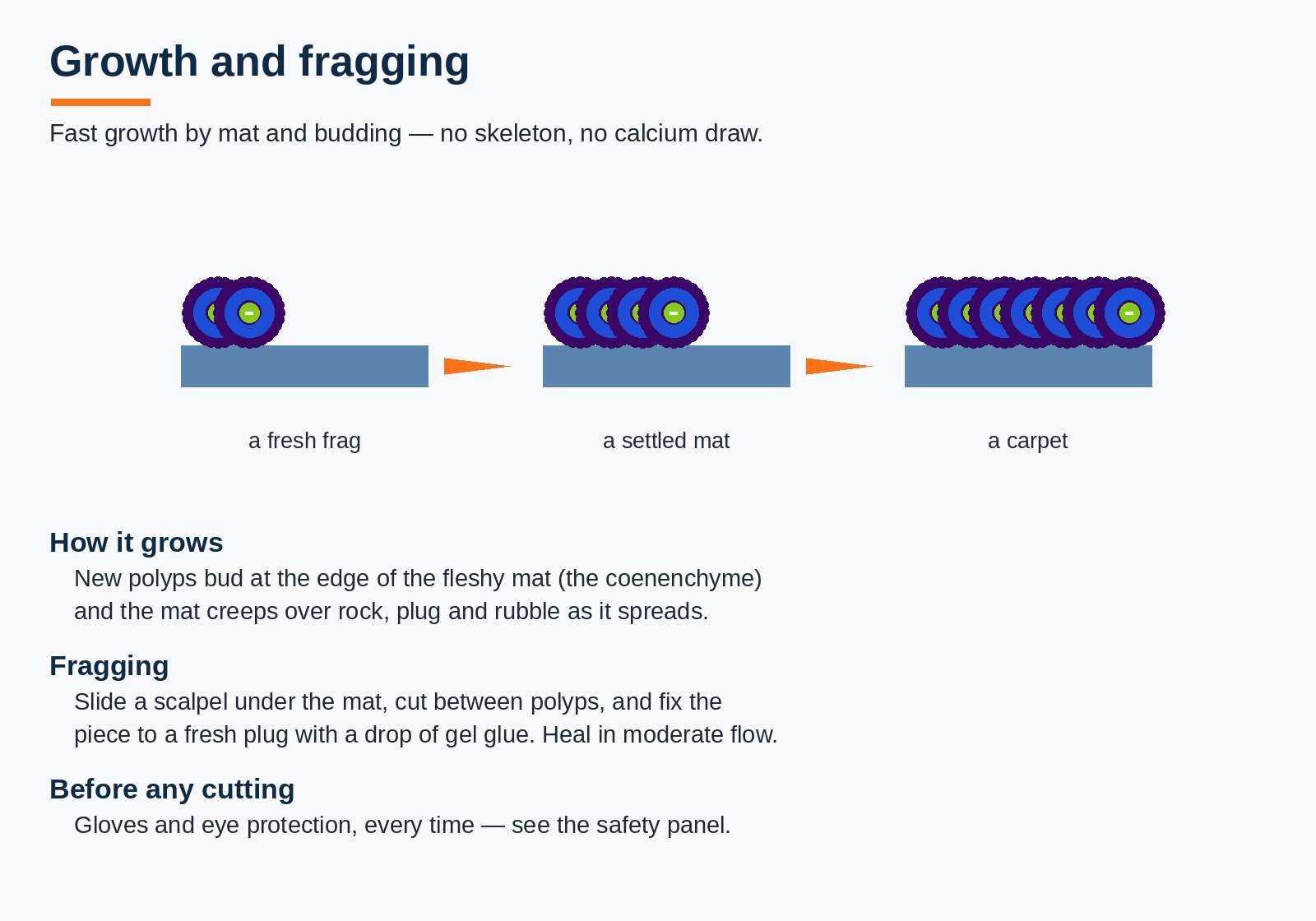
Fragging is straightforward mat work. Slide a sharp scalpel under the mat and cut between polyps, or cut through the plug or rock beneath a section of mat, then fix the piece to a fresh plug or rubble with a drop of gel glue. Keep cut pieces in moderate flow while the edges heal, and give them about a week before shipping or other stress. Do the cutting gloved and wearing eye protection, every time, for the reason covered next.
Handling and pitfalls
Treat every zoanthid as a possible palytoxin carrier, this one included. Palytoxin is documented across this family of corals, most often in Palythoa and possibly in Zoanthus, and the risk rises when tissue is damaged. Wear gloves and eye protection when handling, cutting or scrubbing around the colony. Never boil, steam or pressure-wash rock that carries zoanthids, since heating or aerosolising the tissue is how the worst exposures happen, and palytoxin keeps its toxicity when heated. Wash hands and tools after, and keep the work away from open cuts.
The everyday killers are smaller. Zoa-eating nudibranchs arrive on new frags, tiny and coloured to match the polyps they eat; a polyp that stays open while the colony around it closes may be a nudibranch wearing the colony's colours. Look for their spiral egg coils on the polyp stalks, because the dips that kill the adults miss the eggs. Sundial snails, with a checkered cone-shaped shell, graze zoa mats at night, and sea spiders latch onto polyps. Dip and inspect every incoming frag whatever its source, and quarantine when you can.
Zoa pox shows as small white pustules on polyps that stay pinched and closed; antibiotic dips are the standard keeper response, paired with stable water until the colony opens again. The slow failure is filth: detritus and algae film settling into the mat smother a colony polyp by polyp, and a weekly puff from a turkey baster prevents most of it. A colony closed for more than a few days wants a check in this order: pests first, then parameters, then any recent change in flow or light.
Field notes — what keepers report
Light reports split, and the published bands split with them. Keepers running zoas at the low end, around 50 to 100 PAR, report larger polyps on longer stalks and steady budding. Keepers running this kind of blue and green morph hotter, up through the 150 to 250 PAR band one guide publishes, report tighter polyps and harder colour, with a slower start while the colony acclimates. This entry's Low to Medium card and mid-rock placement sit in the lower half of that argument, which is where a new frag belongs either way; moving up is easy, recovering a bleached colony is slow.
The name draws mixed reports of its own. Keepers who bought Alien Eye by the older dot-centre definition recognise this pattern at once: solid glowing centre, blue face. Keepers who met the name on a green-rimmed, pink-centred zoa in older lists report a different animal under the same label, and forum ID threads on eye-named zoas regularly end with the photo deciding the argument. That history is why this entry keys the morph to its photo pattern rather than to the name alone.
Feeding reports divide by system. Target feeders in lean tanks report faster budding along the mat edge within weeks of starting a routine. Keepers with well-fed fish populations report no visible difference and cleaner water for skipping it. Both reports are probably honest; the variable is what the water already carries.
Nutrient reports carry the closest thing to consensus this genus has, with a genuine split on the target. One camp holds nitrate at 5 to 10 ppm and warns against chasing zero. Another camp reports long-term success below 5 ppm. Keeper after keeper describes zoas sulking at zero nitrate and phosphate and opening again once nutrients register, so the shared ground is the floor rather than the ceiling: measurable beats stripped.
Spread reports agree. On shared rockwork, keepers report fast zoa mats carpeting across seams and crowding slower morphs within a season, and blue morphs draw the same reports as gold ones. On island rock with a sand moat, the same keepers report no trouble at all. Placement, more than temperament, decides which story a keeper gets.
Field Notes
Related species
Antimatter zoas
Zoanthus sp
Same genus
Awesome Blossom zoas
Zoanthus sp
Same genus
Bam Bam zoas
Zoanthus sp
Same genus
Black Bella zoas
Zoanthus sp
Same genus
Blow Pops zoas
Zoanthus sp
Same genus
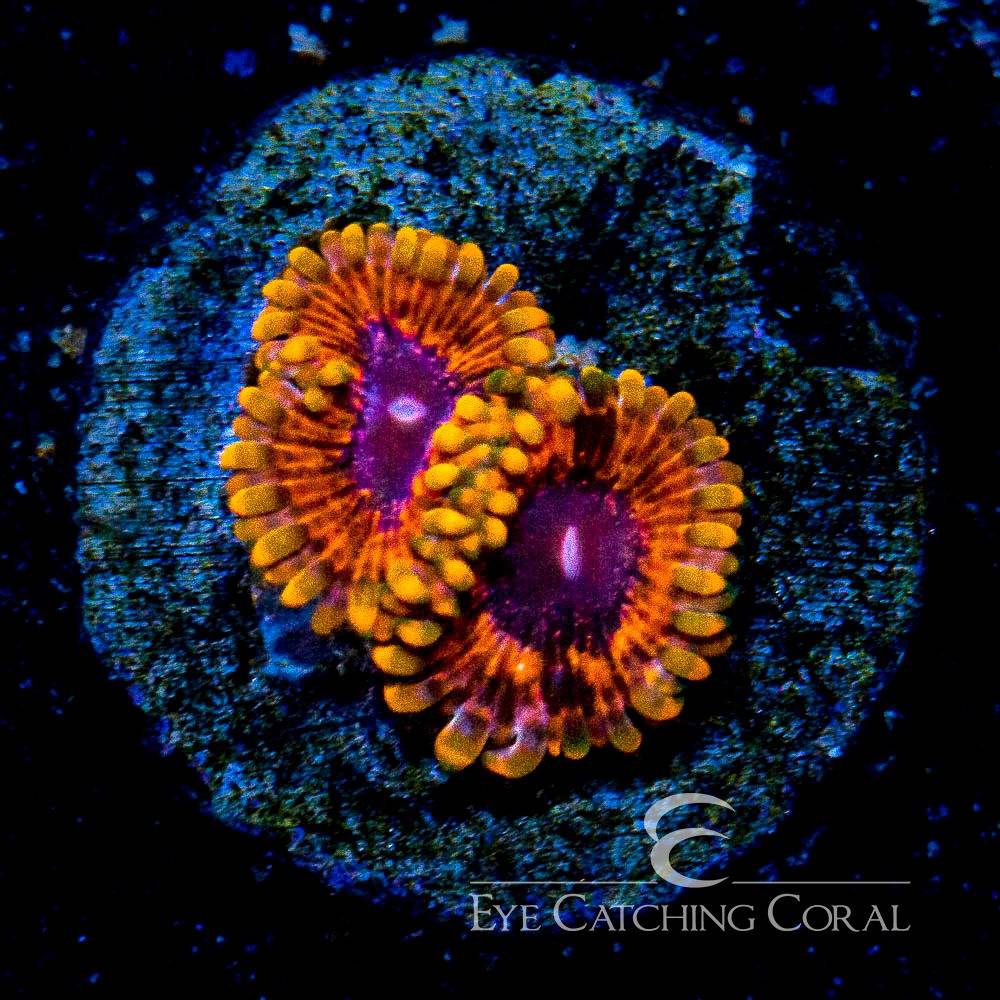
Burning Ember zoas
Zoanthus sp
Same genus
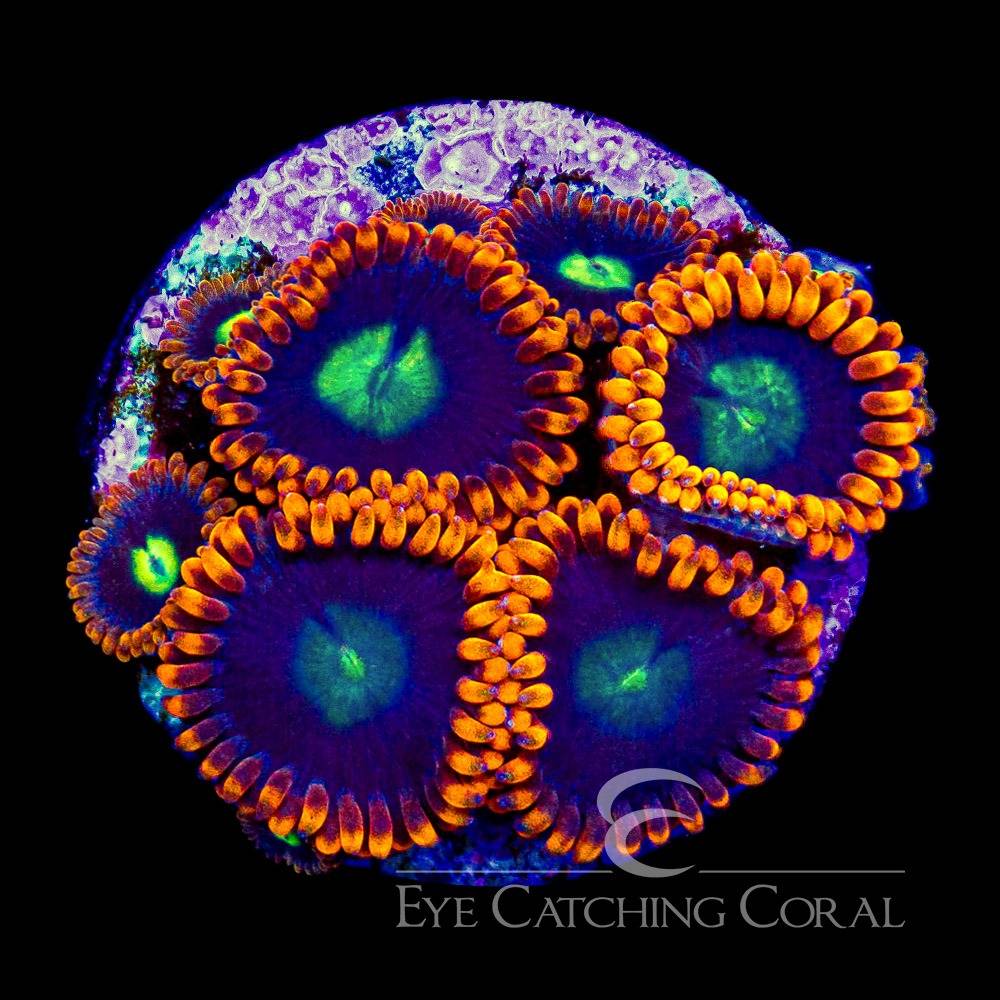
Burning Suns zoas
Zoanthus sp
Same genus
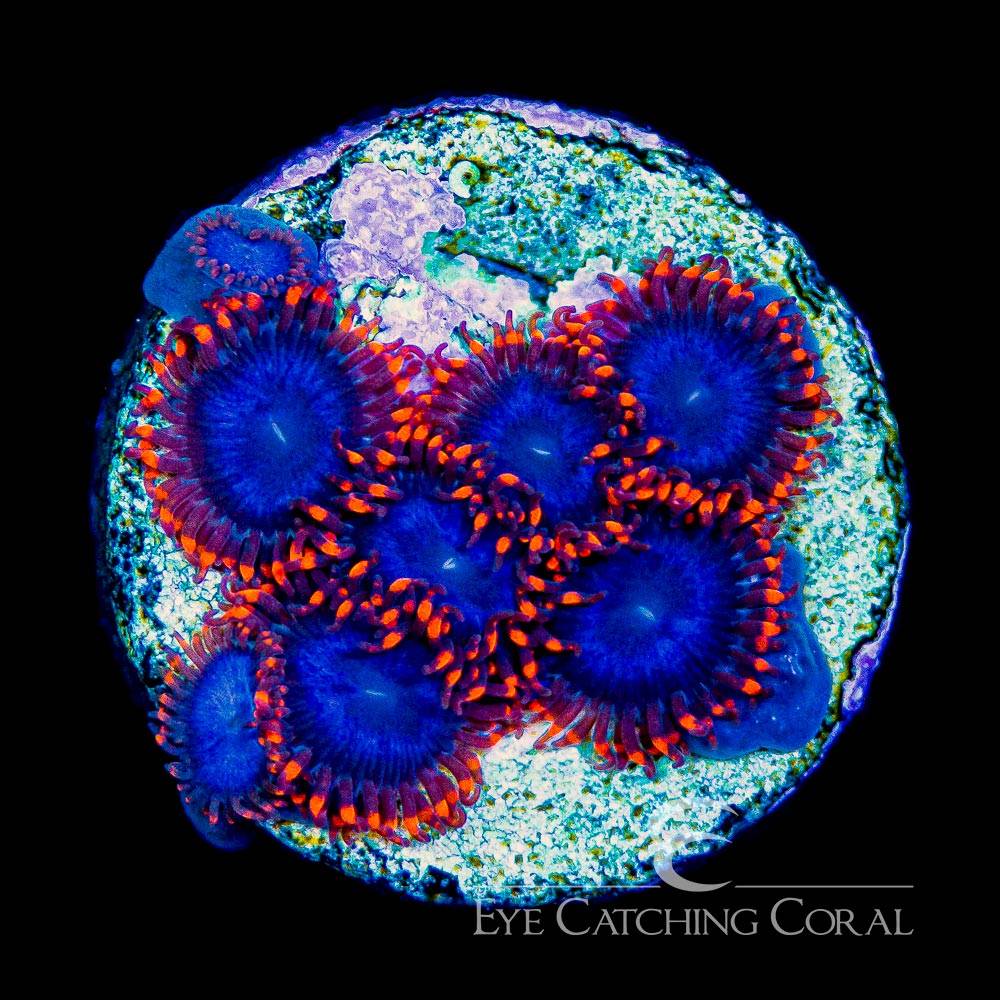
Captain Falcon zoas
Zoanthus sp
Same genus