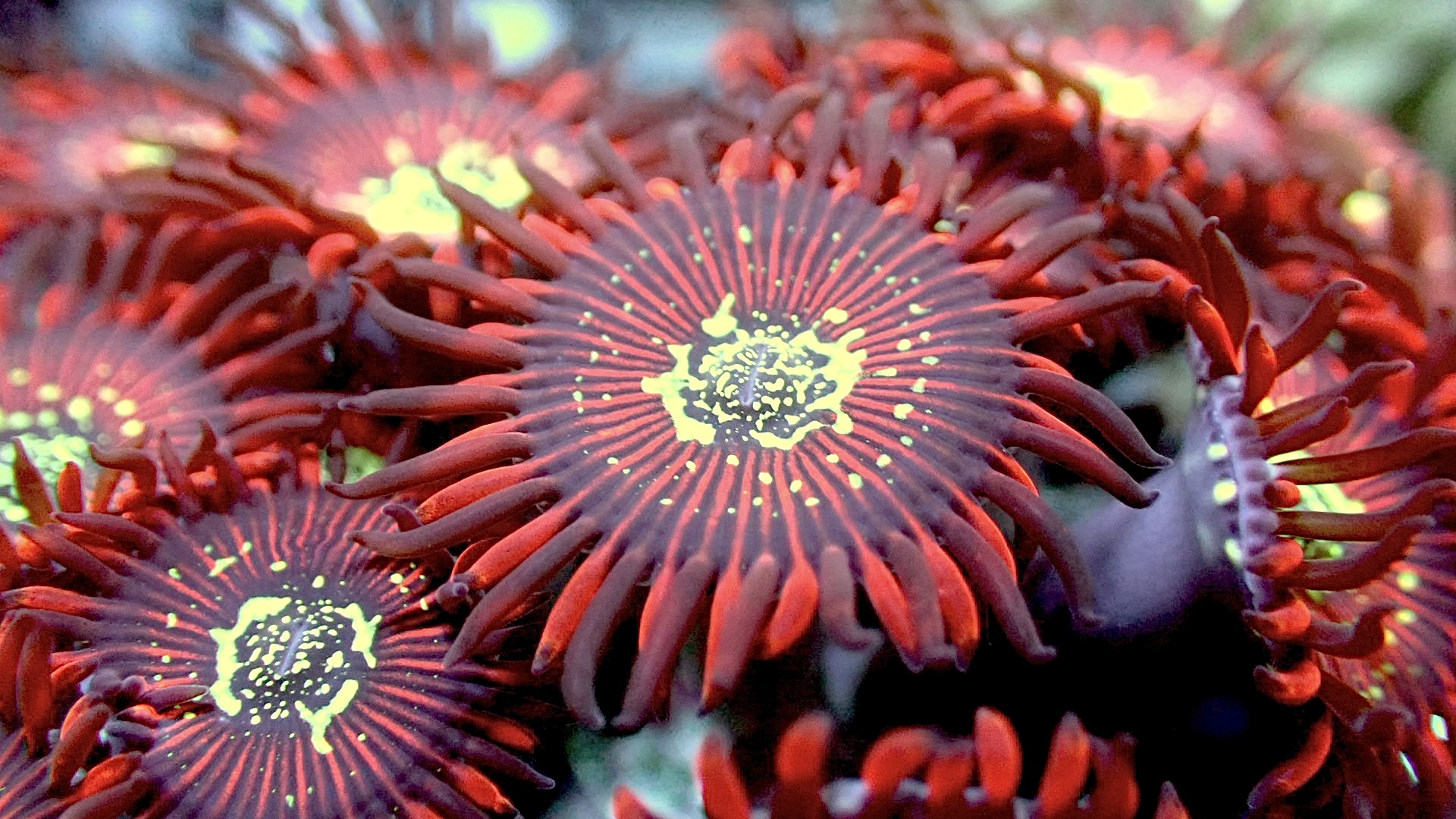
Nuclear Green
Palythoa sp.
Also known as: Nuclear Greens, Mountain Dew palys, Nuclear Green Death Paly
Care Summary
Nuclear Green is the green half of the original "Death paly" pair, a small group of large Palythoa morphs that anchored the high-end paly trade in the 2000s alongside its purple sibling, Purple Death. The first ones into the hobby in the early 2000s were nicknamed "Mountain Dew" palys for their soda-bright colour before the Nuclear Green name — credited to the keeper da6d2003 in the ZoaID era — stuck. The identification is as simple as the name: a large polyp whose whole oral disc is one striking, electric green, with no rings, speckles, or contrasting face to confuse it with anything else.
The polyps are true paly size, running from nickel to quarter sized, and they sit nearly solitary on a greatly reduced mat rather than a thick shared coenenchyme, so a colony reads as a crowd of individual polyps hugging the rock. The tissue is thick and slimy, with fine sand grains worked into the lower columns — a classic Palythoa trait. Like the rest of the Death group, the hue and intensity of the green shift noticeably with lighting and tank conditions, brightening under stronger blue, while the morph itself stays stable and unmistakable.
In the aquarium Nuclear Green is one of the hardiest soft corals in the hobby, sometimes to a fault. It adapts across a wide lighting range and does best in low-to-medium light with medium flow — enough current to keep the skirts waving and detritus from settling between polyps, without pinning them shut. Standard reef parameters suit it: 77–79°F, salinity near 35 ppt (about 1.025–1.026), alkalinity 8–10 dKH, calcium 400–450 ppm. It is photosynthetic, but it shares the Death group's strong feeding response, and growth speeds up visibly when the polyps are offered meaty foods such as mysis.
Plan for its spread before it plans for you. Fed colonies bud quickly and the polyps claim whatever rock they touch, and keepers' long experience with this strain (see field notes) is that it outlasts almost every attempt to remove it from shared rockwork. Grow it on its own island rock, where a solid field of nuclear green is easy to admire and the colony's edge is easy to trim back. It sits peacefully beside other Death-group palys, and keepers have reported mixed, hybrid-looking polyps appearing where two Death morphs grow into each other.
Safety deserves its own paragraph with this strain. The Death palys are the group keepers most often single out for palytoxin caution, and Nuclear Green is one of the two morphs named most often — the other is Purple Death. Handle and frag it only with gloves, eye protection, and a mask if cutting tools throw any spray or mist, keep it away from open cuts, wash thoroughly afterwards, and never boil, steam, or pressure-wash rock that carries it — heat can aerosolize the toxin. One more modern wrinkle: because buyers have grown wary of palys, some sellers now list this coral as a "zoanthid." The name on the listing changes nothing about the animal or its toxin. Treated with respect at handling time, an undisturbed colony is a routine aquarium coral; treated casually at fragging time, it is one of the few zoanthids that can genuinely hurt someone.
Field notes — what keepers report
- Spread and hardiness dominate the keeper record for this strain. One long-running reefs.com thread is a keeper asking how to reduce a colony without removing its rock: he reports taking the rock out roughly every two years to deal with the growth, and never fully clearing them even after torching rocks and leaving them out overnight. Other keepers in the same thread manage the edge by clipping heads or injecting individual polyps, and several argue the better answer is to trade the whole rock to someone who wants the coral. The island-rock advice above comes straight from this pattern.
- Feeding response is a group trait keepers and the old Reef2Reef catalogue summary agree on: Death palys grab meaty foods such as mysis readily, and growth and reproduction increase when they are fed. That is the difference between a colony that merely persists and one that needs its edges managed — feeding is the throttle.
- On light and flow the sources line up: the Death-paly catalogue summary rates the group low-to-medium light and medium flow, defined as current that waves the skirt without closing the polyps, and reefs.com's entry for this strain lists medium light and medium flow with photosynthesis as the feeding mode. Vendor listings (The Coral Centre) likewise rate it easy with medium light and medium flow. The entry therefore rates light Low–Medium and lets placement start low.
- Colour behaviour mirrors its purple sibling: the catalogue notes the group's disc hue and intensity vary significantly with lighting and tank conditions, yet the morphs stay relatively stable — expect the green to shift shade in your tank, and expect it to stay recognizably Nuclear Green. The same catalogue records hybrid-looking polyps where two Death morphs are grown touching.
- Toxicity is the note keepers repeat most, and this strain carries the group's most-cited incident: an experienced industry aquarist's account, collected in reefs.com's palytoxin-tales article, describes fragging Nuclear Greens on a bandsaw while wearing gloves and eye protection but no mask; mist thrown off the blade left him sneezing and coughing within minutes, struggling to breathe shortly after, and flu-like for roughly half a day. In Reef2Reef's palytoxin discussion, keepers name nuclear greens and purple death palys specifically as the ones they would not buy or handle casually, while also noting that an undisturbed colony in the tank is harmless — the danger window is fragging, scrubbing, and handling out of water.
- Price history is part of this strain's story: the Death-paly catalogue records the group falling from around $50 a polyp to roughly $5–10 a polyp as the morphs proved quick-growing and easy to acquire, and TerraReef's listing tells the same arc — once among the most sought-after and overpriced corals in the hobby, now reasonably priced because aquacultured propagation of this hardy coral caught up with demand.
Care
Field Notes
Field Notes
Related species
Green Bay zoas
Zoanthus sp
Leather Toadstool
Sarcophyton glaucum
Stratospheres zoas
Zoanthus sp

Sun Zoanthids
Palythoa grandis

Zoanthus Dragon Eye
Zoanthus sp.
Hologram hammer
Fimbriaphyllia paraancora
Kryptonite candy cane
Caulastrea sp