
Whammin Watermelon
Zoanthus sp.
Also known as: Whammin Watermelons, Wham'n Watermelon
Care Summary
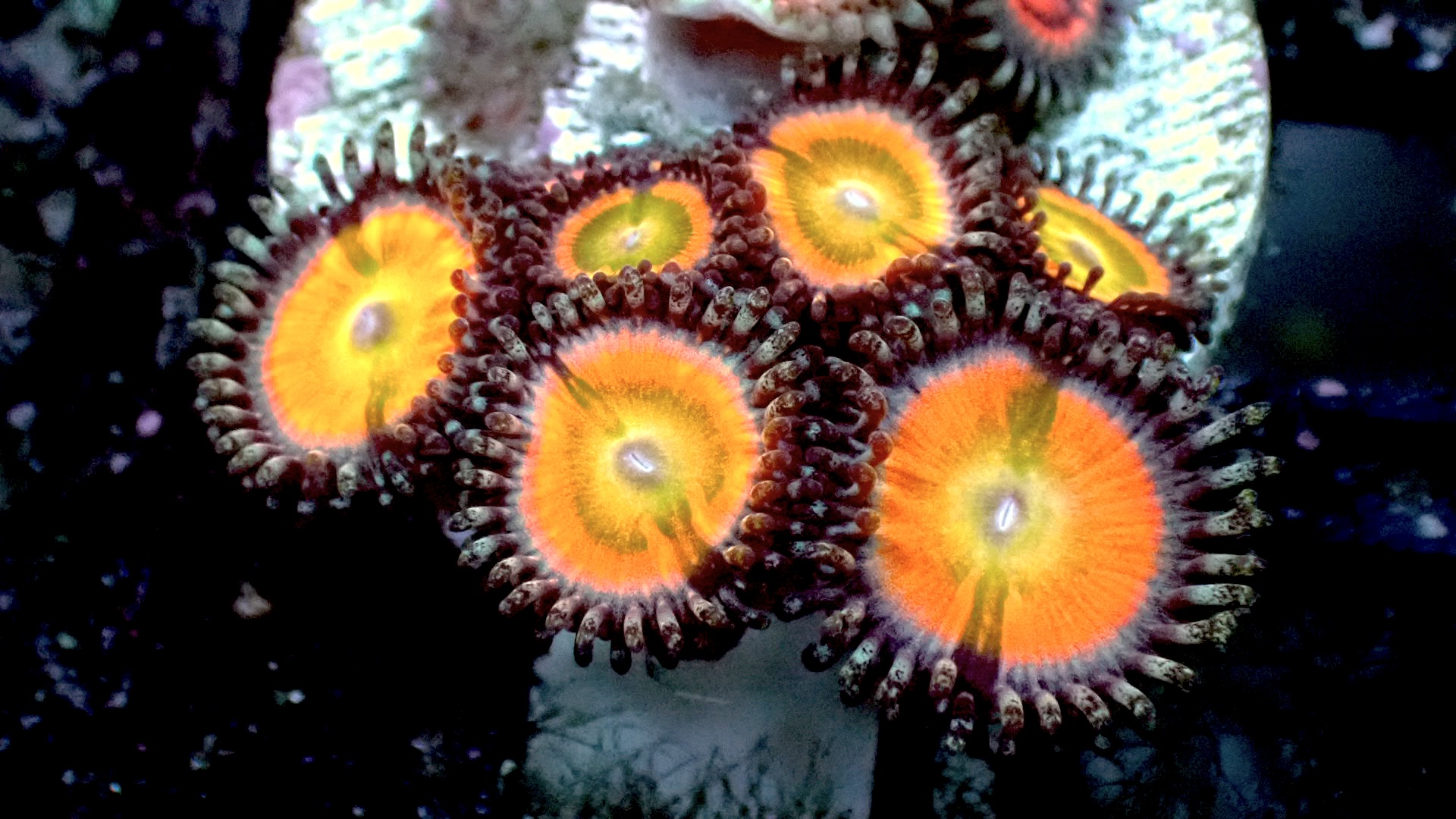
Whammin Watermelon is a classic watermelon-slice zoanthid: a pink-to-red disc and ring around the centre, set inside a bright green skirt, so a closed-up colony reads like a row of tiny watermelon slices. It belongs to the oldest layer of named zoanthids — the same early group as Eagle Eye and Radioactive Dragon Eyes — and it has stayed in the trade ever since because the pattern is bold at a distance, the colours hold under ordinary reef light, and the coral grows willingly.
The identification problem with this morph is famous, and buyers should know it before paying for a label. Whammin Watermelon and Eagle Eye share the same basic design, and the difference is a shade, not a pattern: in the comparison written for Reef Keeping World, Whammin Watermelon carries pinkish-red rings while Eagle Eye carries pinkish-orange rings. That source is blunt about the practical result — the two are so similar that even experienced aquarists cannot always tell them apart, and vendors have sold one under the other's name in both directions. A frag sold as Whammin Watermelon should show the redder, pink-red ring; a frag whose ring reads clearly orange belongs on the Eagle Eye side of the line. Lighting shifts both colours, so judge the ring under a daytime spectrum, not under heavy blue alone.
Taxonomy helps explain why the look-alikes cluster together. The zoanthid identification guide at reefs.com, written by Drew Wham, files "Wham'n Watermelon" alongside Eagle Eyes and Radioactive Dragon Eyes as colour varieties of one species pair — Zoanthus sansibaricus in the Indo-Pacific and its Caribbean sibling Zoanthus sociatus — described there as possibly the most common type of Zoanthus in the aquarium trade, with interconnected polyps and oral discs about 6–10 mm across. Hobby frags arrive with no collection location and no genetic check, so this entry stays at Zoanthus sp. and records the sansibaricus filing here. For care purposes the distinction changes nothing.
Care is the forgiving end of the zoanthid range. Top Shelf Aquatics, which farms this morph, gives a working range of 75–150 PAR with a slow two-to-three-week acclimation when light is increased, and moderate, indirect flow that keeps debris from settling on the polyps while leaving them fully open. Start a new frag low, watch that it opens flat and holds its red ring, and move it up only in small steps. Two hobby care roundups read for this dossier name Whammin Watermelon specifically among the popular zoas whose colours show best under actinic light, and note it can sit higher in the water column once properly acclimated — so the morph rewards a keeper who acclimates first and admires it under the evening blues second.
The coral is photosynthetic and needs no feeding. The farming guidance read for this morph offers fine-particle plankton blends and similar foods a few times a week, with flow paused for ten to fifteen minutes, as an optional support for colour and growth. A colony that is spreading, opening daily, and holding its ring colour on light alone does not need the extra food, and overfeeding a small system costs more in water quality than the zoanthids gain.
Reef To Go's standard reef parameters suit it: 77–79°F, salinity near 35 ppt (about 1.024–1.026), alkalinity 8–10 dKH, calcium 400–450 ppm, with low but detectable nitrate and phosphate. The vendor range read for this morph runs nitrate 5–15 ppm and phosphate under 0.10 ppm. Zoanthids carry no calcium skeleton, so this coral makes no dosing demand of its own; stability matters more than chasing any single number.
Growth is part of the appeal and part of the management. Left to spread, a settled colony forms a dense mat and can cover a rock face completely, which is exactly the watermelon-patch look most keepers buy it for. Give it a defined rock or island rather than a foothold on the main rockwork, because a fast mat will overrun slower neighbours by contact and shade. Trimming a mat edge is ordinary maintenance for this morph, not an emergency.
Safety applies to this coral as it does to zoanthids generally. Some zoanthids and their Palythoa relatives can carry palytoxin, and there is no visual way to tell which colonies do. Handle and frag with gloves and eye protection, keep the coral away from open cuts, handle it submerged where practical, wash thoroughly afterwards, and never boil, steam, or pressure-wash rock that carries it, because heat can aerosolize the toxin. Handled with that respect, a settled colony is a durable, long-lived aquarium coral.
Field notes — what keepers report
- The Eagle Eye confusion is the best-documented keeper experience for this morph, and both halves of it belong in the record. Reef Keeping World reports that vendors have sold each morph under the other's name and that even experienced aquarists cannot always separate them, with the ring shade — pinkish-red here, pinkish-orange on Eagle Eye — as the only working distinction. The practical keeper takeaway in that account is to buy the colour in front of you rather than the label, and to check the ring under white light before deciding which name a colony has earned.
- Difficulty reports line up on the easy side, which is unusual enough in this queue to state plainly. Reef Keeping World calls Whammin Watermelon and Eagle Eye easy to care for and maintain, hardy in just about any reef tank, with fairly quick growth into massive colonies if left to spread. Top Shelf Aquatics' farming notes point the same way — hardy, adaptable, beginner-friendly — while still insisting on a slow light acclimation, because a hardy coral can still bleach if it is moved into strong light in one step. No source read for this dossier rated this morph touchy or a known melter, so this entry claims no melt reputation for it; the family-level zoanthid melt and pest reports that fill general forum threads are not Whammin Watermelon-specific and are not presented as if they were.
- Colour under actinic light is a repeated keeper note. Two independent hobby care roundups single out whammin' watermelon by name among the zoas whose colours pop best under actinic/blue light, alongside Fruit Loops, Bam Bams, and Fire and Ice. Combined with the ring-shade ID problem, that cuts both ways: the colony looks its best in the evening blues, and it is hardest to identify honestly in exactly that light.
- The price history tells the classic-strain story. A 2012 Reef Central frag-swap list offered Whammin Watermelons at $4 per polyp — hobbyist frag pricing from the era when the morph was already a swap-meet staple. A UK keeper discussion from the same era remembers dragon eyes and whammin watermelons as once deemed rare enough to command a reasonably high price, and by then already a standard, attractive zoa findable anywhere at reasonable prices. Current farmed retail sits higher because it is per-frag, not per-polyp: Top Shelf Aquatics lists this morph at $49.99 for a regular frag (about ¾–1 inch) and $89.99 for a large, both unavailable at the time read. An AquaSD sale listing for a generic "Watermelon Zoanthids" at $20 is recorded here only as a name-neighbour data point — that listing does not claim the Whammin morph, and the two should not be priced as the same coral.
- Pest notes in the sources read are family-level: zoa-eating nudibranchs and spiders found on inspection and dipping, debris settling on the mat in weak flow, and overgrowth onto neighbours. No Whammin Watermelon-specific pest or disease pattern was found in the sources read, so this entry claims none. Dip and inspect new frags, keep the mat basted clean, and isolate the colony's rock before the spread becomes the problem.
Care
Field Notes
Related species
Blue discosoma mushroom
Discosoma sp

Digitata Montipora
Montipora digitata
Green Bay Packers zoanthids
Zoanthus sp
Green star polyps
Pachyclavularia violacea
Leather Toadstool
Sarcophyton glaucum

Lunar eclipse zoanthids

Neon green hairy mushroom
Discosoma sp
Rainbow infusion zoanthids
Zoanthus sp
Get notified when Reef To Go has Whammin Watermelon in stock or up for auction. One email when it's in — no spam.