Bellus Angelfish
Genicanthus bellus
Reef Safe

Gallery
The Bellus angelfish is the swallowtail for people who thought they could never keep an angel in a reef tank. It belongs to Genicanthus, the one angelfish genus that left the reef face behind: instead of grazing sponges and picking over rock the way other angels do, it makes its living hovering over deep, current-swept drop-offs, snapping plankton out of the water column — and a fish built to eat what drifts past it has no reason to bite what is growing on the reef. That single fact is why this entry can carry a Reef Safe Yes next to the word angelfish. The other facts are less simple. This is a deep-water fish, collected from depths most divers never reach, with the decompression risks that come with the trip up; it is uncommon and seasonal in the trade; it changes sex; and the two sexes look so different that they were bound to confuse early keepers. Everything below is written for the keeper who wants the fish anyway — which, once a healthy Bellus settles, is most people who have kept one.
Reading the fish
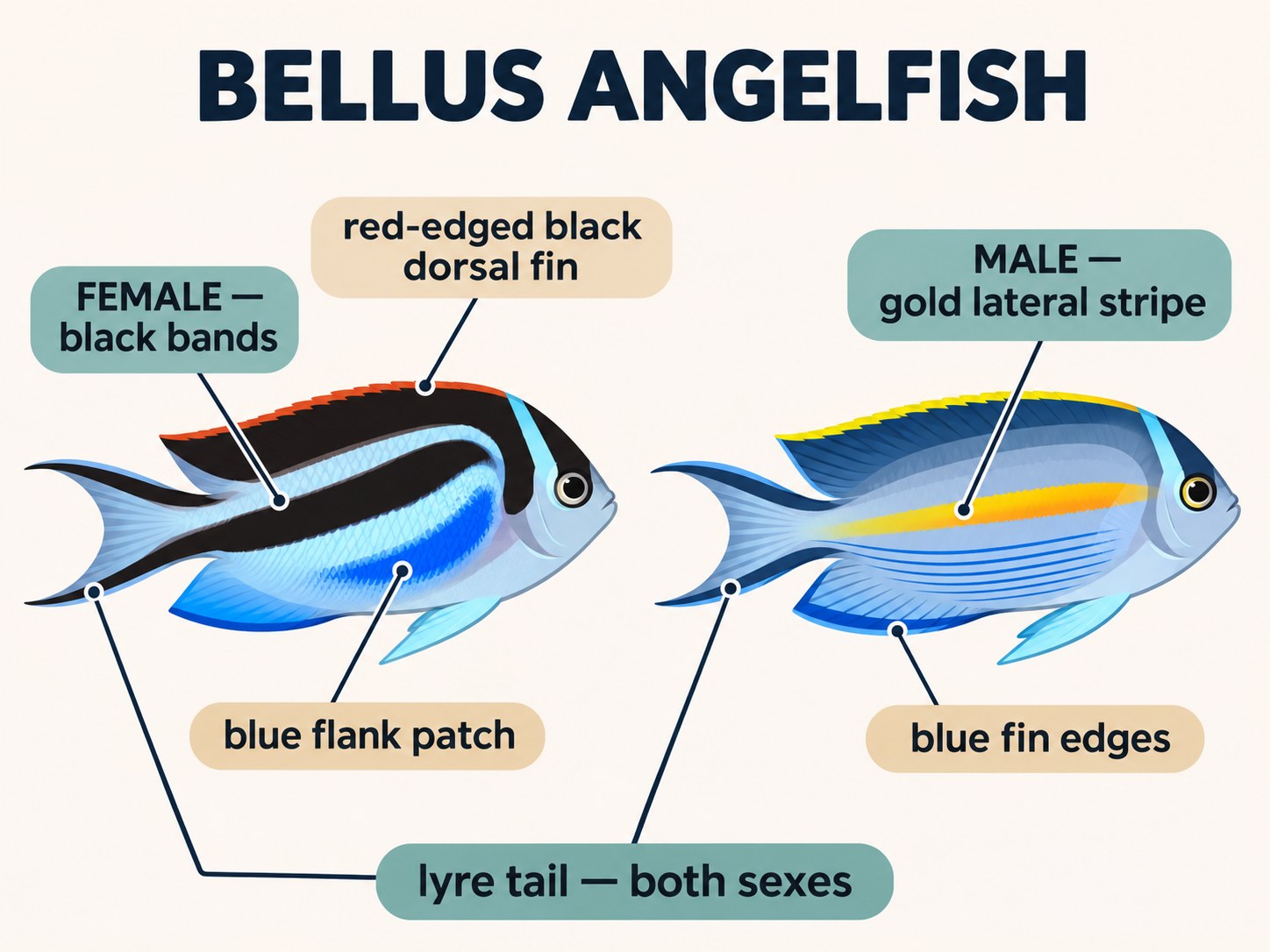
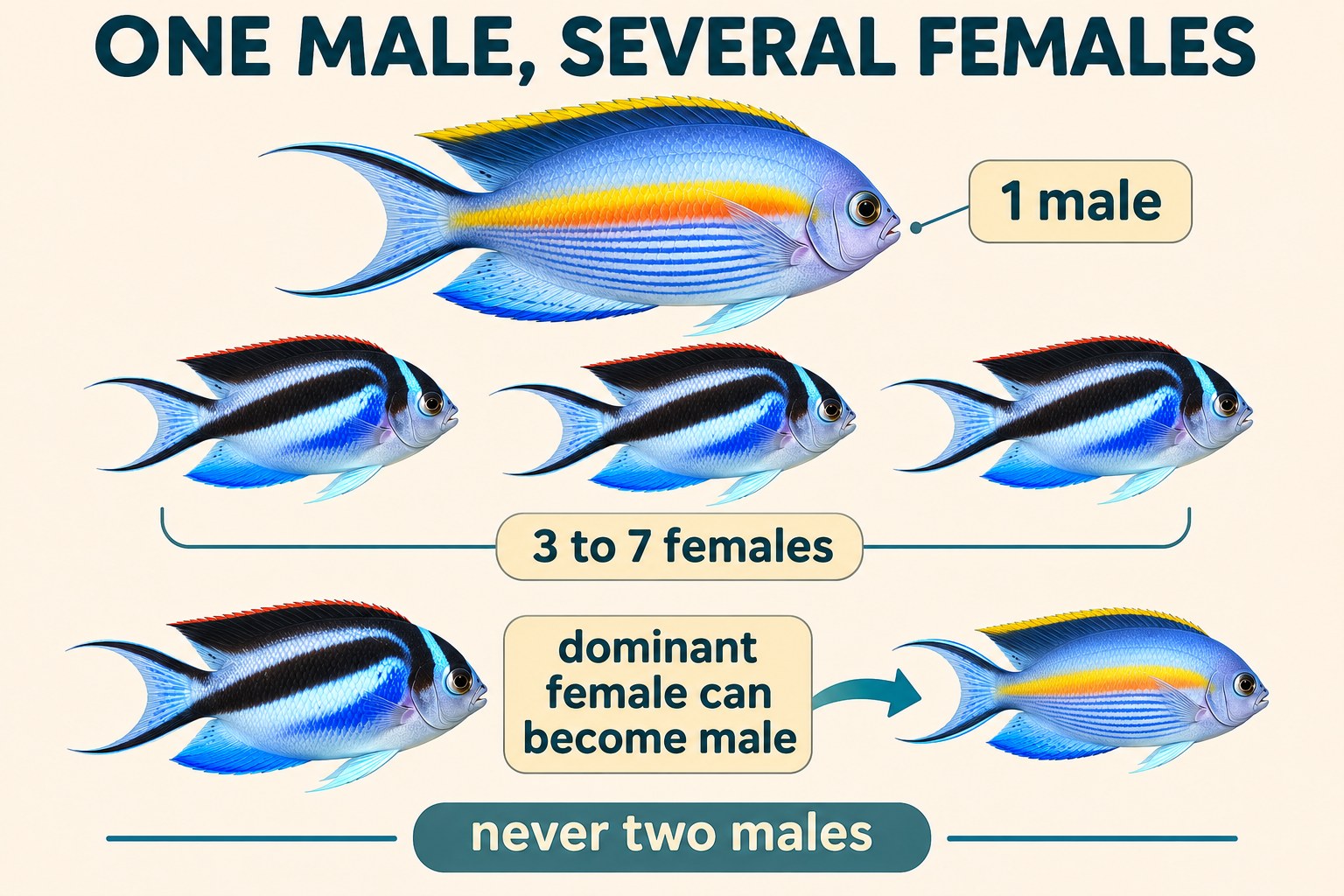
No other common angelfish is as easy to sex at a glance, or as easy to misread if you only know one sex. The female is the patterned one: a pale, iridescent white-blue body crossed by sweeping black bands, with a broad black diagonal band running from above the gill cover down to the lower lobe of the tail, a black bar through the eye, an elongate blue patch low on the flank, and a black dorsal fin edged with a red-to-orange band. Her tail is a true lyre — the upper lobe is edged in black, giving the forked tail a scissor outline when she turns. The male looks like a different species wearing the same silhouette: pale grey-blue overall, quieter, with a yellow-to-orange horizontal stripe along the lateral line, fine horizontal blue striping across the lower body and anal fin, yellow edging on the dorsal, and blue margins on the fins. Both sexes carry the long, tapered swallowtail the genus is named for, and males grow the longer tail streamers. Adults reach 18 cm (about 7 in) at the recorded maximum; most aquarium fish live out their lives nearer 5–6 in. Juveniles and young fish sold in the trade are almost always female-patterned, because every Bellus starts life female — which is why "female" fish dominate shop tanks and true males command the attention they do. Hybrids with the Lamarck's angelfish, a close relative whose range overlaps this one's across Indonesia, have been documented from wild collections: an odd, intermediate fish is not necessarily a mislabelled one, though it is far more likely to be a young or transitioning fish.
Where it comes from
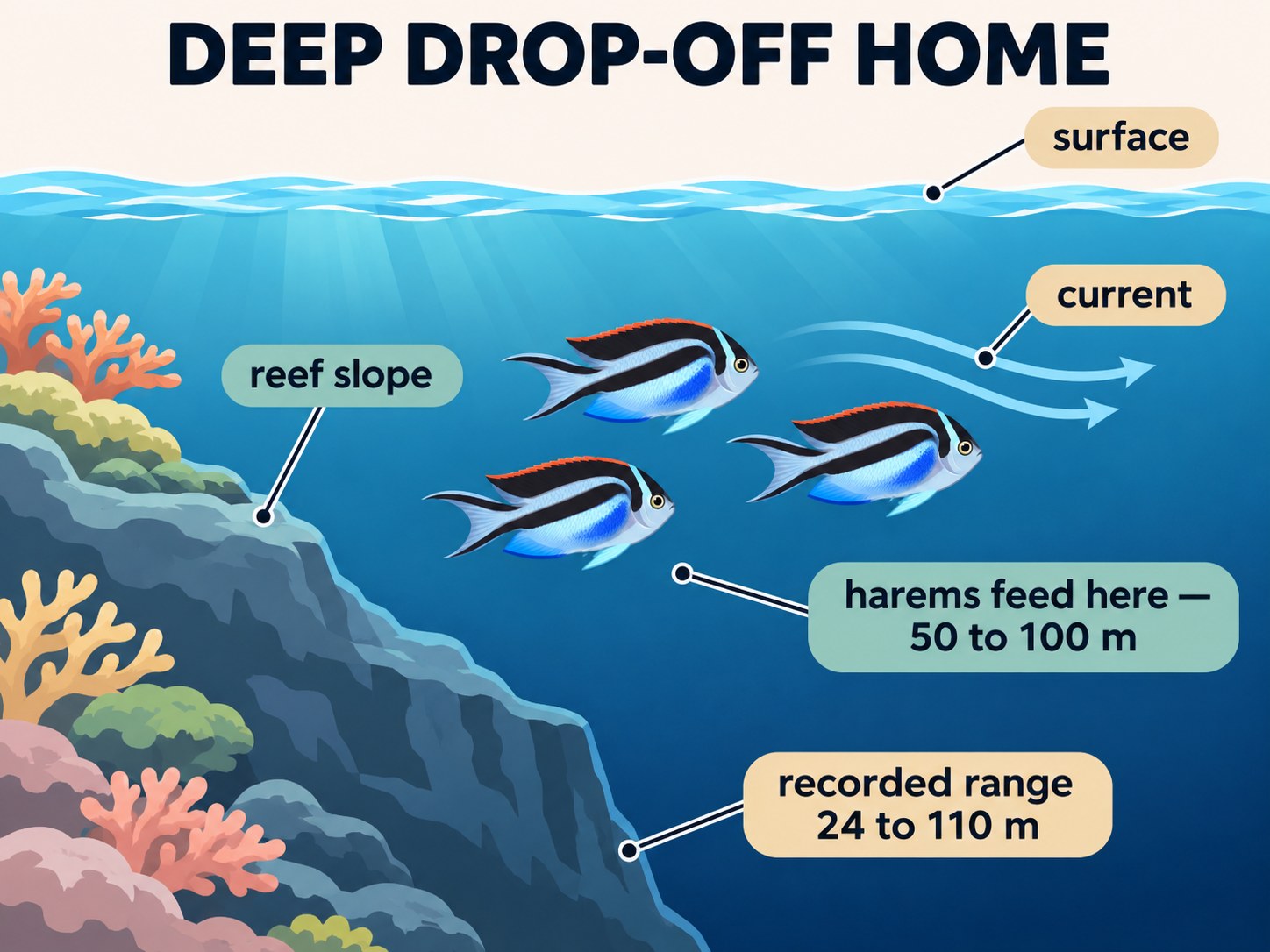
The Bellus has the widest distribution of any fish in its genus, and one of the deepest addresses. It is recorded across the eastern Indian Ocean from the Cocos-Keeling Islands and through the western and central Pacific — Indonesia, the Philippines, southern Japan and Okinawa, Palau, Guam, the Marshall and Cook Islands, Tonga, and east to Tahiti, where Randall's type specimen was taken outside the barrier reef at 60 m. FishBase puts the depth range at 24–110 m, usually 50–100 m, on steep outer drop-offs swept by current, and notes the fish may simply be under-recorded because so little diving happens at those depths. Specialist accounts run deeper still — one widely read genus survey describes the species at 150 feet and beyond, with Cenderawasih Bay fish usually at 160–320 feet — while FishBase also carries a Cenderawasih report of the fish common at just 20–25 m, so the honest summary is a deep-slope fish whose depth shifts with locality, not a single number. Over those slopes it lives in harems of three to seven fish, holding in midwater above the drop-off, facing the current and feeding as a group. It does not hide in the reef when threatened; it out-swims trouble in open water. A reef-associated, non-migratory tropical species, it is assessed as Least Concern — the rarity in shops is a matter of how hard it is to collect, not how rare it is on the reef.
A planktivore, not a grazer
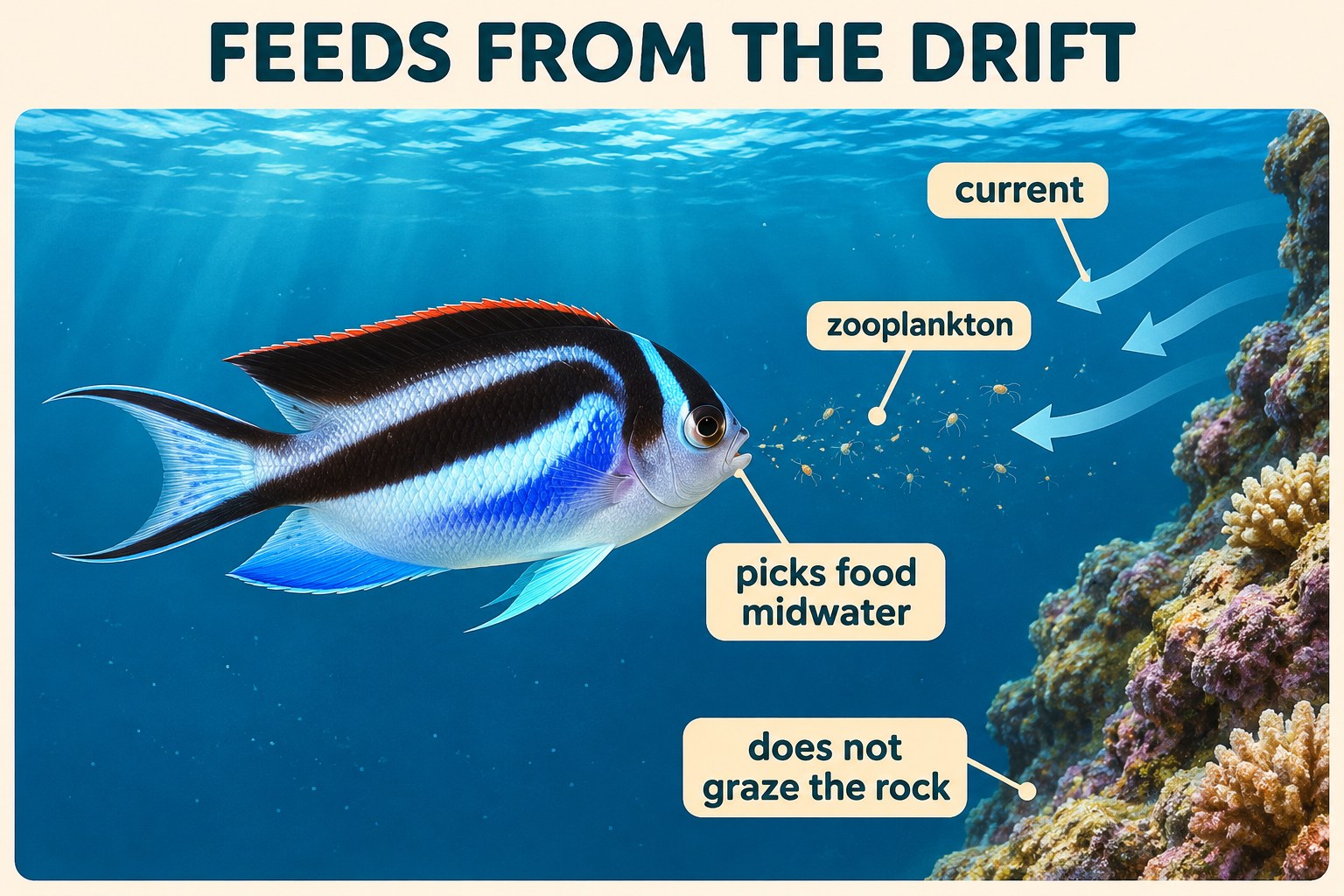
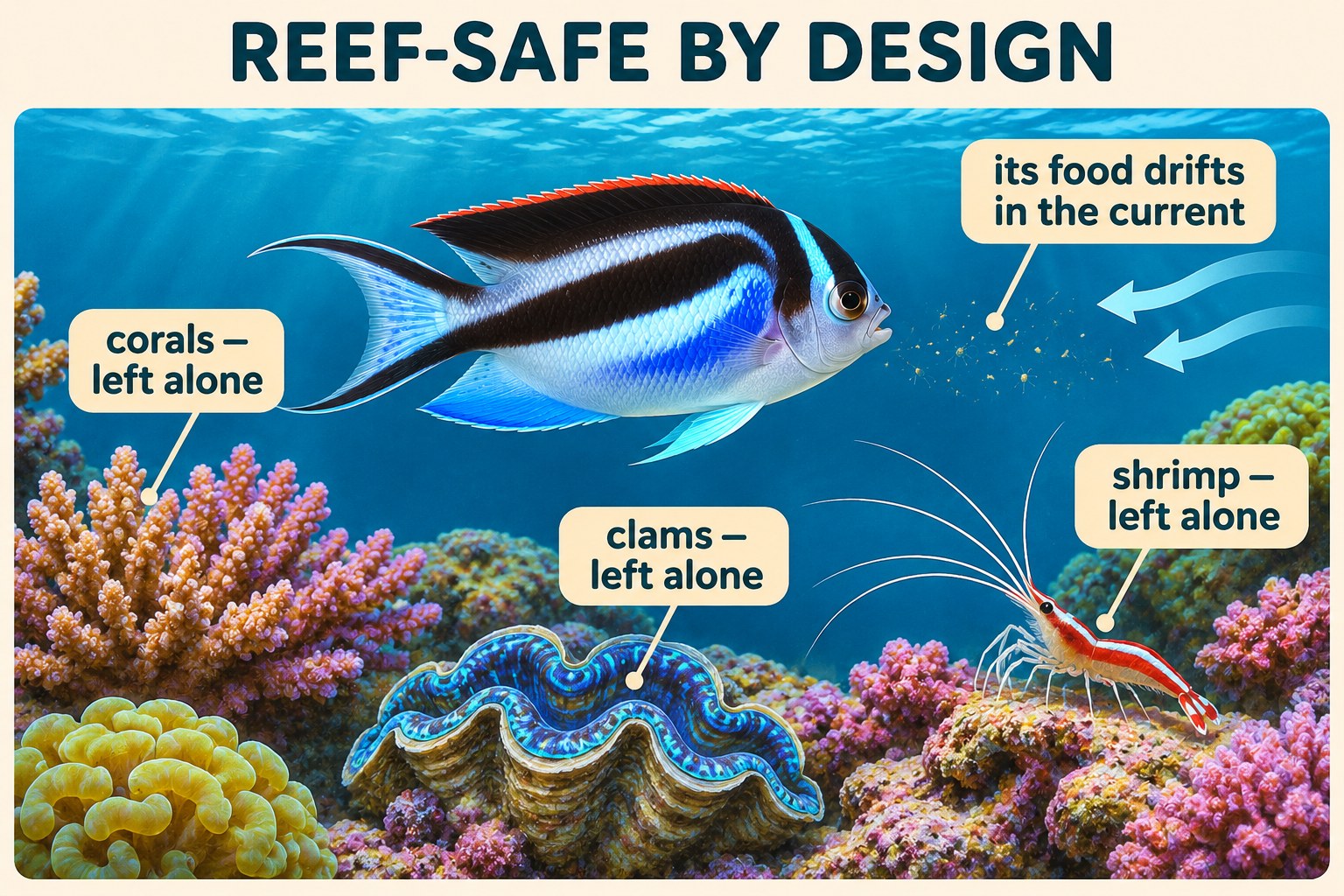
Everything about this fish's behaviour in a tank follows from where its mouth points. A grazing angel cruises the rockwork, mouth to the surface, sampling constantly — and in a reef tank that sampling lands on coral. A Bellus faces into open water and picks individual items out of the drift: zooplankton in the wild, and in the aquarium whatever the current carries past. It is a hovering, midwater feeder (the Mid swimming zone on the care card is its whole life, not a preference), and the care card's Carnivore filing is the closest stored label for that plankton diet. The qualification worth knowing is that the fish is not a strict specialist: several care accounts file it as an omnivore, algae-based foods and spirulina are widely accepted, and at least one long-term pair keeper reports both fish grazing algae clips "just like the tangs." Read those together and the working picture is a plankton feeder that will also pick at vegetable fare — not a rock-grazer, and not a fish whose appetite should ever be pointed at your corals out of hunger if it is fed properly.
Reef safety
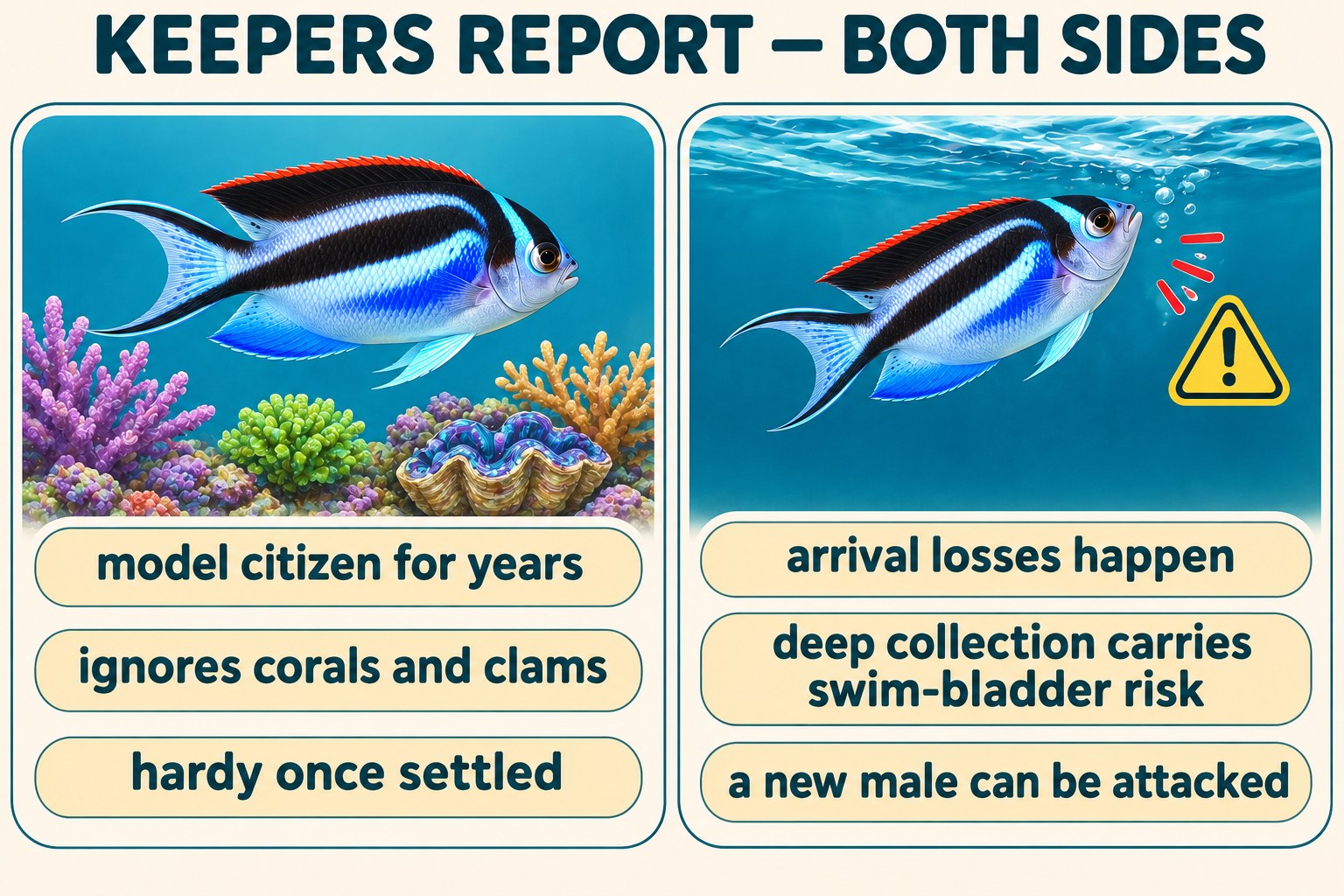
This is as reef-safe as the word angelfish ever gets, and the entry says Yes without the "with caution" the database attaches to most angels. The mechanism is the feeding: a planktivore hovering in the column has no foraging routine that involves coral polyps, clam mantles, or sessile invertebrates, and the keeper record matches the mechanism — Bellus kept for years, singly and in trios, alongside SPS, LPS, and clams with no nipping reported is the normal run of accounts, and "model citizen" is the phrase that recurs. Two qualifications keep the record honest. One retail profile files the species as reef-safe with caution, suggesting an occasional nip at soft corals is possible; no keeper report gathered for this entry actually documents a Bellus doing it, but the claim exists in print and belongs in the entry. And a keeper of the swallowtail angelfish — a close congener, not this species — did document that fish targeting Trachyphyllia, Wellsophyllia, and acans, which is why no Genicanthus should be called 100 percent guaranteed. The Bellus-specific evidence is about as clean as fish evidence gets; keep the fish fed, and the genus-level asterisk is the only one it carries.
Room to swim
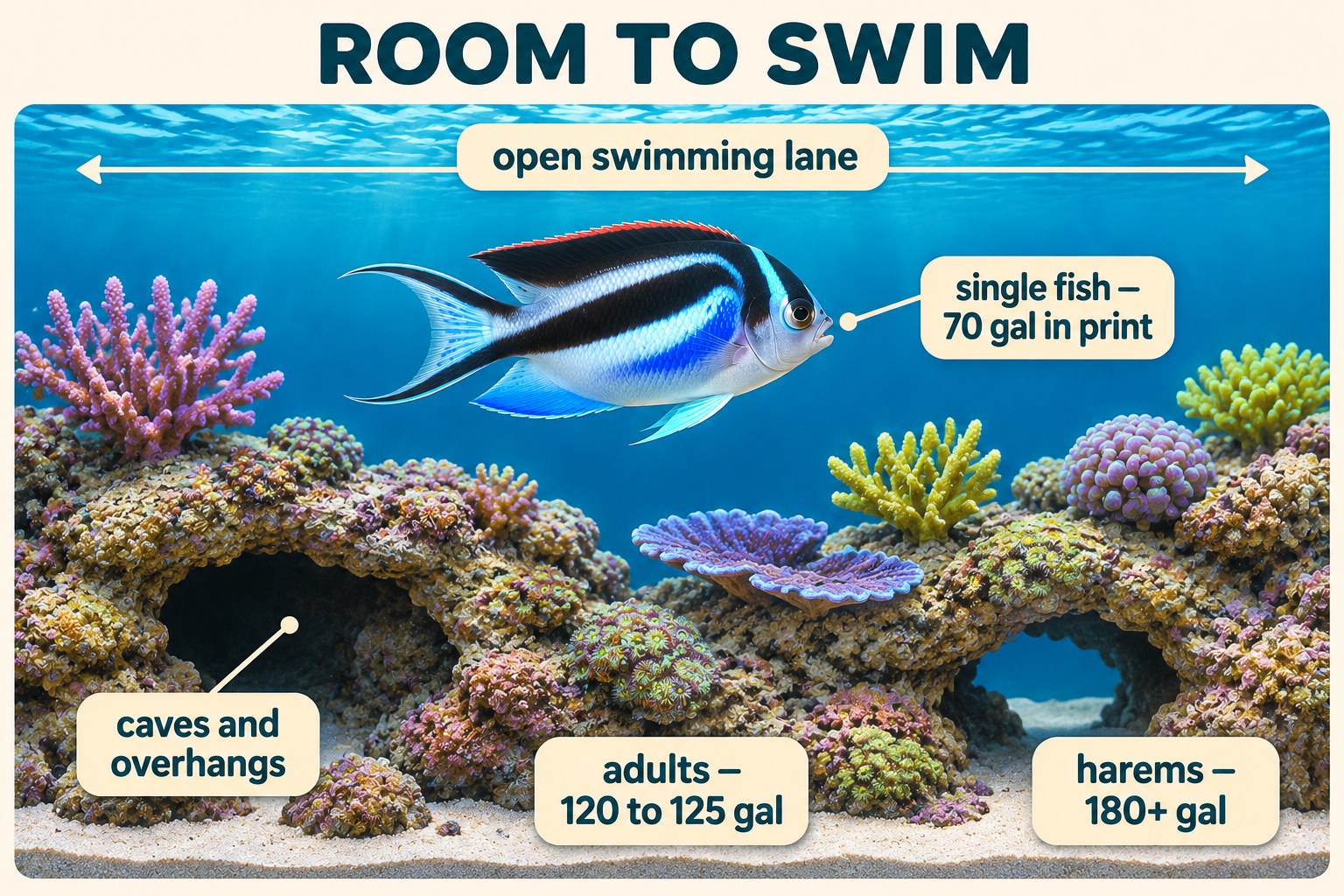
The care card's Large is the field to plan around, and the published minimums spread widely enough that the spread itself is the information: 70 gallons for a single fish is the lowest figure in print (from an older care profile), the serious modern consensus for an adult is 120–125 gallons, and harem keepers are pointed at 180 gallons and up. What the numbers are really measuring is length and open water. This fish cruises the column all day; a long tank with an unobstructed swimming lane is worth more than a shorter, taller box of the same volume. Build the rockwork the way its home slope is built — caves, cracks, and shaded overhangs along the bottom and back where it can drop out of sight, with the upper water open. It is a peaceful fish (the care card's Peaceful is accurate for community life) that does best with other non-aggressive midwater and reef fish, and an established, pushy tang or large angel added before it is the combination keepers warn about — a shy new Bellus behind an entrenched Acanthurus is a feeding problem waiting to happen. A tight lid is cheap insurance for any startled open-water fish. Lighting deserves one note: it comes from water where sunlight arrives filtered and dim, and acclimation goes better when the tank starts dim and brightens over days rather than greeting the fish with full reef intensity on day one.
One, two, or a harem
Every Bellus is born female. In the wild the social unit is a harem — one male with three to seven females — and the aquarium versions that work are the same shapes at smaller scale: a single fish, a male–female pair, or one male with several females in a large system. Two males should never share a tank; fighting is the expected outcome, and the care card's Peaceful does not apply to that one pairing. Sex change is protogynous and social: with no male present, the dominant female transitions — colour and behaviour shifting over several weeks — and a group of females may therefore produce its own male in time. Care guides also claim the reverse, that a lone male may change back toward female when no females are present; keepers' records muddy that tidy picture (see Field notes), so treat any transition timeline as the fish's decision, not a schedule. Introductions are the risky moment. Group members do best added together; adding a male to an established female is a recognised failure mode, with the resident female sometimes attacking the newcomer relentlessly — an acclimation box for a week or two, or a rescape that erases her territory markers, are the standard rescues, and neither is guaranteed. Spawning behaviour — pairs rising into the column at dusk to release eggs and sperm — is reported from very large aquariums, but no successful rearing of the larvae has been reported, and no captive-bred supply of this species is established: the Biota team has bred a cousin (Genicanthus semifasciatus) and names this genus a target, which is promise, not availability. The fish in shops are wild, deep-collected fish, and the next section is about what that means.
Feeding in the aquarium
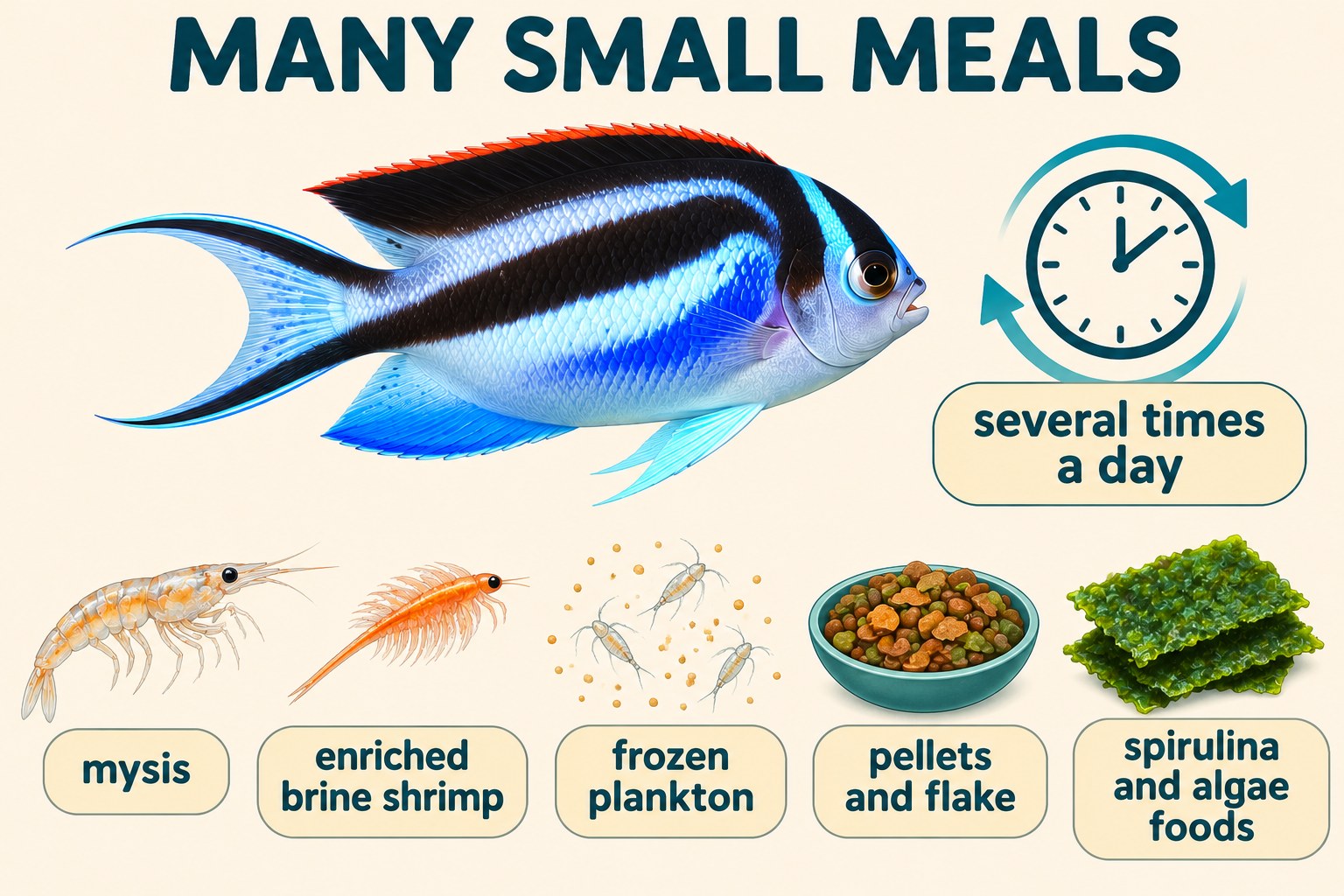
Feed it the way the current feeds it: small items, often. The wild diet arrives in many tiny portions across the whole day, and the aquarium match is several small meals rather than one or two large ones — enriched frozen mysis and brine shrimp, frozen plankton and marine preparations, finely chopped seafood, quality pellets and flake sized for a midwater mouth, with spirulina and algae-based fare in the rotation for the omnivore side of its appetite. New fish can be slow to start, and the genus survey's warning is specific: juveniles and young females adapt well, while wild adult males are the ones that may refuse food — one more reason the younger female is the recommended first Bellus. A fish that is eating aggressively at every feeding has crossed the main hurdle of keeping this species; a fish that watches food drift past untouched after the first days is telling you something is wrong with the fish, not the menu. Because it feeds in the column and competes poorly against fast, boisterous feeders at first, target-feed a new arrival if tankmates are stripping the water before it decides — most settled Bellus lose that shyness and feed with confidence.
The first two months
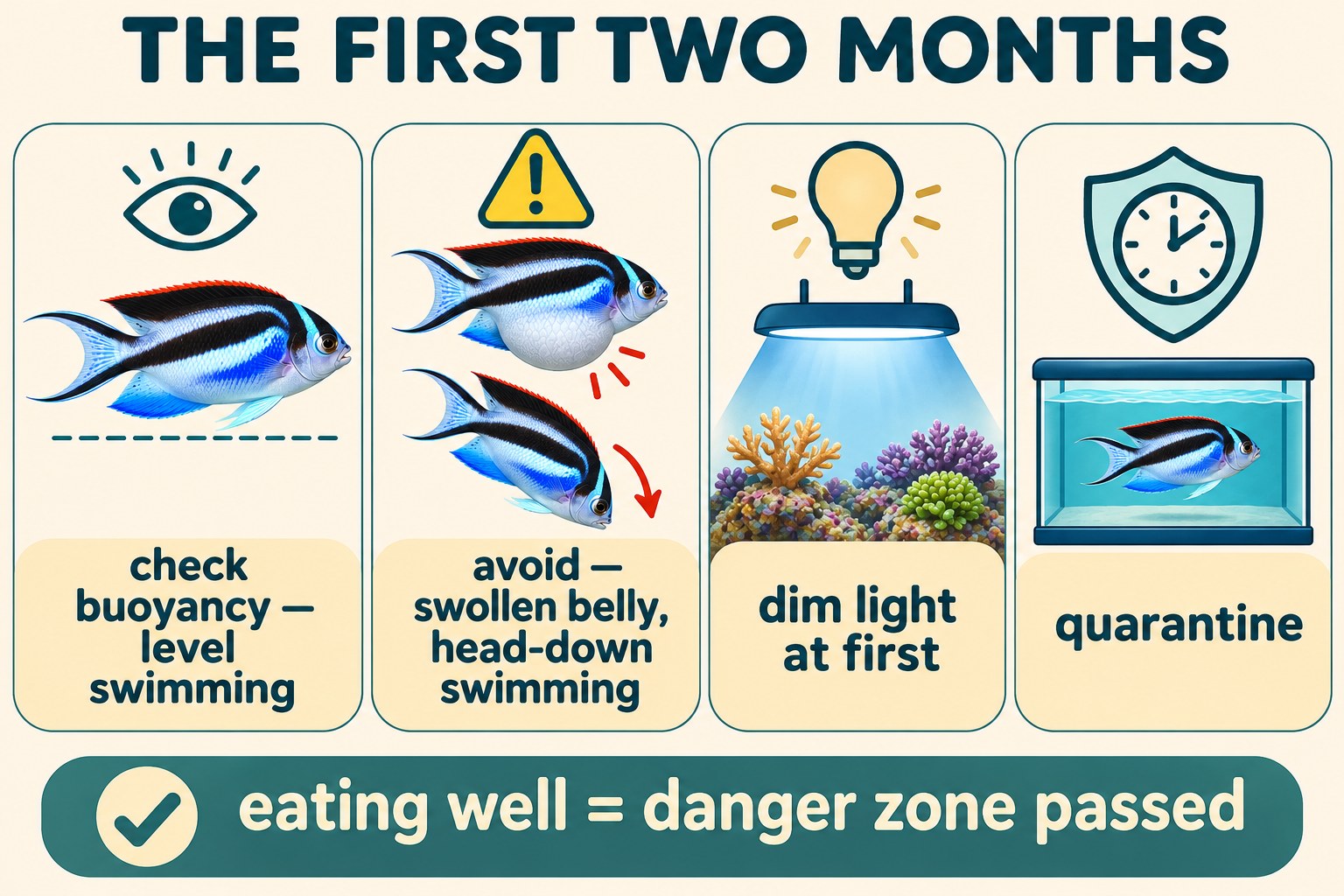
The Advanced rating on the care card is not about the settled fish — settled, this is a hardy, long-lived animal — it is about the journey from 60 metres down to your tank. Collection at depth requires careful decompression, and Genicanthus as a genus are prone to swim-bladder trouble when that process goes wrong: the warning signs in the genus literature are a swollen abdomen, a fish hanging just under the surface looking down, or swimming head-down, and any fish showing them should be passed over, full stop. Collectors sometimes vent the swim bladder with a needle on the way up; done badly, that trades buoyancy trouble for infection. Even a well-collected fish can swim oddly for a while after shipping — pressure changes in flight can upset buoyancy for days to weeks in keeper reports — which is why experienced voices recommend buying pre-quarantined fish from dealers who hold them through exactly this window, and why one harem keeper's rule of thumb is worth adopting as this entry's own: if a Bellus gets through the first one to two months eating well, the danger zone is behind it. Quarantine a new fish, keep its first days dim, offer food little and often, and judge the fish by its trajectory — eating more, swimming level, spending more time out — rather than by its first 48 hours.
Field notes — what keepers report
Keepers who have lived with this fish describe two different animals, and both descriptions are true — they are describing two different phases of ownership. On arrival risk, the reports are sobering and consistent: one keeper's first Bellus arrived dead and the second died within a week before the third settled for years; the genus-wide swim-bladder warning comes from veterinary voices as much as hobbyists, and the repeated advice is to buy pre-quarantined fish and expect the first one to two months to be the window where losses happen. On the settled fish, the same community is nearly unanimous in the other direction: three-plus years of "model citizen" from a female keeper, a trio reported fine with SPS, LPS, and a clam, pairs described as healthy, fat, and bold once established. Hardiness, in other words, is not a property of the species so much as a property of the specimen's first weeks.
On reef safety, keeper reports line up behind the entry's Yes: repeated accounts of Bellus ignoring everything sessile, with the planktivore mechanism cited by keepers themselves. The one shadow in the record is not a Bellus at all — a swallowtail (a close cousin in the same genus) that targeted fleshy LPS — and the one retail profile that files Bellus as "with caution." Keepers also complicate the tidy planktivore label from the other side: one pair keeper reports both fish grazing algae clips alongside the tangs, which matches the omnivore filing in parts of the care literature.
On sex and pairing, the tidy version — dominant female changes when there is no male — survives, but keepers add texture in both directions. A four-year female began turning male with no fish added and no trigger her keeper could identify, which sits awkwardly next to the care-guide claim that transitions are socially switched on and off (and that males revert when females are absent). Pairing is equally two-sided: bonded pairs and harems that chase, display, and coexist for years are well documented, and so is the established female who attacked a newly added male so relentlessly he had to be boxed for his own safety. The working lesson keepers repeat is to add group members together, size the tank for the harem you actually want, and never assume a resident female has read the plan.