Swallowtail Angelfish
Genicanthus melanospilos
Reef Safe

Gallery
The swallowtail is the angelfish for people who have already decided they cannot keep an angelfish. It belongs to Genicanthus, the one genus in the whole family that left the reef surface behind: instead of grazing sponge and coral off the rock like its cousins, it hovers in open water over steep drop-offs and picks zooplankton out of the current, on a small mouth built for exactly that. A fish that never makes its living off sessile animals has no reason to start in your tank, which is why this genus carries the strongest reef-safe reputation any angelfish has — and why the honest version of that claim, with the small statistical caveat keepers attach to it, is set out in full below. It is also two fish for the price of one entry: the male and the female look so different that they were bound to be mistaken for separate species, and every individual starts life female, with the dominant ones becoming male. In the trade it travels as the swallowtail angelfish, the spotbreast angelfish and the blackspot angelfish — all three names describe the male. It is widespread, rated Least Concern by the IUCN, common in the trade, and since 2019 it has also been captive-bred by Biota in Palau, so a buyer who wants to skip the deep-water collection chain entirely (see Choosing and settling in) now has that option.
Reading the fish
Start with the tail, because the tail is the genus. Both sexes carry a deeply forked, lunate tail that narrows at its base and streams into long filaments on both lobes — the swallow tail that names the whole group of about ten Genicanthus species. No other angelfish genus is built like this: the body is longer and more streamlined than a typical angel's, made for holding station in current rather than squeezing through rockwork, and the mouth is small for an angelfish because plankton does not need tearing.
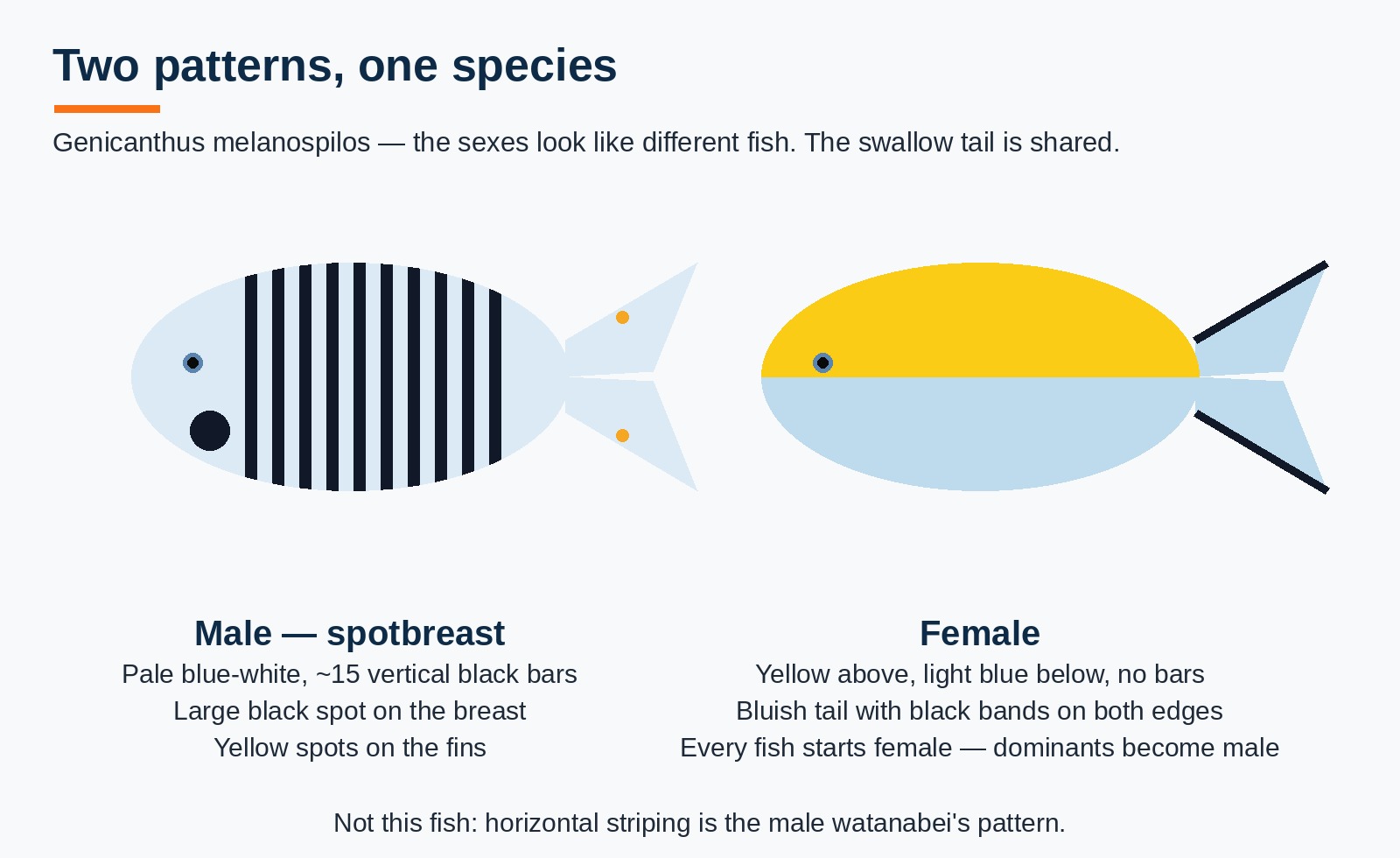
The male is pale bluish-white crossed by roughly fifteen narrow black bars running vertically down the flanks and up over the head, with yellow spotting on the dorsal, anal and tail fins and one large black spot low on the breast — the spotbreast that gives the species its scientific name, melanospilos, Greek for "black spot." The female wears no bars at all: her upper half is clear yellow, her lower half light blue-white, and her tail is bluish with a broad black band along both its upper and lower edges. One caution on the male's bars: some retail copy describes them as horizontal zebra striping. Horizontal striping is the male watanabei's pattern, from a different species; the references that describe this fish from specimens — FishBase, the Monaco encyclopedia, the Australian Museum — all give vertical bars, and a fish sold as a "horizontal-striped melanospilos" deserves a second look before money moves.
The look-alikes
Three relatives account for nearly every mix-up. The zebra angelfish (Genicanthus caudovittatus) is the hard one: its male is also a pale, dark-barred fish, and the references themselves note how similar the two males are. Range settles most cases — caudovittatus is a Red Sea and western Indian Ocean fish, this species is western Pacific to Fiji — and the breast spot is the melanospilos male's namesake mark. Lamarck's angelfish (G. lamarck) wears its black striping horizontally along the body in both sexes and has no breast spot; it is also the documented hybrid partner — a melanospilos × lamarck cross has been recorded in the trade, which is why an occasional swallowtail turns up with muted, in-between striping that fits neither parent cleanly. The bellus angelfish (G. bellus) female is the third confusion, but she gives herself away with orange-to-blue horizontal banding and a lyre tail edged in black, against this female's clean yellow-over-blue split. Hybrids aside, sexing within this species is the easy part of the genus: bars and a breast spot mean male, yellow back and black-edged tail mean female, and there is no third pattern to argue about.
Where it comes from
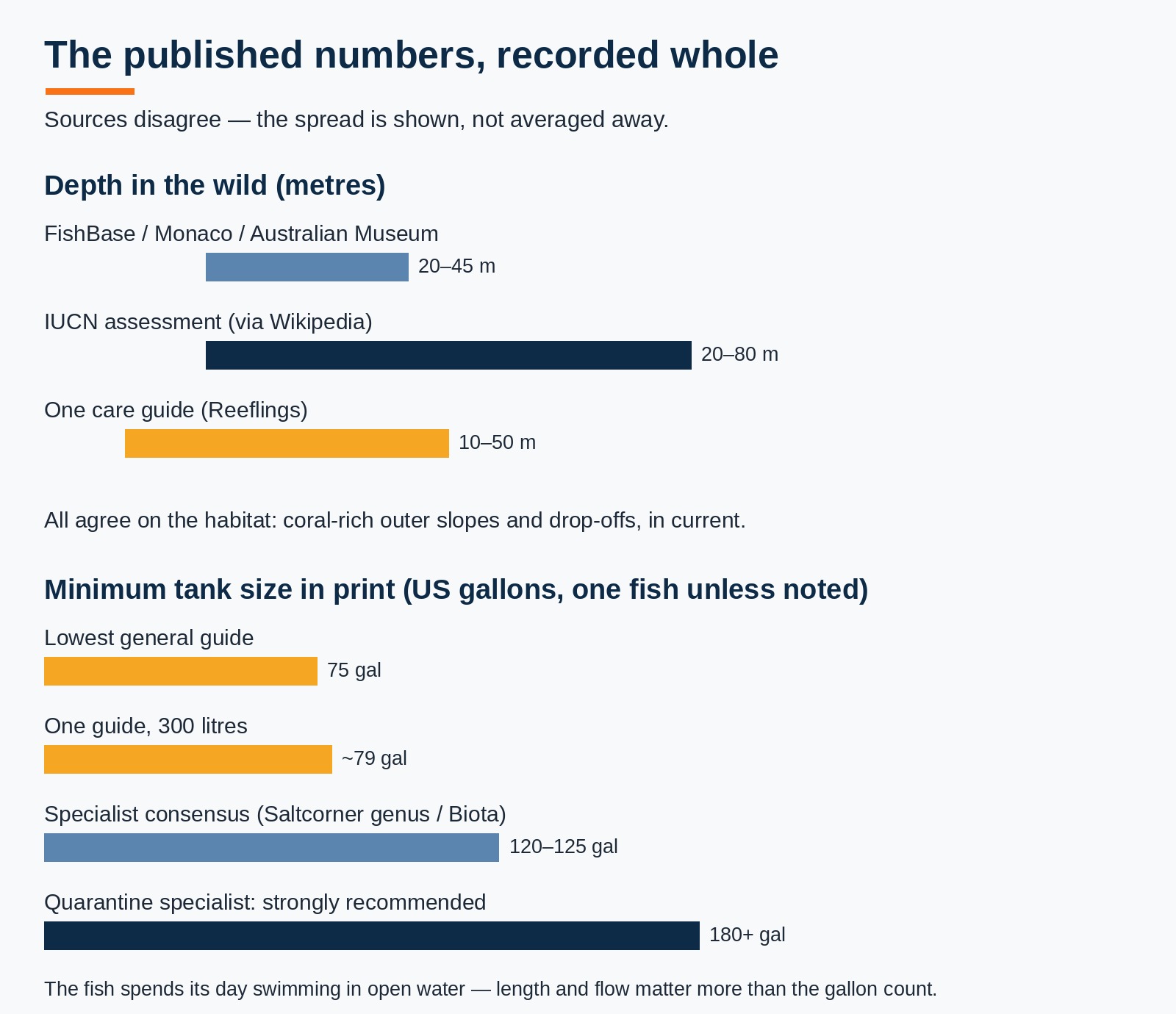
The range is the eastern Indian Ocean and the western Pacific in one sweep: from the Cocos (Keeling) and Christmas Islands and the Malay Archipelago through Indonesia, the Philippines, Papua New Guinea and Palau, north to southern Japan and the Ryukyu Islands, east through Micronesia and the Solomons to Vanuatu, Fiji and a recent record from Tonga, and south to New Caledonia and Australia — Ashmore Reef in the Timor Sea and the northern Great Barrier Reef off Cairns. It was described by Pieter Bleeker in 1857 from Ambon Island in Indonesia. The depth figures in print do not agree, and they are recorded whole rather than averaged: FishBase, the Monaco encyclopedia and the Australian Museum all give 20–45 metres (roughly 65–150 feet); the IUCN assessment behind the Wikipedia account gives 20–80 metres; one care guide gives 10–50 metres. Every source agrees on the shape of the habitat even where the numbers spread — coral-rich outer reef slopes and drop-offs, caves and the bases of boulders, rubble interspersed with sand, and water moving fast enough to deliver plankton. This is a fish of the wall face, not the lagoon.
Life on the drop-off
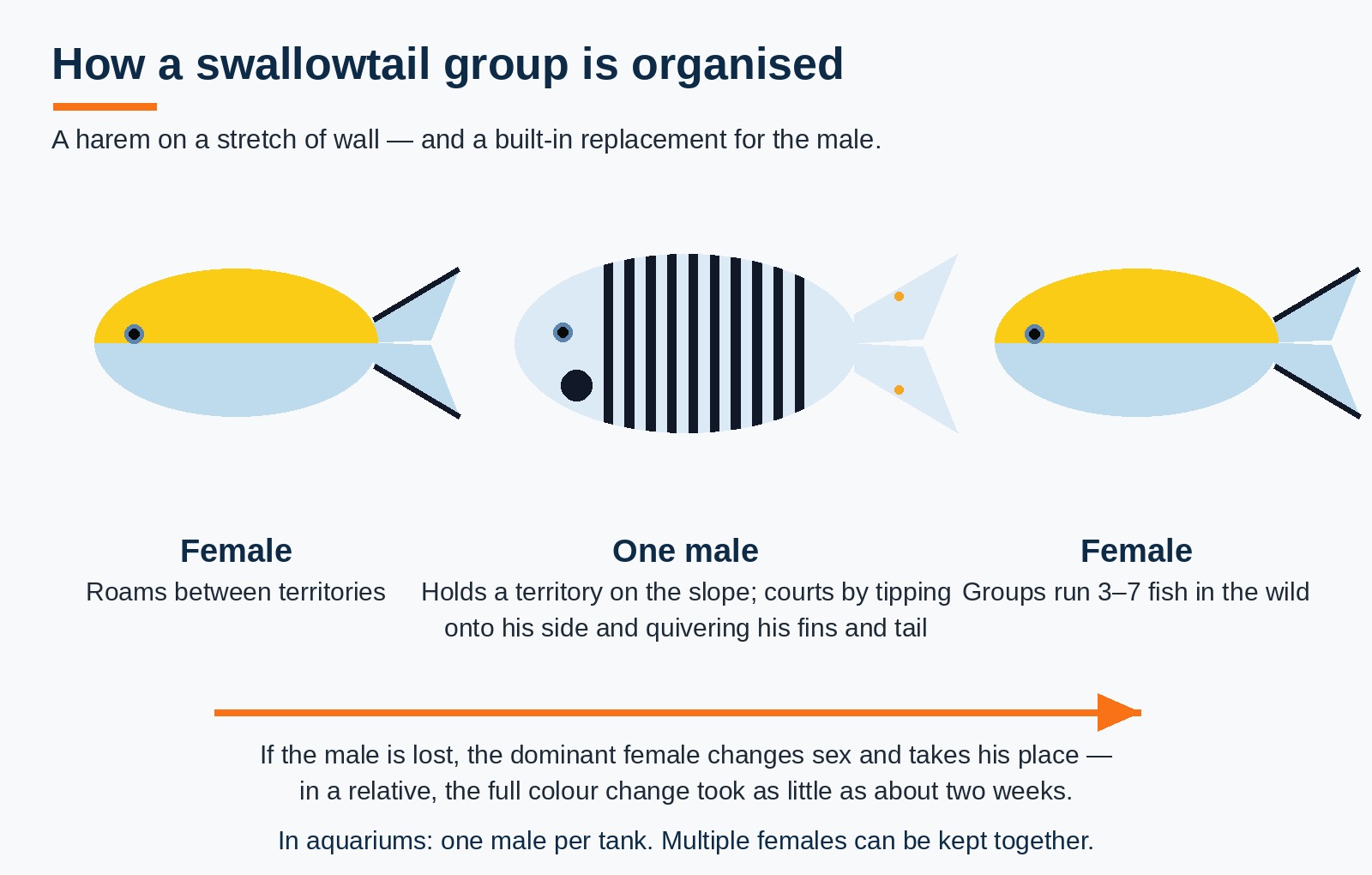
On the wall, this is a social fish with a structure a keeper can actually reproduce. Adults organise into small harems — a single male with several females; group sizes of three to seven are the usual report, and the Australian Museum puts the typical harem at three to four females to one male. The genus-level picture is a lek system: the big males hold territories on the slope, the females move freely among them, and a courting male tips onto his side and quivers his fins and tail. Feeding happens in the same open water, a few metres above the bottom, sometimes well up in the column when the plankton is thick — the fish in the group pick food from the current rather than descending to graze. Sedentary is the word the Monaco account uses for the species as a whole: a group works one stretch of wall, with its caves and boulder bases as the fallback when something large comes through. Nothing in that life maps onto a bare glass box with a pile of rock in the middle, and the tank section below follows from it directly.
Reef safety — why this angel is different
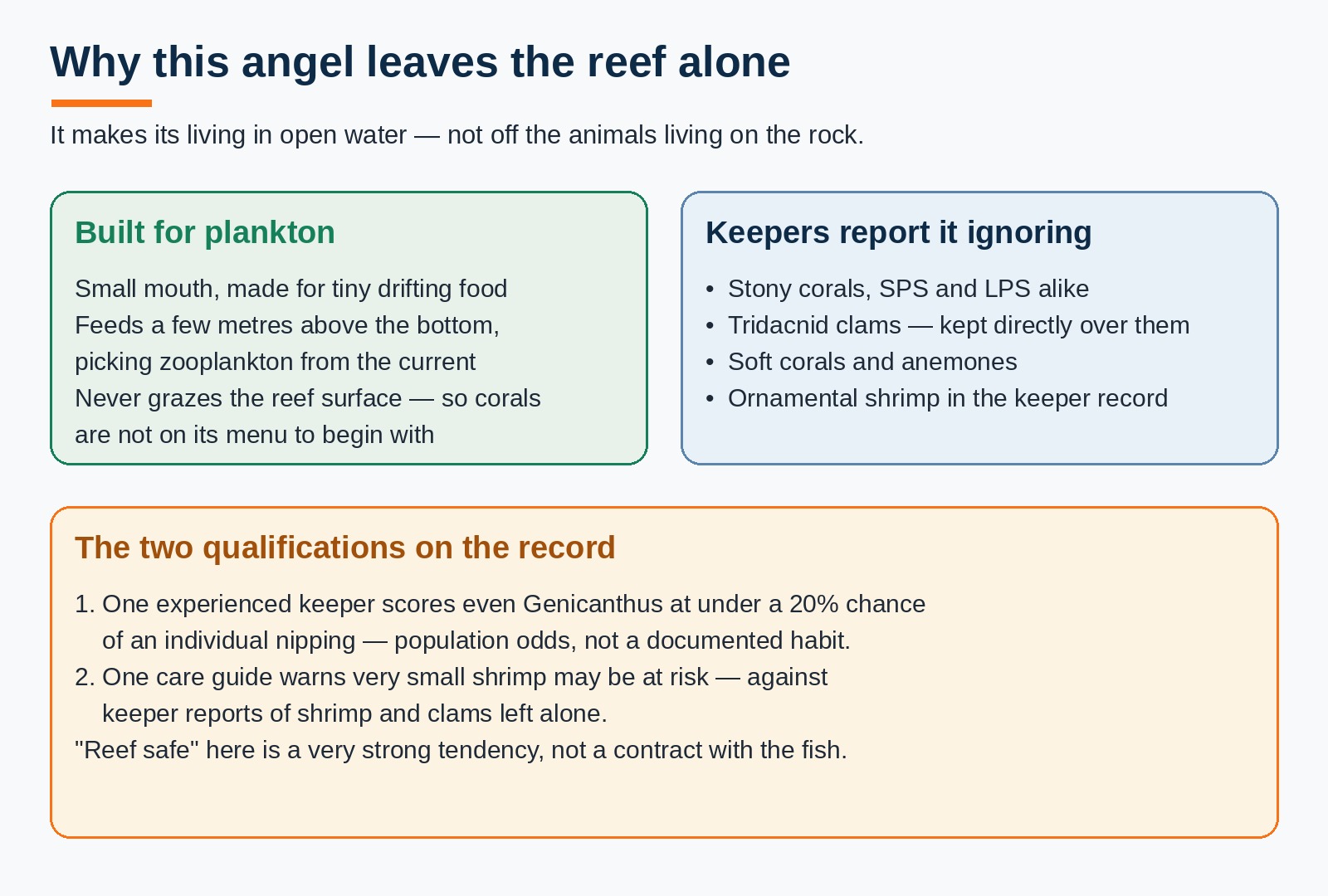
The mechanism is the whole argument. Coral-eating in angelfish is a feeding habit before it is a personality trait: the genera that nip are built to scrape and pick at sessile animals all day, and a coral is simply the nearest example. Genicanthus stepped off that path entirely — small mouth, mid-water feeding, a diet of animals drifting past. The stored rating on this entry is Reef Safe: Yes, the only unqualified Yes an angelfish genus realistically earns, and keeper experience backs it harder than most: keepers running these fish over SPS-dominated reefs and directly over tridacnid clams report, in thread after thread, that the fish never touch either, and the specialist write-ups call the genus the most reef-safe of all the angelfishes, very rarely if ever nipping a coral or a clam. Two honest qualifications belong on the record. One experienced keeper frames all angelfish statistically and puts even Genicanthus at under a twenty percent chance of an individual nipping — not a documented habit of this species, but a reminder that "reef safe" is a strong tendency, not a contract signed by the fish. And one care guide warns that very small ornamental shrimp may be at risk; that claim sits against keeper reports of the fish ignoring shrimp and clams alike, and no pattern of shrimp predation emerges from the keeper record. The fair summary: plan the reef as if the fish will ignore it, because nearly all of them do — and know that the residual risk is an individual exception, not the species' habit.
The tank it actually needs
The published minimums spread almost two-to-one, and the spread itself is the information. At the low end, general care guides print 75 gallons, and one guide's 300 litres works out near 79. An older reference splits it by sex — about 93 gallons for a female, 120 for a male, 132 for a pair. The specialist consensus lands at 120–125 gallons: the Saltcorner library files both of this fish's close relatives at 125 gallons, the Biota profile recommends 125 or more for this species itself, and one quarantined-fish specialist calls 125 the minimum with 180-plus strongly recommended. The stored field on this entry is Large, and Large is right — not because of the fish's length but because of how it spends its day. This is a constant open-water swimmer that holds station in flow; what it consumes is unobstructed swimming length, not gallons as such. A long, open aquascape with moderate rock at the ends — caves and overhangs for the first shy weeks, open column above — fits the animal; a rock wall filling the tank does not, however large the tank is. Strong, directional flow is part of the furniture, not a bonus: the fish feeds and rests in current. A full, tight lid is mandatory — swallowtails jump, and the standard care write-ups say so plainly. Groups need the top end of the range and beyond; the harem arithmetic is in its own section below.
Feeding a planktivore
In the wild the diet is zooplankton, full stop — the references call the species a planktivore or zooplanktivore, and the stored diet field on this entry reads Carnivore, which is the closest bucket the care card offers: every item on the menu is an animal, just a very small one. Feed it like a plankton picker, not like a grazing angel. The working menu is small meaty foods offered in the water column — mysis, enriched brine shrimp, copepods and other fine frozen plankton preparations, chopped down when a piece is too big for that small mouth — spread across several feedings a day rather than one large one; the library standard for the genus is a minimum of several daily feedings while a fish settles, continuing at two to three a day long-term. Settled fish accept quality flake and small pellets, and live zooplankton is reported as especially enjoyed and useful for a new arrival that is still deciding whether the tank is safe. One guide's suggestion of algae and spirulina as dietary staples conflicts with the planktivore record — an angelfish preparation that includes some is harmless, but a swallowtail maintained mainly on greens is being fed someone else's diet. Body condition is the tell: a planktivore fed once a day alongside aggressive tankmates thins behind the head while looking "fine" at a glance, and the fix is frequency and access, not volume per meal.
One, two, or a harem
Singles, pairs and harems are all kept, and the social rules are unusually workable for an angelfish — with one hard line. The genus pattern from the library is: one male per aquarium, because males fight; multiple females can be maintained together; and a male with females is the natural unit. A pair is simply the small end of the harem the species lives in anyway (three to seven in the wild), and a keeper who wants the full behaviour can run one male with two or more females in a genuinely large tank — the 180-gallon-plus end of the recommendations exists for exactly this. Adding a second female later is reported as straightforward when the tank is big enough, with the twist covered in the next section: the dominant female may begin turning male, which is the harem re-sorting itself, not a problem to medicate. Introductions go better with the standard genus handling — an acclimation box or divider for the first meeting where possible, and extra caution from any resident angelfish of another genus, which keeper reports name as a more likely harasser of a new swallowtail than the swallowtail itself is of anything. Against unrelated fish the temperament is peaceful to the point of being the one that gets pushed around early on; established, it holds its own without starting anything.
Sex change, both directions?
The first direction is settled science: Genicanthus are protogynous hermaphrodites — every fish starts female, and a dominant female changes into a male, pattern and all. In a congener the full colour change has been timed at as little as about two weeks, and the practical consequence is that a keeper who buys two females has often bought a future pair. The second direction is where the sources divide, and both sides stay on the record. The Biota profile states the change is irreversible, and for a fully developed male that is the safer planning assumption. Keeper reports complicate it: a lone melanospilos male kept for three years held his tail streamers but let his pattern fade to a reduced, washed version — his keeper's reading was suppressed display rather than true reversion, and he is explicit that the fish never went back to female dress. In the wider genus, though, full male-to-female reversion is repeatedly reported when a larger male of another Genicanthus species asserts dominance, with the reverted fish capable of turning male again if the bigger male is removed. The working summary for this species: female-to-male is normal, expected and often fast; a lone male usually stays male, though his colours may mute without females to display to; and claims of clean reversibility in melanospilos itself rest on genus-level evidence, not on a stack of documented cases for this species.
Choosing and settling in
This is a deep-water fish, and its one real fragility is the journey up. Specimens are collected from the working depths in the depth chart above, and fish brought up from below roughly 35–45 feet need their swim bladders vented — needled — or decompressed slowly, or the expanding bladder injures them. WetWebMedia's long-running genus FAQ is blunt that these gentle fish do not ship well and do not enjoy close confinement in quarantine, and the keeper record in the Field notes includes fish lost to abdominal marks that experienced responders suspected, without proof, were needle injuries. None of that makes the species delicate once settled — the settled fish is hardy — but it makes the individual in front of you the whole decision. Buy a fish that is already feeding in the shop, swimming level with no buoyancy wobble, and free of any dark or reddened spot on the belly or flank; ask how long it has been in. A captive-bred Biota fish removes the collection question entirely and arrives tiny — the documented grow-out fish arrived at about half an inch and reached two and a half inches in five months — so a cultured fish is a grow-out project, not an instant display fish. Expect shyness at first, and expect it to be uneven by sex: the reports range from males out and feeding immediately to a male that stayed in a cave for the better part of four weeks while his female was exploring within days (both accounts are in the Field notes). Dim light for the first days, caves to retreat to, and no crowding in a bare small quarantine are the recurring practical points — one keeper's masked-swallowtail male only began eating when moved from a small QT into a 125-gallon one. Handle any Genicanthus in a container, never a fine net: the cheek spine at the gill cover snags, and tearing it free injures the fish.
Field notes — what keepers report
On settling in, reports split by sex and by individual. In one detailed acclimation account of a pair added to a 200-gallon reef, the female was out and exploring after about four days while the male stayed in a cave for nearly four weeks before showing himself in the open — after which both held their own against an assertive purple tang. Another keeper in the same discussion reports the opposite: his male was out straight away, ignored the resident tang, and settled at once. A third notes the trade wisdom that males are apparently the harder sex to acclimate. The common thread is not that the fish is fragile, but that the first month tells you little — a hiding swallowtail at day ten is still inside the reported normal range.
On reef safety, the keeper record is about as close to unanimity as the hobby gets. Keepers with SPS-dominated reefs and clams report the fish never touching coral or clam, and direct questions about clam safety in the threads are answered with flat confirmations from clam keepers. Against that sits the statistical framing from one experienced angelfish keeper, who scores even this genus at under a twenty percent chance of an individual nipping — offered as population odds, not as a report of a specific swallowtail eating a specific coral. Both are presented here as they were given; a buyer should know the difference between "someone's fish did this" and "someone estimates the odds."
On sex change, keepers add the texture the references lack. A lone male is reported to stay male most of the time, with the odd exception; the best-documented melanospilos case is the male who kept his streamers for three years while his barring faded — his keeper argues that is reduced display in the absence of females or rivals, not reversion, and notes most other accounts claim full reversion instead. Genus-level threads document the real thing in both directions: females turning male within weeks of a second female arriving, and a male bellus reverting to female after a lamarck in the same tank turned male and outgrew him. The honest position, and the one the main text takes, is that this species' reversion is plausible and reported but thinly documented compared with its relatives.
On collection injuries, the reports are sobering and unresolved. In one thread, of two shipped melanospilos, one fed and thrived while the other never ate and showed a dark spot on the abdomen; it was lost, and a responder with veterinary-adjacent experience wrote that he had seen that same presentation in Genicanthus many times, had never been able to stop it, and suspected — his word — injury from swim-bladder needling at collection. In a second, longer quarantine log, a female arrived with a small discoloured spot the keeper likewise suspected was a needle puncture from bladder deflation; buoyancy oddities developed weeks later, though that fish's course is confounded by copper treatment and other developing problems, and keepers of a congener also report simple bloating episodes that resolved on their own with the fish left alone. Nothing here proves the needle theory; what the reports establish is that a belly or flank mark on a newly arrived swallowtail is a recognised bad sign among people who have kept many of them, and a reason to pass on that fish.
On quarantine and space, the genus has a reputation for doing badly in small bare boxes: the WetWebMedia FAQ warns they do not survive close confinement well, and a masked-swallowtail keeper found his male refused food in a small quarantine but ate once given a 125-gallon QT. Keepers are divided on how much of that is the species and how much is the individual — plenty of swallowtails go through ordinary quarantine without incident — but the direction of the reports is consistent: give the fish room, cover and dim light in QT, and do not read a food refusal in a bare 20-gallon as the fish's final answer.
On captive-bred fish, the Reef Builders grow-out of a Biota Palau juvenile is the best-documented case: the fish arrived at barely half an inch, lived its first five months in a 40-gallon LPS aquarium (a grow-out, in a fish that will need ten times the eventual room), and reached about two and a half inches, with a notably brighter yellow dorsal region than wild-caught fish show — whether that brightness is a Palau trait or a culture artifact was left open by the writers themselves. The same coverage inspired the writers to plan harem groups of Genicanthus for larger reef tanks, which is perhaps the most telling keeper verdict available: the people who grew one out wanted a group.


