Black-Ray Goby
Stonogobiops nematodes
Reef Safe

Gallery
Some fish are kept for colour, some for size, and a very few are kept for a relationship. The black-ray goby is the third kind. Left to itself it is a handsome little fish — white body, yellow head, four dark diagonal bands, and a first dorsal fin drawn out into a black-edged filament that can reach half its body length. But the animal it lives with is the real exhibit: in the wild this goby shares a burrow with Randall's pistol shrimp, Alpheus randalli, in one of the cleanest mutualisms in the sea — the shrimp digs and maintains a home it can barely see out of, and the goby stands guard at the door and warns it of danger with a flick of its tail. Kept well, that whole arrangement replays on a patch of sand in a home aquarium, at a scale a ten-gallon tank can hold. Kept carelessly — wrong shrimp, open top, no sand worth digging — you get a shy fish that hides, a fish that jumps, or no fish at all. This entry works through the difference, including the places where the published advice genuinely disagrees with itself.
Reading the fish
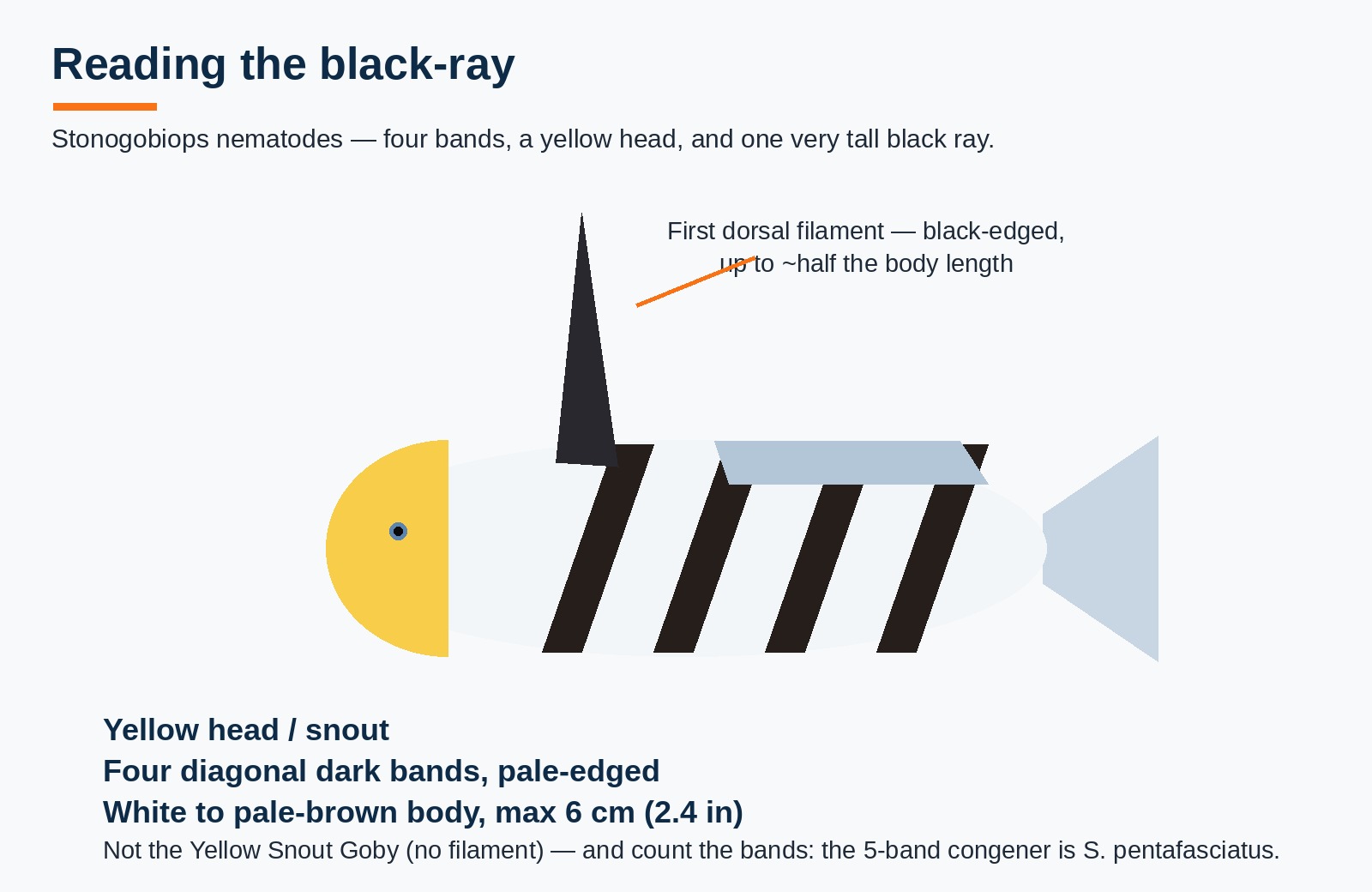
Start with the fin, because the fin is the name. The first dorsal of Stonogobiops nematodes is elongated into a tall, black-edged filament — one retailer measures it at almost half the length of the entire body — and it is carried by both sexes (see the sexing section below; importing a "tall fin means male" rule into this species is a documented mistake). The body underneath it is white to pale brown with a yellow head and snout and four diagonal dark-brown to black bands, each pale-edged, slanting down the flanks. Adults reach 6 cm (2.4 in) total length in the scientific sources; retail copy rounds that variously to 2, 2.5 or 2–3 inches, and the 6 cm figure is the one to plan around.
Two relatives account for most misidentifications. The Yellow Snout Goby, S. xanthorhinicus, shares the yellow head and banded body but lacks the tall filament — the filament is the separator the references themselves give. It also travels under overlapping trade names ("Hi-Fin Banded Goby" is used for both), which is why this entry anchors identity to the scientific name plus filament plus band count, never to the shop label alone. The second confusion is S. pentafasciatus: five black body bands instead of four, a black bar through the eye, and black-tipped pelvic fins. That last detail matters beyond ID — the black pelvic marking belongs to that species and its relatives, and it has been wrongly imported into black-ray sexing advice, as the next sections cover.
Where it comes from
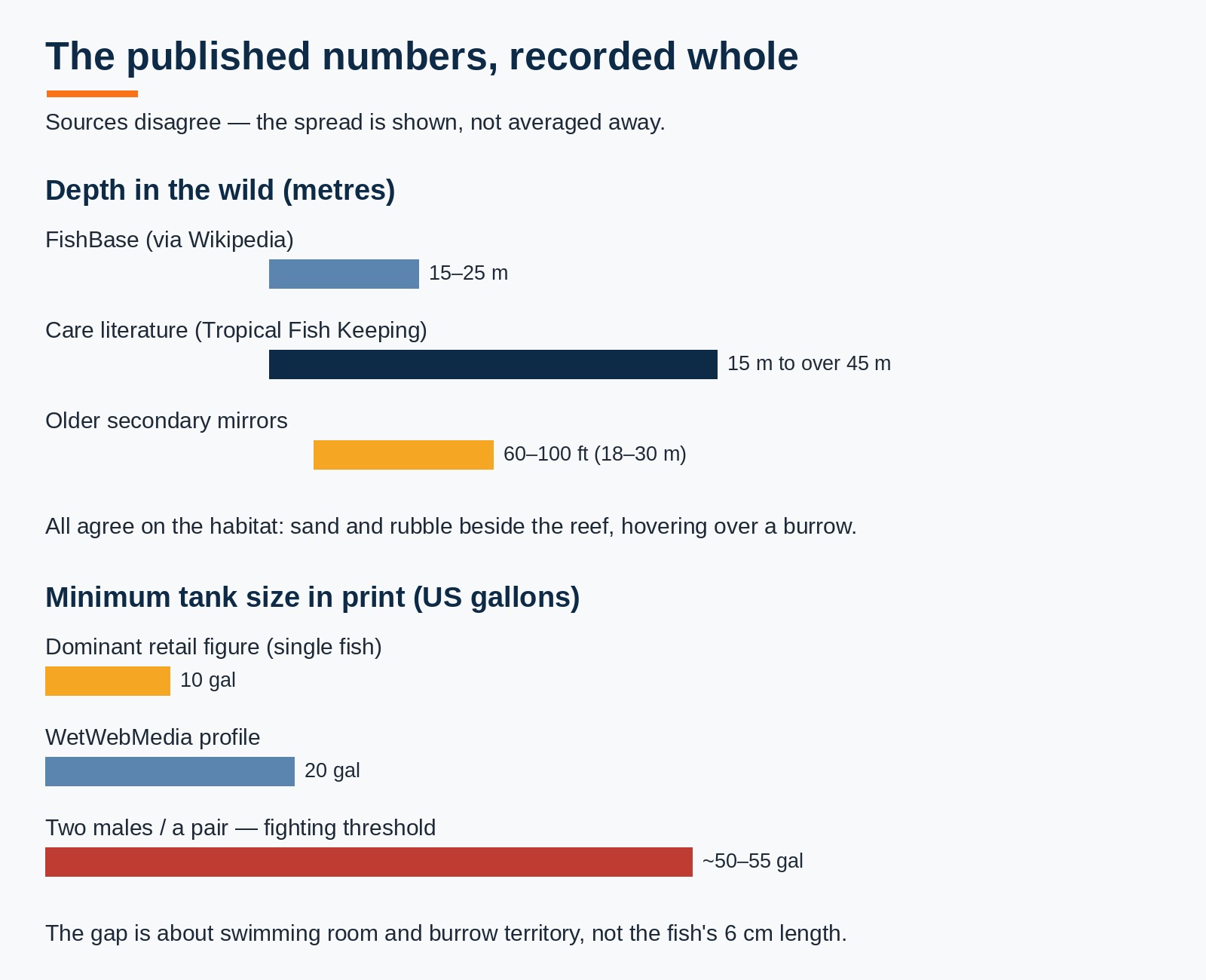
The species was described by Douglass Hoese and John Randall in 1982, from the Philippines, in the same wave that added several Stonogobiops to science — the genus itself had effectively launched only in 1977, late for such a conspicuous fish, because the group lives at moderate depths on sand rather than on the reef face where collectors look first. The full range is the Indian Ocean and western Pacific, from the Seychelles to the Philippines and Bali; the trade draws mainly on Indonesia and the Philippines. The depth figures in print do not agree, and they are recorded whole rather than averaged: FishBase gives 15–25 metres (49–82 feet); a widely used care profile reports encounters from 49 feet to over 150 feet (15 to more than 45 metres); older secondary mirrors give 60–100 feet. Every account agrees on the habitat's shape — sand and sand-rubble bottoms beside reefs, lagoon floors and reef slopes, with the fish hovering just above a burrow entrance. One more fact about the genus explains the behaviour that follows: Stonogobiops keep a functional swim bladder, unusual in the goby family, which is what lets this fish hover motionless a few centimetres above its door instead of perching on the sand like most gobies. No IUCN Red List assessment for this species was located when this entry was researched (checked November 2026) — older pages calling it "secure" are repeating a legacy label, not a Red List category, and this entry does not upgrade it to Least Concern on its own authority.
The partnership
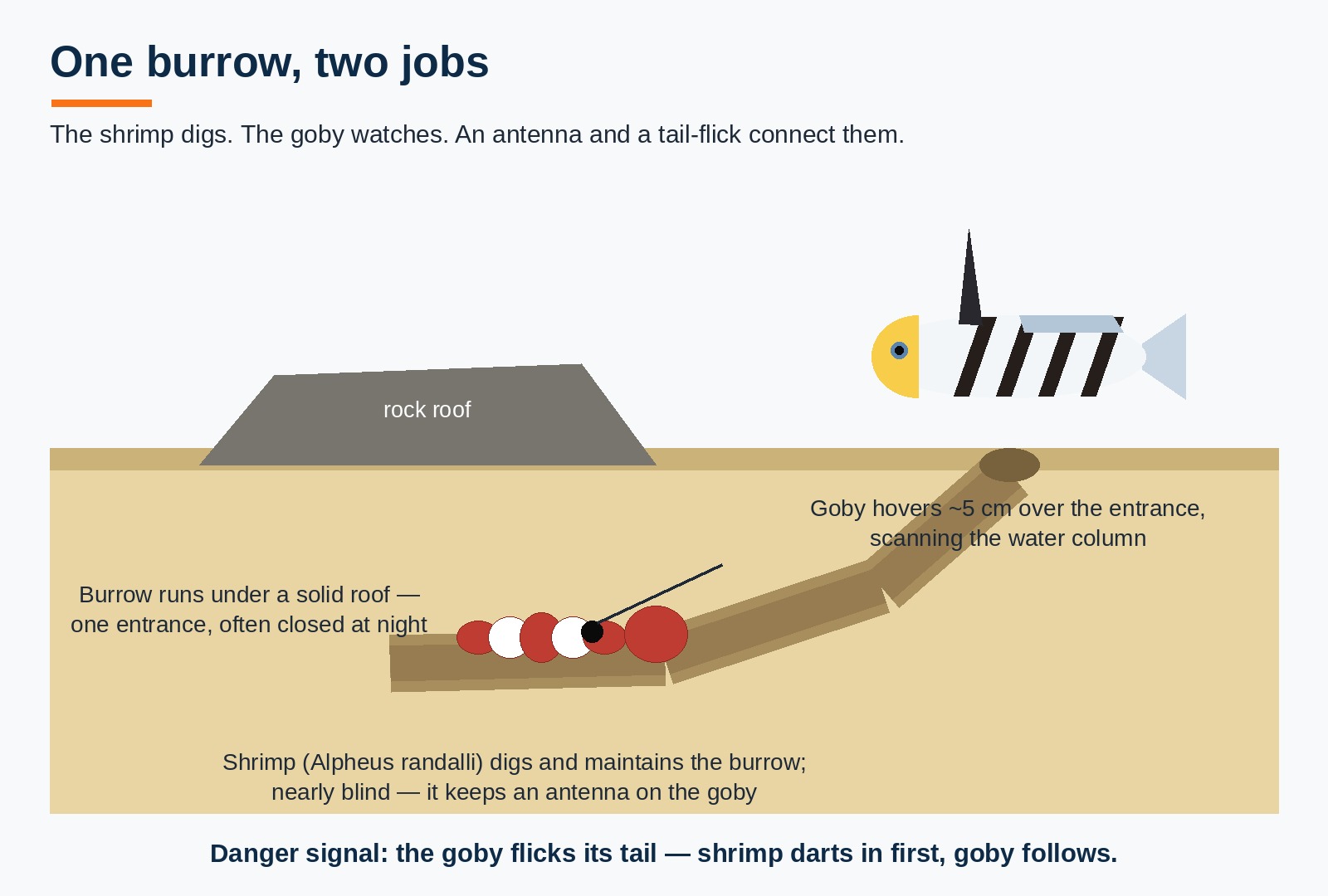
The burrow is a shared asset with a strict division of labour. The shrimp — nearly blind, with eyesight too poor to watch for predators — does all the excavation and maintenance, bulldozing sand and rubble out of a tunnel system that in wild accounts can run about an inch wide and up to four feet long, usually roofed by rock or another solid object. The goby, with far better eyes, repays it as a watchman: it hovers roughly five centimetres (about two inches) above the entrance, scanning the water column, and the shrimp keeps an antenna in contact with the goby whenever it works outside. The warning system is tactile and graduated — a quiver of the tail fin for unease, continuous flicking as the threat grows — and on a real alarm the shrimp darts in first and the goby follows. At night the goby goes inside and the shrimp may collapse or close the entrance behind it, rebuilding the door in the morning; typically only one entrance is kept open at a time. Wild burrows usually hold a male–female pair of gobies, often with their shrimp partner or a shrimp pair, and the female uses the burrow as her nesting site. One popular account adds that the goby passes a share of caught food down to the shrimp; that detail rests on that single synthesis rather than the wider literature, and the same account's dramatic claim that a starved shrimp may kill its goby is recorded here as reported, not established — no other source consulted repeats it.
Choosing the shrimp
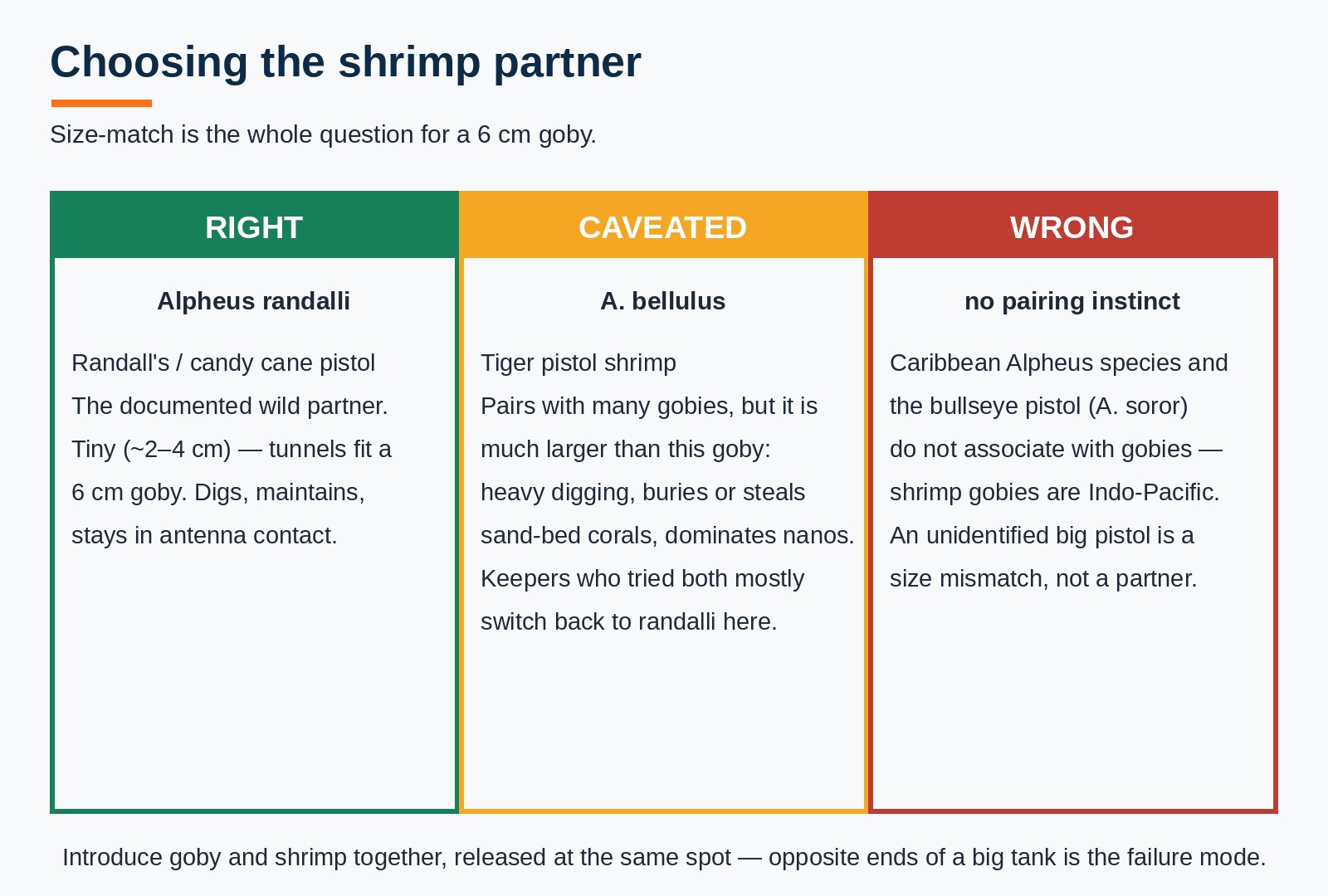
For this goby, the partner question has a right answer, a caveated answer, and some wrong ones — and the three are not interchangeable. The right answer is Randall's pistol shrimp, Alpheus randalli, the documented wild partner. Size is the logic: randalli is a tiny shrimp (roughly 2–4 cm as an adult), its tunnels are narrow, and secondary guidance is explicit that it pairs mostly with tiny shrimp gobies like this one because larger gobies cannot fit its burrows. The caveated answer is the tiger pistol, Alpheus bellulus. Tiger pistols pair readily with many shrimp gobies and forum shorthand often lists the two species as equivalent safe choices — but for a 6 cm goby in a small tank, keeper experience draws a sharper line: the tiger is much larger, moves far more sand, buries and steals sand-bed corals to decorate its entrances, and dominates a nano; keepers who have run both under small Stonogobiops mostly end up switching back to randalli, and one dedicated thread on tigers in a 15-gallon nano concludes the individual is a dice-roll at that size. The wrong answers are the pistols with no pairing instinct to offer: Caribbean Alpheus species do not associate with gobies at all (shrimp gobies are an Indo-Pacific group, which is the whole reason), and the bullseye pistol, A. soror, generally does not associate either. An unidentified large Alpheus is a size mismatch, not a partner. Two practical rules from the WetWebMedia compatibility FAQs sit over all of it: most commensal gobies will try most commensal Alpheus, and the test is whether the shrimp evicts the goby — and in rare cases an aggressive shrimp can kill an insistent goby, so a new pairing is watched, not assumed. Cleaner and peppermint shrimp, for the record, are tankmates, not symbionts; nothing pairs with them.
The tank it actually needs
The published minimums spread two-to-one and the spread is honest information. The dominant retail figure for a single fish is 10 gallons — it recurs across the LiveAquaria-derived care template, several retailers and the specialist goby lists — while the WetWebMedia profile prints 20 gallons for an adult. One encyclopedia aquarium section goes further and floats the species as a candidate for pico tanks of four gallons and under on the grounds that it mostly hides in its burrow; that is an outlier, and this entry does not endorse it — a burrow pair plus a digging shrimp needs sand area and stability a pico cannot offer. The stored tank field on this entry is Nano, which fits the 10–20 gallon working range for a single fish or a fish-and-shrimp pair. What the fish actually consumes is not gallons but floor: a patch of fine sand mixed with rubble, deep enough to dig (care sources ask for a deep bed of small-grain sand with larger particles through it, one putting the mix at four inches or deeper), and a solid roof to dig under — a piece of rock or rubble sitting stable over the chosen spot. The structural warning comes from keepers, not retailers, and it is non-negotiable: rockwork must rest on the glass or on eggcrate, never on the sand, because the shrimp will excavate under it and a sand-supported scape can shift or fall. Flow wants to be gentle to moderate. And the lid wants to be total — see the next section.
The lid is not optional
Every care source consulted requires a tightly fitting cover, and the keeper record shows why "has a lid" is not the same as "is covered." Losses on record include a fish that jumped through a quarter-inch gap along a lid edge — displacing the lid and widening the gap on the way out — and fish that turned up alive in the back chambers of all-in-one tanks, in one comparison case after ten weeks missing. A black-ray is a startle-jumper: the same dart that takes it into the burrow takes it out of the water when the burrow is not the nearest escape. The working standard is a full-cover lid with no open feeding cut-outs, screened overflows, and the back chambers of an all-in-one covered or blocked — on a nano, the chamber check is also the first place to look for a "dead" fish that has simply moved house.
Feeding a hoverer
In the wild this is a zooplankton feeder: it hangs above the burrow and picks small drifting food and tiny crustaceans out of the water and off the sand edge near the door. It does not sift sand like a Valenciennea, and a keeper expecting janitor service from it has bought the wrong genus. The captive menu follows from that — frozen mysis, vitamin-enriched brine shrimp, finely chopped prawn or krill, frozen carnivore preparations and small carnivore pellets, with small live foods like calanus welcome. The stored diet field reads Carnivore, and for once the bucket and the biology agree exactly. Frequency is one of the places the sources split honestly: the care template prints once or twice daily, one retailer says at least twice, and one profile recommends three to four small portions a day. The reconciliation is in the technique every source does agree on — target-feed at the burrow, delivering food to where the fish hovers with a pipette or turkey baster, in small amounts it can finish before the current takes them. That matters most in the first weeks (a new fish may refuse food for days; see Field notes) and in any tank with faster tankmates, because the documented feeding risk for this species is not finickiness — it is competition. WetWebMedia's profile is blunt that a black-ray dominated by pushier fish may simply not get enough to eat. One retail suggestion of algae wafers and spirulina as accepted staples is not repeated anywhere else for this carnivore and reads as generic goby copy; it is not a recommendation here.
One, two, or none — the shrimp and pair questions
Three separate decisions hide inside "how many." The first is the shrimp: the goby survives without one — it digs a smaller burrow of its own — and keeper reports of content, even bold, shrimp-less fish exist and are recorded in the Field notes. But the consistent cost reported for small Stonogobiops kept alone is confidence and visibility: the fish stays closer, shows less, and spends more of the day as a face in a hole. The shrimp is not a welfare mandate; it is the difference between watching the behaviour the species is famous for and mostly not watching the fish. The second decision is a second goby. Wild burrows hold male–female pairs, retailers recommend mated pairs where possible, and the same retailers warn that true mated pairs are very rare and difficult to acquire — which collides with the sexing problem in the next section. Two males fight, with the published threshold consistent across sources at roughly 50–55 gallons: below that, same-sex pairs are a fight risk, and the 50 vs 55 figures are rounding, not disagreement. A single prescriptive care site argues a solitary specimen cannot be happy and a pair plus shrimp is obligatory; that is one site's position, set against the entire trade's single-fish norm and the keeper reports of settled singles, and the entry records it as opinion. The third decision is other gobies: reports and FAQs agree this species is not aggressive to other shrimp-goby species and may even share a burrow system with them in a large enough tank, quarrelling mainly with its own kind when space runs short. Against unrelated fish the temperament is peaceful to a fault — the open-mouth "yawn" display is mostly theatre, and the fish retreats when actually confronted — with one wet-webmedia nuance worth keeping: at feeding time it can bite and hold on tenaciously, and if startled it may bury itself in the sand outright.
Sexing — mostly, you can't
This section exists to retire a piece of folklore. For Stonogobiops nematodes, the references are unusually aligned: both sexes carry the elongated dorsal filament, which grows more pronounced with age in both; males and females are described as virtually indistinguishable, with one encyclopedia account putting it at almost impossible for anyone short of a specialist. The genus-level analysis agrees — a 2024 Reef Builders review divides Stonogobiops into three lineages and places nematodes with yasha in the both-sexes-filamented group, while the short-finned, black-tipped-pelvic pattern belongs to the pentafasciatus lineage. Against that stand two imports, both wrong for this species: the black pelvic-tip rule, which describes congeners, and the forum advice that the taller-finned fish is the male — advice one keeper followed when trying to replace a lost partner, with the result that the attempted pairing failed, most plausibly because the same sex had been selected twice (the case is in the Field notes). The practical consequence is the one retailers already state: pairs are luck and observation, not selection. A keeper who wants a pair buys the most compatible-looking two available, watches them, and has a plan for separating them; a keeper who wants certainty keeps one fish and a shrimp.
Breeding — spawning yes, rearing not yet
The species has spawned in home aquaria; nobody, in any source consulted, has reared the larvae through settlement. The pattern follows the wild account: the female's belly swells visibly with eggs, the egg mass is laid inside the burrow or a cave and fertilised there, eggs hatch in about five to six days depending on temperature, and the larvae need roughly a month to reach metamorphosis — a long, small-mouthed planktonic month that is exactly where attempts end. The most persistent documented effort comes from a hobbyist pair that produced clutches weekly, on and off, for a couple of years, and worked through a long list of first foods — fine rotifers, copepods including Parvocalanus, a Euplotes ciliate that looked most promising — with the longest-lived larvae reaching day six. That keeper's two years of weekly spawns also stand as the longest species-specific captive duration in the record this entry found: the retail lifespan figures (about three years on one nano list, five years on one care profile, "several years" on the template) are retailer-stated, not measured, and keeper reports cluster far shorter for accidental reasons — jumping, chambers, displacement — rather than old age. Treat 3–5 years as the planning range the trade prints, not a promise the evidence underwrites. One more correction on the record: a retail page describing "broadcast spawning" for a hi-fin goby is describing the congener S. xanthorhinicus with generic copy; this species lays a guarded burrow egg mass, and the broadcast claim does not transfer.
Choosing and settling in
Buy the behaviour, not just the fish. A good black-ray is out at its burrow in the shop tank, hovering or perched at the entrance, coloured up, and taking food — and a fish already paired with a randalli in the shop is worth more than either animal alone, because the pairing step (see Field notes) is the one genuinely uncertain part of the whole setup. Settle it like the shy animal it is: sand and a pre-started burrow site ready before arrival — a shallow scrape under a stable piece of rock or rubble gives the shrimp a headquarters to adopt — lights low on day one, and food delivered to the burrow mouth from the start rather than broadcast for tankmates. Introduce goby and shrimp together and at the same spot when you can: released at opposite ends of a large tank, finding each other can take days to weeks or fail outright, while a shrimp guided to the goby's burrow (keepers use a tube, a shot glass or a short length of pipe) usually bonds on contact. Expect the first fortnight to look like failure — hiding for days to weeks is inside the reported normal range, and absence of any sand movement, burrow or snapping for a week and more is keepers' practical signal that a shrimp, specifically, may be gone. Resist rearranging the tank to check: moving rock after a hiding fish adds stress and resets the clock, and a fish invisible behind its rock may be a fish whose pairing quietly succeeded.
Field notes — what keepers report
On pairing with the shrimp, keepers split cleanly by method. Released together at the same spot — or with the shrimp guided to the goby's burrow in a baster tube — pairing is repeatedly reported as essentially instant, bonded on contact. Released apart, the record runs the other way: one keeper's new hi-fin vanished for almost two weeks and then three more with no sighting while its randalli moved sand alone, and the thread's judgement at three-plus weeks was that the fish was most likely lost; the replacement goby then perched in plain view but had still not found the shrimp after nearly a week. A hi-fin and pistol added to a small all-in-one separated on introduction and took a few weeks to hook back up. A comparison case from a larger goby species took over a year to find its shrimp in a big tank. Moving-house reports cut the other way in one respect — established pairs survive moves well when released together, re-finding each other within about a day, and adopt a pre-started burrow when the shrimp is placed in it first and the goby delivered to the same spot.
On life without a shrimp, the majority line for small species like this one is that the fish is noticeably shyer and far less visible: in one discussion the top answer to whether shrimp gobies are unhappy without a shrimp was a plain yes on shyness grounds, with the refinement that small species gain the most confidence from a partner while some large, bold species seem unbothered. A watchman comparison in the same thread reported a fish seen about once a week for six months alone, then out at its burrow almost constantly once a pistol was added. But the contrary cases are real: one keeper's favourite-fish post describes a shrimp-less hi-fin that dug its own small burrow, lived in it, and drove off anything that came near — bold and successful by any measure — and a lone hi-fin that lost its partner kept a tiny burrow alongside a peppermint shrimp and was described as content. The honest summary is that alone costs visibility and confidence in most reports, not health in all of them.
On jumping, the record is one-sided and specific. The documented exits are a quarter-inch gap along a lid edge (the jump displaced the lid and widened its own escape hole), feeding cut-outs left open, overflows, and the back chambers of all-in-one tanks — one nematodes was found alive in a filter compartment after being presumed lost, and a hi-fin in a 30-litre all-in-one got into the back chamber twice, losing colour and taking fin damage in the process. In an all-in-one, "missing" means "check the chambers" before it means anything sadder.
On disappearing generally, keepers divide outcomes into three buckets that look identical from outside the glass: a new fish hiding for days to weeks that eventually emerges (the common case — hunger brings it out, and spot-feeding at the burrow front is the standing advice); a genuinely lost fish, with three-plus weeks of total absence the rough community threshold for concluding so; and — the one newcomers miss — a successfully paired fish that has moved its household behind the rockwork and is living privately, betrayed only by snapping sounds and the occasional flash. One keeper whose pair bonded behind a rock and then "disappeared altogether" left them alone on exactly that evidence and counted them happy.
On feeding, the split is by phase, not by fish. New arrivals are hard: hiding, refusing food for days, needing food placed at the burrow, with fine frozen foods that linger in the water reported as keeping a nervous fish out and feeding longer; one keeper floated boisterous clownfish tankmates as part of why their fish stayed hidden, and one small all-in-one keeper, reflecting on a goby lost after a few months in a young tank, blamed adding the pair before a copepod population was established — their own attribution, in a tank that had other problems, but it matches the care literature's point that a mature tank's pod life helps small gobies settle. Settled fish, by contrast, carry no difficult-feeder reputation at all: hovering at the door, darting out for mysis, brine and chopped seafood, retreating, repeating.
On the tiger pistol question, keeper opinion is genuinely binary, and both poles have fish behind them. Tigers are reported pairing readily and inseparably with a string of goby species, and one keeper's large goby-and-tiger pair kept an ever-changing cave network front and centre — the tiger's size made the symbiosis more visible, not less. The other pole calls the tiger a murder machine and a hassle: sand and rubble moved in volumes a nano cannot absorb, sand-bed corals stolen as burrow decoration until one keeper glued theirs down harder, and one veteran's flat statement that they will never keep another. The nano-specific thread splits the difference from experience — some tigers are reef-safe, others much less, and in fifteen gallons it is a roll of the dice — and its author's stated next step was to retry with a candy cane randalli instead. No keeper report found pairs a tiger with nematodes by name and calls it ideal; the size-matched randalli consensus stands.
On pairs of gobies, the failure case is the instructive one. A keeper who lost one hi-fin of a pair (to a gorilla crab) tried to re-pair the survivor with a new hi-fin and failed — and their own retrospective diagnosis was the sexing advice they had been given: told that fin height sexes these fish, they had most likely introduced the same sex. The same keeper's wider system is the counterweight on multi-goby keeping: a watchman pair with a tiger pistol lived alongside the hi-fins in general harmony, with routine friction — the tiger periodically burying the neighbours' tunnels, the larger watchman venturing over to annoy the hi-fin — managed by space and separate burrows. And small tanks hold one more displacement risk that is not about gobies at all: in one 29-gallon account, hi-fins that had settled, eaten and defended their cave against hermits vanished for a week after a basslet simply took over their home.


