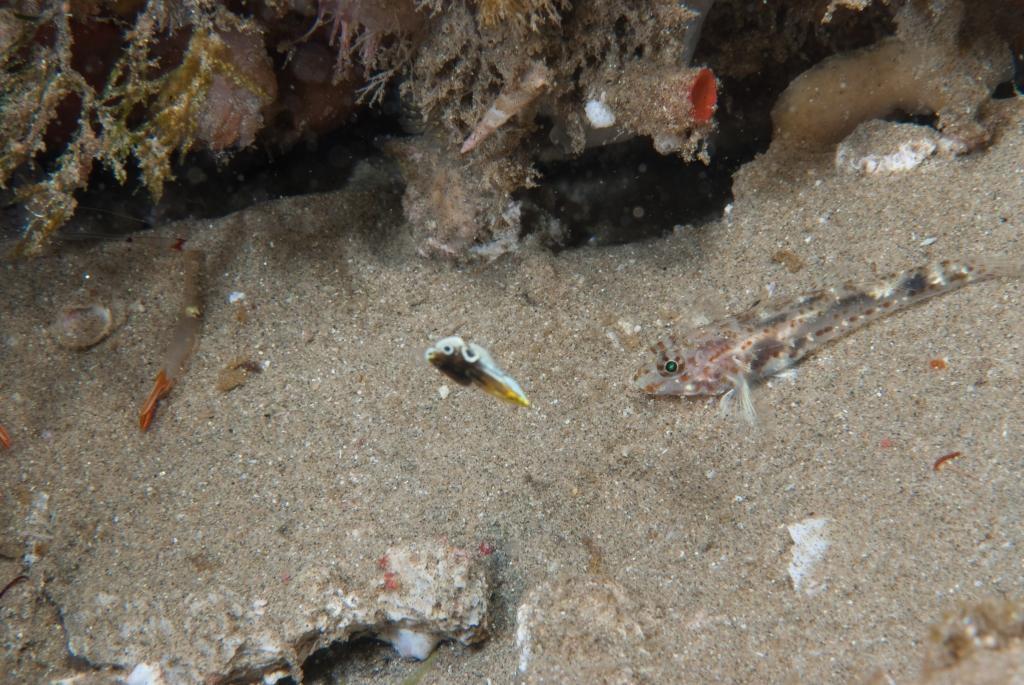
Dusky Wrasse
Halichoeres marginatus
Reef Safe

Gallery
The Dusky Wrasse, Halichoeres marginatus, is a sand-sleeping wrasse of the Indo-Pacific that the trade sees only sporadically — and that sporadic supply is a shame, because a settled terminal male is one of the most quietly spectacular fish in the genus. The species was described by Eduard Rüppell in 1835, and its name is a description: marginatus means edged or bordered, for the dark-edged fins and the dusky margins that stay visible through every colour phase. The genus name Halichoeres joins the Greek for sea (als) with choiros, a pig — an old nod to the wrasse snout. This is a working fish as much as an ornamental one: it hunts small invertebrates across rock, rubble and sand all day, eats several of the pests reef keepers most want eaten, and then vanishes into the sand at night. The original short entry called it a solid choice for reefers who want a useful working wrasse that also happens to look excellent, and everything in the fuller record below supports that — with the sand bed, the lid, and the invertebrate caveats that the short version had no room to explain.
Identification
Few reef fish change as completely as this one, and the phases need to be learned separately. Juveniles are black with numerous longitudinal white streaks and carry a large dark eyespot — an ocellus — on the dorsal fin, the classic false-eye arrangement that sends a predator's strike at the fin instead of the head. Initial-phase fish, the females and young males, are browner and quieter: a brown to olive body with dark stripes formed along the centres of the scales, pale spotting, and the black dorsal ocellus still showing in the middle of the fin. The terminal male is a different animal to look at. Descriptions converge on a greenish to brown body with narrow blue to purple lines across the face, roughly fifteen stripes made of connected dark-blue spots running the length of the body and breaking into spots toward the tail, blue margins on the dorsal and anal fins, and yellow margins on the pectoral and tail fins, the tail itself crossed by bands that end in a greenish-yellow crescent at its base. Trade descriptions of the same male add what the field guides flatten: a rainbow of reds and oranges showing through a predominantly dusky blue ground, and a sunny yellow undertone brightening the front half. Maximum size is 18 cm (about 7 inches) total length, with 10 to 12 cm the size most often actually seen, and maturity is reached at around 7 cm. Two cautions belong in any identification. Regional variation is real and recorded — a Red Sea account describes a dark green adult with an orange spot ringed in blue high on the gill cover and a pale bar down the flank, a fish a keeper working only from Indo-Pacific photographs might not recognise as the same species. And juveniles are easily confused with other small brown Halichoeres until the adult pattern develops, which is one reason this species is mislabelled in shops more often than its distinctiveness deserves.
Reading the care ratings
The entry rates this fish Intermediate for care, Peaceful, Carnivore, a Medium tank, a mid-water swimmer, and Reef Safe Yes, and each label needs its qualifier. Intermediate is not about water chemistry — the species is repeatedly described as hardy and adaptable once acclimated — it is about the shipping and settling record in the field notes, and about two non-negotiable furniture items, sand and a lid. Peaceful describes its behaviour toward other species; the conspecific question, one Dusky with another, is genuinely divided in the sources and gets its own treatment below. Carnivore is exact: the wild record is small invertebrates and fish eggs, with no meaningful plant component, so algae sheets and herbivore formulas are not a diet for this fish. Mid-water is the database's band for a fish that works the whole lower and middle reef rather than the surface. Reef Safe Yes is the label that needs the most care. It means coral-safe — no source read accuses this species of eating or damaging corals, and its pest-eating actively protects them — but at least one genus listing rates the species "Yes, with caution," and the caution is entirely about small motile invertebrates: ornamental shrimp, feather dusters and snails are a separate question from corals, and they are covered under reef safety below.
In the wild
The range is one of the widest in the genus: the Red Sea and the East African coast south to Inhaca Island, Mozambique, then east across the Indian Ocean and the Pacific to the Tuamotu Islands, with Hawaii represented by a single recorded specimen, north to southern Japan and south to the southern Great Barrier Reef and the Austral Islands. It is a shallow fish, recorded from the surface down to about 30 metres, living on lagoon and seaward reefs along the upper edges of coral-rich areas. Adults are benthopelagic — working just over the bottom rather than in it — and are found solitary or in small groups; the social unit underneath that description is the typical Halichoeres harem, one terminal male over a few or more females. Juveniles keep to exposed outer reef flats. The wild diet is broad and entirely animal: a wide variety of small invertebrates — crustaceans, worms, molluscs and the shelled micro-organisms called foraminiferans all appear in accounts — as well as fish eggs and, in some accounts, tiny fishes. Groupers, snappers and other large reef predators are its own predators, which explains the two defences the keeper sees daily: camouflage phases for the young, and the instant dive into sand. The species is assessed as Least Concern, with no major threats recorded beyond localised collection for the aquarium trade; its exact lifespan is unknown, with related wrasses put at roughly four to six years in the wild.
Sand is not optional
Like every Halichoeres in this database, this fish sleeps buried and dives into the substrate when frightened, and that behaviour is a husbandry requirement, not a quirk. Care sources put the bed at 2 to 3 inches of fine sand, deep enough for a fish that will reach six or seven inches to disappear completely, with open sandy areas left in the aquascape rather than every inch covered in rock. A bare-bottom tank, or a dusting too shallow to bury in, leaves the fish with no night refuge and no escape response, and the stress compounds nightly. Where a display must stay bare-bottom, the established workaround in wrasse keeping is a container of sand two inches deep placed in the tank — the fish will find and use it. Quarantine needs the same thinking: a sand tray in the quarantine tank gives a new arrival somewhere to go on the first night, which is precisely when it most wants to. The dive itself is fast enough to injure a fish that meets glass or bare rock instead of sand, which is part of the shipping story told in the field notes. Expect the burial schedule to run on the fish's own clock for the first days — a new Dusky may keep foreign hours, emerging at odd times, before it synchronises to the tank's lights.
Tank size
Published minimums for this species spread across the usual Halichoeres range: 50 gallons in one major retailer's care table, 75 gallons in the widely copied trade description, and 101 to 250 litres — roughly 27 to 66 gallons — in a genus listing that rates its care level medium. The database's Medium rating sits inside that spread. The reasoning that reconciles the numbers is the fish's adult size and working range rather than its purchase size: a two-inch juvenile looks lost in a 75-gallon tank and perfectly kept in a 40, but the adult is a six-to-seven-inch fish that patrols rock and sand continuously and holds a territory in the wild. Length matters more than volume — this is a swimmer and a patroller, not a cave-sitter — and the larger figures also assume the company a Dusky usually keeps, other wrasses and active reef fish competing for the same water. Plan the tank for the terminal male, not the streaked juvenile in the shop bag.
Feeding
In captivity the diet should mirror the wild menu: meaty, varied, and offered the way a grazer-hunter expects to find it — in small amounts, often. The trade standard is vitamin-enriched frozen mysis and brine shrimp as the base, and the care guidance is explicit that these fish need small, frequent feedings through the day rather than one large meal; a fish built to pick invertebrates off rock from dawn to dusk carries a fast throughput to match. Chopped seafood, quality carnivore pellets and other small meaty items widen the rotation. Two hunting details from a detailed retail account of the female and juvenile fish are worth knowing because keepers watch both behaviours without always recognising them: the eyes move independently of each other, scanning in two directions while the fish hunts, and oversized prey is dealt with by a bashing technique — the wrasse seizes the item and throws it against rock to break it into swallowable pieces. A Dusky working the rockwork with intent, stopping, staring with those separately roaming eyes, then darting, is a fed and settled fish doing its job, and a healthy specimen in an established tank supplements its own diet from the tank's pod and worm population between meals.
Temperament
Toward other species the record is consistent: this is a passive, peaceful wrasse, safe with the usual reef community, bold enough once settled to hold its own among active tankmates — wrasse specialists recommend the genus for tanks with tangs precisely because Halichoeres are not easily intimidated — and gregarious in manner once properly acclimated. The divided question is its own kind. One widely used trade description advises housing the Dusky with other peaceful wrasses including its own species, and the wild social system, a male over several females, supports the idea that conspecific groups are natural. Against that, other care summaries warn that the species is generally peaceful but may display aggression toward members of the same species, and the terminal male's wild job is patrolling a territory and chasing rivals. The practical reconciliation keepers work by: one Dusky in a typical home tank, groups only in large systems and only built deliberately from juveniles — wrasse specialists advising on this species specifically say to start with juveniles — and other Halichoeres species, rather than a second marginatus, as the safer way to add a second working wrasse. New additions of any wrasse to a tank holding an established terminal male should expect an inspection period, and an acclimation box is cheap insurance.
Reef safety
The honest summary is: corals safe, cleanup crew negotiable. On the credit side, the species is credited in the trade literature with eating fireworms and bristle worms, pyramidellid snails — the parasitic snails that plague clams, which makes a Dusky a genuine protective presence over a clam collection — and flatworms, and with picking parasites off tankmates. On the debit side, the same literature lists what else may be eaten: feather dusters, fan and tube worms, and very small shrimp. The genus-level keeper record sharpens the snail question: keepers of Halichoeres wrasses report nerite and cerith snails steadily disappearing, popped off the glass and eaten, while trochus, astraea and conchs — larger, harder to flip or crush — generally hold up. Tiny ornamental shrimp of the sexy-shrimp class should be considered at risk with any adult Halichoeres on the general genus record, while the claim that a Dusky threatens an established cleaner shrimp is contested — see the field notes, where both sides of exactly that argument appear. Nothing in the record involves coral tissue: the Reef Safe Yes in the entry's ratings is a statement about corals, and it stands.
Sex change and social life
The species is a protogynous hermaphrodite: every fish begins life female — all juveniles are in fact immature females — and the largest, most dominant female changes sex when the terminal male is lost, becoming the new breeding male. Spawning is by pairs, the fertilised eggs drifting away in open water on the long planktonic larval ride that makes captive breeding impractical and every aquarium specimen wild-caught. For the keeper, the biology shows up as the colour story told above: the drabbest brown juvenile in a group is not a different or lesser fish, it is the same animal at an earlier chapter, and a lone female kept singly will commonly transition toward male pattern over time as the dominant — only — fish in her territory. The transition is also why buying the sex is a fragile idea: a purchased "female" in a tank with no male is a male in waiting, and a purchased terminal male's colour is the one stable state, since the change runs one way only.
Choosing a specimen
Supply is sporadic — more than one source calls the species a relative unknown in the trade despite its looks — so the choosing often happens when a fish appears rather than on a planned date, which makes the checklist more important, not less. Buy the fish that is out, hunting and feeding in the shop tank; a Halichoeres that has synchronised to shop hours and takes frozen food in front of you has already passed the hardest stage described in the field notes. Inspect the mouth and jaw: a sand-diver that has met too many hard surfaces can carry mouth damage, and a fish that cannot feed properly will not recover condition. Prefer a juvenile or initial-phase fish if the tank plan is flexible — specialists recommend juveniles for this species — and reserve terminal males for keepers who specifically want the finished colour and have the tank finished first. A tight-fitting lid or screen is mandatory from the first day, not an upgrade for later: wrasses jump, this genus jumps well, and a startled new arrival exploring upward in the dark is the standard loss story. On arrival, lights low, sand available, and then patience — the first-days behaviour in the field notes is normal, and digging a buried fish up to check on it only restarts the stress the burial was relieving.
Warning signs
The warnings worth acting on are a fish that stays buried well past the settling window with no emergence at all — days of total hiding at the start is normal, a week and more with no appearance at feeding time is a reason to investigate gently — a fish that emerges but will not take any food across several days of varied offerings, visible mouth or jaw damage, rapid breathing or a pinched, thinning body in a fish that has been in the tank long enough to be gaining weight, and repeated jumping strikes at the lid after the first nights, which usually mean a tankmate is harassing the fish at lights-out or the sand refuge is inadequate. A fish that buries at dusk, emerges on schedule, hunts the rockwork and bashes the occasional oversized morsel against a rock is showing the full healthy repertoire, however alarming any single item on that list looked the first time.
Field notes — what keepers report
- The disappearing act is the first thing every Halichoeres keeper reports, and this species follows the genus script exactly: a new fish commonly dives into the sand within seconds of release and may stay buried for days, and the standing advice across wrasse-keeping is to leave it alone — do not dig for it, do not stir the bed to check — because it will emerge when it is ready, often head-first, pausing to look around before committing. Keepers of sand-sleepers also report the emergence schedule running on the fish's origin timezone for the first days, with the fish active at odd hours before it synchronises to the tank lights; a Dusky invisible by day in week one is usually a clock problem, not a dead fish.
- Shipping and first-days hardiness is where the record genuinely splits, and both sides are specific. The general trade record calls the species hardy and adaptable, suitable for novice and experienced keepers alike, and individual keeper reviews include a fish that, in a lights-off quarantine for its first couple of days, was active and eating strongly within a week. The other side comes from the same review page: a keeper who lost a previous Dusky for no apparent reason a day after it arrived, in a genus where a veteran keeper's warning is often quoted — sand-sleepers shipped in bags try to dive into the bag's hard bottom when stressed, he swore off ordering them shipped after sand-sleeping wrasses arrived with mouth and spine injuries, and he urges buying locally and letting the shop hold the fish a week or two until it is eating and on local time, after which he calls these wrasses practically bulletproof. Read together, the two records are one claim: the settled fish is hardy, the journey is the risk.
- Cleaner shrimp safety is contested in a way the care tables flatten, so it is recorded here whole. On one side, experienced wrasse keepers recommending this genus for tang-heavy tanks state plainly that a Halichoeres gives pest control without risking cleaner shrimp, and list the Dusky among their favourite species in the genus on exactly those terms. On the other side, the standard trade description for this species lists very small shrimp, feather dusters and tube worms among the things it may eat, and keeper reports on the genus describe small shrimp added after a wrasse is established and grown as fair game. The reconciliation most keepers land on: an established adult cleaner shrimp, present before or added carefully, is usually left alone; a tiny shrimp introduced into a grown wrasse's territory is read by the fish as food arriving. Size and order of introduction, not species temperament alone, decide the outcome.
- Colour in person outruns every photograph and description, by the trade's own admission — one long-used description calls the adult male a true peacock, a rainbow showing through dusky blue, and concedes that juveniles and females look muted by contrast, which is why shops struggle to sell the brown fish and keepers who grow one out feel they own a secret. Keeper enthusiasm runs the same way: the species appears on wrasse specialists' personal favourite lists and in recommendation threads as the beautiful one of the working wrasses, usually paired with the advice to start from a juvenile and watch the transformation rather than paying for a terminal male. Regional variation cuts the other way for identification confidence: the Red Sea form's orange gill-cover spot and pale flank bar differ enough from the common Indo-Pacific description that keepers comparing their fish against a single photograph regularly doubt a correct identification.
- Pest-control performance is the claim keepers repeat most, and the fine print matters. The repeated trade and keeper record credits the species with fireworms, pyramidellid snails and flatworms — real, valuable targets, the pyramidellid work in particular being protection no chemical treatment gives a clam keeper. But the genus record also shows the limit: keepers running several sand-sleeping wrasses in one tank report nerite and cerith snails steadily vanishing while the wrasses were, by their own account, possibly eating them for sport as much as hunger, and the same tanks' trochus, astraea and conchs untouched. A Dusky is best understood as an indiscriminate small-invertebrate hunter whose tastes happen to include several pests, not a surgical tool that eats only what it was bought to eat.