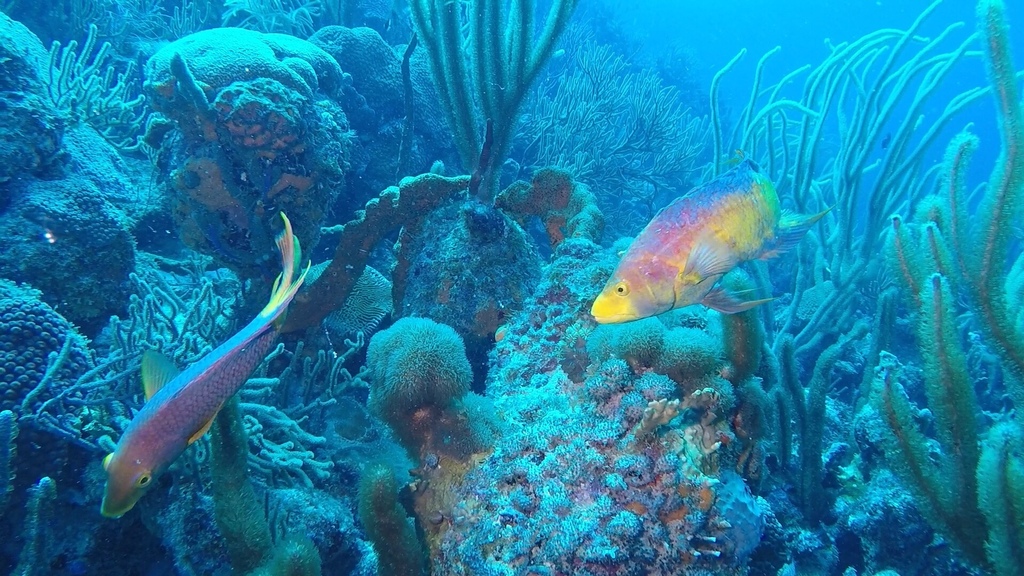
Lyretail Hogfish
Bodianus anthioides
Reef Safe
With Caution

Care facts
- Difficulty
- Intermediate
- Reef Safe
- Caution
- Aggression
- Semi-aggressive
- Diet
- Carnivore
- Tank Size
- Medium
- Swimming Zone
- Mid
Gallery
The Lyretail Hogfish, Bodianus anthioides, is the hogfish that does not look like one: a sharp two-tone wrasse, rusty orange-brown in front and clean white behind, trailing a deeply forked, lyre-shaped tail that no other common hogfish carries. The original short entry in this database called it one of the most elegantly shaped hogfishes, with a red-and-white bicolour pattern that looks hand-painted, noted that juveniles work as genuine cleaner fish and settle a new community surprisingly smoothly, warned in the bluntest terms that any ornamental shrimp worth keeping has to leave the tank before this fish goes in, and recommended it as a solid, hardy choice for the intermediate keeper who wants something more refined than the usual tuskfish or Spanish hog. The fuller record below keeps every one of those verdicts — the elegance, the cleaning chapter, the shrimp warning and the hardiness all survive checking — but it has to put dates and sizes on them, because almost everything said about this fish is true only at a particular age. The juvenile that picks parasites off a tang is the same animal that, grown, blows jets of water into the sand hunting the invertebrates it once ignored, and an honest entry has to hold both fish at once. It also has to be honest about the numbers: the sources disagree about this fish's adult size, its minimum tank, and even whether it is reef safe at all, and those disagreements are recorded whole below rather than averaged away.
A name that means anthias-like
Bodianus anthioides was described by Edward Turner Bennett in 1832, originally as Crenilabrus anthioides, and it has been moved and renamed several times since — it appears in the older literature as Lepidaplois anthioides and under three Cossyphus names, zosterophorus (Bleeker, 1857) and the Liénard names bicolor and boutoni (both 1891). The genus name Bodianus traces back, through Jordan and Evermann, to the Portuguese bodiano or pudiano, from pudor, modesty — an odd inheritance for a family of gluttons, since the hogfishes earned their common name honestly, rooting in the substrate with a pig-like snout and eating with a pig's enthusiasm. The species name is the descriptive one: anthioides joins the Greek anthias — the name Aristotle gave a fish of good omen, now attached to the anthias genus — to the ending -oides, "having the form of." It means, plainly, the hogfish that looks like an anthias, and anyone who has seen the fish understands the choice at once: the slim body, the forked streamered tail and the hovering, picking way of moving belong to the anthias visual world, not to the thick-lipped, bottom-grubbing world of its own genus. It sits in the wrasse family Labridae, among the hogfish tribe that also holds the Spanish, Cuban and Diana's hogfishes — a genus of some thirty described species whose members share the same basic career: part-time cleaners when small, benthic invertebrate hunters when grown, and sex-changers throughout, every Bodianus beginning life female and able to turn male. Its alternate common name, lyretail pigfish, is rarely used in the trade; lyretail hogfish is the name to search, and the fish is unmistakable under either.
Identification
No other hogfish in the trade can be confused with this one once the tail is seen. The caudal fin is deeply cut — described in the formal literature as deeply incised to emarginate — so that its upper and lower lobes trail into points, the lyre shape of the common name; in juveniles the lobes are exaggerated, one detailed account putting the tail lobes at two and a half times the length of the pelvic-fin rays, and the very young fish is almost translucent with the fins edged in white and black. The colour division is the second field mark and it is drawn with a ruler: the head and front portion of the body are orangish-brown in adults — a rusty, sometimes maroon-flecked brown-orange — and the rear body is white, carrying black spots in some descriptions and small red-brown dots in others, the difference probably a matter of size, sex and light rather than of population. Large specimens may flush the white rear with pink. A long brown-reddish stripe runs through each tail lobe from the caudal peduncle, the dorsal fin (twelve spines and nine or ten soft rays) carries a black spot toward its front, the anal fin counts three spines and ten to twelve soft rays, the transparent pectorals carry fifteen to seventeen soft rays, and the pelvic fins are red with black striations. The head profile is rounded in front and then drops almost vertically, darker underneath, with the small canine teeth slightly protruding — the working end of an invertebrate hunter, not the beak of a plankton picker, whatever the anthias silhouette suggests. Males are the larger sex and can look strikingly different at spawning time (see below); females and juveniles wear the brighter yellowish-orange version of the front-half colour. If a fish sold under this name lacks the forked tail or the hard front/back colour split, it is not this fish.
Reading the care ratings
This entry rates the Lyretail Hogfish Intermediate for difficulty, Semi-aggressive, Carnivore, Medium for tank size, Mid for swimming zone and Caution for reef safety, and the sections that follow mostly defend those calls — with one qualification that matters. Intermediate is right for the species as a whole and wrong for its ends: a large juvenile or subadult is one of the easier good-sized wrasses in the hobby, while a tiny juvenile is a transport-sensitive fish that specialists warn needs docile company and cover to survive its first weeks, so the rating is really an average across sizes. Semi-aggressive is a fair summary of an adult and an overstatement about a juvenile, which is peace-loving to the point of vulnerability; the aggression in this species is developmental, arriving with size and tenure, and it is aimed in particular directions — smaller and more docile fish, and anything shaped or coloured like itself — rather than sprayed at the whole tank. Carnivore is exact: this is a benthic invertebrate specialist that will also take small fish, and nothing in its record suggests any interest in algae or prepared vegetable matter. Medium, the tank-size field, is the rating the text has to work hardest on, because the published minimums run from 70 gallons to a 600-litre (roughly 158-gallon) figure and the truth depends on whether the fish in question is a two-inch juvenile or the eight-to-nine-inch adult it becomes; the spread is recorded whole in the tank section and in Field notes, and a keeper planning for the adult should read Medium as the floor for a young fish, not the home for a grown one. Mid describes where it cruises — an open-water patroller of the rock faces — but it hunts low, jets the sand and sleeps in the rockwork or on the sand itself, so read Mid as its travel zone, not its whole address. Caution, finally, is the one-word version of a genuinely split record: corals are essentially safe from its mouth and not entirely safe from its housekeeping, while ornamental invertebrates are not safe at all once it grows — the reef-safety section separates those two very different risks.
In the wild
Few aquarium wrasses range wider. The species runs the whole tropical Indo-Pacific: from the Red Sea down the East African coast to South Africa, through the Seychelles, Mauritius and Réunion, the Maldives, Cocos and Christmas Islands, Indonesia and Papua New Guinea, out through Micronesia to the Line and Tuamotu Islands and Henderson Island, north to the Philippines and southern Japan, and south to Australia, New Caledonia and the Austral Islands — roughly 32 degrees north to 28 degrees south. It is a fish of reef faces, fore-reef slopes, drop-offs and the backs of barrier reefs, in water from 6 to 80 metres by the widest published range and most often between 6 and 60 metres, with Micronesian divers finding it commonest below 25 metres and a New Ireland survey recording it solitary on steep seaward slopes at 6 to 25 metres. Habitat detail matters for the aquarium because this species partitions itself by age. Adults favour ground rich in gorgonians, sea whips and black corals — the steep, current-washed outer slopes — though in the Red Sea adults are also found over shallow sandy back-reef ground. Small juveniles live deeper and differently, associating with large sea fans, including the lattice fan Subergorgia hicksoni, feeding on the small organisms trapped in the fan's mesh, and sheltering behind black corals and in cave ceilings. The wild diet is the benthic invertebrate list its teeth are built for: crustaceans, gastropod and bivalve molluscs, echinoderms including sea urchins, worms, and small fish when the chance offers, with zooplankton also recorded. Two hunting techniques define it. The first is hydraulic jetting: a larger lyretail blows jets of water from its mouth at the sand surface to blow away the cover over buried prey, a behaviour every account of the species mentions because it is so watchable. The second is opportunism with accomplices — adults trail goatfishes and eat the prey the goatfishes' chin barbels flush from the substrate, much as hogfishes generally follow anything that stirs the bottom. The species is assessed as Least Concern, with a moderate vulnerability index (39 of 100 in a 2020 assessment) and good resilience — one encyclopedia account gives a population doubling time of 1.4 to 4.4 years for depleted populations — and although it is collected for aquariums across its range, the collection pressure is softened by the fish itself: it is expensive, and expensive fish are collected modestly.
The cleaner chapter
The trait that sells this fish to community keepers is real, and it has an expiry date. Juvenile lyretails are facultative — part-time — cleaners, in the wild setting up cleaning stations beside sea fans or other prominent reef features, where larger fish come to be serviced; the Monaco encyclopedia account records the young fish cleaning ectoparasites from big fishes and even from sea turtles. In an aquarium the behaviour carries over directly, and the specialist hogfish literature calls watching a juvenile clean its tankmates fascinating: the little two-tone fish presents itself, the client fish holds station, and the hogfish picks parasites and dead tissue from its skin. This is the behaviour behind the original entry's observation that juveniles introduce surprisingly smoothly — a fish offering a service is received differently from a fish claiming territory. But it is a juvenile occupation, dropped as the fish grows and its diet shifts down to the benthos. No account promises a cleaning adult; the retailers who describe the species state flatly that the behaviour stops with growth. A keeper should therefore enjoy the cleaner chapter for what it is — a genuine and charming phase, worth the price of a young fish by itself — without building the tank's parasite strategy around it, and without being surprised when the cleaner retires and the hunter clocks in. What replaces cleaning is not a lesser fish, just a different one: bolder, more predatory, and considerably more interested in the invertebrate livestock than in the fish.
Colour, sex and spawning
Like every hogfish, this species is a protogynous hermaphrodite: individuals begin as females and can change to male, and the genus runs a haremic social system in nature even though the fish is usually encountered alone. The lyretail is generally described as solitary, forming pairs to spawn, and probably haremic — a dominant male holding ground that overlaps the ranges of a few females. The best spawning account is a diver's eyewitness report from the Red Sea, worth retelling because it shows how far the male's dress can depart from the fish in the shop. At dusk a male courted two females near the top of a large coral head; he was larger than either, his front half much darker than theirs, his head rusty-brown where theirs was orangish-brown, and his cheek had turned grey. He swam around a female with all fins erect until one joined him, and the pair rose side by side into the water column and shed their gametes together. Adults are reported to show temporary, possibly permanent, sexual dichromatism — the male's darkening may come and go with the spawning hour or settle in with maturity — and males simply outgrow females. There is no parental care; the eggs are abandoned to the plankton. For the aquarium the practical translation is modest: the species is almost always kept singly, which suits a fish that is solitary by default, pairs or harems are a wild arrangement rather than a captive recommendation, and a keeper who somehow holds two should expect the SaltCorner rule recorded in Field notes — congeners added together or not at all — rather than a peaceful established pair. Sexing a purchased fish by colour alone is unreliable outside the spawning moment; size is the better clue, and a large, dark-fronted fish is the likeliest male.
Tank, rockwork and sand
Start with the disagreement, because it decides the purchase. Published minimums for this species span an unusually wide range: 70 gallons at two different retailers, 75 gallons at another, 75 to 100 gallons for an adult in the specialist hogfish literature, 100 gallons in the SaltCorner library, and 600 litres — about 158 gallons — in the reefflex-derived encyclopedia entry, which candidly explains that its figure assumes a medium specimen kept for several years and that a smaller fish can live for a limited period in less. The spread is recorded whole in Field notes; the working synthesis is that this is an active, open-water swimmer that reaches eight or nine inches on the formal measures and patrols constantly, so length and open swimming room matter more than any single gallon figure — a four-foot tank is a juvenile's home and a six-foot tank is an adult's, and a keeper who buys the fish should be buying it for the adult. What the tank must contain is consistent across every source: plenty of live rock arranged with caves, crevices, overhangs and sleeping shelves, alongside genuinely open water — this fish browses rockwork all day and needs both the structure and the lanes between it. Sand deserves a deliberate decision. The species sleeps under rock shelves, on or under a coral branch, in a crevice, or directly on the sand surface — notably, it is not one of the sand-burying wrasses, so a deep bed is not a sleeping requirement and a bare-bottom or thin-bed system does not deprive it of a bed. But it is a sand hunter: adolescents and adults jet the substrate for buried prey, work the sand edges on patrol, and quickly exhaust whatever natural food a captive sandbed holds, so a sand floor gives the fish its signature behaviour to perform and gives the keeper the detritus-stirring that comes with it, while a bare floor removes the behaviour rather than the need to feed the fish. Temperature and chemistry are standard tropical marine — published ranges run 72 to 82 degrees Fahrenheit at the widest, pH 8.1 to 8.4, specific gravity 1.020 to 1.026 — and one retailer flags a slight sensitivity to water-quality swings, which sits oddly with the hardy consensus and is recorded as the minority view in Field notes. Nothing in any source singles this species out as a notorious jumper, and no lid claim is made here on borrowed genus evidence; a covered tank remains ordinary prudence for any active wrasse, stated as prudence and not as a documented habit of this fish.
Feeding
Feed it like the benthic carnivore it is. The wild diet — crustaceans, molluscs, urchins, worms, small fish — translates into a captive menu of meaty marine foods: mysis and fortified brine shrimp, black worms, chopped shrimp, scallop, clam and mussel, krill, quality frozen carnivore formulas, and pellets and flake once accepted, which hogfishes generally learn to take. The SaltCorner library prescribes feeding two or three times a day, and the multiple-small-meals pattern is the common recommendation — an active, warm-water predator with a hunter's metabolism does better on frequency than on feasts. Variety is not decoration here: a fish built to crack and pick invertebrates should regularly get food with some structure to it, shell-on and chunky items included, rather than a monoculture of one frozen cube. The honest difficulty sits at the start of the story and is size-dependent, and Field notes records it as the split it is: the library warns that this species may be very difficult to get feeding at first and prescribes live black worms or adult fortified brine shrimp as the bridge, while the specialist literature says adolescents and small adults adapt readily and it is the small juveniles that struggle — with transport stress, not with appetite as such. Either way the remedy is the same and worth stating plainly: offer live and strongly scented foods early, feed in quiet conditions without boisterous competition, and do not judge the species by a fish that has eaten nothing in its first forty-eight hours. Once established, the feeding problem inverts — hogfishes are famously enthusiastic, learn the keeper's approach quickly, and will out-compete shy tankmates at the food drop if the keeper lets them; target-feeding the timid is the standard fix. A lyretail that has stopped eating after settling is a fish to investigate, not a mood to wait out (see Warning signs).
Temperament and tankmates
The temperament story is a before-and-after, and both halves are well documented. Before: juveniles are peace-loving, almost to a fault — the specialist literature warns that small juveniles do worse with aggressive company and should be housed with docile fish and given plenty of hiding places, and the encyclopedia notes describe a fish that is initially shy, hides for long stretches if kept under pressure from more aggressive species, and should be allowed to acclimate before bolder fish are added. After: an established adult is a confident, territorial patroller that may behave aggressively toward smaller or more docile tankmates, is described across sources as capable of eating the small fish it once cleaned for, and reserves its sharpest aggression for fish shaped or coloured like itself — one library warns it will become very aggressive toward a similarly coloured species, while allowing that other Bodianus can be kept if all are introduced at the same time. The tankmate lists follow from that arc. The consensus company is the moderately aggressive middle of the hobby: angelfishes, tangs, hawkfishes, groupers, damsels, and the more placid triggerfishes — fish that will neither bully a young lyretail nor be bullied by an old one. The consensus exclusions are the two obvious ones: small, timid, slow fish in adult company, and delicate ornamental invertebrates at any size past juvenile (next section). One retailer's care page advises exactly the opposite company — peaceful gobies, blennies and small wrasses — and that conflict is not smoothed over here; it is recorded in Field notes as written, because a keeper who follows the gentle-company advice with a grown fish is following the minority report against the weight of the specialist literature. Introduction order is the keeper's main tool: the lyretail does best added after its future tankmates are settled if it is adult, or before the boisterous fish if it is young — in both cases, let the vulnerable version of the fish be the one that meets a calm tank. Kept singly is the default and the recommendation; this is a solitary species that pairs only to spawn.
Reef safety
Separate the coral question from the invertebrate question, because this species gives opposite answers. Corals: its mouth is not the problem. The rating services split — one library scores it coral-safe outright, most score the whole reef question "with caution," one retailer scores it flatly not reef safe in its facts table while its own description text says "with caution," and one older retail page claims the fish tends to eat live corals, a claim no specialist source supports and which Field notes records as the outlier it is. The documented coral risk is mechanical, not dietary: a hunting hogfish overturns things. Retail copy warns it is known to overturn corals while searching for food, and a fish that jets sand, pries at rockwork edges and grows to eight inches will rearrange unsecured frags and small colonies as a side effect of breakfast. Glue and mount everything, and a lyretail in a reef is a workable proposition on the coral side. Invertebrates: there is no split. Every source agrees that a growing lyretail becomes a threat to worms, small clams and bivalves, snails, and crustaceans — the original entry's shrimp warning stands at full strength for adults, and it extends to the whole motile cleanup crew: ornamental shrimp, small crabs and hermits, small snails, feather-duster and other tube worms, and small clams are all on the wild menu in taxonomic terms. Size buys time, not immunity — a juvenile may ignore a large cleaner shrimp for months, which is a statement about the juvenile, not a compatibility discovery. The sand-sifting side of the ledger is genuinely double-edged and keepers argue it both ways in Field notes: the jetting stirs and turns the upper substrate, which some accounts praise as useful housekeeping, and the same behaviour clouds water, shakes loose detritus and strips the bed's fauna, which others record as a disturbance — both are true, and which one dominates depends on the system it is done in. Plan the tank as a fish-with-corals system, not a fish-with-a-cleanup-crew system: snails and shrimp in a lyretail tank are a food budget, and keepers who accept that arithmetic keep the fish happily in reefs for years.
Choosing a specimen
Buy size with intention, because size decides which version of this fish arrives. The specialist advice is unusually specific: small juveniles can be more sensitive to transport stress and harder to adjust than large juveniles or subadults, and the small fish's survival improves with docile company and abundant hiding places — so the tiny, exquisitely streamered juvenile that charms in the shop is, counterintuitively, the expert's purchase, while the adolescent or small adult that has already traded some streamer for substance is the beginner-proof one and adapts readily. Trade sizes tell their own story: one major retailer's African listings run from an inch and a quarter to four and a half inches, with price climbing steeply by size — this is an expensive fish at every size, two hundred dollars and up in those listings, and the largest grade costs roughly double the smallest — which should settle any impulse to buy first and plan later. Examine the fish for the hunter's checklist: body full behind the head with no pinched belly, the front/back colour division crisp, tail lobes intact and unbitten, fins free of the fraying that betrays a rough collection and holding chain, and — the decisive test — feeding in the shop on offered frozen food, since a fish already eating mysis has crossed the bridge that the difficult-feeding warnings are about. Ask its origin if the shop knows it; the species comes from across an ocean-wide range and collection quality varies by source. Quarantine is worthwhile for a fish of this price, and the recorded quarantine experience in Field notes — days of hiding, then an appetite that suddenly lives up to the family name — is the normal script, not a warning sign. Finally, check the mouth and the future together: a lyretail's adult jaws handle small fish, so any tankmate small enough to be prey eventually will be — buy the specimen that fits the tank the fish will actually live in at eight inches, with the tankmates it will actually meet at that size.
Warning signs
Most lyretail problems announce themselves as changes from this fish's normal, which is active, visible and hungry — so the first warning sign is absence. A settled fish that takes to hiding for long stretches is telling its keeper something the genus notes state plainly: hogfishes hide when they are being bullied or when they are unwell, and the two causes are separated by watching who else has grown bold. A new fish that hides is normal for days; a new fish still hiding and not eating after the first week, despite live-food offers and quiet conditions, is the difficult-start case the library warns about and needs escalation — varied live foods, a refuge-rich quarantine, and a check of water quality — rather than patience alone. Appetite loss in an established fish is never a shrug: this species eats with enthusiasm, and a refusal that lasts beyond a day or two warrants the standard sequence of parameter checks, an inspection for the spots, scratching or rapid breathing of parasitic disease, and a review of recent additions or aggression. Watch the invertebrate census as a health proxy in reverse — a sudden interest in shrimp it previously ignored is not illness but adolescence, and mistaking the hunter's arrival for a behaviour problem leads keepers to rehome a healthy fish for doing exactly what this entry says it will do. Colour is a softer signal: the white rear half shows stress and poor condition early as a grubby, darkened cast, and a male's darkened front is spawning dress, not decline — context decides which darkening is which. Sand-jetting that suddenly stops, patrol laps that shrink to one corner, or a fish resting on the sand in the open by day are all departures from the active baseline and worth a same-day look. None of this replaces the ordinary marine-fish vigilance; it calibrates it to a fish whose healthy state is conspicuous, so that its quiet states stand out as they should.
Field notes — what keepers report
On hardiness, the verdict is strong but not unanimous, and the disagreement is really about size. The library and encyclopedia records call the species hardy outright, the specialist hogfish survey says it generally does well in the home aquarium, and one retailer grades its care level Easy — against which stand the Intermediate and Moderate grades elsewhere, the report that the fish can be slightly sensitive to water-quality changes, and above all the repeated warning that small juveniles are transport-sensitive and adjust with difficulty. Keepers reading both sides should take the synthesis the specialists themselves offer: the species is hardy, and its smallest size class is the exception — buy past the fragile stage and the hardy reputation is the one that shows up. On getting it eating, reports split in exactly the way the hardiness reports predict. The library record warns the species may be very difficult to get feeding in the beginning and prescribes live black worms or adult fortified brine shrimp; the specialist survey counters that adolescents and small adults readily adapt, reserving the struggle for small juveniles. A recorded quarantine case sits between the two and reads like both: a new lyretail hid behind the quarantine decorations and was not seen to eat for the first couple of days, worrying its keeper, then came out of its shell, began swimming the tank, and fell on frozen mysis so fast it was gone in about thirty seconds — after which its keeper had to increase its food and remarked that it definitely lived up to the name hogfish. The same thread carried the other side of the appetite coin: a fellow keeper replied that they had always wanted one but feared the adult mouth, expecting it would eventually eat their smaller fish — the exact long-term calculation this entry's tankmate section asks buyers to make first. On adult size, the formal and trade figures do not meet: FishBase gives a maximum of 24 centimetres standard length, the buyer's-guide figure carried by Wikipedia is 25 centimetres, the SaltCorner library says 9 inches, the specialist survey — calling it the largest of its three featured hogfishes — says 21 centimetres (8.2 inches), the big retailers sell it as an 8-inch-maximum fish, one general account puts the usual size at only 5 to 6 inches, and a UK retailer's page says approximately 7 inches. The whole spread is recorded here because a buyer sizing a tank deserves to see it: plan on the formal figures, expect the trade ones, and do not plan on the 5-to-6-inch "general size" for a fish with decades of growing room. On tank size, the spread is wider still and is reported whole for the same reason: 70 gallons (two retailers), 75 gallons (a third retailer and a general hogfish care page), 75 to 100 gallons for an adult (specialist survey), 100 gallons (library), and 600 litres, about 158 gallons (the reefflex-derived encyclopedia, which explains its figure assumes keeping a medium specimen for several years and concedes smaller fish can spend a limited period in smaller tanks). No source supports keeping an adult in anything nano or small-medium, and the entry's Medium field should be read against this paragraph, not instead of it. On temperament, the two reputations are both earned and are separated by tenure. One major retailer calls it one of the least aggressive of the hogfishes and one of the best for the home aquarium, and the specialist survey calls juveniles quite peace-loving; the same survey warns that a larger lyretail, once established, may behave aggressively toward smaller or more docile tankmates, the library warns it can be aggressive toward smaller peaceful species and very aggressive toward a similarly coloured fish, and the encyclopedia grades it simply "might be aggressive towards other species." The sharpest conflict in the whole record is over company: the library and the specialist survey both prescribe moderately aggressive tankmates — groupers, hawkfishes, angelfishes, placid triggerfishes — while one UK retailer's page advises housing it with peaceful fish and names gobies, blennies and small wrasses as suitable, the very categories the other sources expect a grown lyretail to bully or eat. Both prescriptions are recorded as written; the weight of specialist evidence stands behind the moderately-aggressive list, and the gentle-company advice is safest read as applying, if at all, to a juvenile in its cleaner chapter. On keeping more than one, the reports diverge by arrangement rather than by outcome: the library allows other Bodianus in the same tank provided all are introduced simultaneously, while warning against any similarly coloured species; a retailer advises keeping the species singly or in pairs to avoid territorial disputes; the wild record is of a solitary fish that is probably haremic, with spawning pairs forming at dusk. No keeper consensus supports adding a second lyretail to an established one's tank, and the simultaneous-introduction rule is the only multi-hogfish path any source endorses. On reef safety the sources argue with themselves in public, which is itself the useful information. One retailer's facts table scores the species Reef Safe: No while its own description on the same page calls it reef safe with caution; a library entry scores coral safety Yes while grading fish and invertebrates "with caution"; most rating services land on With Caution; and one older retail page asserts the fish tends to eat live corals — a claim contradicted by the dietary record everywhere else, which puts corals nowhere on the menu, and recorded here as an outlier. Where every source converges is invertebrates: as it grows, the fish becomes a threat to worms, small clams and crustaceans, in the encyclopedia's phrasing, and the genus pattern behind that warning is not theoretical — a widely read keeper report on a close relative, the candy cane hogfish, describes the fish killing a cleaner shrimp in front of its owner after the shrimp had hidden from it since arrival, a $24 lesson, in the keeper's words, that reef safe does not always mean reef safe. That report is a congener's, not this species', and is included as genus context only; for the lyretail itself, the original entry's instruction stands unamended — any ornamental shrimp you value leaves before this fish goes in. On the cleaner behaviour, there is no disagreement at all, only a shared expiry date: juveniles clean, in the wild at stations by sea fans and even on turtles, in aquariums on their tankmates — "fascinating to watch," in the specialist's words — and the behaviour stops as the fish grows, in the retailers' flat phrasing. Keepers who bought the fish partly for the cleaning should read the unanimity as a promise with a term limit, not as a defect discovered later. On sand, the same behaviour is filed as virtue and as nuisance by different hands: the specialist survey notes the jetting helps stir the upper layers of soft substrate; the library lists disturbing sandbeds by blowing jets of water into them among the species' warnings; the encyclopedia adds that the searching can cloud the water and shake loose detritus, and that the natural food in a captive sandbed is quickly exhausted anyway. All three descriptions are of one behaviour, and keepers plainly divide by system — a stirred bed is housekeeping in a fish-focused tank and a dust storm in a fine-sand reef — so the field record supports either reaction and warns only against being surprised by it. On frag security there is a single, uncontested keeper-grade warning: the species is known to overturn corals while searching for food, which is why its reef rating carries caution even from sources that acquit its mouth — the practical consequence (mount everything) is in the reef-safety section, and no contrary report of a large lyretail leaving loose frags politely alone appears in the record. On sleep, the library's account is specific and uncontradicted: under rock shelves, on or under a coral branch, in a crevice, or directly on the sand surface — a roster worth recording because it frees this species from the deep-sand requirement its sand-burying wrasse relatives impose, a point keepers of bare-bottom and thin-bed systems will weigh differently from keepers choosing sand for the jetting behaviour. On price and availability, the trade record describes a fish that is only occasionally seen, priced like a rarity at common sizes: one major retailer's African listings run from about an inch and a quarter to four and a half inches with prices from the low two hundreds to over four hundred dollars by size — figures recorded as a snapshot of one seller's page, not a market quote, but consistent with the encyclopedia's observation that collection of this species stays modest partly because its high cost limits demand. The keeper consequence is the one already given in Choosing a specimen: at these prices the quarantine, the feeding test in the shop, and the adult-tank plan are not refinements — they are the purchase.