Tiger Cowrie
Cypraea tigris
Reef Safe
With Caution
Gallery
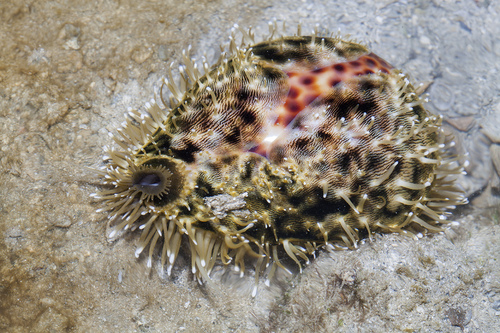
The Tiger Cowrie, Cypraea tigris, is a large sea snail of the cowrie family Cypraeidae, spread across the warm Indo-Pacific from the East African coast and the Indian Ocean to Hawaii and Polynesia. It lives on coral reefs, rocky ground, and sandy bottoms from the low intertidal down to roughly 40 metres, in lagoons and on outer reef slopes, and is frequently found in the neighbourhood of Acropora thickets. By day it stays wedged in a crevice, under a rock, or inside the shelter of a coral colony; after dark it comes out and grazes its way across the reef. It is one of the most widely recognised shells in the world, common in souvenir and collector trades far beyond the aquarium hobby.
The shell
The shell is egg-shaped, heavy, and famously glossy, pale cream to golden brown underneath a scatter of dark spots and blotches that gives the species its name. No two patterns match: the ground colour runs from almost white to, in rare specimens, nearly black, and the spotting can look like two layers of colour laid one over the other. Average adults measure around 8 to 10 cm (3 to 4 inches); large ones reach 15 cm (6 inches), with the Hawaiian form noted for growing bigger than most. The gloss is not a finish applied to the shell but a condition the living animal maintains. A fleshy mantle, mottled black and grey with a fingerprint-like pattern and crowded with short finger-like papillae, wraps up from both sides and can cover the shell completely. Its constant movement over the surface keeps the shell polished and stops encrusting organisms from settling, and its pattern camouflages the snail while it feeds. Threatened, the cowrie pulls the mantle back inside; the shell opening itself is a long slit lined with tooth-like ridges, and there is no operculum.
Reading the care ratings
The entry rates this snail beginner for difficulty, peaceful in temperament, an omnivore by diet, a bottom placement, and reef safe with caution, and each of those ratings needs the others to make sense. The hardiness behind the beginner rating is real: a tiger cowrie that is eating is a sturdy animal with modest demands. The caution is equally real, and it is not about the snail's behaviour toward fish or its aggression, of which it has none. It is about what an adult eats and what a snail of this weight does to a reef layout on its nightly rounds, covered in the feeding and field-notes sections below.
Feeding
Feeding is where the tiger cowrie changes its mind about life. Juveniles are herbivores, grazing algae and detritus off rock and sand, and small specimens in a tank behave like oversized cleanup crew. Adults are carnivores. The wild adult diet is led by sponges and extends to other soft-bodied sessile invertebrates, anemones and soft corals among them, taken with a file-like radula at the end of an extendable proboscis. The changeover is gradual and size-linked rather than sudden, which is why a young tiger cowrie can graze harmlessly in a reef for months before the keeper's soft corals start to look interesting to it. In a tank, once the snail is adult, offer pieces of clam, shrimp, mussel, or fish two to three times a week, placed in front of it at night; a snail that extends its proboscis and eats is telling you it has made the switch. Keeping an adult well fed on meaty food is the single most effective way to lower the risk to everything sessile it shares the tank with. Standard reef water suits it: temperature in the mid-70s Fahrenheit, specific gravity 1.023 to 1.025, pH 8.1 to 8.4, and calcium in the 350 to 450 ppm range to support the shell. Like other snails it is intolerant of copper-based medication and suffers under high nitrate, so treat it in a separate system if the display ever needs medicating.
Housing
Housing should give it both sand and live rock, with caves and overhangs it can disappear into during the day. Rockwork and frags need to be secure: a 10 to 15 cm snail with a muscular foot pushes through a tank like a small bulldozer, and most physical damage attributed to tiger cowries is toppling rather than biting. A fitted cover is worthwhile, since cowries climb and explore glass at night. Choose tankmates that will leave the mantle alone: rough or nippy fish can injure the soft tissue, and the natural predators of large snails, triggerfish and puffers among them, will simply eat it. A medium tank rating assumes a juvenile-to-adult animal with room to forage; the old guidance kept with this entry, a 75-gallon minimum, remains the sensible floor for an adult.
Breeding
Breeding does not happen in aquaria. In the wild the sexes are separate, fertilisation is internal, and the female settles over her mass of egg capsules and broods it under her foot until the larvae hatch; the young then spend a long planktonic period in open water, which home systems cannot support. Every tiger cowrie in the trade is wild-collected, and the species, once common across its range, has thinned in places under shell collecting and reef damage and is treated as endangered or vulnerable in some localities, Singapore among them. Buy from suppliers who collect responsibly, and expect to keep the animal for years rather than months.
Field notes — what keepers report
Field notes: the diet-change test
Keepers who specialise in cowries describe the diet change as something you can test for rather than guess at: once a tiger cowrie passes about 2.5 inches it cruises for algae less and less, and if it has started taking sessile invertebrates such as pineapple sponges or pest anemones, a piece of clam or shrimp set in front of it draws out the proboscis and settles the question. From that point their practice is target feeding two to three times a week, and they credit regular feeding with keeping both the snail and the tank's corals alive.
Field notes: reef safety, honestly split
On reef safety, published opinion genuinely splits, and both sides are worth hearing. One long-standing retail position holds that no true Cypraea preys on corals or other animals at all, and that the cowrie family's predatory reputation belongs to close relatives in the genera Cyphoma and Ovula, which do eat gorgonians and soft corals. Against that, multiple care references and the cowrie-keeping literature report adult tiger cowries eating sponges first and soft corals and anemones after them, with the juvenile-to-adult diet switch documented in the scientific literature on the species. Where nearly everyone agrees is the shape of the risk: SPS corals are consistently reported untouched, soft corals are the group to worry about, and LPS losses are usually mechanical, a colony knocked over or buried rather than eaten. The entry's reef-safe-with-caution rating sits on that shared ground.
Field notes: bulldozing
The bulldozing is the report that repeats most often and with least disagreement. Keepers describe frags pushed off plugs, small rocks shifted, and aquascapes rearranged overnight, and the standard advice is to glue or pin anything the snail's nightly route crosses. The same keepers often note the flip side: in a fish-only or species setup, an adult's appetite for sponges and pest anemones, Aiptasia and majanos included, gets counted as a benefit rather than a risk.
Field notes: tank size
Tank size draws the widest spread of opinion in the whole file. Recommendations in print run from as low as 20 gallons to 100 gallons for the same animal; the experienced middle ground ties the number to the individual snail's size and to how much open foraging ground the rockwork leaves, rather than to a single figure.
Field notes: out in daylight
Finally, the strictly nocturnal picture is mostly but not entirely true. Large, robust adults have been observed grazing openly in daylight on the reef, and some tank specimens settle into the same confidence under dim or moonlight-style lighting; most, though, keep the night shift for their whole lives, and a tiger cowrie that is out and exposed at midday in a new tank is more often unsettled than bold.
Field Notes
More to explore
Abalone
Haliotis rufescens
Arrow Crab
Stenorhynchus seticornis
Astrea Snail
Astraea tecta
Banded Coral Shrimp
Stenopus hispidus
Berghia Nudibranch
Berghia stephanieae
Black Sea Cucumber
Holothuria atra
Blue Dragon Nudibranch
Glaucus atlanticus
Blue Knuckle Hermit Crab
Dardanus megistos