
Fire seas mushroom
Rhodactis sp
Videos
What it is
Fire Seas is a mushroom morph in the genus Rhodactis, filed that way in Reef To Go's own records and sold under that name as a 1-inch frag. Mushroom "corals" are corallimorphs, order Corallimorpharia: soft-bodied animals with no skeleton at all, built around a flat oral disc on a short stalk, with a foot (pedal disc) underneath that grips rock. Their polyp parts come in multiples of six, and taxonomically they sit much closer to stony corals than to the true soft corals, whose parts come in eights.
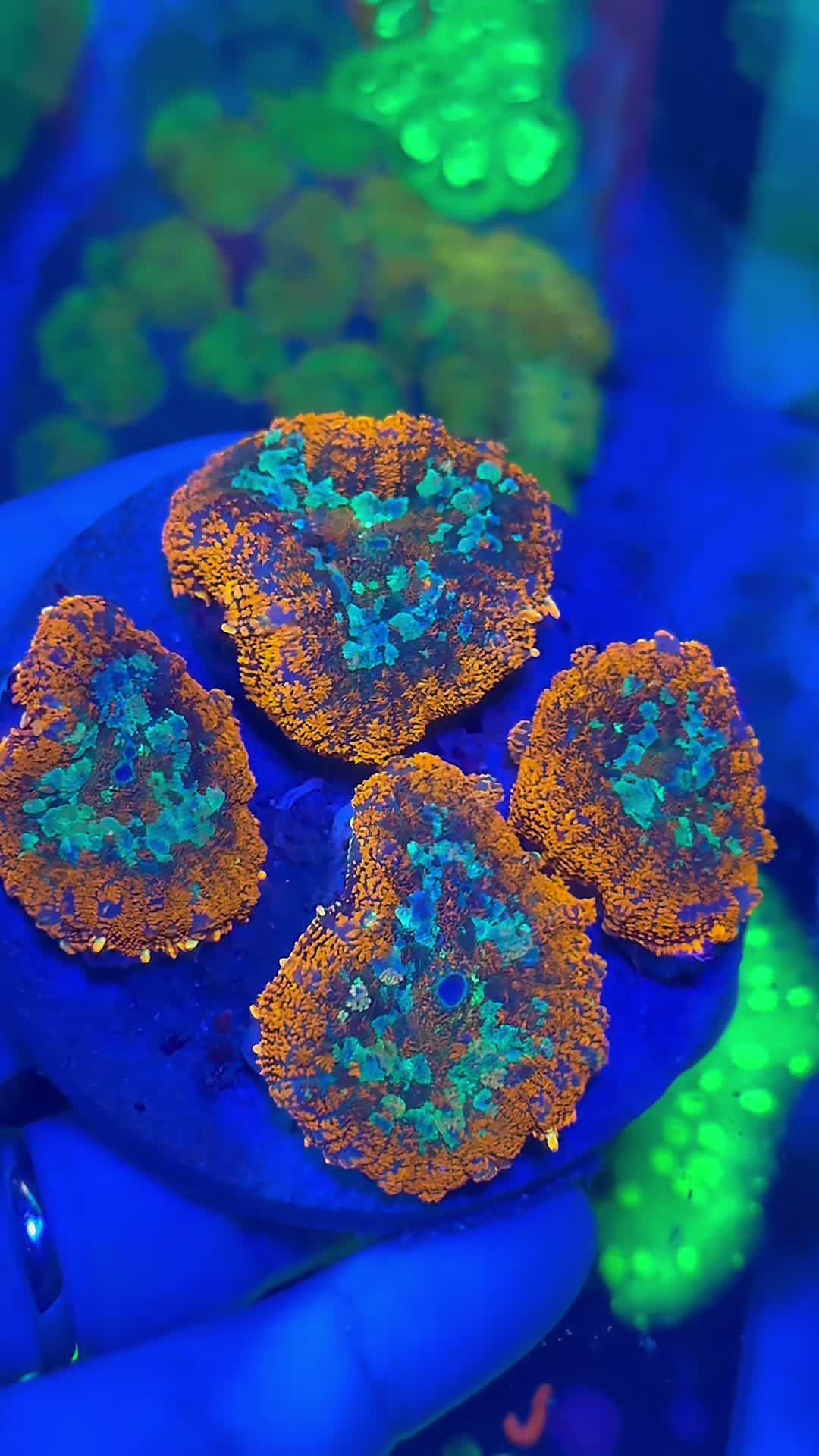
A single polyp is the whole animal. It has one central mouth, a disc covered in short tentacle-like structures called pseudotentacles, and no way to move quickly. When conditions suit it, the polyp walks very slowly by shifting its foot, and when conditions stop suiting it, the foot lets go and the polyp drifts. Both behaviours come up again and again in keeper reports, and both shape how this morph should be placed.
Rhodactis as a genus comes from the Indo-Pacific, including Fiji, Tonga, the Solomon Islands and the Great Barrier Reef, where these mushrooms live on reef slopes, in lagoons and bays, and in other sheltered spots with gentle water movement. The genus spans a huge size range in the wild and in the trade, from roughly 1-inch bullseye types to giant elephant-ear animals. Fire Seas sits at the small, collectable end of that range as a frag-grown morph, and individual polyps should be expected to grow well beyond frag size without ever approaching the giant end of the genus.
Reading the Fire Seas
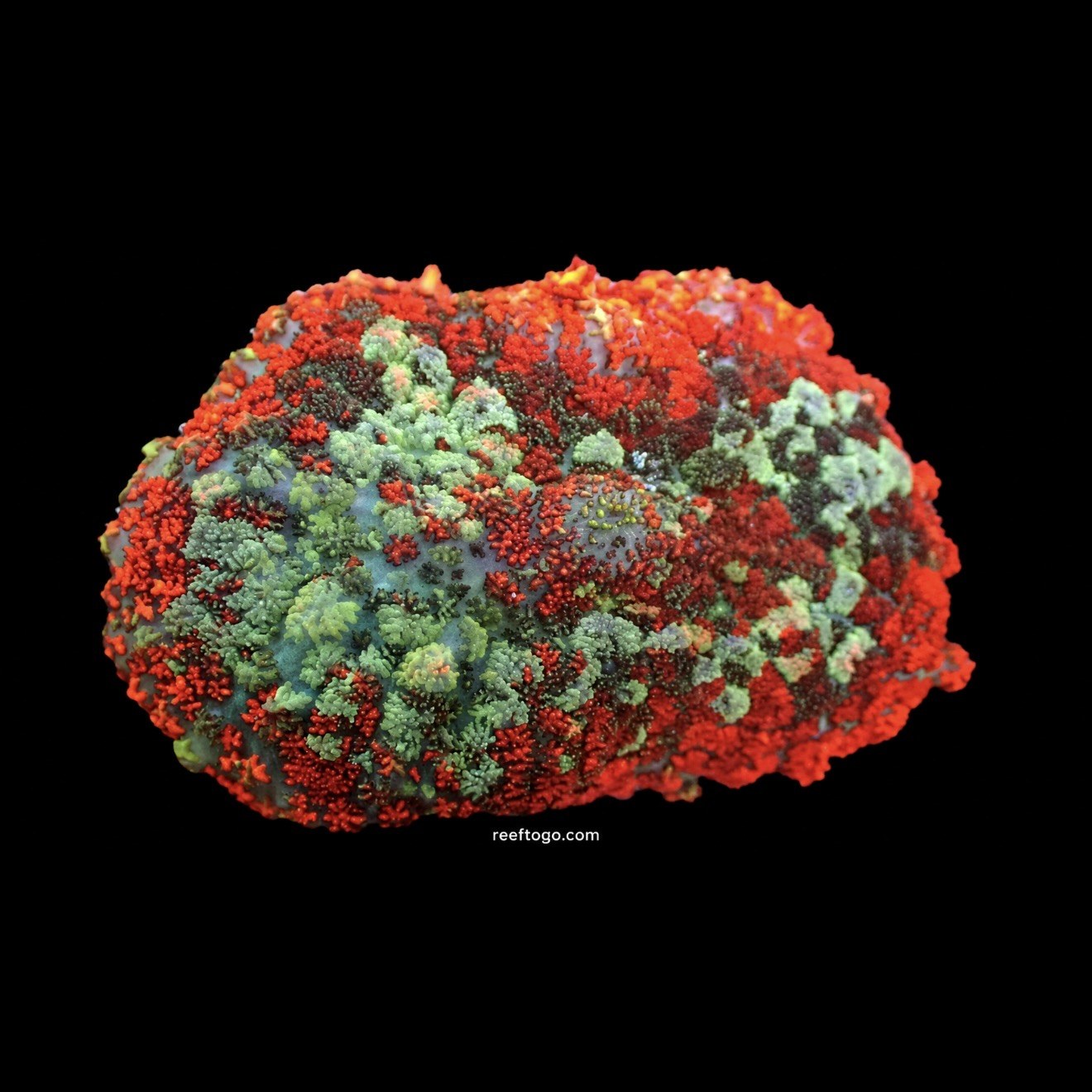
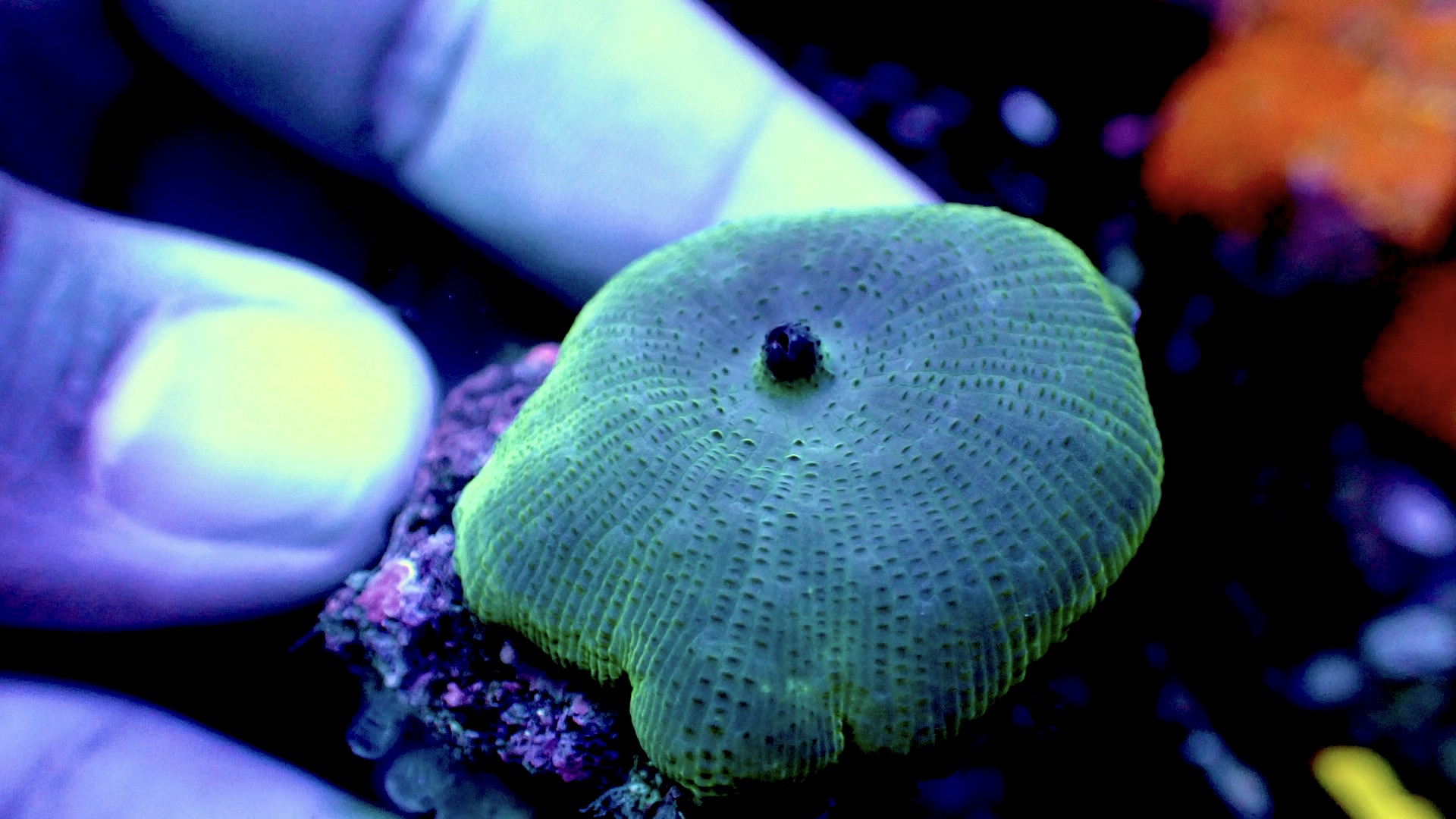
The pattern is readable at a glance once the parts are separated. The centre of the disc carries irregular, mottled patches of teal-green, broken up like shallow water over sand. Around that centre, and thickening toward the edge, the disc is covered in dense orange-gold pseudotentacles, short and branched, giving the whole polyp a fuzzy, granular surface. The rim reads as a band of orange. The mouth is small, dark, and sits at the centre of the disc, one per polyp.
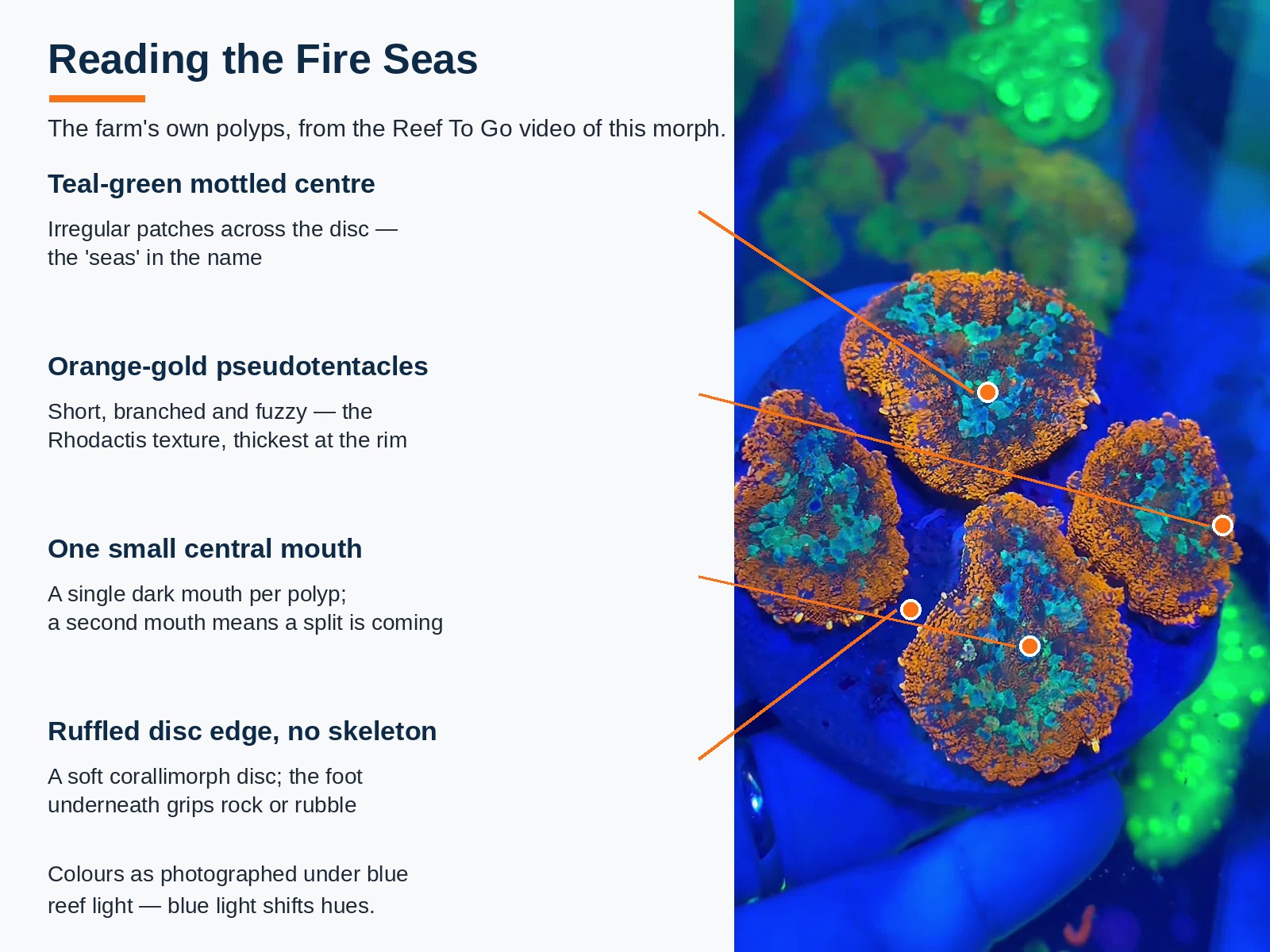
The texture does the genus work. A smooth, mostly bare disc points to Discosoma. A disc covered in uniform round bubble vesicles points to Ricordea. A fuzzy disc of branched pseudotentacles, thinner and more textured than a Discosoma, is the Rhodactis build, and Fire Seas shows that build clearly in the farm's footage. Colour alone is a weak ID tool in this group, because lighting changes it so much; texture plus pattern is the reliable route.
Colours here are described as photographed under blue reef light, which is how the farm's video and most sale photos are shot. Blue light saturates oranges and pushes greens toward teal, so the same polyp under whiter light will look flatter and browner-gold. Judge a newly arrived frag against that, and give it weeks to settle before judging its colour at all.
The name, honestly
"Fire Seas" is a trade morph name, and it describes the pattern plainly: orange fire around teal seas. A diligent search in November 2026 found no vendor listing, naming announcement, or origin record for a morph under this exact name outside Reef To Go's own material, so no namer, release year, or collection locality is claimed here. Plenty of mushroom morphs circulate this way — named by the farm or importer that grew them, passed along frag to frag, with the name travelling better than the paperwork.
That matters for buyers in one practical way. Two mushrooms sold under similar fire-and-teal names from different sources may be the same morph, close relatives, or unrelated polyps that converged on a similar pattern under similar lights. The pattern and texture described above are the checkable identity of this entry; the name is a label for that pattern, and the farm's own photos and video are the reference for what the label means here.
Colour and light
Fire Seas is photosynthetic, hosting zooxanthellae in its tissue, and its working light range follows the published Rhodactis bands. Tidal Gardens bands mushroom light as low at 30–50 PAR, medium at 50–150 PAR, and high above 150 PAR. Within those bands, Tidal Gardens has kept Rhodactis long-term at around 75 PAR, and has also kept Rhodactis thriving at roughly 100–150 PAR placed 18–20 inches deep in an SPS-dominated tank. The practical reading for this morph: start a new polyp low, then settle it somewhere in the 50–150 PAR span and leave it there.
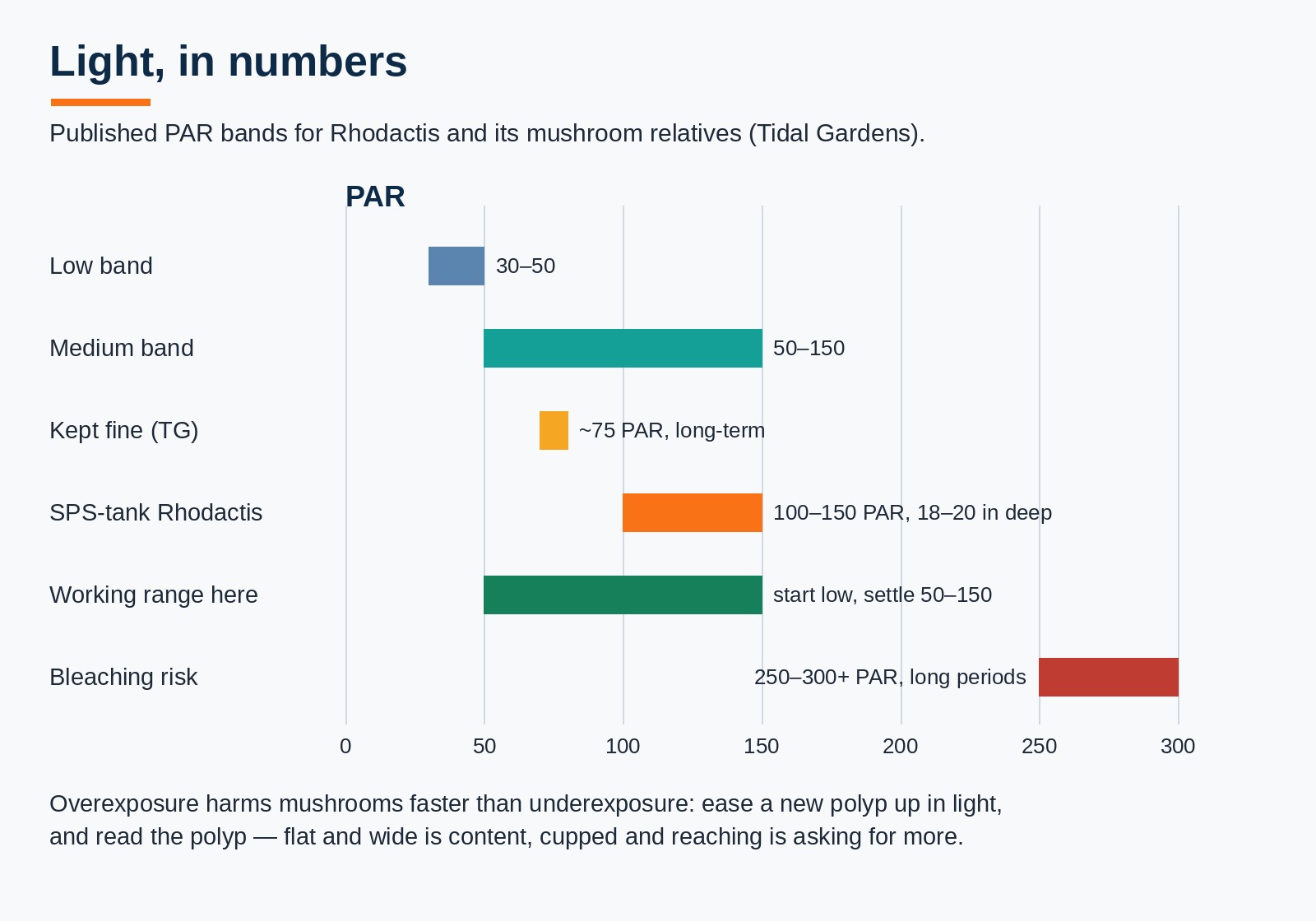
Too much light is the dangerous direction. Rhodactis profiles put bleaching risk at sustained exposure in the 250–300 PAR region and beyond, and Tidal Gardens warns that severe overexposure in mushrooms produces oxide radicals that show on the flesh as strange white growths — a warning every keeper should know before a pale patch gets mistaken for growth or disease. Underexposure is easier to read and easier to fix: a polyp that cups upward and stretches toward the light is asking for more, and it can be moved up gradually over days. A polyp that shrinks flat, pales, or lets go has usually had too much, too fast.
Tidal Gardens also notes that Rhodactis colour stays comparatively consistent when lighting technology or intensity changes within a sane range, so chasing colour with ever-bluer or ever-stronger light buys less here than patience does. Stable light in the working band, given time, is the colour strategy.
Flow, placement and neighbours
Place Fire Seas at the bottom to bottom–middle of the tank, on rock or rubble, in gentle indirect flow, with 2 inches of clear space around the colony. That placement matches its care card and every care source consulted. Low flow does two jobs for a mushroom: the polyp extends wider and flatter in calm water, and the foot keeps its grip. Flow strong enough to lift a disc edge is flow strong enough to start a detachment, and a drifting mushroom reattaches poorly — several sources describe detached Discosoma and Rhodactis polyps tumbling for weeks without gripping anywhere.
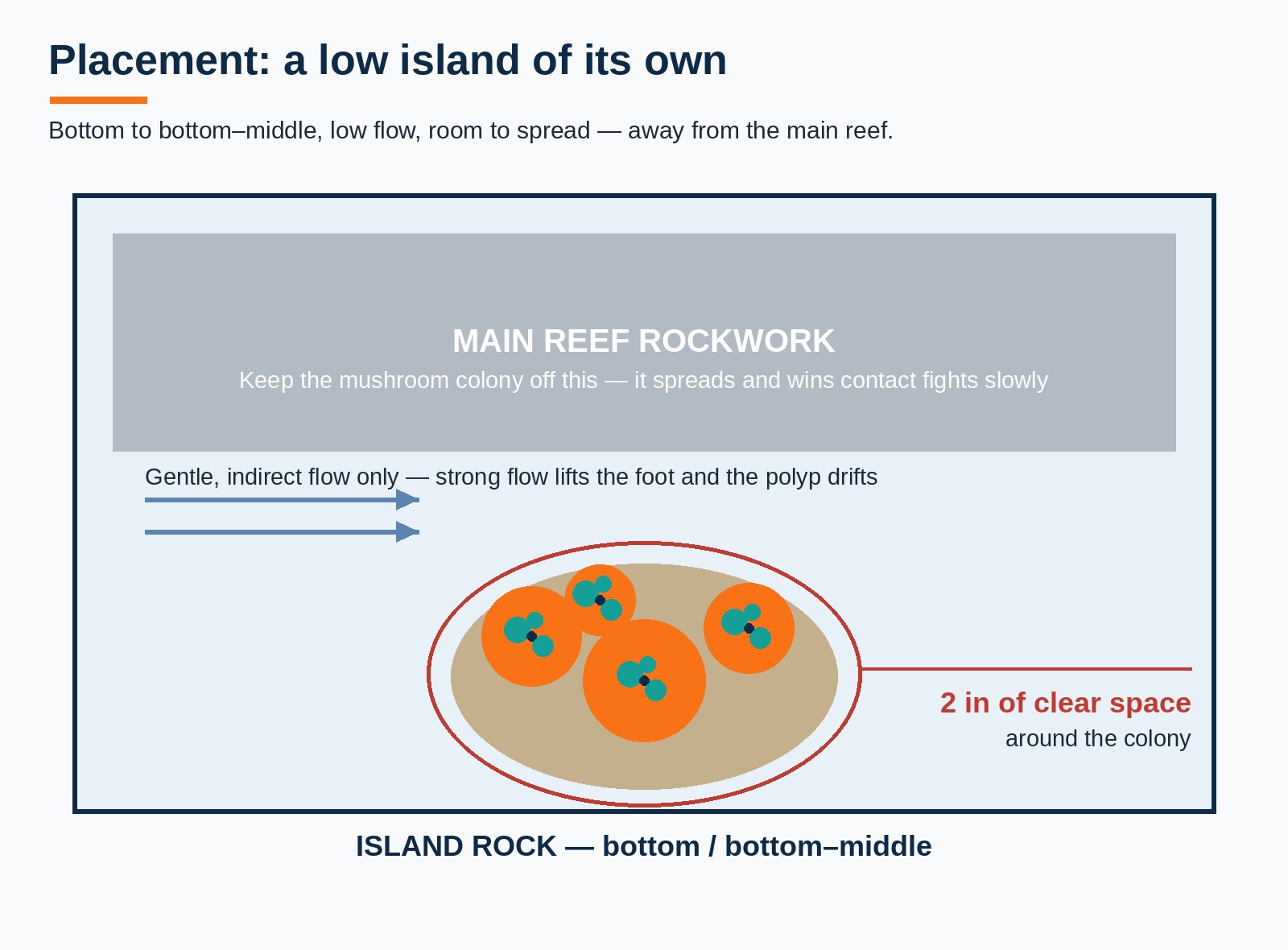
An island rock, separated from the main reef by sand, is the placement experienced mushroom keepers keep recommending, and it suits this morph well. A settled colony spreads polyp by polyp across whatever rock it touches. On an island, that spread has a natural border. On the main rockwork, the colony eventually reaches neighbours it will shade, touch, and slowly overgrow.
Neighbours need a measured description, because the labels in print disagree with each other (that split is covered in the field notes below). Fire Seas carries no sweeper tentacles and cannot sting at a distance. Contact is the issue: Rhodactis carry a moderate sting on contact, can irritate more sensitive corals they rest against, and win slow contests by growing over the loser. Other Rhodactis morphs are the safe company — mixed mushroom gardens of Rhodactis are a standard, successful arrangement — and hardy neighbours that hold their own fare better than delicate pieces placed within the 2-inch ring.
Feeding
Light covers the baseline. A Fire Seas polyp under working light, in water carrying normal reef nutrients, needs no target feeding to survive, and Tidal Gardens' position on Rhodactis is that photosynthesis alone is adequate. Feeding is a growth and colour lever, pulled deliberately, rather than a requirement.
Rhodactis feed more actively than their smooth Discosoma relatives. Sources on the genus describe polyps folding the disc margin up and over food items to envelop them, taking small meaty foods and zooplankton-sized offerings that Discosoma largely ignore. A keeper who wants to feed can turn pumps off, rest a small amount of fine meaty or particulate coral food on the disc, and give the polyp unhurried minutes to fold and take it in. Broadcasting fine foods and phytoplankton also reaches mushrooms, which absorb dissolved and fine particulate nutrition from the water.
Two cautions keep feeding helpful. First, uneaten food resting on a disc invites tankmates to pick at the polyp, and repeated picking damages mouths — feed small, and feed the tank's shrimp and fish first if they rob corals. Second, mushrooms come from comparatively nutrient-rich, sheltered water and generally look better with measurable nitrate and phosphate than in ultra-sterile water; keepers running ultra-low-nutrient systems report mushrooms shrinking and sulking, a pattern covered again in the field notes.
Growth and fragging
Expect moderate growth from a settled polyp, in line with its care card: a healthy frag expands, thickens, and then multiplies. Rhodactis multiply mainly by longitudinal fission. A second mouth forms on the disc, the tissue between the two mouths draws in over days to weeks, and the polyp pinches into two separate mushrooms, each rounding out with a mouth of its own. Watching for a second mouth is the reliable way to know a split is coming, weeks before the discs separate.
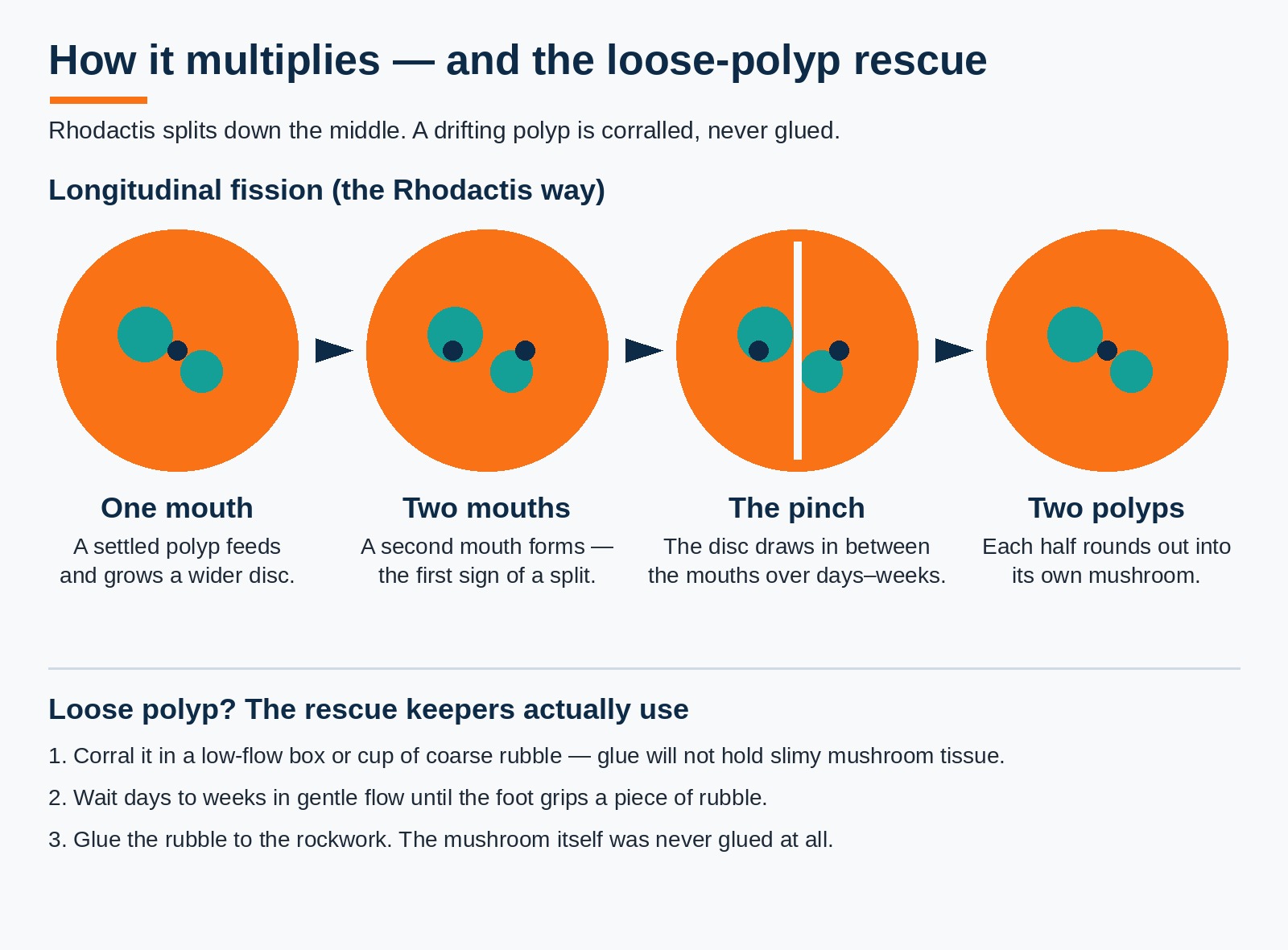
That fission route is slower than the Discosoma route, which is worth knowing before growth rates get compared across a mushroom garden. Discosoma spread by pedal laceration, walking and leaving foot fragments behind, each fragment becoming a polyp; a Discosoma colony can advance noticeably faster than a Rhodactis colony in the same tank, and the difference is method, not health.
Manual fragging follows the fission map: a large polyp can be cut through the mouth so each piece keeps part of it, with every piece left attached to substrate. Tidal Gardens is blunt about the two risks — infection after cutting, and the difficulty of reattaching any piece that comes loose — and records losing a bounce mushroom that never recovered from being cut. For a morph at frag size, the natural split is the safer producer: slower, and the polyps arrive already attached.
Handling and pitfalls
Detachment is the headline pitfall for every mushroom, and the response is a method, not glue. Superglue does not hold slimy mushroom tissue; keeper threads are full of glued polyps floating free within a day, and one widely repeated account has a rubber band slicing a polyp in two. A loose Fire Seas polyp goes into a low-flow box, cup, or basket layered with coarse rubble, where it can sit undisturbed for days to weeks until its foot grips a rubble piece. The rubble then gets glued to the rockwork. The mushroom itself is never glued at all.
Read detachment as information before treating it as bad luck. Polyps let go most often when light jumped too fast, flow increased, or salinity moved — keeper reports specifically link floating mushrooms to salinity drops, so a drifting polyp is a prompt to check the refractometer and any recent changes before blaming the animal. A polyp that detaches repeatedly from the same spot is voting against that spot; move the rubble it grips, not just the polyp.
New frags deserve a slow first week: drip acclimation, a coral dip per the dip maker's directions, placement low in low flow, and no rearranging while the foot sets. A closed, contracted mushroom on day one is normal mushroom behaviour after shipping and handling. A mushroom that stays contracted, expels its innards as white filaments repeatedly, or starts to dissolve at the edges needs stable water, lower light, and time in calm conditions — and separation from anything picking at it.
Handle polyps with clean, wet hands or gloves, wash hands after tank work as with any reef animal, and keep mushroom rock out of any boiling or steaming cleaning routine; reef tissue belongs in the tank or in the bin, never in a cooking pot. Frags travel best attached, so a Fire Seas frag riding on its rubble or plug is worth more than a loose polyp in a bag, however bright the loose one looks.
Field notes — what keepers report
Feeding divides keepers, and both sides have results to point at. One camp never target-feeds Rhodactis at all and grows colonies on light alone, matching the Tidal Gardens position that photosynthesis is adequate. The other camp target-feeds settled polyps and reports faster growth and fuller discs, and the genus's food-folding behaviour is well documented when food is offered patiently with pumps off. The honest summary from the reports: feeding speeds a willing polyp up; it rescues nothing, and a polyp that will not fold for food usually has a placement or water problem to fix first.
Light reports split the same way, and depth explains most of the split. Beginner guides commonly cap mushrooms at 50–100 PAR and call them low-light animals, full stop. Against that stand documented Rhodactis thriving at 100–150 PAR deep in SPS tanks, and Tidal Gardens' own long-term success around 75 PAR. Keepers reconciling the two usually land on acclimation: a polyp raised in dim water bleaches when dropped straight into bright water, while a polyp eased up over weeks can hold the higher band. The number matters less than the ramp.
Aggression labels in print genuinely conflict for this genus. Retail tables for Rhodactis variously list the temperament as Peaceful and as Semi-aggressive — at least one major retailer's own material uses one label in its facts table and the other in its text — and care sites split between "generally peaceful" and "moderate sting, give it space." Keeper experience threads those two together: nothing is stung at range, contact damage to delicate neighbours is real, and overgrowth does the slow damage. The 2-inch space on the care card is the working compromise those reports support.
Spread speed gets exaggerated in both directions by comparison with Discosoma. Sellers and sellers' guides call mushrooms fast-spreading as a group, and Discosoma earn that label with pedal laceration. Rhodactis keepers report a slower, steadier advance built on fission, with colonies taking seasons to carpet an island. A Fire Seas colony that adds polyps steadily without racing is behaving normally for its genus.
The detachment threads carry the most consistent keeper wisdom in this whole entry. Reports agree that salinity dips, flow changes, and light jumps trigger most releases; that babies budding off a crowded colony also drift and are a sign of success rather than failure; and that the rubble-box corral outperforms every glue, band, and net method tried. Several keepers add that a mushroom can take weeks to reattach and look healthy again — one widely shared case took about a month before the polyp attached and extended fully all day — so patience is part of the method, not a sign it failed.
Field Notes
Related species
Gold burst mushroom
Rhodactis sp
Same genus
Rhodactis Mushroom
Rhodactis sp.
Same genus
Sunkist Bounce Mushroom
Rhodactis sp.
Same genus

Acid Galaxy Yuma Ricordea
Similar care · Soft
Blue discosoma mushroom
Discosoma sp
Similar care · Soft

Lava Monster Yuma
Similar care · Soft

Mellow Yellow Yuma
Ricordea yuma
Similar care · Soft

Neon green hairy mushroom
Discosoma sp
Similar care · Soft
Recommended from the shop


Love this species? No tank needed.
Reef art from the shop — for the wall, not the tank.


Get notified when Reef To Go has Fire seas mushroom in stock or up for auction. One email when it's in — no spam.