
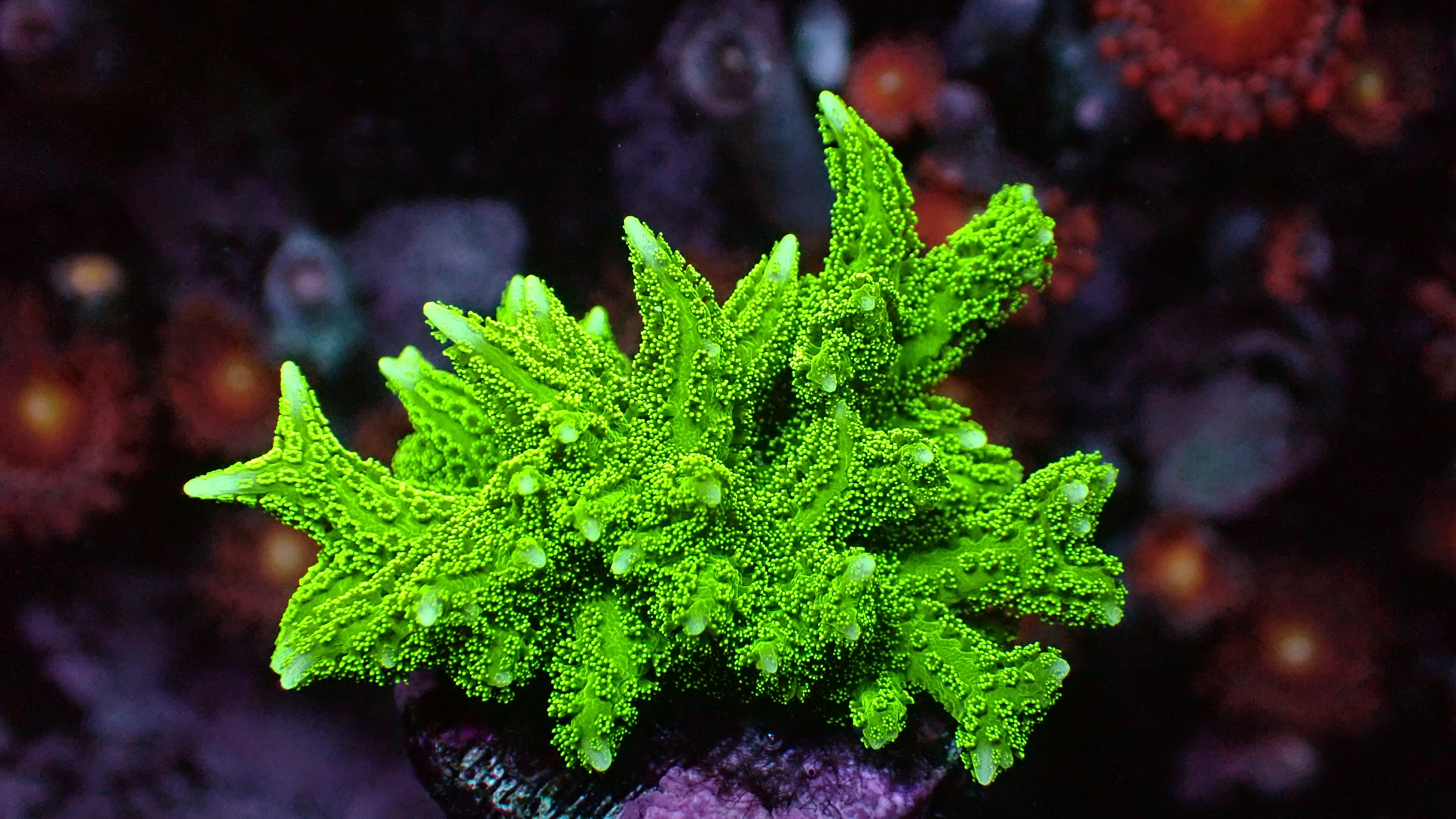
Jade birdnest
Seriatopora sp.
Jade birdnest is an SPS coral listed as Seriatopora sp., grown for the dense thicket of thin branches a settled colony builds. Birdnest corals grow as a tangle of tapering branches with polyps set in neat rows along each stem, and branch tips that end in fine points. A healthy colony looks like a small woven nest lifted off the rock, with new tips paler than the body as growth extends. The jade name follows the soft green tone carried through the branches and polyps, a color that reads cleanly under blue-leaning light and deepens in a stable tank.

The entry lists intermediate care, high light, medium flow, middle placement, peaceful behavior, and moderate growth. The original notes add stable alkalinity as a point to watch. Place the frag in the middle of the rockwork on solid rock, with room on every side for the thicket to widen. High light in the middle of the tank holds the green color and keeps branch growth compact. A colony kept too low or shaded grows thin, spaced branches that reach for light, while a sudden jump in light can bleach the fine tips first.
Medium flow should move through the whole thicket and change direction as it passes. Birdnest branches shed waste and trapped detritus poorly in still water, and pockets inside a dense colony collect film when the current only brushes the outside. A direct jet can strip tissue from the branch it hits. Broad, varied movement that makes the whole colony sway slightly is the pattern to set, and flow needs to be revisited as the thicket fills in and starts to block its own center.
Feeding is fine and indirect. The small polyps take fine particulate food and dissolved nutrients from regular broadcast feeding, and light supplies much of the energy. Stable alkalinity, calcium, and magnesium carry the branching skeleton, and birdnest corals answer alkalinity swings quickly, with tip recession a common first sign. A tank with present, steady nutrients and steady chemistry supports clean tips and even color, while chasing numbers with large corrections tends to set the colony back.
This coral is listed as peaceful, with no sting and no sweeper reach. Spacing is about growth and shade. The thicket widens in every direction, shades whatever sits beneath it, and can grow into a neighbor and die back at the contact point, which leaves a bare patch inside the branches. Leave open room around the frag, keep slower SPS clear of its future footprint, and plan for pruning room once branches start to crowd nearby pieces.
Growth is listed as moderate, and a settled birdnest can speed up once its base encrusts and branch tips multiply. Each tip is a growth front, so a colony with many tips adds size visibly over a season in steady water. Growing tips that pale evenly can be normal new growth, while tips that turn bare and skeletal while the base stays colored point to an alkalinity swing or a recent change in light or flow.
Common pitfalls include mounting the frag low in dim light and waiting for color that needs a brighter spot, parking it where detritus settles into the thicket, and making large alkalinity corrections in a single day. Start in the middle of the rockwork under high light, keep varied flow moving through the branches, and hold alkalinity steady.
Field notes — what keepers report
- Alkalinity reports dominate the keeper record for birdnest corals. Keepers describe colonies sailing through stable months and colonies that lost branch tips within days of a dosing swing, with no other change made. Both sides land on small, steady dosing as the practice that keeps tips intact.
- Flow reports split on density. Keepers with open, younger colonies describe modest flow as plenty, while keepers with mature thickets describe raising flow or pruning the center after film and bare patches appeared inside the branches. The shared lesson is that a birdnest colony changes its own flow as it grows.
- Color reports track light. Keepers in strong light describe compact growth and the clearest jade green, while keepers in lower light describe longer, thinner branches and a duller tone that improved after a slow move up. Recovery is described in weeks, and keepers advise moving the frag in stages.
Field Notes
Related species

Bubblegum digitata
Montipora digitata
Exosphere zoanthids
Zoanthus sp

Aculeus Acropora
Acropora aculeus
Anacropora
Anacropora gracilis

Caliendrum Seriatopora
Seriatopora caliendrum

Digitifera Acropora
Acropora digitifera

Finger Porites
Porites cylindrica

Florida Branch Acropora
Acropora florida
Recommended from the shop

Love this species? No tank needed.
Reef art from the shop — for the wall, not the tank.


Get notified when Reef To Go has Jade birdnest in stock or up for auction. One email when it's in — no spam.