Yellow Polyps
Terrazoanthus sp.
Trade name: Parazoanthus gracilis
Care facts
- Care
- Beginner
- Light
- Medium
- Flow
- Medium
- Place
- Mid
- Space
- Not recorded
- Origin
- Indo-Pacific
- Growth Rate
- Fast
Gallery
What it is
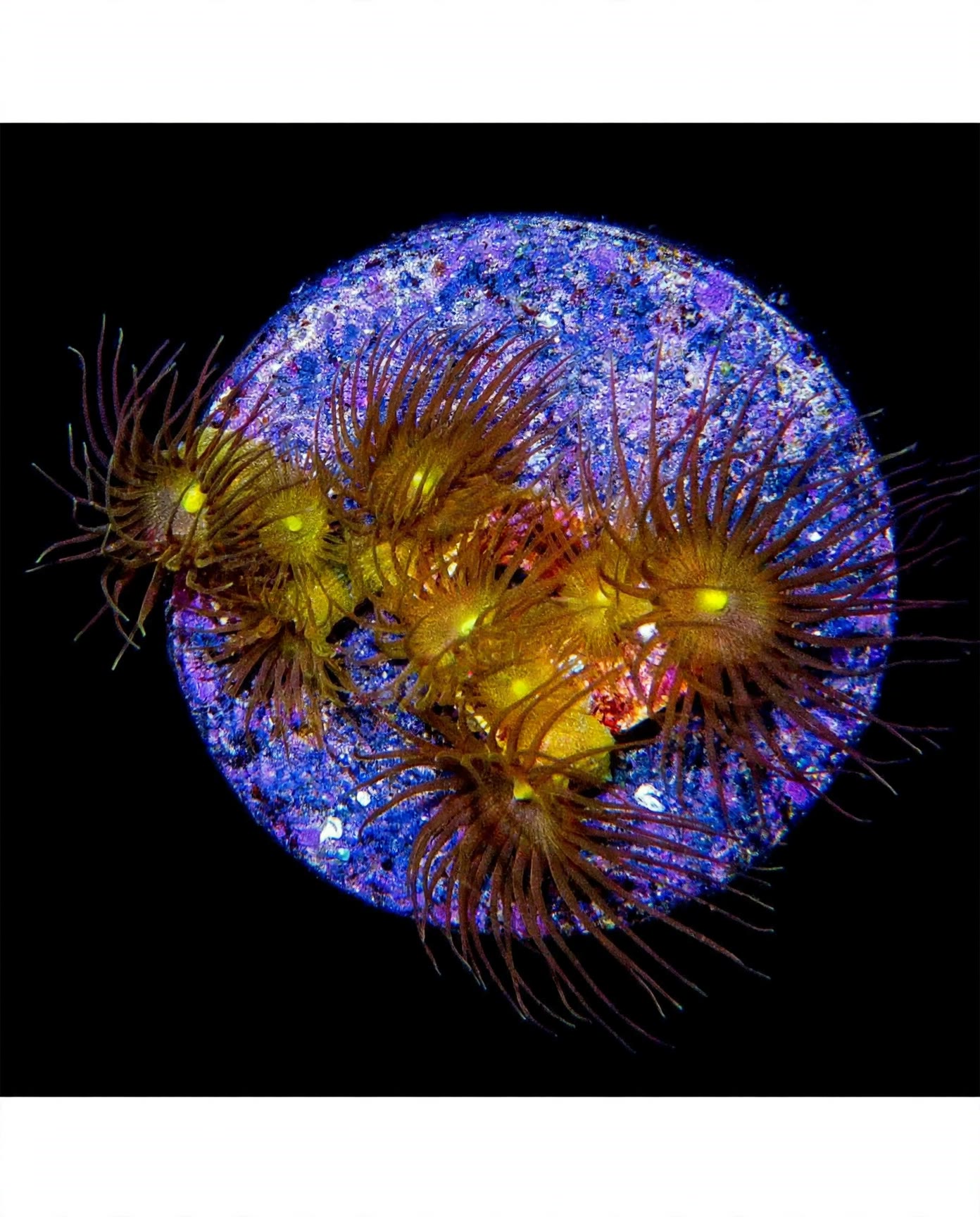
Yellow polyps are a small colonial zoanthid-type polyp that has been a reef-tank staple for decades. Each polyp is tiny — usually under a quarter inch across — with a uniform yellow oral disc and a ring of relatively long, thin yellow tentacles. The polyps stand on individual thin stalks and join to their neighbors through low stolons and thin flesh at the base, so a settled colony reads as a dense yellow mat even though no thick cushion holds it together.
The colony lives free on rock and frag plugs, photosynthesizes, and feeds actively. Bright yellow animals in the trade come mostly from Indonesian rock.
The name on the label
Nearly every yellow polyp in the hobby is sold as Parazoanthus gracilis, and that name is wrong twice over. True Parazoanthus species live on sponges, and the real gracilis — described from Japan and partnered with hydroids — now sits in the genus Hydrozoanthus. Taxonomists who have sampled the trade animal point to an undescribed species of Terrazoanthus, a free-living genus split out of the old Parazoanthus catch-all in 2010.
Yellow polyps are a different animal from Palythoa as well. Palythoa polyps sit embedded in a thick coenenchyme packed with sand and grit, and they run much larger. Close this animal down and look between the polyps: bare rock and thin stolons mean yellow polyps, while a gritty cushion means Palythoa. The old name Protopalythoa turns up in older books; it was folded into Palythoa and never applied to this animal in the first place.
Color and light
The yellow comes from pigment the tissue shows under daylight. Under blue actinic light the colony fades to a muted grey-blue and looks washed out; under a daylight spectrum around 6,500–10,000 K the yellow comes back at full strength. Tanks lit for glowing zoanthids make this coral look dull, and tanks with a good white channel make it shine.
It adapts to a wide band of intensity. At low light, around 50 PAR and under, the polyps grow larger and take on a mustard tone. In stronger light past roughly 150 PAR they stay smaller — as little as a quarter of the low-light size — and turn a brighter canary yellow.
Flow, placement, and neighbors
Moderate to medium-high flow suits it. Moving water keeps detritus from settling around the bases and helps the polyps catch food; a direct blast from a powerhead is too much.
Give the colony its own rock, ideally an island separated from the main rockwork. Listings often call yellow polyps peaceful, and that undersells them. The colony spreads by budding at a fast clip once settled, encrusts over whatever it touches, and experienced sellers warn it wins stinging contests against nearby corals. Kept on an island, the spread is easy to enjoy and easy to trim. Loose in the main rockwork, it becomes a long-term tenant.
Feeding
Yellow polyps are photosynthetic and do not require feeding, but they hunt with more enthusiasm than most zoanthid-types. The long tentacles are built for prey capture, and the polyps close on flake food, baby brine shrimp, and finely chopped mysis. A colony fed small meaty foods a few times a week grows noticeably faster than one left to light alone.
Handling
Treat yellow polyps with the same respect given to Palythoa. Palythoa is confirmed to carry palytoxin, sometimes at high concentrations, and while the yellow polyps animal itself has never been assayed directly, an unidentified Parazoanthus species has tested positive at high levels — the honest summary is that this animal remains untested. Wear gloves and eye protection when fragging or handling colony rock, keep cuts out of the water, work with the colony submerged, and never boil, steam, or pressure-wash rock that carries zoanthid-type polyps. Wash hands and tools afterward.
Field notes — what keepers report
Keepers describe a coral that survives beginner mistakes: it tolerates swinging parameters, dim corners, and missed water changes better than almost anything else in the tank, and it usually opens again within days of a move.
The same keepers warn about the flip side. Given a season of good conditions, the colony covers every surface it can reach, grows up the bases of neighboring corals, and needs regular trimming to hold its island. Reports of it overwhelming slower tankmates are common enough that many experienced keepers refuse to let it touch the main rockwork at all.
Color reports split by lighting rather than by source. Under white-heavy light the colony photographs as bright yellow suns; under the blue-heavy light most reef tanks run today, the same colony reads olive to grey, and owners sometimes assume it is fading when the spectrum is the whole story. Feeding response gets mentioned often — a fed colony extends taller, opens wider, and buds faster than an unfed one in the same system.
Field Notes
Related species
Magician zoanthids
Similar care · Soft
Armor of God
Palythoa sp.
Similar care · Soft
Blue Sympodium
Sympodium caeruleum
Similar care · Soft

Blueberry Haze Zoas
Zoanthus sp.
Similar care · Soft

Blueberry Zoanthids
Similar care · Soft
Bob Marley zoas
Zoanthus sp
Similar care · Soft

Burning Willow Zoas
Zoanthus sp.
Similar care · Soft

Cabbage Leather Coral
Sinularia brassica
Similar care · Soft