
Zombie Eyes
Zoanthus sp.
Also known as: Zombie Eye


Care Summary
Zombie Eyes carries one of the oldest names in the zoanthid hobby, and the name began as a pattern description before it belonged to any single colony. The master strain queue describes the morph in one line — a pale disc with a dark dilated-looking centre, the original pattern name. That parenthetical is the entry's core fact: in the first naming era of the early 2000s, keepers named what a polyp's face did, and Zombie Eyes named a face whose centre sat wide and dark, the way a dilated pupil reads in a pale eye.
The naming history survives in a first-hand account gathered in the field notes below. A keeper writing in the Reef2Reef PE Zoanthid Catalogue history recalls the era directly: eagle eyes meant a ring pattern, alien eyes meant a dot centre, zombie eyes meant a dilated centre — "like your dead" — and dragon eyes meant the bright green slit mouth. The same account explains what happened next across the whole pattern family: most of those pattern names, Zombie Eyes among them, became associated with one zoa or paly over time. A modern buyer therefore meets the name in its second life, attached to specific material, while the older literature uses it as a pattern word. Both uses are real, and the entry records both.
Identification follows from that history. Judge the pattern first: a pale disc, a centre that sits dark and wide against the face, and a skirt that frames the contrast. Colour claims deserve care, because the surviving keeper record points red: in a 2011 identification exchange read for this entry, a colony photographed and labelled as Ked's Reds — a red zoanthid — was re-identified by another keeper as Zombie Eyes, and the owner accepted the correction. Material red enough to travel under a red strain's name, carrying a pale-and-dark-centred face under other light, is the practical identification problem this strain presents. The honest working rule is the pattern definition plus the centre contrast, checked under neutral light, with any red-name history on the frag treated as context rather than verdict.
Three neighbouring names need clearing away before a buyer compares listings, because the current trade record for this name is mostly collisions. White Zombie is a separate, modern, large-polyp strain with its own database entry and its own vendor listings; keeper discussion files that material as Zoanthus gigantus in the agave family. Zombie Eyes Goniopora is an AquaSD sale name for a goniopora. Zombie Eye Goniastrea is an AquaSD sale name for a faviid. Each name sits close enough to Zombie Eyes to fill a search result page, and none of them is this zoanthid.
The strain-level record is thin, and this entry says so plainly rather than padding it. Searches run for this dossier found no current retail listing for a plain Zombie Eyes zoanthid, no vendor care sheet written for this strain, and no price band that can be quoted honestly. What survives is the pattern-era history, a small set of keeper mentions across 2008–2011 and later club posts, and the family care record. That scarcity is itself useful information for a collector: material offered under this name today arrives with a pattern claim, and the pattern definition in this entry is the check to run against it.
Care follows the hardy zoanthid pattern, held steady. Top Shelf Aquatics' family guidance gives calcium 380–450 ppm, alkalinity 8–9.5 dKH, magnesium 1,250–1,350 ppm, nitrate 5–15 ppm, phosphate under 0.10 ppm, temperature 75–80°F, and salinity 1.024–1.026. Reef To Go's standard reef parameters sit inside that frame: 77–79°F, salinity near 35 ppt (about 1.024–1.026), alkalinity 8–10 dKH, calcium 400–450 ppm, with low but detectable nitrate and phosphate. Reef Builders' family guide runs close alongside, at salinity 1.025–1.026, 75–78°F, alkalinity 8–12 dKH, calcium 400–450 ppm, and magnesium 1,250–1,350 ppm, with weekly water changes of 10–20 percent. Zoanthids carry no calcium skeleton, so the colony itself makes no dosing demand; stability does the work.
Light should start low and rise slowly. The family band in the vendor guidance is 75–150 PAR, with a new frag placed in lower light first and exposure raised gradually over two to three weeks. A pale-disc colony pushed straight to peak intensity risks bleaching the face that carries this strain's identity, so the acclimation matters more here than the final number. A colony that stretches on long stalks is asking for more light; a colony whose centre contrast washes out is asking for less, and the two requests arrive from opposite placements, so move one frag at a time.
Flow should be moderate and indirect. The working pattern keeps debris and algae film off the mat, brings food-bearing water across the polyps, and leaves the colony open and extended. A pump aimed straight at the frag, or flow strong enough to fold the polyps, closes the colony and starts the decline a keeper can misread as disease.
Feeding is a light supplement. Light drives most of the colony's energy. The family guidance records fine phytoplankton and zooplankton foods, plus products such as Reef Roids or Benepets, fed a few times weekly by broadcast or gentle target feeding with the flow paused for about 10–15 minutes so the polyps can capture food. Reef Builders advises dipping zoas and palys periodically or whenever a problem appears, because the family hosts nudibranchs, sundial snails and zoa-eating spiders that travel on new frags.
Placement should plan for a mat that spreads at the family's general pace. Give the colony lower to middle rockwork with the standard 2-inch clearance, keep distance from slow encrusters, and use an island rock or a rubble border when the garden plan needs a hard boundary. The growth tile on this entry is Moderate by the care-card default rule, so placement advice stays general: expect a settled zoanthid mat, watch the leading edge, and prune or lift rubble before the colony reaches a slower neighbour.
Safety applies here as it does across the family. Some zoanthids and their Palythoa relatives can carry palytoxin, and no visual check separates a carrying colony from a clean one. The handling rule from the family guidance is plain: gloves and eye protection whenever the coral is handled or fragged, care around open cuts, no exposure to high heat, and thorough washing afterwards. Heat matters because palytoxin keeps its toxicity when heated, so boiling or steaming rock that carries a colony is a hard rule to keep. Handled with that respect, a settled colony is a durable, long-lived aquarium coral carrying a name from the hobby's first naming era.
Field notes — what keepers report
- The pattern-name origin is the defining keeper record for this strain, and it comes from a participant in that era. The Reef2Reef PE Zoanthid Catalogue history post recalls the early-2000s naming directly: eagle eyes for the ring pattern, alien eyes for the dot centre, zombie eyes for a dilated centre — glossed by the writer as "like your dead" — and dragon eyes for the bright green slit mouth, in the same seasons when the first Purple People Eaters and Nuclear Greens (then called Mountain Dew palys) were arriving. The writer adds the mechanism that shapes every old pattern name: most pattern names became associated with one zoa or paly over time, while the pattern sense faded.
- The earliest dated photographic trace found in the sources read is a keeper's January 2008 forum post in a Reef Central zoanthid photo thread, sharing a photo file named zombieeyes.jpg alongside other named morphs of the period. The file name alone shows the name in ordinary keeper use by 2008, in its pattern-era sense.
- An identification dispute from July 2011 shows the name at work on real material. In a Reef Central collection thread, a keeper posted photographs labelled Ked's Reds, and another keeper corrected the label: those polyps were zombie eyes. The owner accepted the correction and noted the frags had arrived under the Ked's Reds name. Both sides belong in the record — a red-name shipment on one side, a pattern-based re-identification on the other — because they show how this strain's material actually circulated: by photograph and pattern judgement, with names following the face rather than a lineage chain.
- A Texas club record shows the strain in a working collection years later. An Austin Reef Club keeper's tank log lists cherry bombs and zombie eyes among the zoas destroyed by a filefish (the fish, nicknamed Rambo, was removed after also eating a Tubb's Blue colony), with the keeper expecting the colonies to grow back. The mention is casual and practical: Zombie Eyes appears as an ordinary named holding in a serious zoa collection, in the same Central Texas reefing community Reef To Go serves.
- The modern-name record splits, and the split is worth keeping visible. Keeper discussion of the modern White Zombies describes that material as Zoanthus gigantus in the agave family, prone to strong colour and pattern shifts with PAR, spectrum, nutrition and water chemistry, with lineage separating the hardier material. None of that record transfers to Zombie Eyes: the names share a word and nothing else in the sources read, and this entry keeps the two strains apart for exactly that reason.
- No price band is recorded for this strain, deliberately. Searches run for this dossier found no current retail listing for a plain Zombie Eyes zoanthid to quote; the priced near-names are the separate corals in the NOT aliases line (White Zombie at $104.99 cut-to-order and $179.99 on a WYSIWYG listing at Top Shelf Aquatics; Zombie Eyes Goniopora at $60 and $62 in AquaSD sale threads; Zombie Eye Goniastrea at $10 in an AquaSD sale thread). Quoting any of those figures as this strain's price would mislead a buyer, so the entry records the absence instead.
Care
Field Notes
Related species
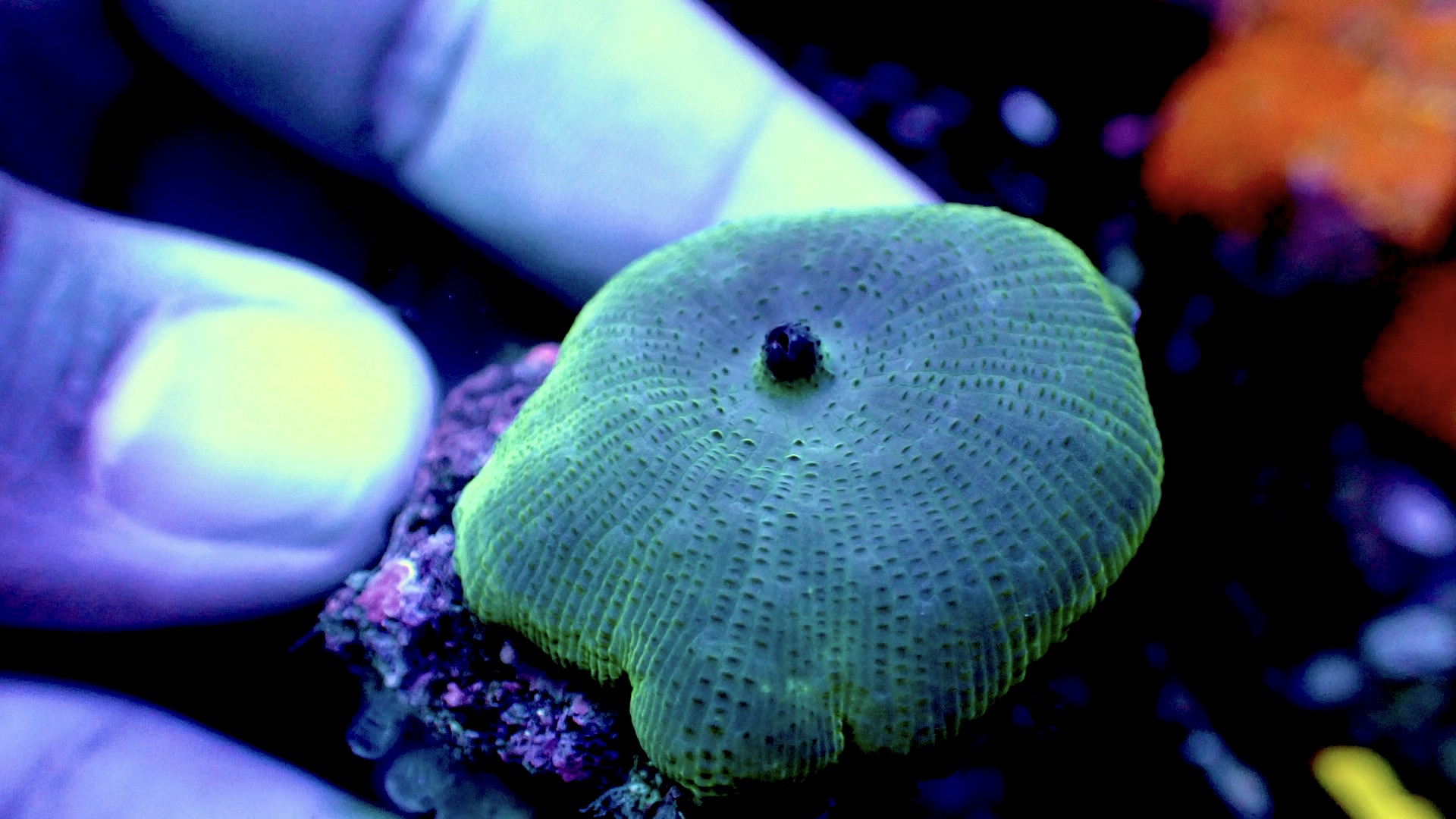
Blue discosoma mushroom
Discosoma sp

Digitata Montipora
Montipora digitata
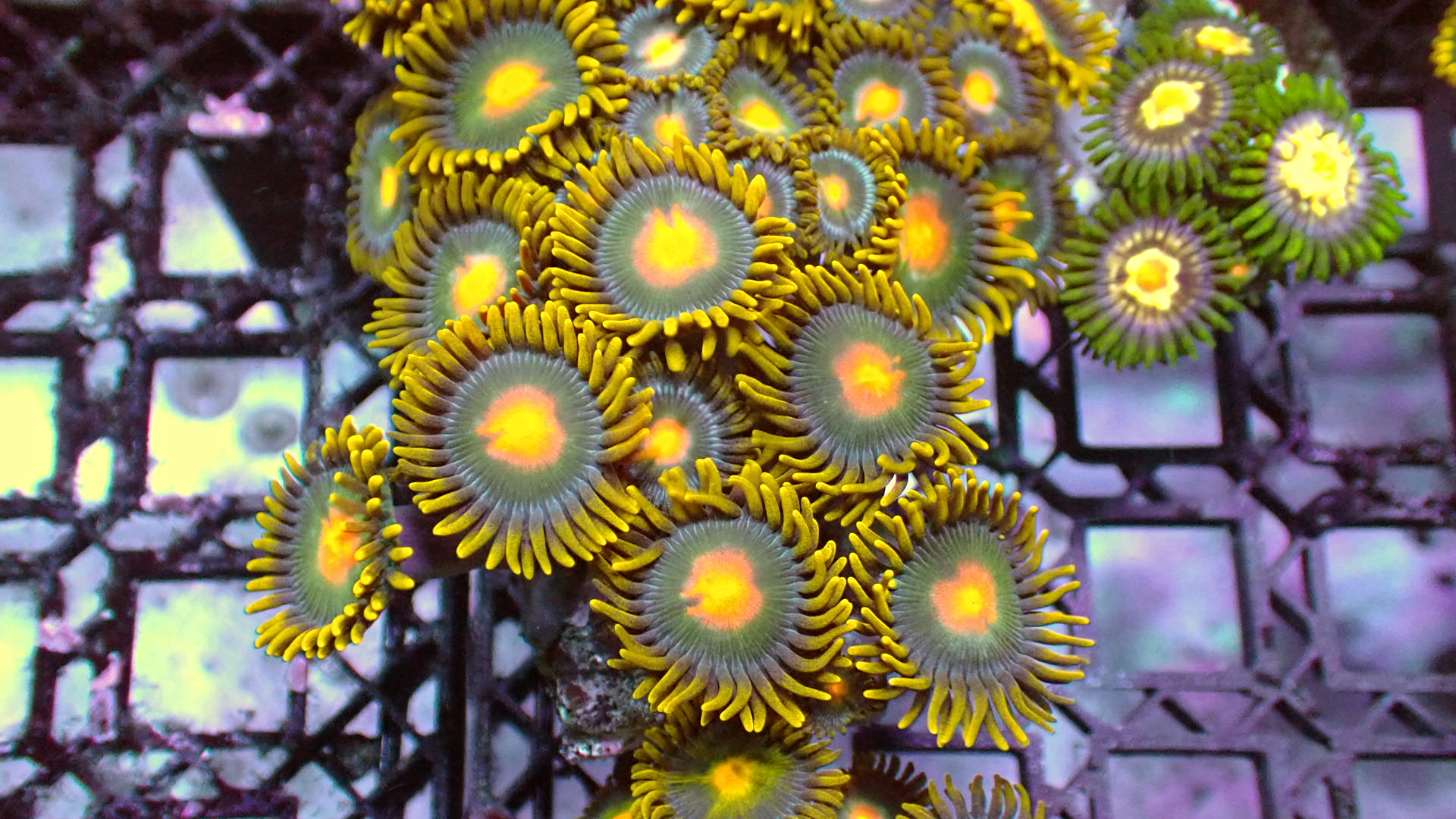
Green Bay Packers zoanthids
Zoanthus sp
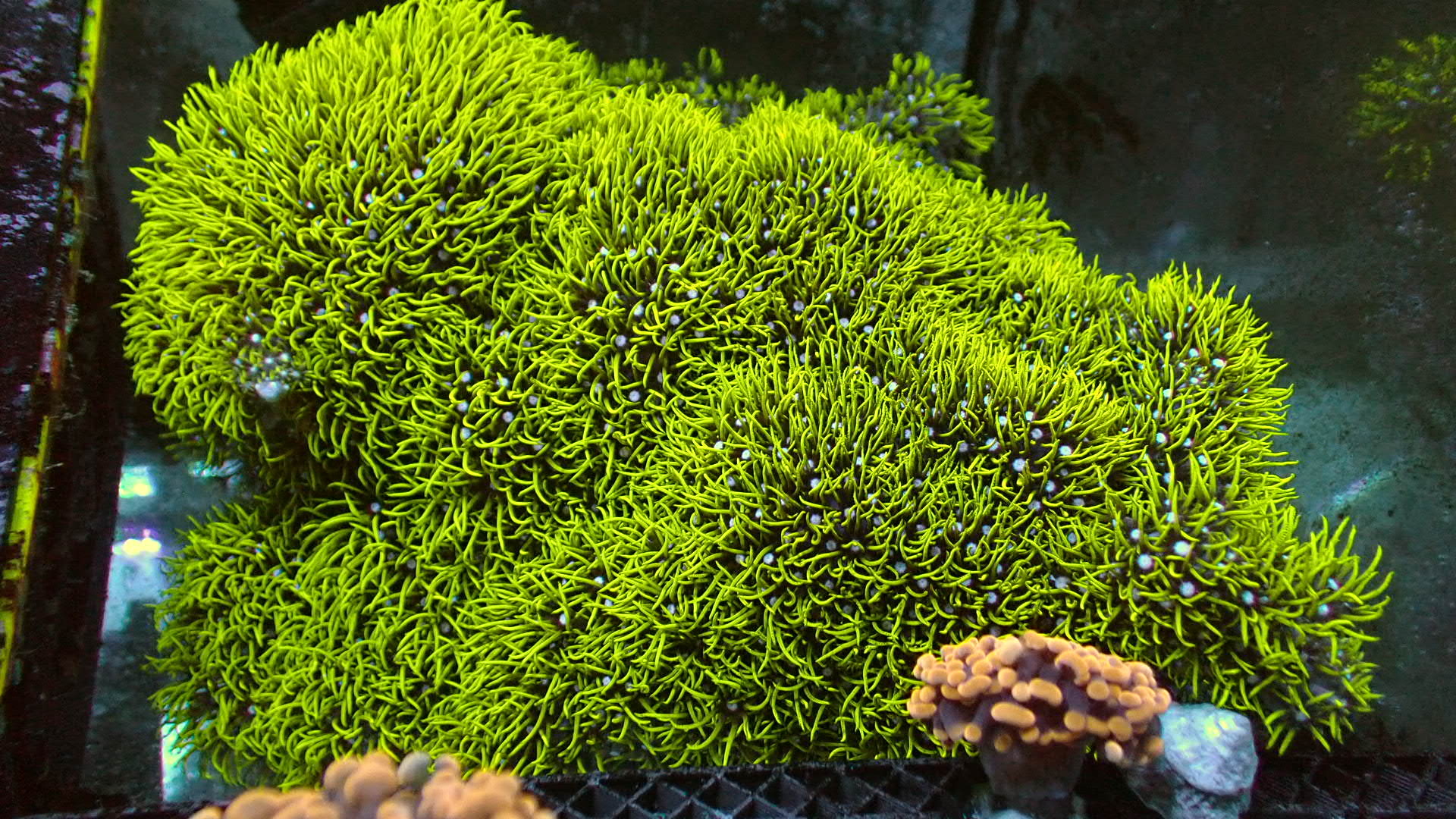
Green star polyps
Pachyclavularia violacea
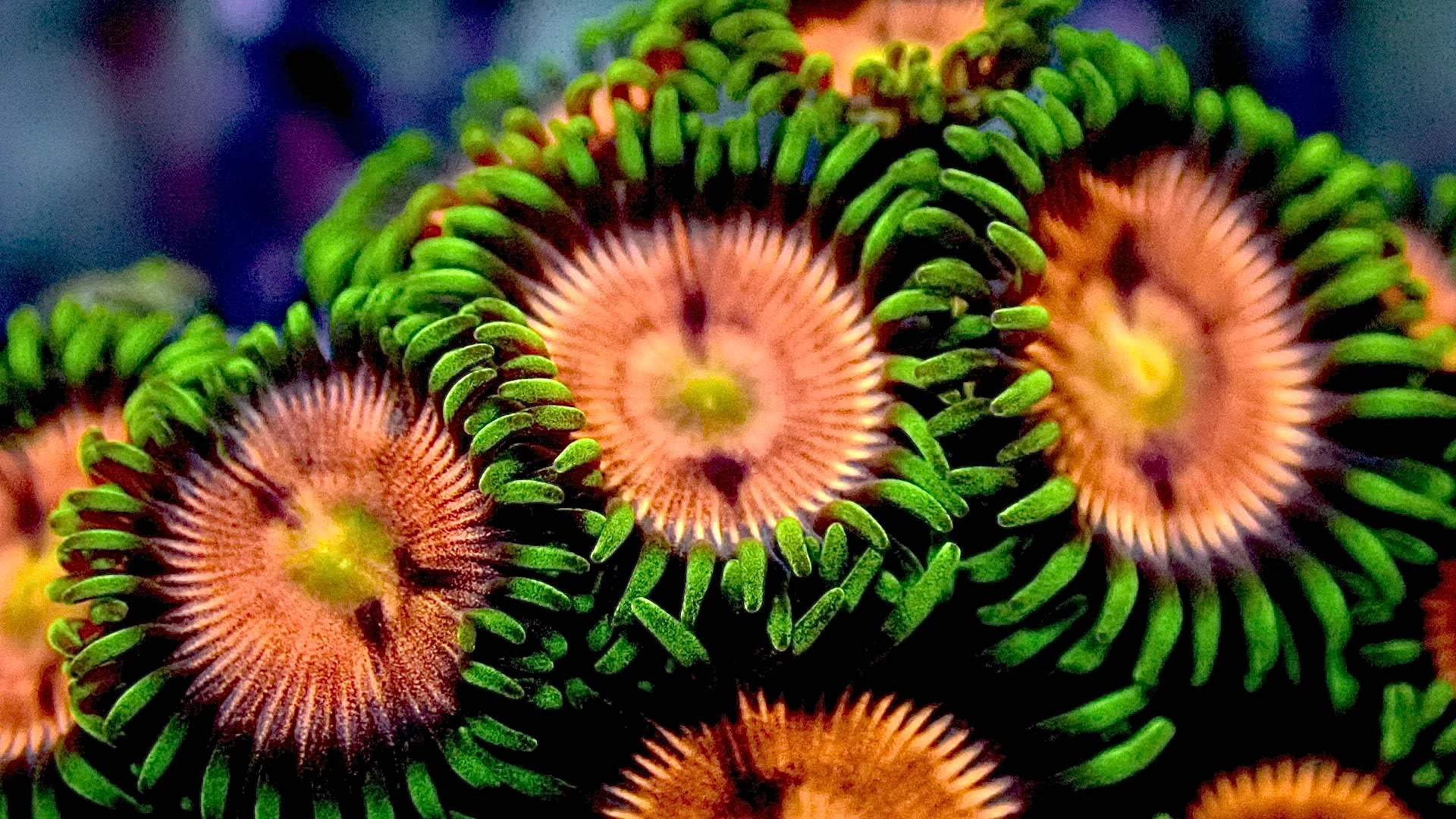
Laser lemon zoanthids
Zoanthus sp.
Leather Toadstool
Sarcophyton glaucum
Lunar eclipse zoanthids

Neon green hairy mushroom
Discosoma sp
Love this species? No tank needed.
Reef art from the shop — for the wall, not the tank.


Get notified when Reef To Go has Zombie Eyes in stock or up for auction. One email when it's in — no spam.