
BC Bubblebath Unicorn
Acropora sp.
Also known as: Bubblebath Unicorn
BC Bubblebath Unicorn is a named Acropora strain from Battlecorals, carried in the master strain queue with a one-line description: pastel rainbow "unicorn" colors. The BC prefix is the farm prefix, and it does real work in the name — the strain circulates through Battleboxes and keeper collections under the full BC form, through national retail under the same form, and through at least one keeper's top-three Battlecorals list under the short form, Bubblebath Unicorn. A frag with no path back to the Battlecorals line is a pastel Acropora with a borrowed name.
The colour record rests on the pastel character, and the entry keeps its limits visible. The queue filing gives pastel rainbow colours. The strain's vendor FAQ at Top Shelf Aquatics is built around the pastel "bubblebath" look as the thing a keeper can lose: the first question on the page asks why the coral loses that look and shifts to brown or neon green. No fuller zone-by-zone colour description for this strain — which hues sit on the branches, which on the tips, which on the polyps — was found in words in the sources read for this entry, and this entry assigns none. One keeper datum exists in words: a keeper growing the strain reported odd colouring developing on his piece, with the tips turning dark blue. That report stands in the field notes as one tank's record. A frag sold as Bubblebath Unicorn should read pastel first; a browned or neon-green piece under this name may be a shifted colony rather than a wrong one, and its light and nutrient history is the first question to ask.
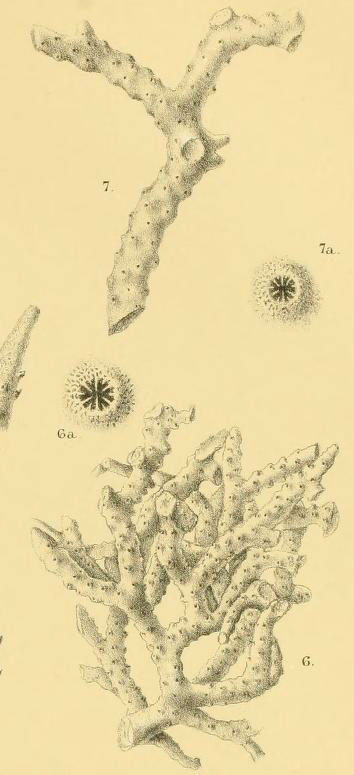
Growth form is the second half of the identity, and the strain FAQ describes it plainly: dense, bubbly branch clusters that easily shade their own base. That single sentence drives the placement, flow, and spacing guidance for the strain. A dense cluster needs an angled mount on an open face, cross-flow that reaches the interior skeleton, and clearance wide enough that the thickening colony keeps receiving light and current on every side. Growth pace is slow on the keeper record, covered in the field notes, so the cluster a buyer pictures is a multi-year project.
Care follows the Acropora standard, tuned hard by the strain record. Top Shelf Aquatics frames the genus as the centerpiece group of advanced systems: vibrant colour and dynamic growth in exchange for careful attention and stable conditions. The strain adds colour work on top of survival work. Holding the pastel look takes a high, blue-heavy light window and a narrow nutrient band at the same time, and the entry treats stability — of alkalinity above all — as the strain's main husbandry point.
Water chemistry follows the standard reef shape, with the strain sources refining the edges. Reef To Go's standard parameters suit the strain's base: temperature 77–79 °F, salinity near 35 ppt (about 1.024–1.026), alkalinity 8–10 dKH held steady, calcium 400–450 ppm. Top Shelf Aquatics gives this strain's page calcium 420–440 ppm, alkalinity 8–9.5 dKH, magnesium 1,300–1,450 ppm, nitrate under 10 ppm, phosphate under 0.10 ppm, temperature 75–80 °F, salinity 1.025–1.026, and pH 8.1–8.4. The strain FAQ narrows the working band for colour: nitrate 5–15 ppm and phosphate 0.03–0.07 ppm, with alkalinity held at 7.5–8.5 dKH. The FAQ's framing deserves its own sentence in any keeper's notebook: ultra-low nutrients wash the pastels out, and excess nutrients brown the coral. The band between those two failure modes is where this strain lives.
Light is where the pastel look is won or lost. The strain FAQ puts the colour-preserving window at PAR roughly 300–350 under a blue-heavy spectrum with modest whites. The same page's general section sets the genus at 200+ PAR, with whiter light (10K–14K) encouraging faster growth at less vivid colour and deep blue (18K–20K) enhancing colour at slower growth. Acclimation follows the page's guide: float for temperature, drip acclimate, then raise lighting intensity gradually over two to three weeks. The FAQ's tip-burn answer is the strain's clearest diagnostic: pale, burnt tips with a healthy base usually mean high PAR combined with a sudden alkalinity rise, and the response is daily testing, dKH movement kept under 0.2 per day, PAR lowered 10–15 percent, white channels reduced, phosphate checked against bottoming out, and full light resumed only after a week of stability and visible recovery.
Flow follows the strain FAQ at full strength. Strong, random flow is the baseline, and the placement answer adds the mechanism: cross-flow or alternating gyres to push water through the interior skeleton of a cluster that shades and shelters its own base. The general flow guidance on the same page — mixed wavemaker types producing strong randomized patterns, with regular audits as branching colonies change the tank's flow dynamics — applies to this strain with extra weight, because a dense cluster alters its own flow field faster than an open stag does.
Feeding is a supplement with a real but secondary effect. The coral is photosynthetic first. Top Shelf Aquatics feeds its farmed Acropora a phytoplankton blend alongside Benepets, Reef Roids, and various aminos, target-fed gently with pumps off for roughly 10–15 minutes, and credits nutrient-rich feeding and trace elements such as iron and iodine with supporting pigmentation and tissue development. A system with fish, fed normally, covers much of the background nutrition; the strain's narrow nutrient band argues for restraint, since overshooting the band browns the coral the feeding was meant to colour.
Placement should plan for the cluster from the first day. Mount the frag at an angle on an open rock face, with 6–8 inches of clearance, in the middle-to-upper rockwork where the strain's light window is reachable. The FAQ's early-growth rotation advice — turn the colony every few weeks until it develops a more open structure — translates, for a glued frag, into choosing the angle and the face carefully before the glue sets, and into pruning for openness as the cluster thickens. Nothing that needs light should sit inside the future cluster's shadow, and nothing aggressive should sit inside its clearance.
Pests and health checks carry the Acropora list, and the strain FAQ names the inspection routine. Watch for Acropora-eating flatworm bite marks in their crescent pattern, sand-like egg clusters on shaded bases, and hesitant polyp extension; red bugs show as persistent polyp pinching. Quarantine new frags, inspect under white light with a magnifier, run a sequence of dips over several weeks, and brush bases gently. The same page notes that hosting acro crabs can improve polyp extension and deter micro-predators. The genus challenges on the page — rapid tissue necrosis under stress or instability, bleaching under sudden light or temperature change — set the response order: check stability first, light second, pests third, and change one variable at a time.
Price anchors place this strain in the premium named-Acropora band, with a long trade run underneath. Top Shelf Aquatics lists the strain today at $129.99 for a cut-to-order frag, typically ¾"–1", photographed from the mother colony; earlier crawls of the same retailer's page carried $149.99 and $99.99. AquaSD sale threads repeat the strain across several sales: $124.99 and $199.99 in the Easter Week sale, $74.99 in the anniversary flash sale and the new-inventory teasers, $74.24 and $98.99 in a clearance drop, and $28.00 after a 65%-off Labor Day sale applied to a $79.99 regular price. The recorded spread runs from a $28 sale-event frag to a $199.99 sale-thread listing, with current national retail at $129.99. Battlebox inclusions — the channel in the progression record below — price the strain differently again, as one curated piece inside a bundled box, and the dossier records that channel without inventing a per-frag split.
Field notes — what keepers report
- The longest dated keeper record for this strain is a progression thread, and it sets the growth tile's timescale. On Reef2Reef, keeper ryshark documented his BC Bubblebath Unicorn from a frag received in a Battlebox in May 2022: the clear photograph he singled out, taken with the mini colony lifted close to the camera, came a year and a half later, and the final two photographs in the thread show the colony at its current size, drawing responses that praise the colony and call its growth interesting. A frag that reads as a mini colony at eighteen months and as a colony worth a dedicated progression thread years later is a slow, compounding grower — steady rather than stalled, and measured in years.
- The slow-grower framing appears independently in a second keeper's words. In the "Bubba's SPS Journey" thread, a keeper asked bubbaque for an updated picture of his BC Bubblebath Unicorn, saying he knew the strain is a slow grower and mainly wanted to see the colours on bubbaque's coral because his own piece looked weird. Bubbaque answered that his piece was starting to develop odd colouring of its own that he was curious about, with the tips turning dark blue. Two keepers, two tanks, and the same two observations — slow growth, and colour that does unexpected things — arriving without either keeper answering the other. A further reply in that thread holds that light makes a huge difference, from a keeper who could not grow the strain at first until he got a better light; that claim sits comfortably beside the strain FAQ's narrow 300–350 PAR window.
- The colour-shift record has a vendor side and a keeper side, and they agree on the shape while differing on the details. The vendor side, from the strain FAQ: pastels wash out under ultra-low nutrients, excess nutrients brown the coral, and a blue-heavy spectrum at PAR 300–350 with nitrate 5–15 ppm and phosphate 0.03–0.07 ppm brings the shimmer back once stability returns. The keeper side: dark blue tips appearing on a piece whose owner called its colouring odd, and a second keeper describing his own piece as weird-looking in the same exchange. Neither keeper record names nutrients or spectrum as the cause in his own tank, so the entry records the vendor mechanism and the keeper observations side by side without merging them into a single settled story.
- The strain's standing among Battlecorals keepers is a quiet, durable record. In the Reef2Reef thread asking keepers for their top three to five Battlecorals frags, one keeper's first-ever Battlecorals order produced a top three of Secale, Death Lemon, and Bubblebath Unicorn, with the caveat that his pictures did not do the frags justice. In a later collection thread, a keeper building an expensive SPS want-list placed BC Bubblebath Unicorn on it alongside Walt Disney, JF Homewrecker, ORA Pearlberry, and Oregon Blue Tort — company that marks the strain as a recognised collector piece rather than a novelty. A tank journal on Humble.Fish lists BC Bubblebath Unicorn in a planned high-end Acropora roster beside PC Rainbow, ORA Red Planet, and RR Pink Cadillac. The strain keeps appearing on lists keepers write for themselves, across a decade of threads.
- The price record splits by channel, and both channels stay visible. Retail channel: $129.99 today at Top Shelf Aquatics for a cut-to-order ¾"–1" frag, with $149.99 and $99.99 on earlier crawls of that retailer's listings. Sale channel: AquaSD's repeated listings at $199.99, $124.99, $98.99, $74.99, and $74.24, down to $28.00 in a 65%-off event. Bundle channel: Battlebox frags, the route in the progression record, where the strain arrives as one selected piece in a curated box. The dossier records the full spread rather than averaging it away; the honest summary is a strain that trades at premium named-Acropora retail, appears constantly in one major sale vendor's events, and built its keeper base largely through the farm's own boxes.
Field Notes
Related species

Aculeus Acropora
Acropora aculeus
● Beginner · ●●● Advanced
Anacropora
Anacropora gracilis
● Beginner · ●●● Advanced

Caliendrum Seriatopora
Seriatopora caliendrum
● Beginner · ●●● Advanced

Digitifera Acropora
Acropora digitifera
● Beginner · ●●● Advanced

Florida Branch Acropora
Acropora florida
● Beginner · ●●● Advanced

Fused Staghorn Coral
Acropora prolifera
● Beginner · ●●● Advanced

Gemmifera Acropora
Acropora gemmifera
● Beginner · ●●● Advanced

Granulosa Acropora
Acropora granulosa
● Beginner · ●●● Advanced
Recommended from the shop


Love this species? No tank needed.
Reef art from the shop — for the wall, not the tank.


Get notified when Reef To Go has BC Bubblebath Unicorn in stock or up for auction. One email when it's in — no spam.