
Goniopora pedunculata
Goniopora pedunculata
Also known as: Goniopora minor, Anemone Coral, Mini Goni, Short Tentacle Goni, Bernardpora
Care Summary
Goniopora pedunculata carries more history than any other flowerpot in this database, because the genus itself is defined by it. When Quoy and Gaimard described the species in 1833, it became the reference point for Goniopora: the Poritidae phylogeny published in PLOS ONE lists Goniopora pedunculata as the type species of the genus, the one species against which the idea of a Goniopora is anchored. A keeper who learns this coral has learned the template the other twenty-nine or so species vary from.
The name a keeper finds in books is often the other one. Crossland described the same coral as Goniopora minor in 1952, from Great Barrier Reef Expedition material, and the minor name ran through the twentieth-century literature — Veron's Corals of the World still files the species under Goniopora minor today, and the IUCN assessed it under that name as well. Veron and Pichon addressed the overlap in 1982: pedunculata, published in 1833, is the older name and the valid one, and minor stands as its junior synonym. This entry files the coral under pedunculata and carries minor as an alias, so a search under either name lands in the same place.
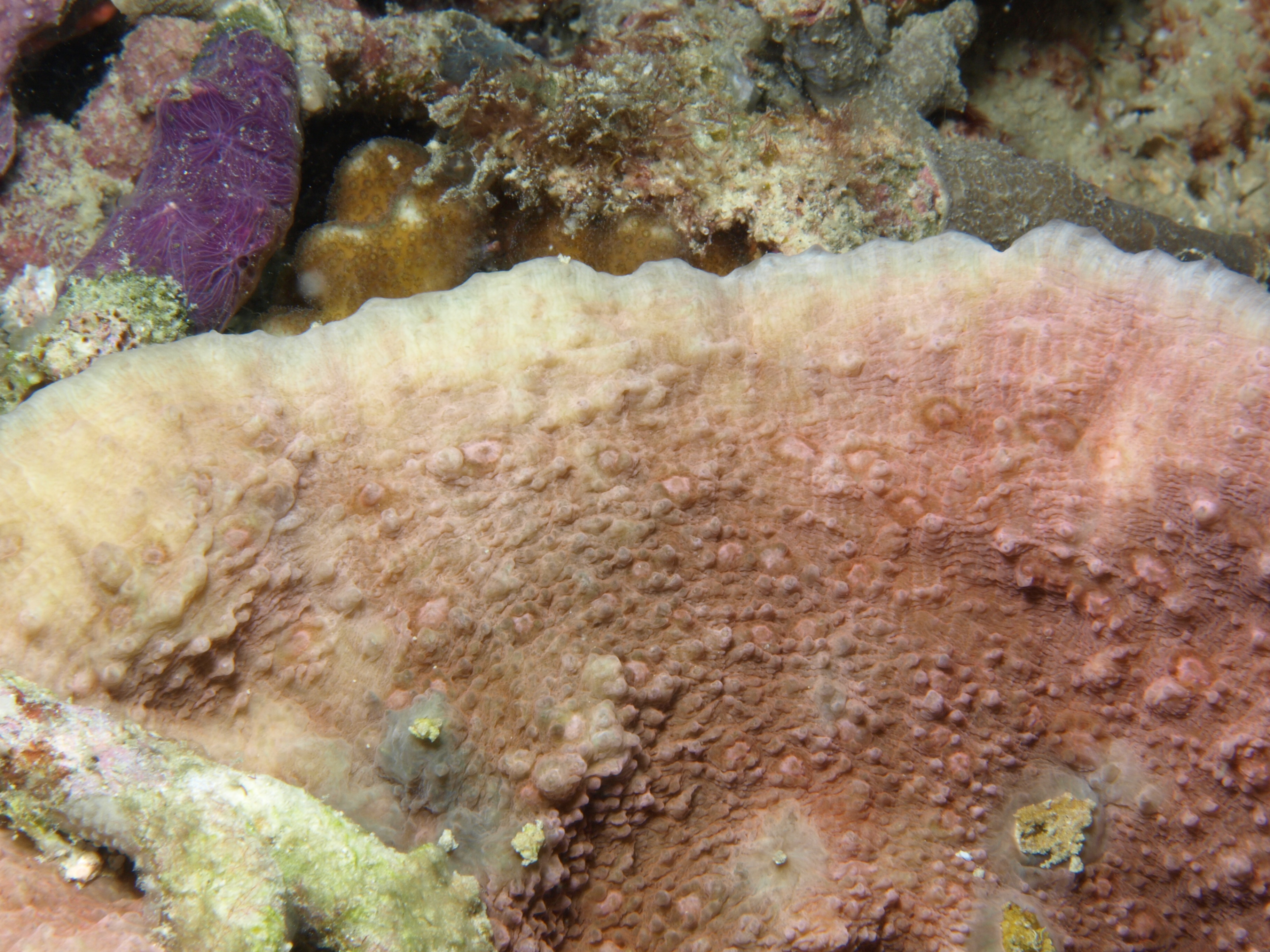
The skeleton is how the species is told apart, and the description has been stable since Veron. Colonies are hemispherical or encrusting. The calices — the cups each polyp sits in — are circular, 2.5 to 4 millimetres across, with thick walls. Inside each calice, six thick pali usually stand in contact and form a small crown, and every septal structure is heavily granulated, rough to a hand lens. Living colonies run brown or green, usually with oral discs coloured distinctly from the rest of the polyp and pale tips on the tentacles. Corals of the World adds the field marks a diver actually uses: subtidal reef environments, especially lagoons, across the Indo-Pacific, and common where it occurs.
Its closest lookalike in this database is Goniopora tenuidens, the similar species Corals of the World names against it: tenuidens carries blunt tentacles of uniform length in regular bundles, while pedunculata polyps are smaller, shorter, and far less showy. The second lookalike is a different genus altogether. True Bernardpora stutchburyi separates on characters a photograph can sometimes show: its tentacles split into two cycles, alternating three outer tentacles against one inner, and its shallow corallites are filled with pali. Encrusting pedunculata colonies are routinely sold as Bernardpora in the aquarium trade, and just as routinely sold as mini or short-tentacle Goniopora. All three labels can point at the same coral, which is why this entry records the trade labels as aliases and the corrections in its field notes.
In the wild the species is a lagoon coral. It grows subtidally in sheltered reef environments and lagoons through the tropical Indo-Pacific — the specimen records behind WoRMS run from the Red Sea and Indian Ocean coasts through Southeast Asia and the Philippines to Australia, Guam, and the western Pacific islands — and like the rest of its genus it tolerates the turbid, food-bearing water that lagoon habitats carry. The IUCN listed it as Near Threatened in 2008 under the Goniopora minor name, citing the broad pressures reef corals face across a wide range rather than a local collapse; Corals of the World calls it common. Like all Goniopora, it moves in the aquarium trade under CITES Appendix II.
Aquarium care follows the genus pattern, with feeding at the centre. Goniopora are photosynthetic, and the early hobby's light-only approach produced the famous delayed decline: a wild colony would arrive glorious, hold for three to six months, then refuse to open and die back to a white skeleton. Top Shelf Aquatics puts early wild-collected success below 20 percent and properly kept aquacultured specimens near 80 percent survival through the first year, and traces the turnaround to regular feeding and stable chemistry. The working routine across the sources read is fine-particle food two to three times a week — powdered plankton blends made for Goniopora, rotifers, phytoplankton as system food, and liquid amino acids — clouded gently over the colony with the pumps paused for fifteen to twenty minutes.
Light and flow sit at moderate settings. Tidal Gardens recommends 75–125 PAR for the genus and has grown Goniopora from about 40–50 PAR to more than 200 PAR, favouring the lower end when in doubt because excess light bleaches and buys nothing. Start a new colony low and raise light gradually over weeks; full, even polyp extension through the day is the sign the level suits it. Flow should be low to moderate, indirect, and preferably random — enough to sway the polyps gently and carry food past the colony. A powerhead aimed at the colony from close range can kill tissue at the contact point and start a chain reaction through the rest of the colony.
Reef To Go's standard reef parameters suit it: 77–79°F, salinity near 35 ppt (about 1.024–1.026), alkalinity 8–10 dKH, calcium 400–450 ppm. Two genus requirements sit on top of that base. Alkalinity stability matters more than any single value — Top Shelf Aquatics calls it the most critical parameter for long-term Goniopora success, with swings triggering tissue recession even in settled colonies. And the water must carry some food value: detectable nitrate and phosphate, with the Tidal Gardens consensus at phosphate around 0.05 ppm and nitrate in the 10–20 ppm band. Ultra-clean systems with nutrients at zero starve flowerpots from both directions at once — no food in the water, and too little arriving by hand.
Placement is the decision this species makes permanent, so it gets its own paragraph. A hemispherical colony on the sand bed behaves like any other flowerpot. An encrusting colony placed on rockwork spreads across that rock, bonds to it, and advances at the margin month after month. Keeper reports gathered in this entry's field notes describe colonies that could not be chiselled off structural rock, shrugged off boiling-water treatments at the growth edge, and stung every neighbour they reached. Put an encrusting pedunculata on a rock you are happy to give it, isolated from the main structure, and give it clear space on every side. The sting is real: plan spacing for the hot end of the Goniopora range, well clear of torches, hammers, and SPS frags you value.
Choosing a specimen starts with knowing which coral is actually on offer. A frag sold as a short-tentacle or mini Goniopora, or as Bernardpora, may well be this species — check the polyp size (small, short, densely packed), look for the two-cycle tentacle pattern that would mark true Bernardpora, and assume encrusting growth whatever the label says. Prefer a settled, aquacultured frag over a fresh wild colony; the survival gap between the two is the largest single factor the care sources describe. Look for even tissue cover to the very edge of the skeleton, oral discs holding their colour, and no pale receding margin. Handle any new colony by its base only, settle it once in its long-term spot, and leave it there — this genus sulks after moves, and an encruster repays a single, permanent placement.
Field notes — what keepers report
- The Bernardpora mix-up is the defining keeper story for this species, and the thread read for this dossier shows both halves of it. The original poster bought a bright orange "Laffy Taffy Goni" from a major vendor, learned from a Jake Adams video that short-tentacle material like it was being sold as the wrong genus, and watched it encrust across his main structural rock like a Montipora, sting everything it reached — his comparison is Hydnophora-level — and shrug off a retaliatory attack from his own gold torch. Boiling water syringed along the growth edge failed; the colony was out again the next day, and frags taken from its edge began plating off the side of the rock. Other keepers in the thread report buying the same coral as "mini Gonis" from local shops. Then the correction arrives in-thread: a specialist commenter argues the coral is not Bernardpora at all, that the Bernardpora identification was a misidentification popularised by Reef Builders, and that the encrusters are more likely Goniopora minor/pedunculata or Goniopora gracilis — giving the true Bernardpora marks (tentacles in two cycles, three outer to one inner; shallow corallites filled with pali) that the thread's corals do not show. Top Shelf Aquatics' current care guide takes the middle position a buyer actually meets: it separates the three genera, says Bernardpora tend to have smaller polyps and an encrusting form, and warns they can be territorial and sting neighbours. The label dispute is unresolved in the hobby; the growth and sting reports are consistent across every account.
- Aggression reports for the encrusting form run far hotter than the genus average, and both ends are on record. A vendor care guide rates Goniopora generally as peaceful to semi-aggressive and suggests two to three inches of spacing. Keepers who lived with the encrusting form describe a coral that killed as it advanced, tolerated a torch's tentacles stuck to it without damage, and kept coming after direct attempts to kill back its edge. Until a colony proves otherwise, this entry's High aggression rating follows the form-specific reports rather than the genus average.
- Removal is a project, not a chore, once an encruster bonds to structure. The thread's working suggestions from other keepers: chisel it off over several attempts, cover the growth with kalk paste or a thin layer of two-part epoxy and frag tiles, apply lye paste at the edge with all flow off, or accept the drastic route of removing and replacing the rock. Several of those are last resorts that risk the rest of the tank, which is the practical reason this entry pushes isolated placement so hard.
- The genus-level keeper consensus from the long-term Goniopora thread applies here in full. Keepers call Goniopora homebodies: one experienced keeper carved out a permanent goni neighbourhood after losing frags he had moved, and another watched a moved Amazeballs sulk for three days and reopen the moment it went back to its original spot. Aquaculture is the other dividing line — one keeper put his overall success near 60 percent and attributed most of the losses to wild purchases, while his aquacultured reds and greens grew fast. A former store manager reports amino-acid dosing lifting his shop's Goniopora success rate drastically, with an overdose warning attached.
- Light reports split wider than the guides, as they did for Goniopora tenuidens. Published guidance clusters at moderate levels — Tidal Gardens recommends 75–125 PAR. The same keeper thread holds colonies thriving at 250–300 PAR with medium to high flow, one keeper's accidental exposure of his bottom-of-tank LPS to over 300 PAR (polyps shortened; the losses he recorded were the underfed colonies and the ones whose skeletons grew algae, and daily feeding brought the rest back), and his conclusion from dive footage of shallow-water colonies: the biggest enemies are hunger and algae on the skeleton, ahead of strong light. Acclimation and feeding read as the variables behind the conflicting numbers; nobody in the thread recommends starting a new colony at the high end.
- Identification trouble is not only a trade problem. The iNaturalist record for this species is 11 observations, several of them argued over inside their own pages — the one CC BY observation behind this dossier's photo lead began as Bernardpora stutchburyi, carries a computer-vision-suggested replacement name, and still sits at needs_id. Specialists separate this species from Bernardpora and from Goniopora tenuidens on skeleton characters — calice size, wall thickness, the crown of six pali — which a living, extended colony hides. A keeper buying this coral is usually buying a growth form and a set of probabilities, and the honest care plan is the one that survives either name being right.
Care
Field Notes
Related species
Chalice Coral
Oxypora glabra

Lobophyllia Corymbosa
Lobophyllia corymbosa

Favites Brain Coral
Favites pentagona

Tomato Torch Euphyllia
Euphyllia glabrescens

Elegance coral
Catalaphyllia jardinei

Alveopora Coral
Alveopora spongiosa

Anemone Coral
Heliofungia actiniformis

Brain Maze Coral
Platygyra lamellina
Get notified when Reef To Go has Goniopora pedunculata in stock or up for auction. One email when it's in — no spam.