Kung pao montipora
 ▶ Video
Care facts
- Care
- Intermediate
- Light
- High
- Flow
- Medium
- Place
- Middle to top
- Space
- Not recorded
- Growth Rate
- Moderate
Gallery
Videos
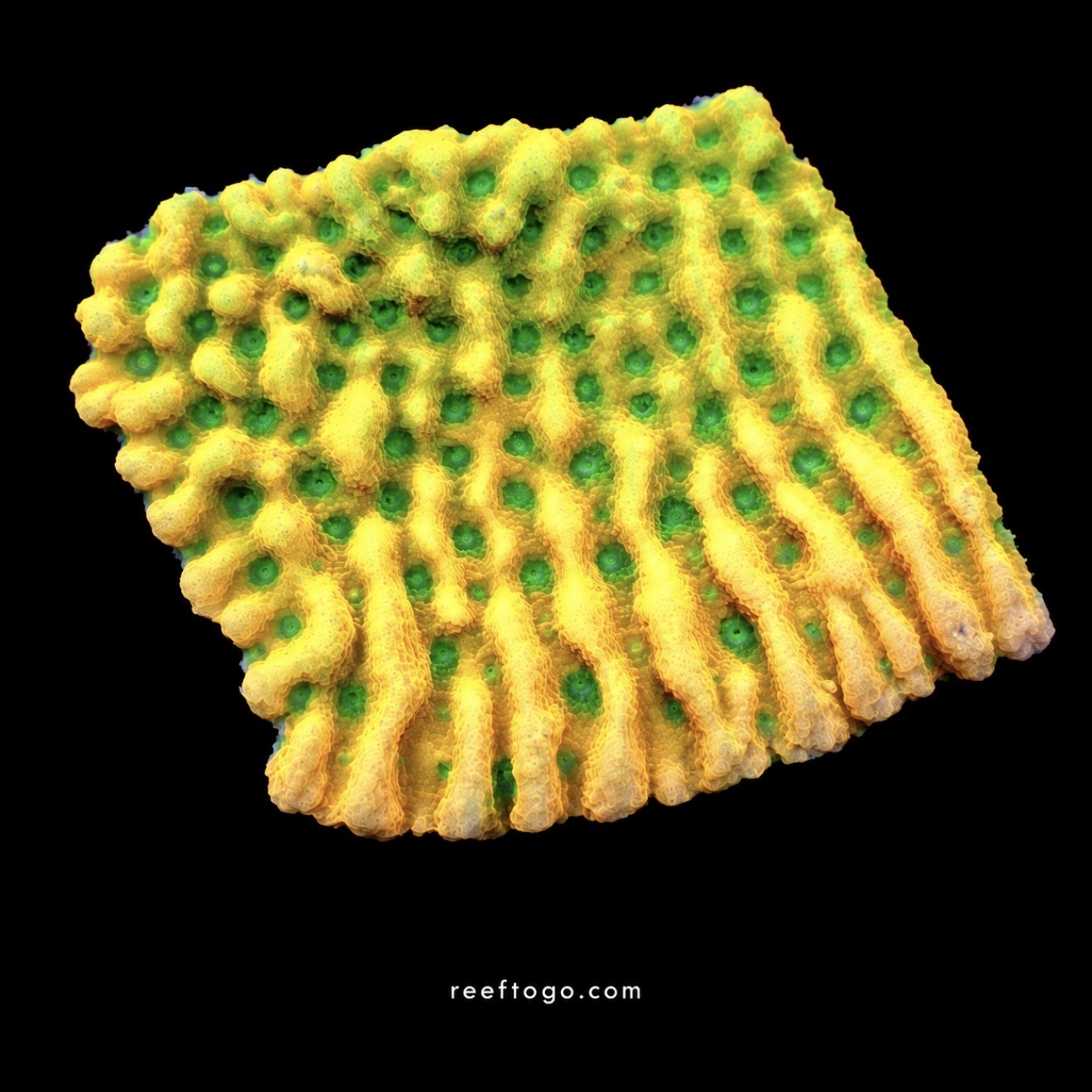
Kung Pao is a plating Montipora dressed in traffic-light colors: a deep green base plate, raised ridges running a warm yellow, and tiny lime-green polyps dotting the surface between them. As the plate grows outward it lays down concentric growth rings, and the rim curls and ruffles where it meets open water. Under strong blue light the yellow ridges fluoresce and the whole plate takes on a roasted, golden edge — the look that earned the morph its name.
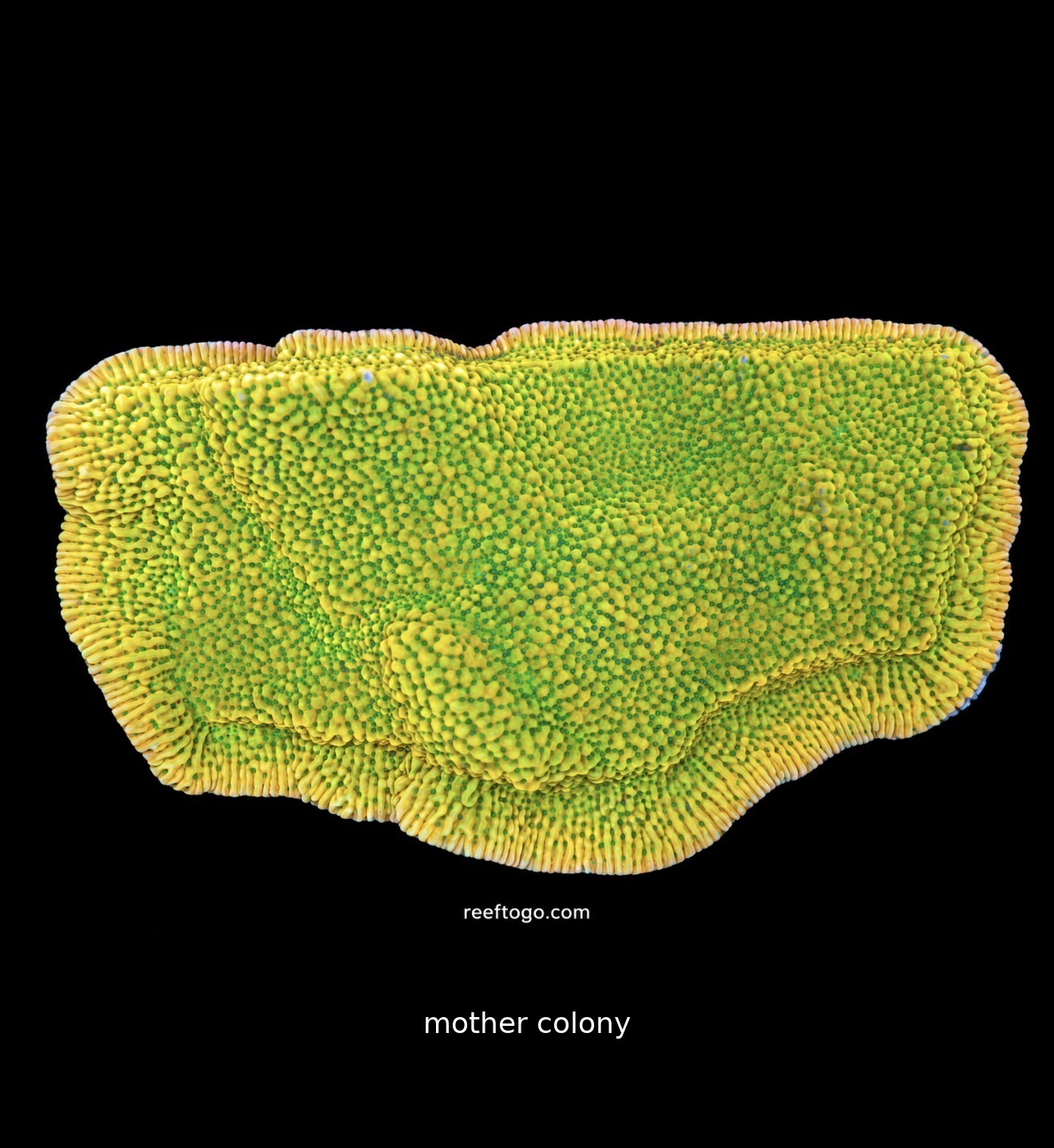
Montipora of this growth form encrust first, then plate outward from rock faces on Indo-Pacific reef slopes, stacking thin shelves into the current to harvest light. The plate is a light-collecting surface, and everything about its care follows from that. This entry rates it intermediate: an SPS that rewards stability and punishes swings, without the fragility of the most demanding Acropora.
Give it high light and medium flow at a middle-to-top position on a bare rock face. Flow should move across the plate rather than blast it, keeping the polyps out and even and detritus from settling on the upper surface — a pocket where waste collects will cost tissue in patches. Polyps that stay tight day after day point to current that is too hard or light that is too low for this morph. It takes no target feeding; photosynthesis and stable chemistry do the work. Hold 77–79°F, salinity near 35 ppt, alkalinity 8–10 dKH, calcium 400–450 ppm, and keep alkalinity steady day to day, because plating montis show alkalinity swings as burnt or peeling rim tissue.
Growth is moderate — a healthy plate adds visible rim every month — so leave about three inches of clearance while it fills in; it will shade and overgrow whatever sits beneath the edge. Inspect new montis for Montipora-eating nudibranchs, tiny frilled slugs that graze the underside at night, and dip before mounting. Fragging is simple: snap or saw a section of plate, glue it flat, and it will skin over the break and keep plating.
Field notes — what keepers report
- Sellers describe the Kung Pao as one of the easier montiporas and a good grower, and one aquaculture shop calls it a reasonably fast grower once settled. Keeper-side reports temper that: as a Montipora palawanensis it is widely described as slower than the familiar caps and digitatas, and one keeper's thread shows a colony built slowly from a dime-sized frag, still modest after extended care, kept happily on the sandbed at roughly 250–300 PAR with moderate flow.
- Light guidance conflicts in print. One vendor lists very high PAR (350–500) for the strain, while a farm growing it long-term reports its best results at moderate-to-high light (PAR 150–250) and another grower recommends lower to moderate light with good flow. The one detailed keeper report sits between those poles, on the sandbed under strong light.
- Growers stress flow for a practical reason: the encrusting, slightly plating growth form collects detritus on its surface, and strong intermittent flow is what keeps the tissue clean. Excess nutrients get blamed by growers for washed-out color in this strain.
- The most vivid keeper report in the thread is a setback story: hydroids colonized the back of one keeper's colony and forced it to grow in only one direction until he coated them in kalk paste to clear the way.

Field Notes
Related species
Flaming phoenix montipora
Similar care · SPS

Neon Green Montipora Spongodes
Montipora spongodes
Similar care · SPS

Aequituberculata Montipora
Montipora aequituberculata
Similar care · SPS

Bubblegum digitata
Montipora digitata
Similar care · SPS

Confused Rainbow Montipora
Montipora sp.
Similar care · SPS
Electric daisy stylocoeniella
Stylocoeniella sp.
Similar care · SPS

Finger Coral
Porites cylindrica
Similar care · SPS
Finger Porites
Porites cylindrica
Similar care · SPS