Bluespine Unicornfish
Naso unicornis
Reef Safe

Care facts
- Difficulty
- Intermediate
- Reef Safe
- Yes
- Aggression
- Semi-aggressive
- Diet
- Herbivore
- Tank Size
- Large
- Swimming Zone
- Mid
Gallery
Most unicornfish are bought for the horn and regretted for the size. The bluespine deserves a more honest pitch than either. It is a plain-coloured, olive-grey grazer that grows — fast, and for a long time — toward 70 centimetres of fish, carries two fixed blue scalpels on each side of its tail that do not fold away like other surgeonfish, and in return becomes one of the most personable large fish in the hobby: calm with unrelated tankmates, recognisably interactive at feeding time, and hard at work on leafy algae all day. None of that fits a normal tank. This entry is written for the small number of keepers whose systems genuinely fit the fish, and for everyone else it should work as a clear, early no — because a bluespine bought small is a rehoming problem with a date on it, and the keeper record on that point is not really a debate.
Reading the fish
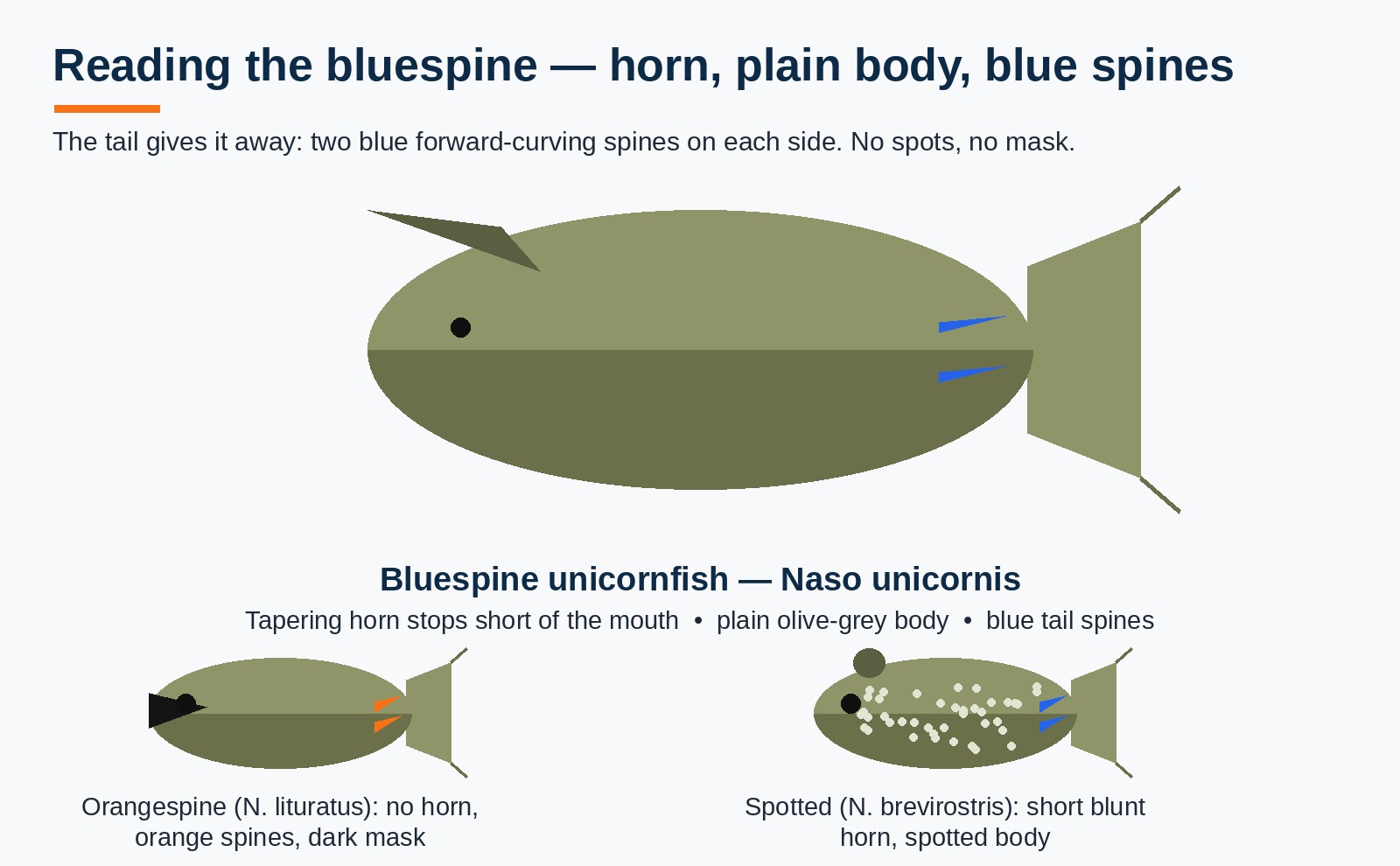
Forget the horn for a moment and start at the tail, because the tail is the name and the reliable field mark. On each side of the narrow waist before the tail fin — the caudal peduncle — an adult bluespine carries two bony plates, each armed with a forward-curving, knife-like spine, and the plates and spines are blue: bright enough on a mature fish, especially under blue-heavy light, to be the first thing you see. Unlike the single scalpel of most surgeonfish, these spines are fixed. They stand permanently out and cannot fold into a groove, which matters for identification, for handling, and for any fish that starts a fight with one.
The body in front of that hardware is deliberately unshowy: yellowish to olive-grey or bluish-grey above, paler below, with whitish to blue lips and yellowish dorsal and anal fins edged with thin blue lines. The forehead horn of an adult is a tapering bony projection at about eye level that points forwards and stops short of the mouth — it never grows past it. The tail fin itself changes with age, slightly notched in young fish and squared off in adults, with trailing filaments at its corners that lengthen in males. There are no spots, no stripes and no mask. A "bluespine" offered with any of those is a different fish wearing its name.
Three relatives cause the confusion. The orangespine unicornfish, Naso lituratus — the familiar lipstick or Naso tang — has no forehead horn at all and orange, not blue, tail plates, with a dark mask running from mouth to eye. The spotted or shortnose unicornfish, N. brevirostris, carries a much shorter, blunter forehead projection and a spotted body, and it is the species most often hiding behind a generic "unicorn tang" label; at least one retail page sold as a blue unicorn tang describes brevirostris, not this fish. The bignose, N. vlamingii, grows a rounded forehead bump rather than a tapering horn. The combination that is actually unicornis is: tapering horn stopping short of the mouth, two blue forward-curving spines per side, and a plain olive-grey body.
Where it comes from
Naso unicornis was described by Peter Forsskål in 1775, from Jeddah in the Red Sea, and its range since then has turned out to be most of the tropical Indo-Pacific: the Red Sea and East Africa across to Hawaii, the Marquesas and the Tuamotu islands, north to southern Japan and south to Lord Howe and Rapa. In Hawaii it is called kala — a name shared there with the other horned unicornfish, so the local name alone does not identify it — and it has been an important food fish in Pacific Island cultures as well as a heavily speared species across parts of its range, with reported local declines in biomass in some places even though the species as a whole is listed as Least Concern.
The depth figures need the same honest treatment as the tank sizes below. The full published range is 0–180 metres, and that number is real — but it describes where the species has been recorded, not where it lives its life. Adults work channels, moats, lagoons and seaward reefs in strong surge, mostly in shallow water over reef slopes that fall away into deep water; one behavioural summary puts most adult life within roughly the upper forty feet. Juveniles keep to shallow, protected bays and harbours. The pattern is a fish tied to well-lit, algae-growing, wave-washed rock, coming and going singly or in small groups through the day and feeding as it goes.

The horn — what it is and is not
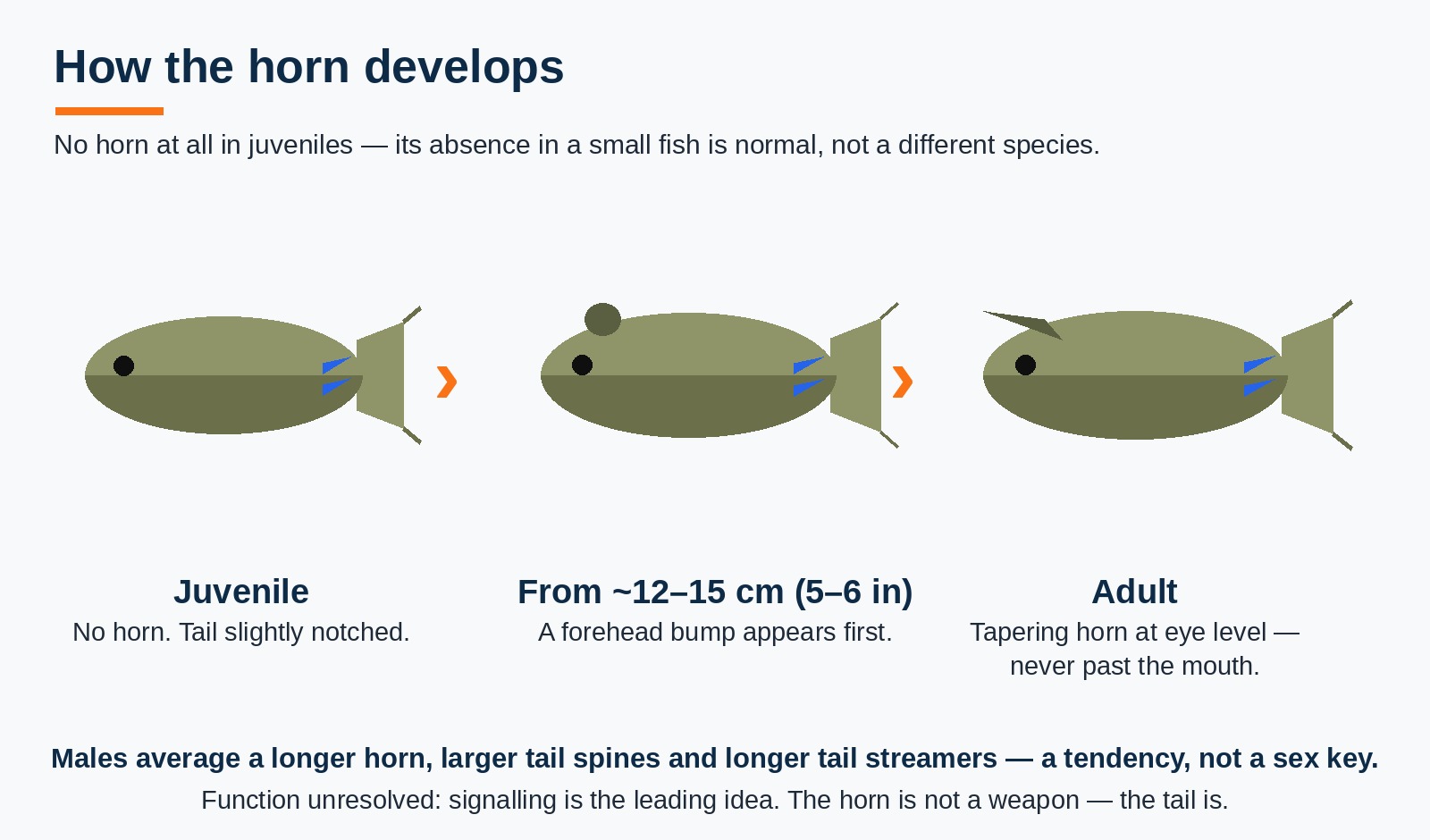
A juvenile bluespine has no horn, and that absence is normal, not a defect or a different species. The horn begins as a bump on the forehead when the fish is about 12 centimetres long — retail and forum copy rounds the same event to about five or six inches, the difference being rounding and whether you count the first bump or a clearly visible projection — and it grows from there into the tapering adult structure, lengthening with the fish. Males tend to run longer horns than females of the same size, but only as a tendency (see the sexing section); both sexes grow one.
What the horn is for is genuinely unsettled, and this entry will not pretend otherwise. It is not a weapon: no source describes it being used to fight, and when this fish fights it uses its tail. The leading idea in the morphology literature is signalling — researchers have watched male unicornis use the horn together with rapid colour changes in displays aimed at females and at other males, which fits a sexual-selection story — but a specialist review of the structure concludes there is still no convincing explanation beyond signalling, and an older idea, that plankton-feeding unicornfish use the horn to judge distance to prey where there are no visual references, cannot explain a benthic algae-eater like this one. Buy the fish because the horn looks extraordinary, by all means. Just do not let anyone sell you a function for it as settled science.
A grazer built for surge
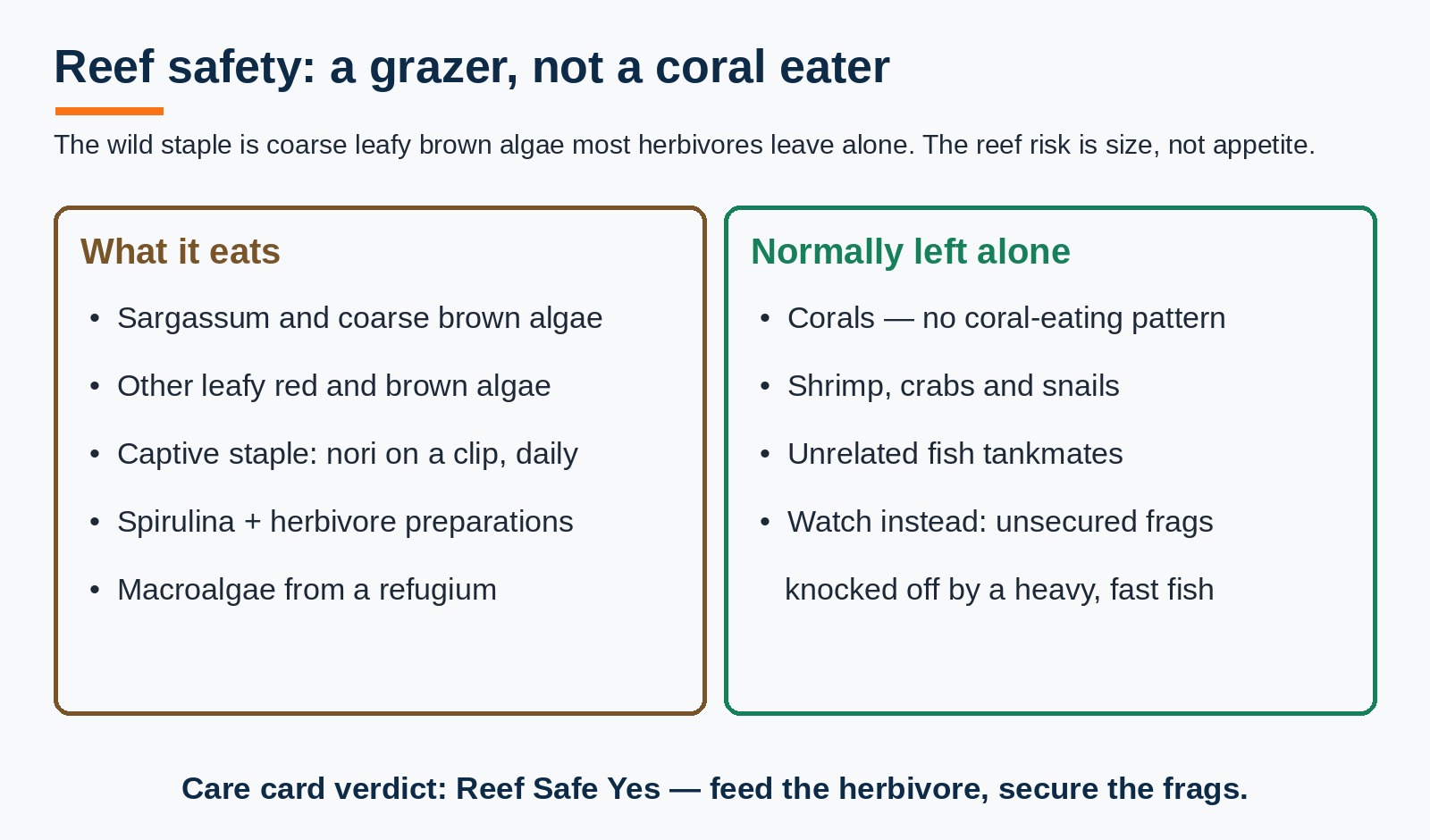
In the wild this is a specialist, and the specialism is coarse food most herbivores leave alone: leafy brown algae, above all Sargassum, with other coarse-bladed brown and red algae alongside. That diet is why ecologists care about the species — it is one of a relatively small number of reef fish that eat fleshy macroalgae, so where bluespines are removed by fishing, seaweed that other grazers will not touch can gain ground on the reef. It has even been recorded eating an invasive seaweed that mats over corals in Hawaii. Minor amounts of zooplankton appear in some habitat summaries, but the fish is a browser of attached algae, not a plankton-picker, and the stored diet field on this entry — Herbivore — is the correct plan for keeping one.
Everything about the captive version follows from that. This is a daytime, open-water grazer accustomed to surge: strong, turbulent flow, high oxygen, and something to pick at between meals. A still, quiet, sparsely fed tank is not a kind approximation of its home; it is the opposite of it.
The tank it actually needs
Here is the spread, whole, because the bluespine suffers more than most fish from minimums quoted small. The serious adult figures in print run from 250 gallons (one wholesaler-retail source) through at least 300 gallons and six to eight feet of length (a major trade wholesaler) and 350 gallons (one long-standing library account) to 360 gallons in the standard retail care template. Against those stand a care-guide figure of about 500 litres — roughly 130 gallons — and, at the far edge, juvenile product copy suggesting a small fish can start in 30 to 50 gallons. Those last two are not adult recommendations and must not be read as one. A 130-gallon tank does not house a 50-centimetre adult, and a juvenile's starter tank is a promise to buy the big one on a fast clock, because the growth in the first years is measured in inches per year, not per decade.
Read the stored tank field — Large — as the category it is, and this section as the number behind it: plan on 250 gallons as the floor for a genuinely committed keeper, 300-plus with an eight-foot run of open water as the honest target, rockwork kept low and at the sides so the middle of the tank is a swimming lane with grazing surfaces at its edges, flow strong enough to keep a surge-zone fish exercised and the water highly oxygenated, and filtration sized for what a heavily fed half-metre herbivore produces, which is a great deal of waste. One fish per tank is the standing rule in every serious source; groups belong to public aquaria. The lid, too, is part of the size conversation — a powerful, startled fish of this weight can jump, and keeper guidance for the species calls for a robust, secure cover rather than open water.
Feeding a large herbivore
Feed it like the wild fish and most captive problems shrink. Seaweed should be available essentially all day: dried nori on a clip, replaced as it is finished, is the practical staple, backed by spirulina-based foods, herbivore preparations, and macroalgae from a refugium where one is running — the original short note on this entry had exactly that right, and added the other half of the truth, which is that a well-fed bluespine is visibly better coloured than a thin one. Vegetable variety beyond seaweed — the retail lists include items such as zucchini and broccoli as supplements — is variety, not the main course. Several small feedings beat one large one; one library account puts a number on it at three or four feedings a day, on top of grazing material, and that rhythm matches the biology of a fish built to eat a little, constantly, all day. Small amounts of meaty food will be taken and are included in some varied-diet recommendations, but they are garnish. The health-critical share is algae, and genus-level guidance is blunt that a Naso short of algae-based food is a fish whose immune system and condition will show it. A bluespine that is losing weight behind the head and along the back is not a picky fish to be tempted with richer food; it is an under-grazed fish to be given more seaweed, more often.
Reef safety and temperament
The care card calls this fish Reef Safe: Yes and Semi-aggressive, and both labels need their footnotes. On reef safety the sources are unusually united — retailer, library, wholesaler and care-guide accounts all list it as safe with corals and with mobile invertebrates, and no pattern of coral-eating attaches to the species. The risk a bluespine brings to a reef tank is not appetite, it is physics: a heavy, fast, half-metre fish with fixed tail scalpels will knock unsecured frags off their mounts, can rearrange light rockwork by collision rather than intent, and produces a waste load that a reef's filtration has to be built for. Secure the frags, and the fish is reef-safe in the only sense it ever claimed to be. The one appetite caveat is the feeding one above: a chronically underfed large herbivore is the individual most likely to sample things it would otherwise ignore, which is an argument about nori, not about the species.
Temperament is where the labels genuinely split, and the entry keeps both. Several respected accounts call the fish flatly peaceful — one wholesaler describes it as peaceful but not shy, well defended, and not inclined to intentionally bother anything — while the standard retail template exists in both a peaceful version and a semi-aggressive version, and the stored field here is Semi-aggressive. The behaviour underneath the labels agrees everywhere: relaxed and unbothered by unrelated fish, assertive to the point of fighting with other Naso and similar surgeonfish, quicker to defend space when the tank is too small, and more confident — which reads as bolder, not nastier — as it grows. Plan it as the only unicornfish and usually the dominant large tang in the system, added with the understanding that later tang additions are the ones that will have the problem.
The scalpels — handling and safety
Two fixed, forward-curving, permanently erect spines on each side of the tail base are a different proposition from the folding scalpel most tang keepers know, and they set the handling rules without exception. Never net this fish: the spines tangle in mesh, injure the fish and tear free badly, and every experienced source gives the same alternative — herd it into a large, clear, solid container for any move. Never grab or steady one by hand near the tail: the fish defends itself by swimming past and flicking its tail sideways, and the cut that motion makes in skin is described in field accounts in terms that do not need repeating to be believed. The same spines are why fights with other surgeonfish are not watched-and-seen in this genus, why a bluespine should be given a wide berth during tank maintenance once it is large, and why one genus note reports big Naso scalpels scratching even acrylic. None of this makes it a dangerous pet in daily life — it is not aggressive to its keeper — but it is a fish to handle like edged equipment: rarely, deliberately, and never casually.
Sexing, spawning and lifespan
Sexing is a tendency, not a key. At the same body size, males average a longer horn, noticeably larger tail plates and spines, and longer tail streamers than females; one scientific description phrases all three cautiously, a popular summary states the tail-spine difference more strongly, and a morphology review doubts the horn at least is strongly dimorphic at all. In a shop, with fish of different sizes and ages, none of that adds up to a reliable sex. Keepers who need a known sex need a known pair history, not a horn measurement.
In the wild, pair-spawning has been directly observed. In captivity there is no success to report: no source consulted records this species bred in a home aquarium, and its size, surge habitat and open-water spawning behaviour explain why. Lifespan needs the same care as size. A scientific database lists a maximum reported age of 55 years for wild fish — a figure about the species' potential, not a promise for a tank — while retail care copy offers only vague "several years" language, which undersells a fish that, in a system actually built for it, should be planned for in decades, not years. Buy one as a long commitment or do not buy one.
Choosing and settling in
Buy size honesty, not size hope. A good bluespine at any size is thick through the body, active in open water rather than pressed to the rock, grazing or investigating, and taking offered seaweed — and a thin fish, however cheap or however appealing its horn, starts behind, because putting weight back on a large herbivore takes time it will spend growing anyway. Check the tail base for undamaged blue spines, the forehead for a bump appropriate to its size (absence under about five inches is normal), and the identity against the look-alikes above, especially in small, hornless juveniles sold under a bare "unicorn tang" label. Settle it into flow and food from the first hour: strong current running, nori on a clip before it goes in, rockwork already arranged with an open lane, and no other Naso or close surgeonfish rival waiting to make the first day a territorial dispute. Expect it to take to captive food quickly by tang standards — trade experience describes a fish that settles and eats readily when the system fits — while allowing the genus' normal grace period of up to about a week for a reluctant starter before escalating to veterinary worry.
Field notes — what keepers report
On size, the keeper record is one long, consistent warning, and both of its poles end at the same place. Asking on a large-reef forum about a unicorn tang for a display of roughly 250–270 gallons and six feet long, one keeper was told by several experienced voices that the fish grows fast while young, that rehoming is a certainty rather than a risk, and that the real difficulty is finding any private system able to take a fish past a foot long — the asker decided against the fish, saying plainly that getting attached and then being forced to part with it was the deciding factor. The success story in the same discussion makes the identical point from the other side: a keeper who kept one for about four years rehomed it at roughly eight inches, with about a centimetre of horn by then, and had arranged the new home about a year before the move. Nobody in these threads reports a bluespine that stayed conveniently medium. Popular growth summaries circulating a figure of roughly four-plus inches a year in the early years, reaching most of adult length within about five years, match the direction of those reports even where the exact rate varies with feeding and system.
On personality, keepers and trade staff who have lived with the fish are strikingly warm about it, and this is the side of the record that explains why the size warnings have to be repeated at all. The recurring description is a fish that calms as it settles, learns the feeding routine, follows its keeper along the glass, and can be trained to take food from the hand — a major wholesaler's staff account calls it personable, hardy and peaceful with almost everything it could be kept with, and long-term keepers describe watching the horn and streamers develop over years as the pleasure of the species. Set against that, the honest counterweight is individual variation and crowding: tang friction in the reports is aimed at other tangs and at cramped quarters, and the one vivid aggression case keepers pass around involves a congener moved temporarily into a far-too-small tank — a different species under obvious stress, recorded here as a warning about space, not as this species' character.
On reef safety in practice, keeper experience supports the care-card verdict with a housekeeping asterisk. No pattern of coral- or invertebrate-eating emerges from the reports; what owners of large bluespines actually complain about is collateral — frags knocked from unsecured mounts, grazing enthusiasm applied to everything green including algae a keeper wanted to keep, and the sheer waste output of a heavily fed large herbivore testing a system's filtration, exactly the load the wholesaler account warns about when it says flow and filtration should be as strong as the keeper can manage.
On feeding, the reports divide by what was offered, not by the fish. Bluespines with seaweed available through the day — a nori clip kept filled, macroalgae to browse, several small meals — are described as easy, eager feeders that hold colour and weight; the difficult cases trace back to tanks where a large, constantly grazing herbivore was fed like a mid-sized omnivore, once or twice a day, with algae as an occasional supplement rather than the staple. Keepers treating nori as the main course and everything else as garnish report a different fish from keepers doing it the other way round, and the wild diet — coarse leafy brown algae, all day, in surge — says the first group has the biology right.
Field Notes
Related species

Blonde Naso Tang
Naso elegans
Same genus

Orangespine Unicornfish
Naso lituratus
Same genus

Spotted Unicornfish
Naso brevirostris
Same genus

Naso Tang
Naso lituratus
Same genus

Oneknife Unicornfish
Naso thynnoides
Same genus

Sleek Unicornfish
Naso hexacanthus
Same genus

Vlamingii Tang
Naso vlamingii
Same genus

Whitemargin Unicornfish
Naso annulatus
Same genus