Social Wrasse
Cirrhilabrus rubriventralis
Reef Safe

Gallery
The Social Wrasse, Cirrhilabrus rubriventralis, is the longfin fairy wrasse: a small, scarlet, white-bellied fairy wrasse whose terminal males trail absurdly long, paddle-shaped red pelvic fins and raise a filament pennant off the front of the dorsal fin when they display. The original short entry in this database called it a Red Sea endemic the hobby largely ignores, baffling given how beautiful the dominant males become, and praised the natural social hierarchy that develops when a group of three or more is kept in a 75-gallon or larger tank, its ready acceptance of frozen mysis and enriched artemia, and the secure lid it demands because it jumps. The fuller record below keeps every one of those verdicts — but it has to qualify the first of them, because the name on this entry now covers less ground than it did when the entry was written. A 2016 revision split the old, wide-ranging "rubriventralis" into three species, and under that split the true Cirrhilabrus rubriventralis is the Red Sea fish, while the fish the aquarium trade actually sells under this name almost never come from the Red Sea at all. That is not a reason to avoid the fish — by every account it is one of the most familiar and affordable fairy wrasses in the hobby — but it is a reason to read this entry as covering a very close species complex, and to buy the individual fish in front of you rather than a map locality.
A name that split in three
The species was described by Springer and Randall in 1974, from Red Sea specimens, at a time when only seven other Cirrhilabrus were known at all — it was the eighth fairy wrasse science had named. The describers singled out the pelvic fins: remarkably large, bulbous, trailing and entirely red, and the species name rubriventralis simply points at that red underside finnage. For four decades the name was applied across the western and central Indian Ocean, to the Red Sea fish, to a Sri Lanka–Maldives–Chagos population, and to an East African coastal population, because the three look very much alike and, as a detailed review of the group noted, commonly used genetic markers show negligible differences between them — the group appears to be caught in the early stages of splitting, with appearance changing faster than genes. In 2016 Benjamin Victor formalised what the colour differences had been suggesting and divided the complex into three allopatric species: Cirrhilabrus rubriventralis in the strict sense for the Red Sea (extending to the Gulf of Aden and Oman), the new Cirrhilabrus rubeus for Sri Lanka and the Maldives, and the new Cirrhilabrus africanus for the East African coast. FishBase now carries the entry exactly that way: Western Indian Ocean — Red Sea, a species complex with C. rubeus and C. africanus. The practical consequence for keepers is documented in the group's review literature: the Red Sea phenotype is practically absent from the aquarium trade, and trade "rubriventralis" are almost exclusively collected from Sri Lanka and the Maldives — which is to say, most fish sold as this species are, under the current taxonomy, C. rubeus, with East African shipments representing C. africanus. The three are close enough in care that nothing in the husbandry below changes with the label, but a keeper who specifically wants the Red Sea fish should know that a shop label alone does not deliver one.
Identification
This is one of the small fairy wrasses: the rubriventralis group rarely exceeds about three inches in standard length, and FishBase gives a maximum of 7.5 cm total length for the Red Sea species. The resting colours of the true species are a uniformly bright red ground, variably tinted orange, over a clean white ventral half, the two zones meeting sharply where other fairy wrasses carry a lateral stripe; that stripe is usually absent or reduced to a row of metallic spots, but it can flare into prominence in metallic blue during display. The dorsal fin is red but heavily darkened toward the rear, with a single metallic spot at the base of each membrane forming a dotted stripe along it. Females and initial-phase fish across the group are uniformly orange to red fading to white below, carry a single black spot on the caudal peduncle, and show fine spots and striping along the upper body; their pelvic fins and dorsal embellishments are undeveloped, which makes females of the group's species nearly indistinguishable from one another. The terminal male is unmistakable, and two structures do the work. The first and second dorsal spines stretch into a long filamentous pennant that the male raises and folds away at will. And the pelvic fins — scarlet, widened into pendulous paddles — trail back past the anal fin in a fully developed male, a trait shared across this group and with no other fairy wrasses. The tail is weakly double-emarginate, finely spotted and steely blue, and during display it takes on a metallic, foil-like shine that the fish exploits by paddling it rapidly side to side like a rudder, a nuptial behaviour recorded only in this group. The Sri Lanka–Maldives form most keepers will actually meet differs in small, checkable ways: its colour runs more variably from intense red to light yellow-orange, and its rear soft dorsal fin is almost always yellow where the Red Sea fish's is dark red.
Reading the care ratings
The entry rates this fish Intermediate for care, Peaceful, Carnivore, a Medium tank, a mid-water swimmer, and Reef Safe Yes, and each rating survives scrutiny with a note attached. Intermediate rather than Beginner is the honest call for a fairy wrasse: the genus ships and acclimates with some fragility, new fish hide, and the feeding rhythm is several small meals a day rather than one — but within the genus this complex sits on the easier, hardier, less expensive end, and the original entry's point that it takes frozen food readily is well supported. Peaceful is accurate toward unrelated tankmates and needs its exception stated plainly, because it is a large one: toward other fairy wrasses, and especially toward its own complex, this fish can be assertive to aggressive, a point the field notes take up in full. Carnivore is exact in the planktivore sense — a picker of zooplankton from the water column, not a grazer and not a sand hunter. Medium is the rating that hides the widest published spread, recorded whole in the tank section below: 30 gallons for a single fish at the low end, the original entry's 75 gallons and up for a group at the high end. Mid-water is the database's zone, and it is fair for a feeding fish, with the species-specific wrinkle that this is one of the less bold Cirrhilabrus and tends to work closer to the substrate than its cousins unless its companions are very passive. Reef Safe Yes is unanimous across every source consulted: no corals, clams or ornamental invertebrates are harmed, the one standing genus-level caveat being very small, delicate shrimp.
In the wild
Under the modern split, the true species is a Red Sea fish, recorded through the Gulf of Aden to Oman, on fringing reefs over coral or rubble bottoms, at depths FishBase gives as 3 to 43 metres in water of about 24 to 28 degrees. It feeds on zooplankton in the water column, hovering over the bottom with the rest of its genus, which as a group works low-complexity rubble slopes and reef edges in feeding aggregations — typically one dominant male with a group of females, the females outnumbering the males — and dives for cover among coral and rock when threatened. The broader complex occupies the same niche across its range: the Sri Lanka–Maldives–Chagos population in the central Indian Ocean and the East African coastal population to the west, each in the same shallow, well-lit reef habitat. Like the rest of the genus it is a daytime fish that sleeps pinned in the rockwork at night, wrapped in the mucus cocoon Cirrhilabrus secrete around themselves, which is understood to mask their scent from night predators. Breeding in the wild follows the fairy-wrasse pattern FishBase records for the species as distinct pairing during spawning: courtship at dusk, the male in full nuptial dress — body lightened toward white, the lateral stripe lit metallic blue, fins erect, tail flashing — rising and pairing with a female for a pelagic spawn.
Display, colour and sex
Colour in this fish is a behaviour, not a finish. A resting male is red over white; a displaying male transforms in seconds, the red lightening toward bright white, the hidden lateral stripe appearing in metallic blue, the dorsal pennant erecting, the pelvic paddles spread and the steely tail catching the light as he paddles it. Males flash like this at females and at rival males, and the capacity cuts both ways socially: a male persistently harassed by a stronger male is reported in the hobby literature to revert toward female colouration, possibly even reversing sex — fairy wrasses are protogynous hermaphrodites, females first, with the dominant female of a group the standing candidate to take over a vacant male role, and this complex is one where the boundary is visibly negotiated rather than fixed. The second colour phenomenon is duller and purely aquarium-made: the whole rubriventralis group is noted as very susceptible to aquarium-induced darkening, the intense red dorsum taking on a sooty, blackened shade in captivity, with the intensity of aquarium lighting suspected to play a part — a curiosity the group's reviewers flagged precisely because wild fish live in shallow, brightly lit water. A social wrasse that darkens is not necessarily ill; the darkening is a recorded group trait, and the field notes treat the keeper split over it.
Tank, lid and layout
The physical requirements are the fairy-wrasse standard, tightened by this species' habits. The lid comes first because the original entry is right to insist on it: this species jumps, fairy wrasses escape through overflow gaps as readily as open tops, and a dominant male that took months to colour up is, as the original put it, a painful way to learn the lesson — a tight cover with no gap at the overflow or cable cut-outs is non-negotiable. Inside the tank it wants the structure its wild life implies: live rock with caves and bolt-holes it can vanish into and sleep in, rubble and low cover near the bottom it prefers to hover over, and open water above for feeding. On size, the published figures spread honestly and are recorded whole: a specialist magazine's species account gives at least 30 gallons for a single fish, with a male and several females possible in a tank over four feet long; one retailer lists 30 gallons minimum and a three-inch maximum; another lists 50 gallons for this active fish; and the original entry's recommendation — a group of three or more in 75 gallons or larger — sits at the generous end, aimed at the social keeping this entry is named for. The reading that reconciles them is that a single fish lives in modest volume, while the harem behaviour that makes the species interesting needs length and rock structure more than raw gallons. New fish should be given a quiet acclimation: the genus pattern is to hide for days at first, and limited disturbance inside and outside the tank during that window is repeatedly named as the difference between a fish that starts feeding and one that fades in the rockwork.
Feeding
In the wild this is a water-column planktivore, picking zooplankton carried past its station over the rubble, and the aquarium diet should imitate the size and the frequency of that food rather than its exact contents. The original entry's observation stands: frozen mysis and enriched artemia are taken readily, which puts this complex among the easier fairy wrasses to feed. Around that core, the genus-standard rotation applies — enriched brine shrimp, calanus and other fine zooplankton preparations, finely chopped seafood, and quality small pellets or flake for the meals in between. Frequency matters more than menu breadth: fairy wrasses are high-metabolism, all-day feeders, and the care literature for the genus warns that a single daily feeding leads to slow wasting; two to three small feedings a day is the working standard, three or four in wrasse-focused systems. A newly imported fish that will not yet look at frozen food is started the way the genus usually is — live or enriched brine to trigger the feeding reflex, then a transition onto the frozen rotation once it is snapping confidently — and the check for a thin fish is at feeding time, where a social wrasse should be up in the column competing, not watching from the rock.
Temperament and tankmates
Toward the general community the record is consistent and good: a peaceful fish for clownfish, gobies, anthias, firefish and other unaggressive company, inoffensive to corals and sessile invertebrates, and itself vulnerable to belligerent tankmates — the genus guidance is blunt that a fairy wrasse introduced among aggressive fish typically stays hidden and starves or sickens, and that groupers, large dottybacks, bigger angelfish, Thalassoma wrasses, most triggers and large puffers are the company to avoid. The complication is horizontal, toward other fairy wrasses. The widely used Cirrhilabrus complex compatibility chart classes this complex by aggression relative to its relatives and gives the pairing advice in plain terms: species within the same sub-group should never be mixed, and its own example of a problematic trio names this complex alongside two others. The specialist magazine account adds the individual dimension: this is one of the less bold species, inclined to stay near the substrate, but kept with very peaceful, passive companions it can become the dominant fish in the tank. Both things are true at once, and the stocking rule they produce is simple — one male of this complex per tank unless the system is genuinely large, other fairy wrasses chosen from distant complexes of similar temperament, and this fish added with its assertiveness, not just its beauty, in mind.
Social groups and the harem question
The species name in this entry is Social, and the social system is the reason to keep it. In the wild the fish lives in harems — one dominant, displaying male over several females — and the original entry's claim that a group of three or more in a large enough tank develops a natural hierarchy that is genuinely interesting to watch is exactly what group keepers report the fish is for: the pennant-raising, stripe-flashing, tail-paddling display repertoire exists to be used on an audience of its own kind, and a lone male performs almost none of it. The honest constraints are sourcing and sex. Retailers note that assembling one male with multiple females is recommended practice but can be challenging simply because females are less often offered and are hard to tell from one another and from initial-phase males. A group assembled from juveniles or females will sort itself, the dominant individual transitioning to male — the protogynous pattern — which is the usual route to a working harem, and the transition brings the group's one real risk, because the sorting is done by chasing and display and a too-small tank gives the losers nowhere to be subordinate in peace. Kept singly, the trade-off is recorded in the field notes: a lone male often dulls over time without conspecifics to display to, which is the keeper argument that for this species the group is not an upgrade but the point.
Reef safety
Fully reef safe on a unanimous record, and the shortest section in this entry. The fish does not nip corals, does not molest clams, snails or crabs, and spends its day in the water column rather than on the rockwork's inhabitants. The single standing caveat is the genus-level one repeated in the wrasse literature: with the possible exception of small, delicate shrimps, fairy wrasses do not harm invertebrates — a keeper with unusually tiny ornamental crustaceans should know the exception exists, and every other reef inhabitant can ignore it.
Choosing a specimen
Buy the behaviour before the colour, because in this complex colour is the variable part. The fish to take home is out over the rock in the shop tank, feeding in the column, with fins intact — check the long pelvic paddles and the dorsal pennant for tears — and, following the standard wrasse-buying advice, check the mouth: fairy wrasses injure their snouts battering at shipping bags, and a rubbed-raw mouth is a recognised route to infection and a fish that cannot feed comfortably. Prefer a smaller female or juvenile over a full terminal male when the source allows the choice: the genus record is that terminal males ship worse than juveniles or smaller females, and a younger fish will colour and transition in your tank, which for this species is half the show. Know which fish you are actually buying in the complex sense — a Sri Lanka or Maldives fish (the trade norm, now C. rubeus) will tend to a more orange, variable ground colour and a yellow rear dorsal fin; an East African fish (C. africanus) shows stronger facial striping; and a fish invoiced simply as social or longfin fairy wrasse with no locality is most likely the Maldives form. None of them is the wrong fish. What is wrong is paying a Red Sea premium for a label, or rejecting a healthy Maldives fish for not matching a Red Sea photograph.
Warning signs
The warnings are the fairy-wrasse standard, sharpened for this species. A new fish still hiding and refusing food beyond the first several days has failed to acclimate, and the cause is usually social — a tankmate it is afraid of — or a mouth injury, both of which need finding rather than patience. A settled fish that leaves the water column and takes to hovering low and dark by the rock has usually lost a social contest; in this complex persistent harassment can push a male back toward female dress, so a colour reversion in a previously displaying male is information about the tank's hierarchy, not a lighting fault. Sooty darkening of the red, by contrast, is a documented group response to aquarium conditions including bright light, and on its own, in a feeding, active fish, it is the recorded nuisance of this group rather than a diagnosis. A thinning fish at feeding time means the feeding rhythm has failed it — fairy wrasses waste slowly on once-a-day feeding long before they look starved. Any gap in the lid or an unscreened overflow should be treated as a warning sign in itself. And a fish that was displaying daily and stops, in a group tank, has usually been displaced — the harem has a new centre, and the keeper's job is to make sure the old one still eats.
Field notes — what keepers report
- Boldness reports split by company, and both sides are on the record. The specialist magazine account calls this one of the less bold Cirrhilabrus, tending to stay close to the substrate rather than swimming out in open water — and adds that with very peaceful, passive companions it can become the dominant fish in the tank. The genus-level keeper literature describes the opposite trajectory over time: fairy wrasses shy on introduction, hiding for several days, then — given a peaceful acclimation — becoming quite brazen, even nipping at or resting against the keeper's hand during maintenance. The two accounts describe the same fish at different ends of its first month and in different company, and the practical reading keepers converge on is that this species' confidence is set by its tankmates, not by the fish.
- Aggression reports split by direction. Retail and general care sources describe a peaceful fish that coexists well with peaceful tankmates and does well in a harem — one retailer goes so far as to recommend the harem while noting it is hard to assemble. Against that, the group's scientific reviewers call the common Maldives form fairly aggressive, and the keeper-built Cirrhilabrus compatibility chart warns that this complex should not be mixed with its own sub-group at all and names it in an example of a problematic three-complex mix. Keepers reconcile the two by aiming the word peaceful correctly: peaceful upward and outward, toward unrelated fish; assertive sideways, toward other fairy wrasses — and the sideways direction is the one that decides wrasse-stocking plans.
- The aquarium darkening is the group's signature keeper complaint. The review literature states it flatly: all members of this group are very susceptible to aquarium-induced darkening, the intense red back going sooty black, with intense aquarium lighting suspected as a contributor — flagged as curious because the fish come from shallow, well-lit reefs. Keeper discussion of fairy-wrasse colour loss adds the second, social explanation from the genus record: a male kept without conspecifics often loses his chromatic edge, in well-known examples fading toward female dress, because display colour is maintained by social interaction. A darkened social wrasse therefore has two recorded candidate causes — light and loneliness — and keepers who fix one without checking the other report mixed success, which the record supports.
- Group keeping is praised and hedged in the same sources. The praise is the original entry's: three or more in a large tank produce a real, watchable hierarchy, and group displays are the species at its best. The hedges are practical: the harem is hard to source because females are seldom offered; groups should be introduced together, or females first; and a harassed male reverting toward female colour — possibly even sex — under a stronger male is documented in the magazine account, which is the mechanism by which a two-male group quietly becomes a one-male group with a stressed fish in it. The consensus plan that emerges is one male with several females, added together, in a tank with the length to let subordinates keep their distance.
- Feeding ease splits by specimen rather than by species. This complex is widely described as among the easier fairy wrasses to feed — the original entry's frozen mysis and enriched artemia verdict, echoed by retailers calling it highly adaptive and quick to acclimate. Set against that is the genus literature's warning about the specimens at the top of the size range: larger individuals often have great difficulty adjusting to captivity, terminal males ship worse than juveniles or females, and snout abrasion in transit is common enough that checking the mouth before purchase is standing advice. Keepers read the two together as a buying rule — the species is easy, the big finished male is the risky way to buy it.
- The jumping record is the one point with no other side. The original entry, the retailers and the genus guides all say the same thing in the same words: it jumps, it finds overflow gaps, and a secure lid is the difference between keeping this fish and losing it — including while the keeper's back is turned during maintenance, a loss the genus literature records more than once.
Field Notes
Related species

Blueside Fairy Wrasse
Cirrhilabrus cyanopleura
Same genus

Exquisite Fairy Wrasse
Cirrhilabrus exquisitus
Same genus

Laboute's Fairy Wrasse
Cirrhilabrus laboutei
Same genus
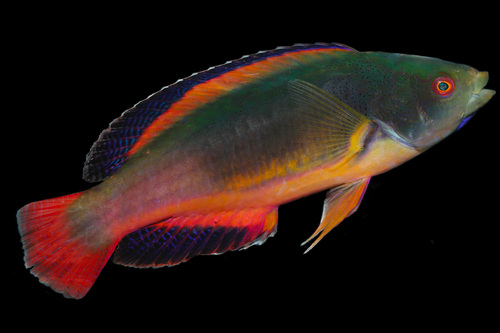
Scott's Fairy Wrasse
Cirrhilabrus scottorum
Same genus
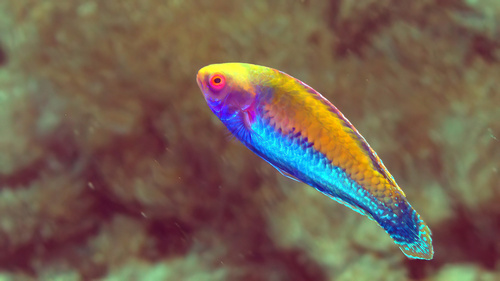
Solar Fairy Wrasse
Cirrhilabrus solorensis
Same genus
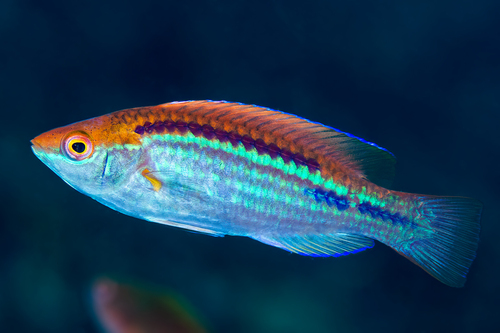
Lubbock's Fairy Wrasse
Cirrhilabrus lubbocki
Same genus