Blastomussa Wellsi
Blastomussa wellsi

Care facts
- Care
- Beginner
- Light
- Low-Medium
- Flow
- Low
- Place
- Bottom
- Space
- Peaceful
- Origin
- Indo-Pacific
- Growth Rate
- Slow
Gallery
# Blastomussa wellsi care guide
Start a new Blastomussa wellsi in subdued light, with water moving past it rather than pushing its flesh flat. Then give it time and watch how it settles. Its fleshy heads can hide the hard skeleton underneath. They can also hide early damage.
A settled colony can suit a careful newer reef keeper. Still, “beginner” does not mean it can shrug off shipping stress, unstable water, stinging neighbors or sudden light changes. This guide keeps published species information, aquarium care advice and individual keeper reports separate, so you can see what each one tells us.
Identity and natural history
Soft flesh, hard skeleton.
Blastomussa wellsi is a reef-building stony coral. It can look like a mushroom coral when its broad, fleshy heads cover the skeleton, but it is not one. Hobbyists call it an LPS coral. That means large-polyp stony coral, an aquarium grouping rather than an official scientific rank.
Ask about the coral you are buying.
Find out how long the seller has held it. Ask whether it is a healed, captive-grown frag, what lighting it has been under, and whether it has recently lost tissue. Those answers matter when deciding how gently to introduce it.
A photo under ordinary viewing light can help record its condition. Check the outer edge, the base and the mouth. Use the photo to look for damage, not to settle the species name from its colors. The name gives you a starting point for care. The coral's condition and recent history tell you how cautious to be.
What its wild habitat tells us.
Corals of the World places this species on sheltered lower reef slopes and in cloudy water. That makes a protected spot a sensible starting choice in a tank. It does not tell us an exact aquarium light setting. Cloudy natural water is also no reason to let waste sit on the coral.
The same reference describes mostly separate, tube-shaped skeletal cups. Each cup houses a polyp and is called a corallite. These cups measure 9–14 mm across. That is a skeleton measurement, not the width of an inflated head. Expanded flesh can hide the shape of the colony, even during the day.
Why the names can be confusing.
Wijsman-Best described B. wellsi in 1973. The current OBIS record places it in the family Plerogyridae. Older aquarium pages may say Mussidae. The different family label reflects how scientists classify the coral; it does not mean your coral has changed.
A 2014 study described another species, Blastomussa vivida, and explained that it had previously been confused with B. wellsi. Telling them apart involves the skeleton, including cup size and the structure of the thin ridges called septa. It is not a simple red-versus-green test.
A seller's name, a good photo or a large inflated head may therefore leave some uncertainty. Keep the supplier's identification and the coral's history with your records. If the name is uncertain, say so rather than renaming it from looks. Wellsi and merleti are familiar aquarium names, but they are not the only described species in this genus.
Sources for this section: [OBIS species record](https://obis.org/taxon/207386); [Corals of the World](https://www.coralsoftheworld.org/species_factsheets/species_factsheet_summary/blastomussa-wellsi/); [Benzoni and colleagues, 2014](https://repository.naturalis.nl/pub/801817).

Lighting and acclimation
Start gently when its history is unknown.
Low light is a cautious starting point for a new arrival. Tidal Gardens reports better expansion in dim light and trouble keeping its Blastomussa looking good under bright light. That is an experienced grower's advice, not a controlled test showing the species' maximum light tolerance.
LiveAquaria, by contrast, lists moderate lighting for B. wellsi. Rather than choosing one label for every tank, ask what your coral has been used to and measure the spot where you plan to put it.
Use numbers as context, not a promise.
Récif at Home describes keeping its maricultured wellsi at 40–80 µmol/m²/s PAR. Other suppliers describe brighter conditions. This range tells us what that grower uses. It is not a proven best range for every wellsi, or a guarantee for a coral that has just been shipped.
PAR is a measure of light arriving at the point being measured. Take the reading at the coral's actual height and angle, with the lighting schedule you intend to use. A light's percentage setting, wattage or distance from the glass will not tell you what the coral receives in a different tank.
Pick a spot you can watch.
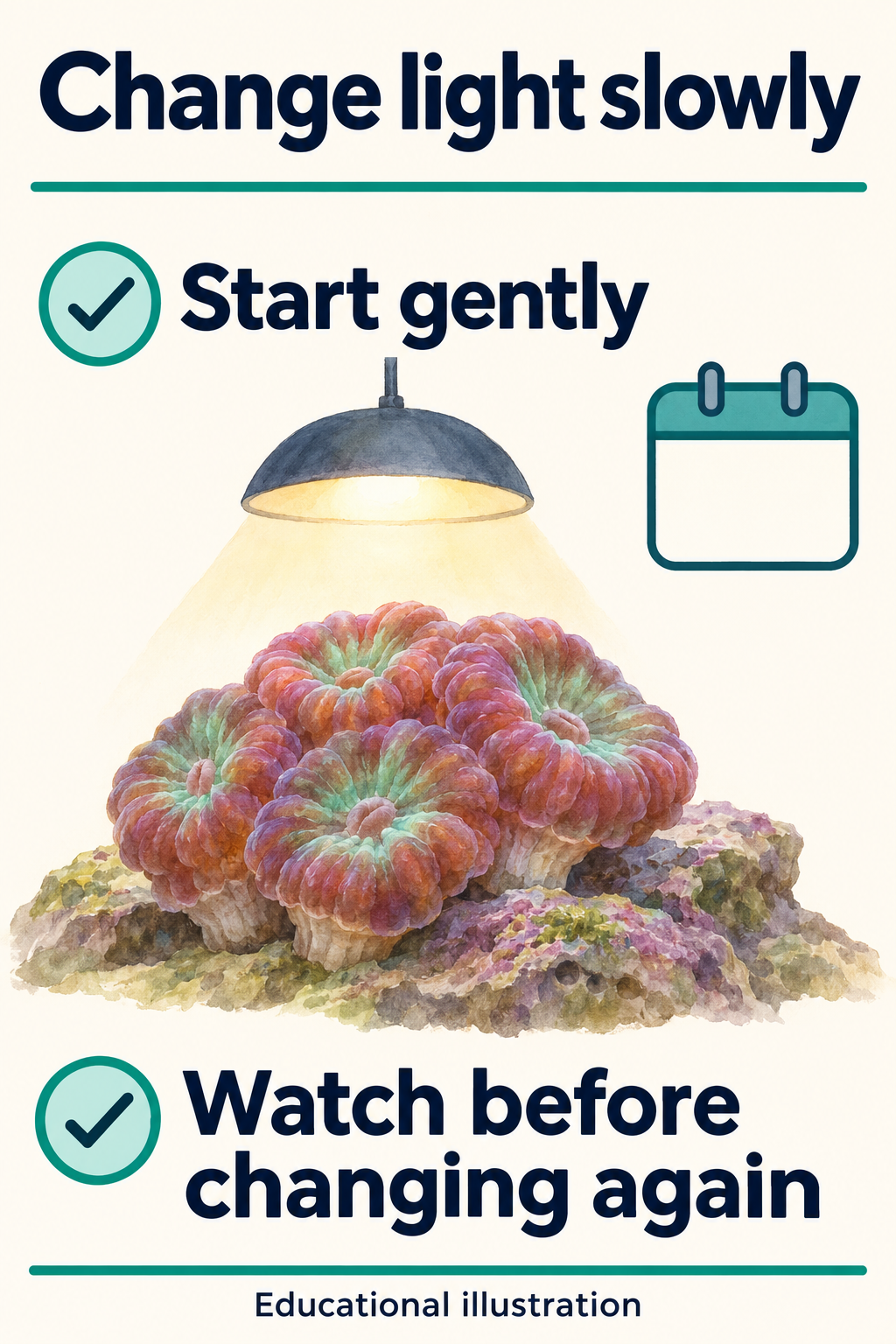
Choose a lower-light spot with water moving through it. Avoid a dark pocket where debris collects. Lower rockwork often makes the coral easier to inspect than a deep cave does.
If your coral is already settled and growing, do not move it just to match someone else's number. When you do need to change its light, make a small, deliberate adjustment. Watch the response before making another change.
Write down the date, location and light schedule. Take comparison photos at roughly the same point in the daily light cycle. This is a useful way to observe the coral, not a fixed acclimation timetable proven for this species.
Look at the whole situation.
Paling, staying closed or showing new bare skeleton all deserve a closer look. None proves that the light is too strong. Ask whether the problem actually followed a lighting change. Check for changes in temperature or salinity, and look for a neighbor touching the flesh.
A coral that closes after handling is not automatically bleaching. A fully inflated coral does not prove that a sudden increase in light was safe, either. Look for steady tissue coverage, normal feeding responses when food is offered, and gradual growth. The fullest-looking head in one photo is not the goal.
Sources for this section: [Tidal Gardens](https://tidalgardens.com/wysiwyg-cherry-bomb-blastomussa.html); [LiveAquaria](https://www.liveaquaria.com/products/big-polyp-blastomussa-coral); [Récif at Home](https://www.recifathome.com/en/other-lps-section/28698-wysiwyg-blastomussa-wellsi.html).
Flow placement and neighbors
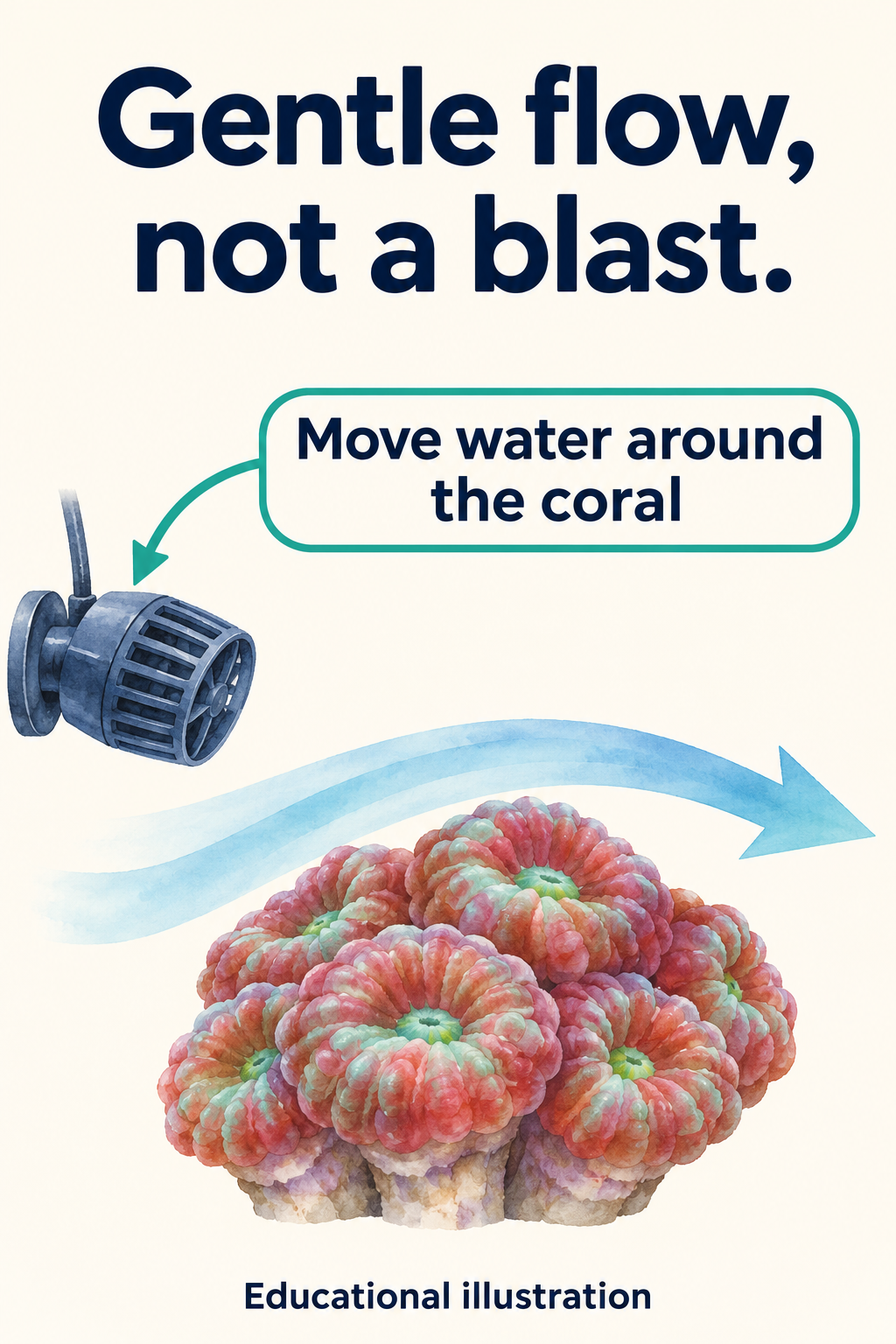
Move water past it, not straight into it.
Start with gentle-to-moderate indirect flow. Water should reach the colony without constantly pressing the flesh against its skeleton. Low flow does not mean still water. A tank's total turnover also says little about the current behind one particular rock.
Tidal Gardens reports healthy Blastomussa in both low- and strong-flow systems. LiveAquaria recommends low flow. The useful question is what reaches the coral itself: is water circulating around it, or is a concentrated jet hitting the flesh? There is no pump setting that answers that for every tank.
Watch it through the pumps' normal cycle. If the flesh stays flattened or pushed to one side, check the local current. If particles keep settling on it, ask whether the spot is too sheltered or whether feeding is leaving more waste than the system removes.
Try changing the direction of the flow or the coral's position before assuming that simply turning flow up or down will solve the problem. Do not judge its normal appearance right after moving it. Handling may have made it contract.
Give it a firm, clean place to sit.
A stable low rock or secure frag base is often useful. Keep soft tissue off loose sand and away from sharp edges. Near the sandbed, think about burrowing fish, snails and pumps that might lift sand onto the coral.
Leave enough room for an expanded head to stay clear of the glass and neighboring skeletons. Put glue on suitable bare support or the plug, not living flesh. Keep the coral easy to inspect.
“Bottom” means a suitable low-exposure spot. It does not mean burying the colony.
Peaceful corals still need room.
Blastomussa is usually described as relatively peaceful. That does not make contact with other corals safe. Bob Goemans recommends keeping it away from more aggressive neighbors.
Look at how far the other coral reaches and expands, not just how much room the blasto occupies now. Check after dark when needed. Leave space for growth and for feeding without repeatedly brushing the tissue.
The sources do not support one exact clearance in centimeters. If two corals touch, create a dependable gap and inspect the affected edge. A “peaceful” care label does not protect the flesh from injury.
Sources for this section: [Tidal Gardens](https://tidalgardens.com/wysiwyg-cherry-bomb-blastomussa.html); [LiveAquaria](https://www.liveaquaria.com/products/big-polyp-blastomussa-coral); [Saltcorner species account](https://www.saltcorner.com/AquariumLibrary/browsespecies.php?CritterID=2516).
Water chemistry and steady maintenance
Use a steady reef routine.
Blastomussa does not need a special water recipe. Like other stony corals, it needs water conditions that support both its living tissue and its calcium carbonate skeleton.
Randy Holmes-Farley’s general reef guidance gives calcium of about 380–450 ppm. It also explains that raising calcium beyond ordinary seawater levels does not usually make corals build skeleton faster. His updated guidance warns against automatically pushing nutrients down to an undetectable reading.
These are general reef recommendations. They do not define the highest and lowest levels B. wellsi can tolerate.
Understand what the reference ranges mean.
Reef Builders gives general aquarium ranges of 8–12 dKH alkalinity, 1200–1400 ppm magnesium and 32–35 ppt salinity. These broad ranges are not an invitation to let your tank swing between the ends. Choose a steady operating point that suits the whole aquarium and the salt mix you use.
Check the units before comparing advice. Salinity in ppt is not written the same way as specific gravity. Alkalinity may be given in dKH, meq/L or ppm equivalents. Do not add a corrective dose because two readings use different units.
Make the checks repeatable.
A useful routine matters more than a shelf full of additives:
- Check that temperature control and freshwater top-off are working.
- Measure salinity with a properly calibrated instrument.
- Track alkalinity often enough to see how much the tank uses.
- Record calcium and magnesium alongside it.
- Watch nutrient trends when feeding or nutrient removal changes.
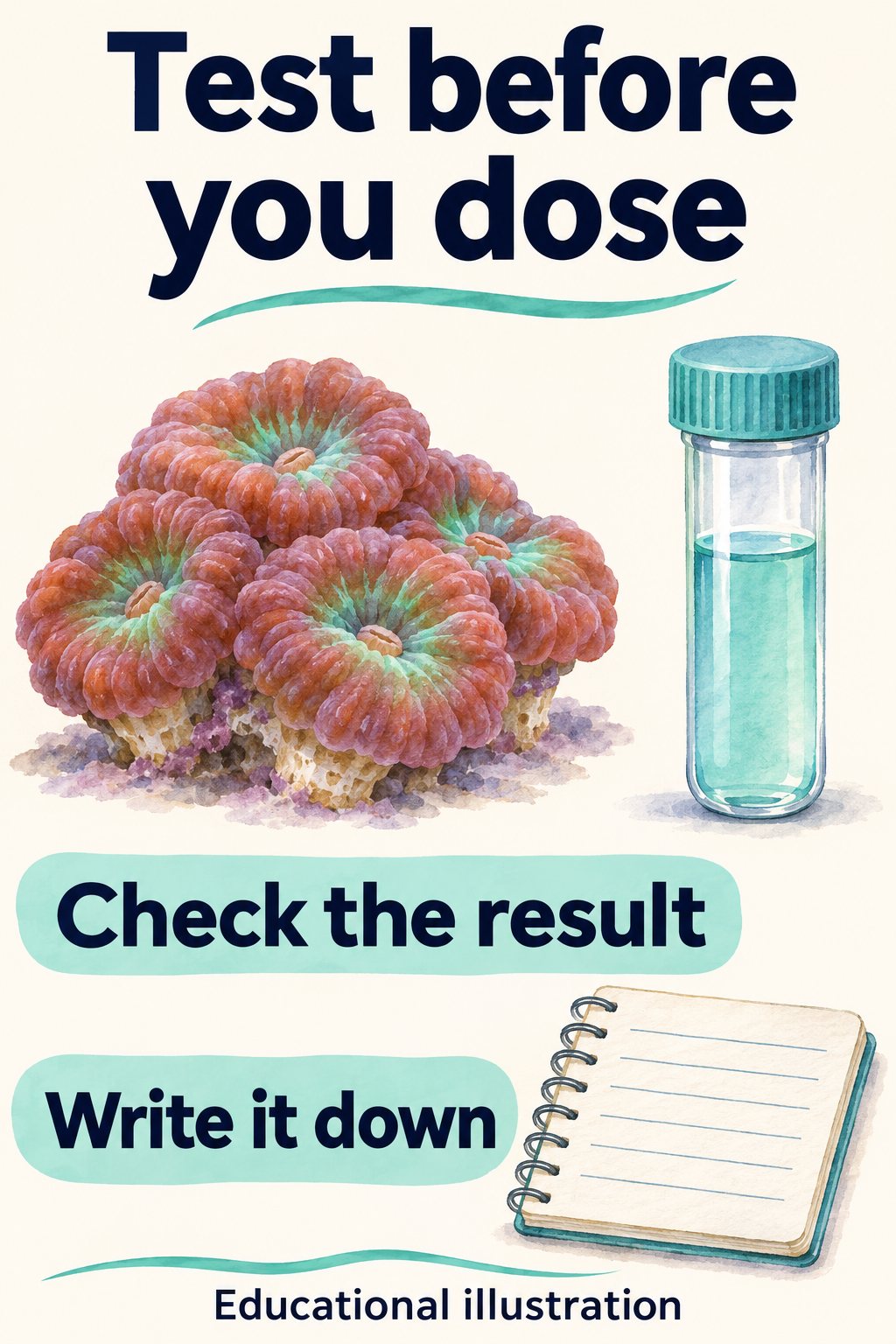
If a result is unexpected, check the method and the condition of the reagents. Repeat the test before making a major correction. This is cautious general reef keeping, not a testing schedule proven specifically for Blastomussa.
Dose for a reason.
A colorful coral or a supplement list in a product description is not enough reason to dose trace elements. Base additions on a credible need, measured use where that applies, and the instructions for the product and your system.
Be careful about increasing feeding and increasing nutrient removal at the same time without tracking what happens. If the coral starts declining, a short record of measured values, dates, water changes and equipment adjustments helps far more than “parameters are fine.”
Keep a routine that is working unless there is evidence it needs changing. Still, fix unsafe conditions promptly. Stability is not a reason to leave a real problem untreated.
Sources for this section: [Holmes-Farley’s reef chemistry reference](https://www.reef2reef.com/threads/optimal-parameters-for-a-coral-reef-aquarium-by-randy-holmes-farley.173563/); [Reef Builders parameter reference](https://reefbuilders.com/wp-content/blogs.dir/1/files/2022/05/RB-AquariumParameter-1.pdf).
Feeding and energy balance
Food can help, but tanks differ.
Blastomussa gets energy from its partnership with photosynthetic organisms living in its tissue. It can also catch food.
Sources differ on how important deliberate feeding is in a tank. LiveAquaria says extra food is not needed for health. Tidal Gardens emphasizes feeding in its long-term care. Their tanks may differ in the food already in the water, the corals being kept and what each grower counts as success.
Neither view proves that every colony needs daily meals. They also do not show that feeding is pointless.
Offer a small portion and watch it eat.
For a settled colony, a manageable portion is a sensible way to try direct feeding. Récif at Home describes using Artemia or mysis. Keeper discussions also mention prepared coral foods.
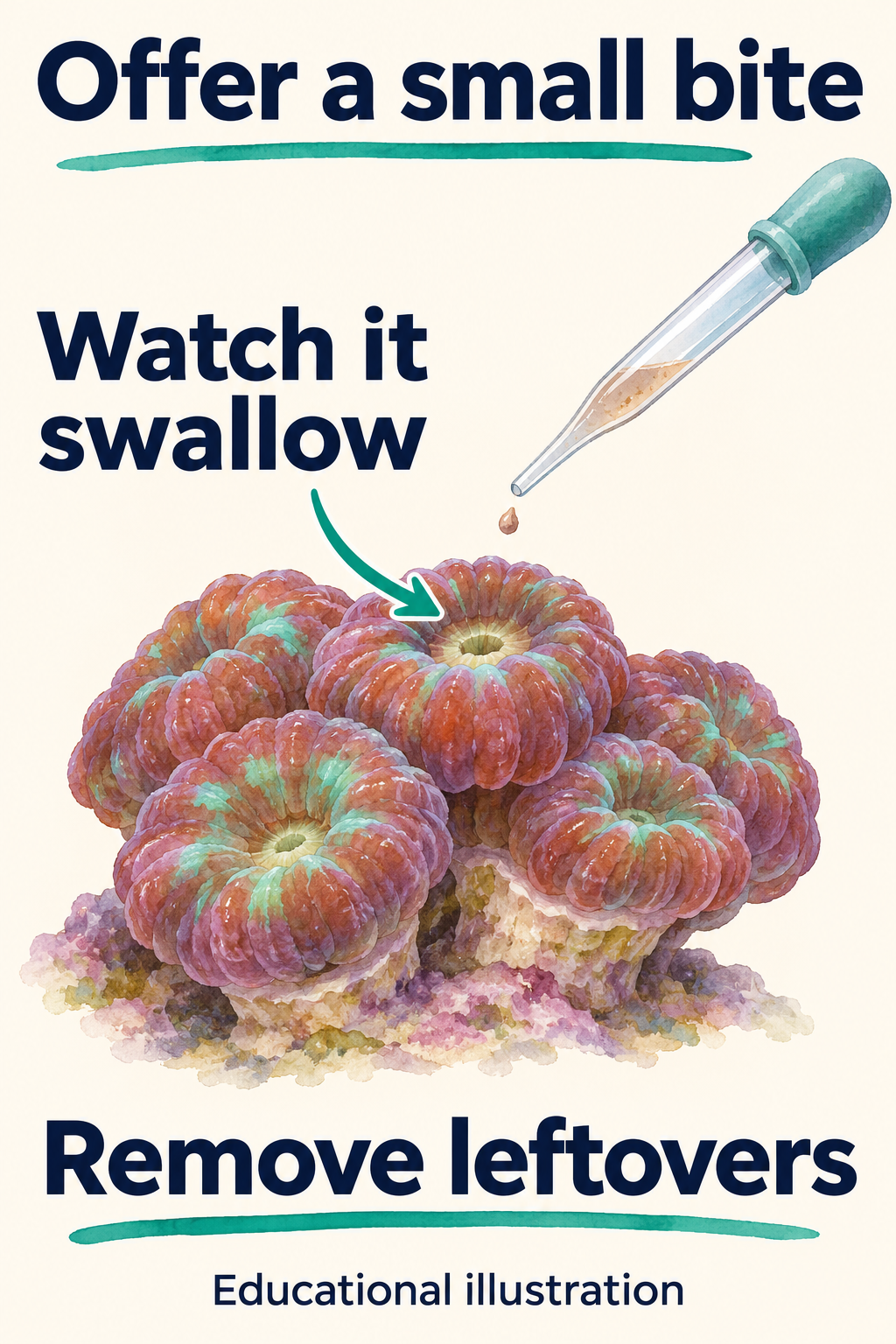
Choose food the polyp can catch and swallow. Let a small portion drift gently onto responsive tissue. Do not push a large piece into a mouth or touch the flesh with the pipette.
A feeding response shows that the coral noticed the food. Seeing it swallow and retain the food tells you more than seeing food stuck to mucus.
Check what happens next.
Fish or shrimp may steal the meal. If that keeps happening, you may need to supervise feeding or adjust the feeding setup. Do not cover the coral in a way that cuts off safe water exchange.
If you temporarily reduce pump flow, restore normal circulation afterward. Remove obvious leftovers from the surrounding area without rubbing the coral.
Repeated refusal calls for a look at the coral's condition, the portion size and any disturbance. Do not keep piling food onto a closed head. One missed meal alone does not diagnose a disease.
Let the response guide the routine.
Begin with a modest routine the aquarium can support. Adjust it based on whether food is eaten, how the tissue looks and how nutrients change.
There is no well-supported number of meals that guarantees new heads. A keeper who reports fast growth after feeding has also supplied light, flow, stable water and time. A single report cannot separate those effects.
Compare the colony over weeks and months. One afternoon of full expansion will not tell you whether a food is working. Record the food, roughly how much you offered, whether it was eaten, and any change in nitrate or phosphate. Feeding should be a planned part of care, not an automatic treatment for every problem.
Sources for this section: [LiveAquaria](https://www.liveaquaria.com/products/big-polyp-blastomussa-coral); [Tidal Gardens](https://tidalgardens.com/wysiwyg-cherry-bomb-blastomussa.html); [Récif at Home](https://www.recifathome.com/en/other-lps-section/28698-wysiwyg-blastomussa-wellsi.html); [Keeper feeding discussion](https://www.reef2reef.com/threads/feeding-blastomussa.780753/).
Arrival inspection and troubleshooting
Have its first home ready.
If you use a separate observation or quarantine tank, prepare it before the coral arrives. It needs suitable light, circulation and water quality. An unheated cup is not an adequate substitute.
Follow the supplier's arrival instructions and compare the relevant water conditions. Avoid putting shipping water into the display. LiveAquaria recommends acclimation and separate observation. It also notes that some corals can take days to open after introduction.
A newly closed coral needs to be considered in context. Do not jump straight into several treatments just because it is not yet open.
Inspect more than the mouth.
Under useful viewing light, check the skeleton, plug and tissue edges. Look for small pest anemones nearby, damaged flesh, trapped debris, a loose base or signs that another animal has touched it.
A reef-safe dip, used according to its label, can be part of an introduction routine. It does not prove the coral is free of every pest or problem. Do not mix products or make up your own concentrations.
Handle it by the hard base. Where practical, let inflated tissue retract before lifting the coral. Keep the soft flesh from dragging across the bag, a net or a sharp skeletal edge.
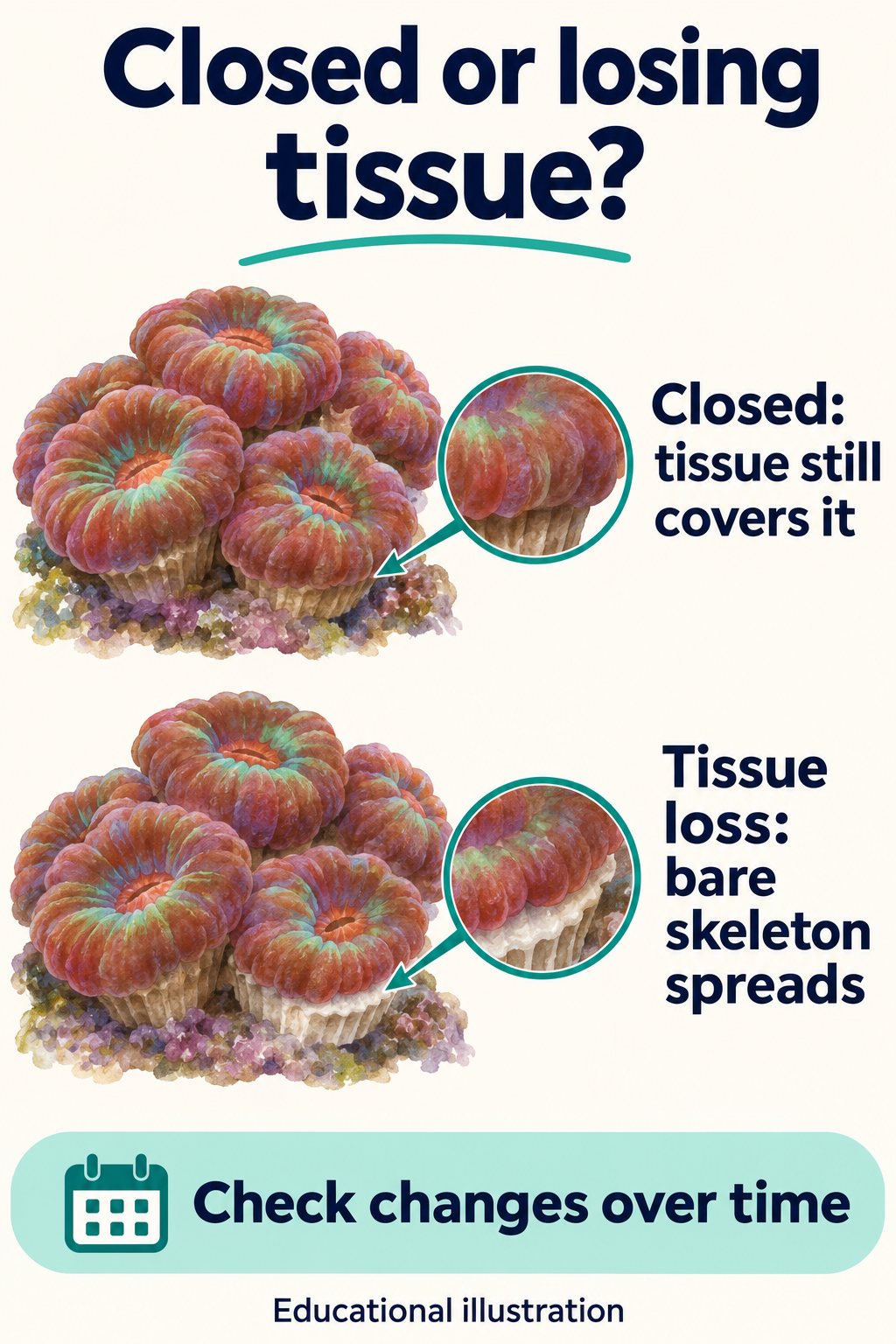
Closed is different from losing tissue.
An intact head that looks smaller may simply have contracted after handling or changed its expansion during the day. An edge that keeps pulling back and exposing more bare skeleton is a different sign.
Photograph the same area over time. Note whether one head or the whole colony is affected. Review recent changes in light, flow, salinity, temperature, dosing and feeding. Then inspect the immediate surroundings. This helps avoid several big adjustments before you know what changed.
Act on worsening tissue loss without guessing at a cure.
If tissue loss continues, separate the affected piece when you can do so safely in a suitable system. Protect other animals from direct contact. Seek informed help and provide photos plus actual water measurements.
Separation may reduce risk. It is not a diagnosis or a guaranteed cure. Brown material, mucus or tissue recession alone cannot tell you which pathogen, if any, is involved.
The sources reviewed for this guide do not establish a medication treatment specifically for B. wellsi. This guide therefore does not prescribe antibiotics, peroxide or improvised iodine doses.
A coral that is clearly getting worse needs timely attention. Repeated blind dipping and moving can also make it harder to understand what happened. In a 2024 keeper discussion, small Aiptasia near the coral were a useful clue. Check nearby irritants before assuming every closed polyp has a lighting or chemistry problem.
Sources for this section: [LiveAquaria acclimation guidance](https://www.liveaquaria.com/pages/liveaquaria-step-by-step-acclimation-guide); [Saltcorner handling account](https://www.saltcorner.com/AquariumLibrary/browsespecies.php?CritterID=2516); [Keeper troubleshooting account](https://www.reef2reef.com/threads/blastomussa-hasn%E2%80%99t-opened-fully-for-4-days-or-so.1042436/).
Growth propagation and responsible sourcing
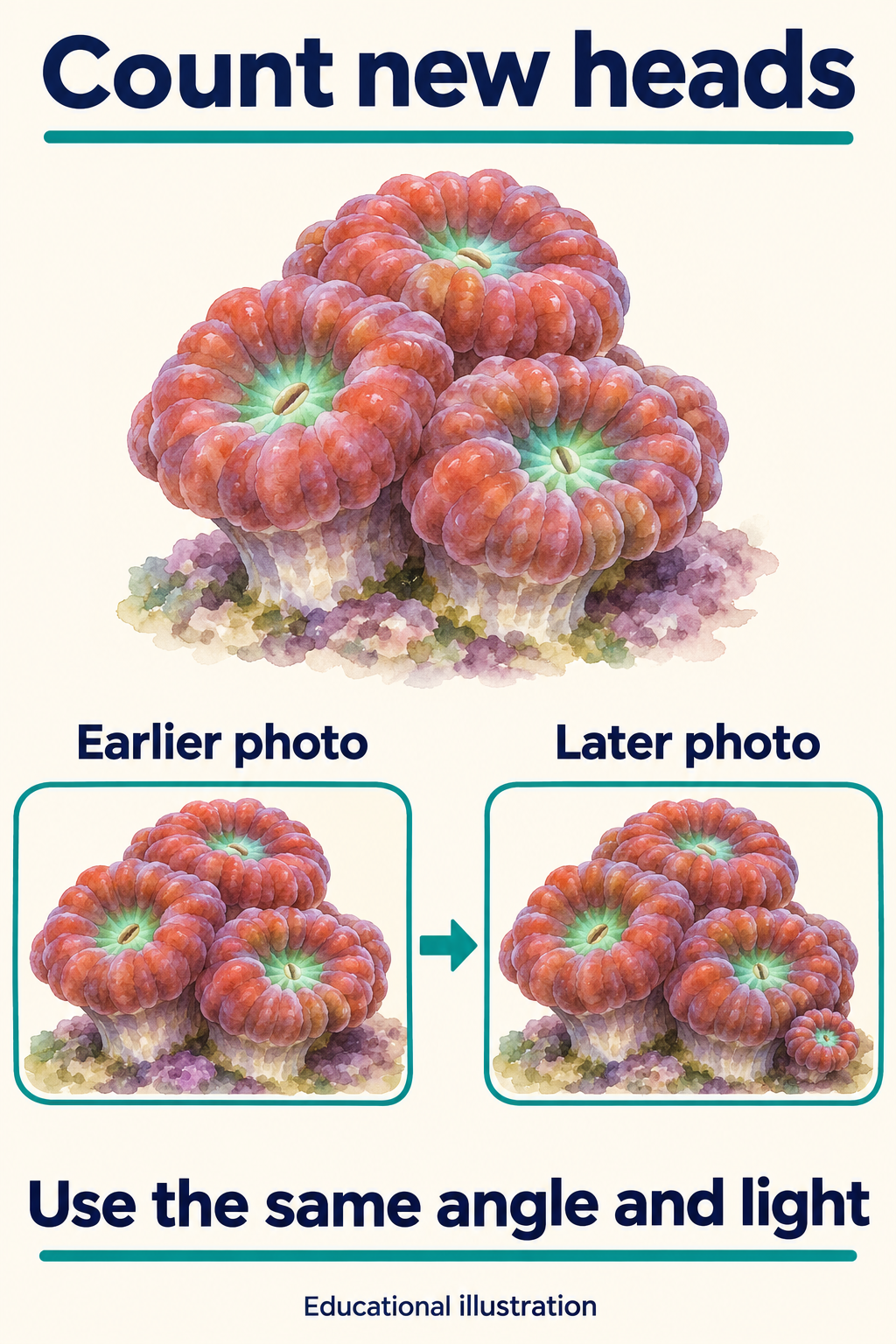
Track new growth, not just a fuller head.
New polyps around the edge and more living coverage can show that a colony is growing. A head that swells more at one time of day has not necessarily built more skeleton or added heads.
Take photos from the same position. Count clearly separate new polyps when you can. Keep the purchase date and any fragging history in the record so the comparison has a useful timescale.
“Slow growth” is a sensible expectation when planning space. It is not a limit on every settled, well-fed colony.
Check the skeleton before planning a cut.
Blastomussa can be propagated in aquariums. A dense colony is not necessarily a group of heads that can simply be pulled apart.
A Reef Central account describes letting the flesh retract, then using a coral saw to separate skeleton between polyps while protecting the living tissue. That is an experienced keeper's method. It does not guarantee a clear cutting route through every wellsi colony.
Part of that discussion is about merleti. Its structure should not be assumed to match every coral sold as wellsi. Inspect the actual skeleton before choosing where to cut.
Do not learn on a stressed arrival.
For a newer keeper, buying a healed frag is usually a better starting project than cutting a newly arrived coral. If you plan to frag a healthy, established colony, first prepare the support, tools and recovery location.
Use eye and skin protection, equipment suited to wet aquarium work and clean handling practices. Do not cut through a mouth. Do not assume living tissue ends at a change in color.
If you cannot find a safe separation through the skeleton, stop and get experienced help. Do not force a break. This is a cautious handling outline, not a complete guide to using a saw or chemical treatments.
Give the frag a steady recovery.
Secure the piece without crushing its flesh or putting glue on it. Keep the recovery conditions stable and watch the cut edge for continuing tissue loss. This is not the time to try brighter light or heavier feeding.
When you share or sell a captive-grown frag, pass along its lineage and care history. Be honest about its identification. A named color form is not a scientific species identification.
Knowing where the piece came from and how it was kept helps the next keeper make a smoother transition. That is more useful than promising a certain head count by a certain date.
Source for this section: [Reef Central propagation account](https://forums.reefcentral.com/threads/fragging-101-i-blastomussa.1998889/).
Field notes — what keepers report
These are paraphrased keeper reports, not controlled experiments or confirmed diagnoses. The trade identification may be uncertain, and tank measurements are often incomplete. Successful keepers also use different methods. Read each report for its context and the questions it raises.
Some keepers see a benefit from feeding.
In the December 24, 2017 “Blastomussa wellsi care” discussion, Rob Rowe linked an improvement to starting weekly target feeding. He also suggested dimmer placement for a coral that was closing.
Another participant reported success with low-to-medium light, moderate indirect flow and occasional coral foods. These experiences support trying manageable extra food. Neither was a controlled comparison that makes weekly feeding a requirement.
[Read the discussion](https://www.reef2reef.com/threads/blastomussa-wellsi-care.345849/)
The quietest spot is not always the best one.
The January 2019 “Blastomussa troubles” thread began with a coral declining after months in conditions that had seemed acceptable. Some replies suggested less light and flow.
Another keeper, kichimark, reported success with medium flow and wondered whether the more sheltered heads were receiving less food. The reviewed discussion did not settle these competing ideas with a confirmed diagnosis or documented recovery. It is a reason to check the coral's actual situation rather than assume the quietest location is safest.
[Read the discussion](https://www.reef2reef.com/threads/blastomussa-troubles.537217/)
A growth story is not a feeding schedule for every tank.
In December 2020's “feeding blastomussa” thread, eggwater described feeding every two or three days. They also acknowledged that some keepers do not target feed.
In the same discussion, exnisstech reported a self-identified wellsi growing from three heads to more than twenty in about eighteen months. They broadcast-fed mysis several times a week.
The original poster had merleti, so not every comment in the thread applies specifically to wellsi. The growth report tells us what happened in one aquarium. It neither predicts a new frag's growth nor proves that feeding caused it.
[Read the discussion](https://www.reef2reef.com/threads/feeding-blastomussa.780753/)
Dim-light success does not rule out every other placement.
In a December 2013 lighting discussion, CoralReefLife reported more heads and a larger colony over six months. The coral sat near the sand under a multi-bulb light, with steady indirect flow.
That differs from advice to keep it permanently in deep shade. But no PAR reading was supplied. The lamp description alone cannot show that the coral received unusually strong light. We can keep both this experience and dim-light successes in view without averaging them into one supposed ideal setting.
[Read the discussion](https://www.reef2reef.com/threads/blastomusa-lighting-and-care.141507/)
Check nearby irritants before moving it again.
In March 2024, a keeper with a partly closed Blastomussa received different suggestions about light, flow and tank maturity. They later found small Aiptasia near the coral and thought these were causing the irritation.
That was the owner's explanation. The discussion did not provide a confirmed clinical diagnosis or prove long-term recovery. It still offers a useful reminder: inspect the plug and nearby animals before repeatedly moving the coral in response to competing advice.
[Read the discussion](https://www.reef2reef.com/threads/blastomussa-hasn%E2%80%99t-opened-fully-for-4-days-or-so.1042436/)
Use reports to ask better questions.
Ask what was measured, how long the coral had been settled and whether the report concerns wellsi or another Blastomussa. Find out what happened after the suggested change. Keep conflicting reports rather than selecting only those that fit your preferred routine.
In your tank, record a starting point. Change one non-urgent factor at a time. Judge tissue condition and actual growth rather than relying on a single impression of how full the heads look.

Research reviewed November 8, 2026. This readability revision keeps the original sources and care advice. The eight educational figures are ChatGPT-generated illustrations. They are not specimen photos or evidence for identifying the coral, and they do not replace the existing main image or original gallery photo.
Sources retained from the original guide
1. [OBIS species record](https://obis.org/taxon/207386) 2. [Corals of the World](https://www.coralsoftheworld.org/species_factsheets/species_factsheet_summary/blastomussa-wellsi/) 3. [Benzoni and colleagues, 2014](https://repository.naturalis.nl/pub/801817) 4. [Tidal Gardens](https://tidalgardens.com/wysiwyg-cherry-bomb-blastomussa.html) 5. [LiveAquaria](https://www.liveaquaria.com/products/big-polyp-blastomussa-coral) 6. [Récif at Home](https://www.recifathome.com/en/other-lps-section/28698-wysiwyg-blastomussa-wellsi.html) 7. [Saltcorner species account](https://www.saltcorner.com/AquariumLibrary/browsespecies.php?CritterID=2516) 8. [Holmes-Farley’s reef chemistry reference](https://www.reef2reef.com/threads/optimal-parameters-for-a-coral-reef-aquarium-by-randy-holmes-farley.173563/) 9. [Reef Builders parameter reference](https://reefbuilders.com/wp-content/blogs.dir/1/files/2022/05/RB-AquariumParameter-1.pdf) 10. [Keeper feeding discussion](https://www.reef2reef.com/threads/feeding-blastomussa.780753/) 11. [LiveAquaria acclimation guidance](https://www.liveaquaria.com/pages/liveaquaria-step-by-step-acclimation-guide) 12. [Keeper troubleshooting account](https://www.reef2reef.com/threads/blastomussa-hasn%E2%80%99t-opened-fully-for-4-days-or-so.1042436/) 13. [Reef Central propagation account](https://forums.reefcentral.com/threads/fragging-101-i-blastomussa.1998889/) 14. [Read the discussion](https://www.reef2reef.com/threads/blastomussa-wellsi-care.345849/) 15. [Read the discussion](https://www.reef2reef.com/threads/blastomussa-troubles.537217/) 16. [Read the discussion](https://www.reef2reef.com/threads/blastomusa-lighting-and-care.141507/)
Field Notes
Related species

Blastomussa Merleti
Blastomussa merleti
Same genus
Pineapple Coral
Blastomussa merleti
Same genus

Stomping Grounds Blasto
Blastomussa merletti
Same genus
Aussie Blastomussa wellsi
Blastomussa wellsi
Same genus
Red Scarlet blastomussa
Blastomussa wellsi
Same genus

Candy Cane Coral
Caulastraea echinulata
Similar care · LPS

Blue mouth Duncan
Duncanopsammia axifuga
Similar care · LPS
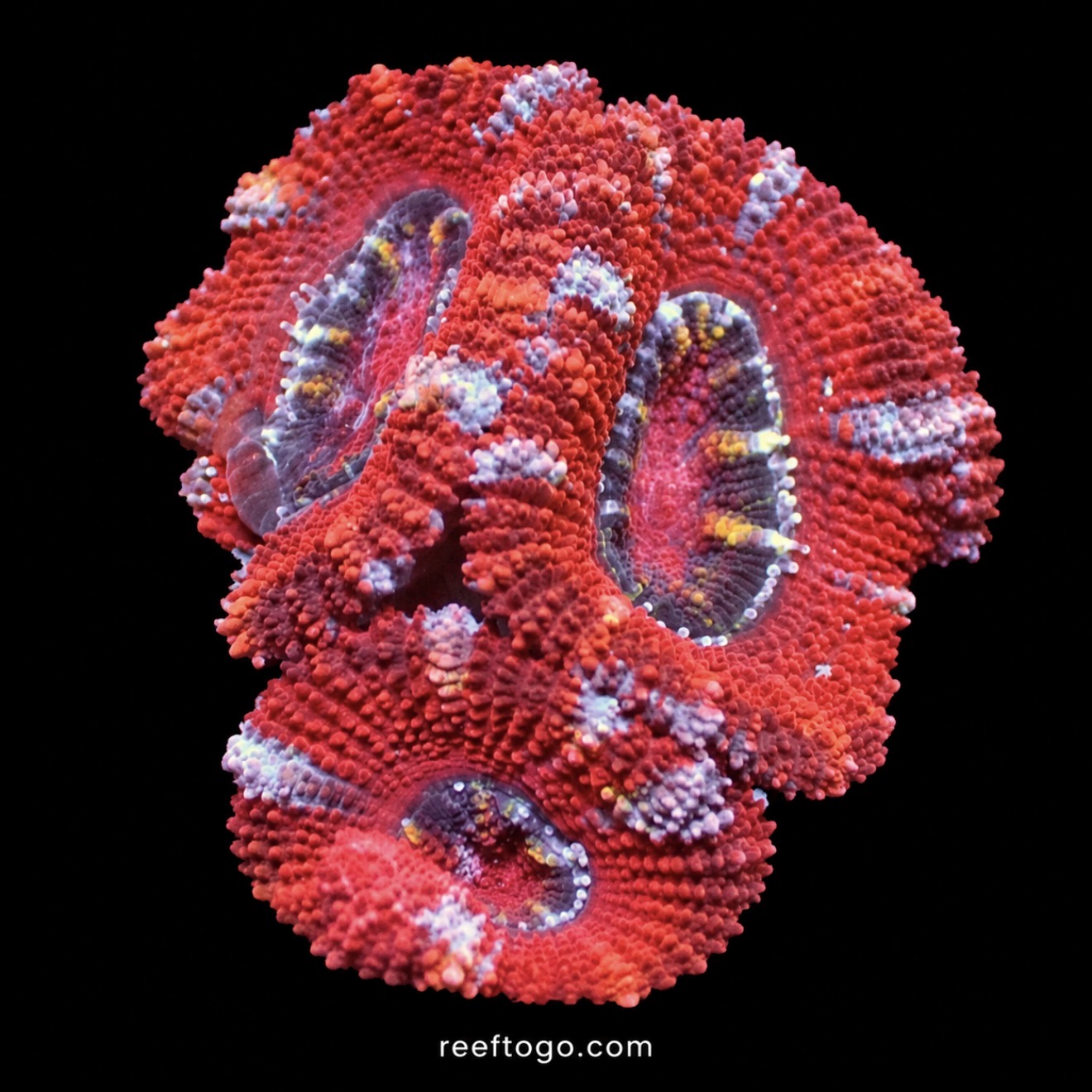
Bulls eye acan lord
Micromussa lordhowensis
Similar care · LPS