 ▶ Video
Gallery
Videos
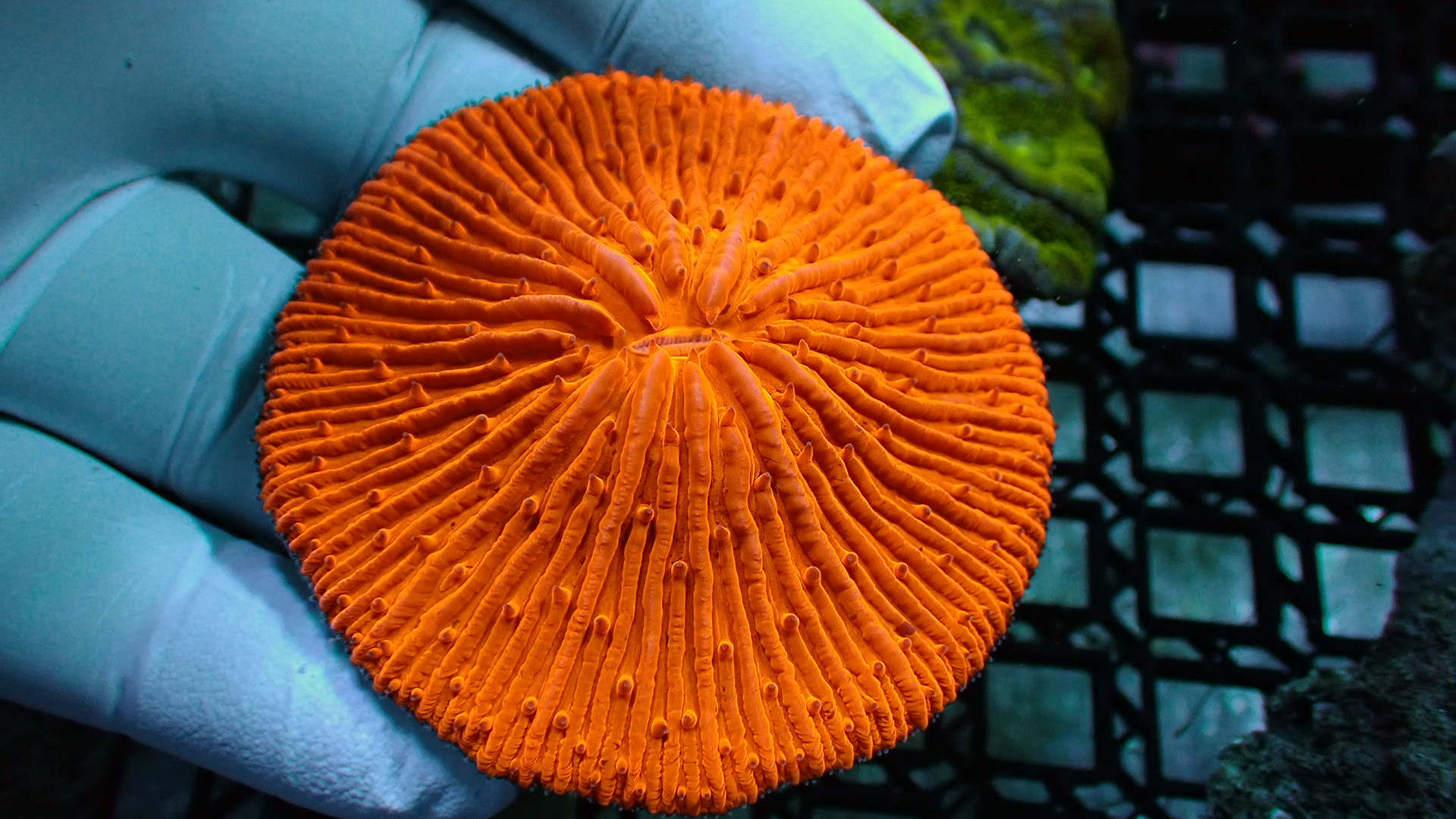
The Orange Plate is a single, free-living disc of a coral — one large polyp resting on the sand, shaped like a small dinner plate with a mouth at its center. Short, tapered tentacles cover the upper surface, and on this morph they run a rich, saturated orange over a deeper orange-brown disc. Expanded and feeding, the tentacles stand up in a dense carpet; at rest they lie back and the skeleton's radiating partitions show through.

Fungia plate corals live unattached on rubble and sand across the Indo-Pacific, and the body plan is built for that life. The polyp can inflate with water to right itself after a tumble, work itself slowly across the bottom by swelling and rocking, and dig out when sand settles over it. Plates also produce anthocauli — small stalked buds that grow from damaged or aging tissue and drop off as new independent plates — which is why a plate that looks finished sometimes leaves a cluster of babies behind. Keep that mobility in mind in the tank: a wandering plate ends up wherever the current and its own rocking take it.
Care is beginner-level with one hard rule: the plate lives on the sand bed, never on rock. Rock edges and points tear the soft underside tissue as the coral shifts, and those wounds invite infection. Set it flat on open sand in low light and low flow, matching this entry's ratings, where it will not tumble into the glass or beneath the rockwork. Standard reef parameters suit it: 77–79°F, salinity near 35 ppt, alkalinity 8–10 dKH, calcium 400–450 ppm.
It feeds gladly and visibly. Lay small meaty foods — mysis, chopped shrimp, a coral pellet or two — onto the tentacles near the mouth once or twice a week, and the polyp works the food inward with slow waves of the tentacles. Guard the meal while it eats; shrimp and bold fish steal from plates. Growth is slow, the disc thickening and widening over months, and a healthy plate inflates fully every day, holds its orange under modest light, and may in time surprise you with a ring of daughter plates along a damaged edge.
Field notes — what keepers report
- Plate corals walk, and keepers delight in reporting it. A plate inflates its tissue and shuffles across the sand, and hobbyist accounts credit a motivated Fungia with covering as much as twelve inches in a day and even climbing slopes around thirty degrees. Keepers add the practical flip side: a wandering plate parks itself wherever it pleases, and that spot rarely matches the aquascape plan.
- Substrate choice is the hard lesson in the threads. Keepers report plates cutting and tearing their own tissue on crushed coral and coarse substrate — one gave up keeping them on crushed coral entirely — and plates moved onto rockwork fare worse, with the delicate underside damaged by rock contact and the small fauna living in it. Fine sand on the bottom is the near-unanimous keeper answer.
- Keepers report that a healthy plate can right itself after being flipped and can shrug off sand that blows onto it, but the self-cleaning costs the coral energy, so a plate that is constantly getting buried is a plate under chronic stress. Keepers treat repeated burial as a flow problem to fix rather than a trick to admire.
- Fungia mucus gets respect in keeper mail: the WetWebMedia crew warns that plate corals are mobile, capable of climbing, and produce mucus toxic enough that neighbors should be kept at a distance. Keepers of the long-tentacle relatives (Heliofungia) report a rougher ride than with true Fungia, including sudden bacterial declines that mirror the losses seen in elegance corals.

Field Notes
Related species

Plate Coral
Fungia fungites
Same genus

Blue mouth Duncan
Duncanopsammia axifuga
Similar care · LPS

Pineapple Coral
Blastomussa merleti
Similar care · LPS

Stomping Grounds Blasto
Blastomussa merletti
Similar care · LPS
Kryptonite candy cane
Caulastrea sp
Similar care · LPS
Aussie Blastomussa wellsi
Blastomussa wellsi
Similar care · LPS
Blastomussa Merleti
Blastomussa merleti
Similar care · LPS

Blastomussa Wellsi
Blastomussa wellsi
Similar care · LPS