
Purple Hornet
Zoanthus sp.
Also known as: Purple Hornets, OG Purple Hornet
Care Summary
Purple Hornet is the zoanthid that started the hornet series. A specialist ID source puts it plainly: the original Hornet was the Purple Hornet, named for a skirt that alternates purple and yellow, echoing the banding of the insect. The trait that lasted longest was the clean ring around the mouth, and today the hornet name is handed to most zoanthids that carry that ring. The full look to judge a frag by is a deep purple disc, a bright yellow-to-gold ring circling the mouth, and that alternating purple-and-yellow skirt on a plump, full polyp.
That plump shape matters for identification. The same ID source contrasts the original trio — Red, Blue, and Purple Hornets — with the later Rainbow Hornet: the originals are full and juicy in the polyp, while Rainbow grows thinner and flatter, carries a metallic orange skirt, and is suspected to be a different species altogether. A thin, flat polyp with an orange skirt sold as a Purple Hornet deserves a second look. The Blue Hornet is the closest sibling: the same ring pattern on a blue disc where the Purple Hornet's disc runs a much deeper purple.
Care starts lower than many zoanthids want. Farming guidance written for this morph reports the best growth and success between 50 and 100 PAR, with about 75 PAR as the working average, and placement in the middle to bottom of a mixed reef. Start a new frag low, acclimate upward slowly over a few weeks, and judge it by polyp extension and ring clarity rather than by how brightly it fluoresces — keepers note this morph stays comparatively muted under blue light, with the yellow at the mouth doing the visual work (see field notes).
Flow should be moderate and indirect: enough movement to keep detritus from settling on the mat, with no pump aimed straight at the colony. Direct flow folds or closes the polyps, and a mat that stays dirty invites the decline keepers call melting. The coral is photosynthetic and needs no feeding; the vendor guidance read found little benefit beyond the fines from frozen foods and occasional amino acids for keepers who choose to offer them.
Reef To Go's standard reef parameters suit it: 77–79°F, salinity near 35 ppt (about 1.024–1.026), alkalinity 8–10 dKH, calcium 400–450 ppm, with low but detectable nitrate and phosphate. Zoanthids have no calcium skeleton, so there is no dosing demand from this coral itself; stability is the requirement, because small swings are what stress a collector morph first.
Placement needs one extra thought beyond light and flow: protect it from its neighbours. This is a slow grower, and faster zoanthid mats will shade and overrun it in a crowded garden. Give it its own rock area or a defined island with room to spread at its own pace, and keep sweeper-tentacled corals out of reach. Next to pink or yellow zoanthids, a settled colony reads especially well once it has filled in.
Safety applies to this coral as it does to zoanthids generally. Some zoanthids and their Palythoa relatives can carry palytoxin, and there is no visual way to tell which colonies do. Handle and frag with gloves and eye protection, keep the coral away from open cuts, handle it submerged where practical, wash thoroughly afterwards, and never boil, steam, or pressure-wash rock that carries it, because heat can aerosolize the toxin. Handled with that respect, a settled colony is a durable, long-lived aquarium coral.
Field notes — what keepers report
- The original-of-the-series status is the point keeper and ID sources agree on most strongly. Legendary Corals' hornet ID page credits the Purple Hornet as the first Hornet, named for its alternating purple-and-yellow skirt, and explains that the clean mouth ring became the pattern the whole series is now judged by. That history is also why the name is borrowed so freely: a Reef2Reef sale listing read for this dossier offered a zoa described only as the nearest to Purple Hornets the seller had seen, which tells a buyer the name functions as a benchmark other morphs are measured against.
- Slow growth is reported consistently. A keeper-oriented roundup of affordable zoas describes Purple Hornets as not fast growers that stick close to the rockwork on short stems, and warns they can be outcompeted by more aggressive zoas, so placement choice matters. The hornet-family pattern shows up in a Reef2Reef growth thread too, where a keeper reported nearly every zoa in the tank multiplying within two months except a particularly stubborn Blue Hornet — a sibling morph, not this one, so treat it as family context rather than a Purple Hornet measurement.
- On difficulty, reports split by source type, and both sides belong in the record. Vendor farming guidance for this morph presents standard, manageable zoanthid care at low-to-medium light, while also warning that high-end zoas as a group include known melters, where small problems can kill a colony for no obvious reason. The Legendary Corals ID page adds the comparison point: the later Rainbow Hornet is much easier to care for than the original trio, which places the Purple Hornet on the fussier side of the hornet family by contrast. The honest summary is a hardy family with a comparatively demanding member.
- Colour expectations need managing. The keeper roundup above calls these the thinking keeper's zoas: deep purple with subtle yellow lashes, a small yellow accent right around the mouth, and a colony effect that builds as the mat fills in — while noting they do not light up brightly under blue LEDs the way many collector zoas do. Vendor hornet-family guidance (written for a sibling morph, Murder Hornet) reports the yellow ring washing out under intense white light or in nutrient-poor, ultra-clean water, with a blue-heavy spectrum, moderate light, and detectable nitrate and phosphate keeping the ring clear. Family-level guidance only — no Purple Hornet-specific ring-fading test was found in the sources read.
- Melting prevention, from the same hornet-family vendor guidance and general zoa keeper practice, converges on the unglamorous basics: clear flow dead spots around the mat, inspect at night for zoa-eating nudibranchs, sundial snails, and spiders, keep detritus basted off the skirts, and stabilise parameters before reaching for dips. No Purple Hornet-specific melt rate or cure was found in the sources read, so this entry claims none.
- Price in listings actually read has come down a long way from the morph's scarce early reputation: a current ReefStable listing prices a frag of 2 or more polyps at $29.99. No verified historic peak price was found in the sources read for this dossier, so none is claimed here — the scarcity-era pricing story is widely repeated in the hobby and should only be added if a dated primary listing can be cited.
Care
Field Notes
Related species
Exosphere zoanthids
Zoanthus sp
King Kong Yuma mushroom
Ricordea yuma
Stratosphere
Zoanthus sp

Finger Porites
Porites cylindrica
Jawbreaker mushroom
Discosoma sp.

Massive Lobe Coral
Porites lobata
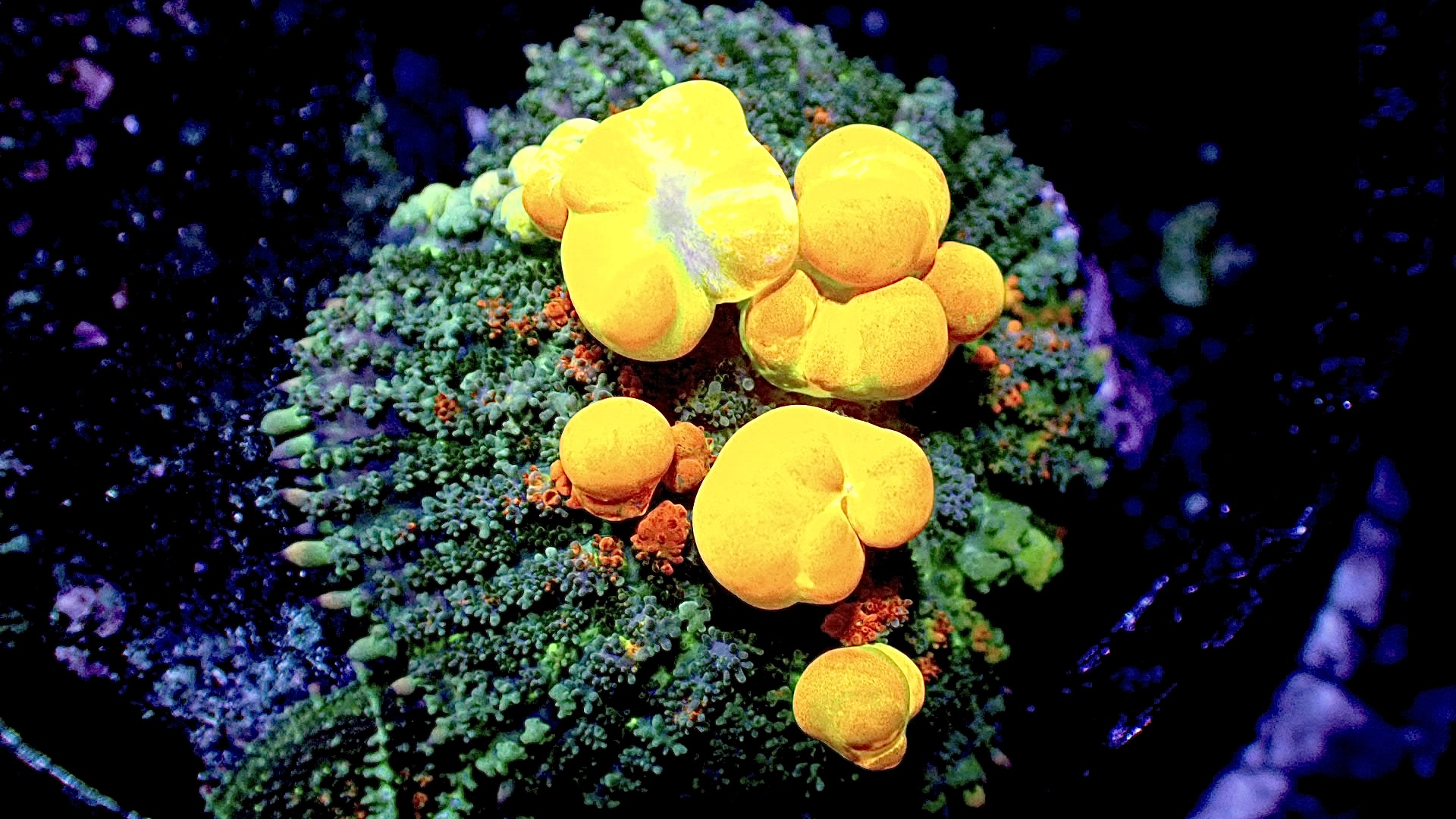
OG bounce mushroom
Rhodactus sp

Potato Chip Coral
Pavona cactus