Lavender Tang
Acanthurus nigrofuscus
Reef Safe

Care facts
- Difficulty
- Intermediate
- Reef Safe
- Yes
- Aggression
- Semi-aggressive
- Diet
- Herbivore
- Tank Size
- Large
- Swimming Zone
- Mid
Gallery
The Lavender Tang, Acanthurus nigrofuscus, is a surgeonfish of the Indo-Pacific and Hawaii, ranging from the Red Sea and the east African coast east to Hawaii and the Tuamotu Islands, north to southern Japan, and south to the southern Great Barrier Reef, New Caledonia, and Rapa. It is also sold as the Brown Tang and the Spot-Cheeked Surgeonfish, and under its scientific name it is one of the most numerous surgeonfishes on the reefs it inhabits. FishBase puts its maximum published total length at 21 cm (about 8.3 inches), with most adults nearer 18 cm, and its depth range at 0 to 25 metres. In the wild it lives over hard substrates on shallow lagoon and seaward reefs, from the lower surge zone down past 15 metres, grazing benthic algae as it goes.
Identification
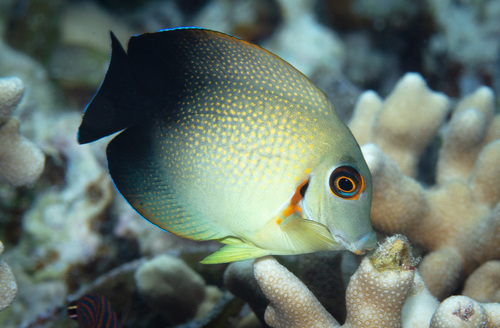
Recognition takes a closer look than the showier tangs demand. The body is brown to brownish-lavender overall, sometimes carrying fine bluish-grey longitudinal lines and sometimes not — FishBase notes both forms — with orange spots scattered over the head and chest in many specimens. The reliable marks are at the fin bases: a prominent black spot, larger than half the eye diameter, at the base of the dorsal fin, a smaller black spot at the base of the anal fin, and a narrow black margin around the groove that holds the caudal spine. The pectoral fins are pale with a narrow black upper edge. None of that photographs dramatically, which is the heart of this fish's reputation problem: in a store photo or under white shop light it reads as a plain brown tang, and the lavender cast the name promises only shows in person, on a settled fish, under reef lighting.
Reading the care ratings
The entry lists intermediate care, semi-aggressive temperament, a herbivore diet, a large tank, midwater swimming, and reef safety marked Yes, and the combination needs reading as a whole. Intermediate rather than beginner is not about fragility — by surgeonfish standards this is a hardy, willing feeder — it is about space, grazing demand, and tang politics, all covered below. Herbivore is the working fact of the species: everything about its wild life is organised around cropping algae, continuously, all day.
Tank size
Tank size deserves plain language. Large on this entry means swimming length and open water, not just gallons. Retail and care-guide minimums for this species spread widely, from about 75 gallons at the low end to 100–125 gallons in the more conservative listings, with at least one guide specifying a tank five feet or longer. The spread exists because the fish is a constant swimmer and grazer that works a whole reef, not a cave-sitter. A long tank with a continuous swimming lane, open sand or open water in front of the rockwork, and plenty of grazing surface suits it far better than a tall, rock-filled box of the same volume. Juveniles are often sold at 2 to 3 inches and look deceptively manageable; plan for the 7- to 8-inch adult from the start.
Feeding
Feeding follows the herbivore listing and the wild diet. In nature it feeds on filamentous algae and algal turf cropped from hard substrates; a long-running feeding study in the Gulf of Aqaba found brown and red algae dominating in summer and lush green algae in winter, a seasonal switch tied to fat storage and the start of gonadal activity. In a tank that translates to daily seaweed — nori or other dried algae on a clip, offered in more than one place if other grazers compete — plus an algae-based staple, spirulina-rich foods, and grazing rock it can pick at between meals. It will also take meaty frozen foods such as mysis and brine shrimp, and keepers should let it, in moderation: the bulk of the diet should stay plant-based, but a fish that only ever sees one green sheet tends to lose condition. A rounded belly and constant picking are the signs the ration is right; a pinched look behind the eyes is the early warning it is not.
The scalpel
Like every surgeonfish, it carries a scalpel — a sharp, folding spine on each side of the caudal peduncle, here seated in its black-rimmed groove. It is a defensive weapon, used with a sideways slash of the tail, and it matters most at netting and bagging time, when a startled fish can cut a net, a bag, or a hand. Move it in a rigid container rather than a net where possible, and never cup it in a bare hand.
Temperament
Temperament is listed semi-aggressive, and the honest target of that label is other surgeonfish, especially other Acanthurus. Toward unrelated fish this species is usually steady, and several long-standing care references place it, with the Convict Surgeonfish, among the more peaceful tangs — with the practical rule that it should be the first surgeonfish introduced if more than one is planned, because established, more aggressive tangs can bully it. FishBase adds the wild context that explains a lot of captive behaviour: this species sits at the bottom of the pecking order among surgeonfishes, and in nature it answers that problem with numbers, feeding in groups large enough to overwhelm the territorial defences of algae-farming damselfish. A lone aquarium fish has no school to hide in, so a specimen that is chased off the food by tankmates is behaving exactly as its wild ranking predicts — fix the hierarchy or the feeding access, not the fish.
Reef safety
Reef safety is marked Yes. This fish grazes algae from rock and glass and leaves coral tissue and ornamental invertebrates alone, which is precisely why it earns its keep in a reef: the wild species is part of the grazing pressure that stops algal turf from smothering coral, and a settled aquarium specimen does the same work on a small scale. The one reef cost is indirect — a hungry grazer in an algae-free tank still has to eat, so a bare, sterile system is a poor home for it no matter how reef-safe the fish itself is.
A gut built for algae
One piece of natural history belongs in any book-ready account of this species. Its intestine hosts Epulopiscium fishelsoni, a symbiotic bacterium so large — up to about 600 by 80 micrometres, a little smaller than a printed hyphen — that it was first mistaken for a protist. It helps regulate the pH of the host's gut, which in turn shapes how well the fish digests its algal diet and absorbs nutrients. It is a reminder that this tang does not digest seaweed alone; it farms the machinery that does, which is one more reason crash diets and long food-free stretches suit it so badly.
Choosing and quarantining
Quarantine and selection matter. Choose a fish that is already grazing or taking seaweed at the store, alert, with clear eyes, intact fins, and no pinched belly. Care guides for the species flag susceptibility to marine ich in the first weeks after shipping and stress, as with many Acanthurus, so a proper quarantine and a slow, dim-light acclimation are worth the patience. In the wild it reproduces in large spawning aggregations; there is no captive breeding to speak of, and aquarium specimens are wild-caught, which puts the weight on choosing a healthy, feeding individual at the start.
Warning signs
Warning signs include a settled fish that stops grazing, weight loss along the back despite daily seaweed, persistent hiding in a species that should be working the rock in the open, and colour that stays washed-out and blotchy well past the acclimation period — brief stress mottling when the lights change or after a scuffle is normal tang behaviour, a fish that never colours back up is telling you something about food, bullying, or water.
Field notes — what keepers report
- Colour reports are the most consistent theme, and they explain the fish's whole reputation. Keepers repeatedly say the same thing the original short note said: it does not photograph well. Under camera flash or white light it looks plain brown and gets passed over; keepers who bought one anyway describe a settled adult under blue-heavy reef light developing a genuine lavender-purple sheen with blue-grey lines, better month by month on a good algae diet. The other side is also reported: stressed, newly imported, or underfed fish stay drab and blotchy, and keepers warn not to judge the species by a pale store specimen — or to expect show-tang colour from a fish that is being bullied or starved of greens.
- Temperament reports split by tankmates, in a pattern that matches the published guidance. In single-tang tanks and with unrelated tankmates, keepers describe a passive, almost placid grazer that nips algae off the glass and minds its own business, sometimes kept for a year or more without a single aggressive act. In multi-tang tanks the reports divide: some keepers house it successfully alongside bristletooths and sailfins in larger systems, while others report trouble that mostly happens after lights-out, when tang hierarchies get renegotiated in the dark — one keeper traced repeated injuries on a passive lavender tang to night-time tang aggression and found a moonlight helped. The through-line keepers draw is order of introduction: added first, it usually holds its own; added last, behind an established aggressive tang, it is the one that gets driven off the food.
- Algae-control reports split by algae type. Keepers credit this species with steady, all-day work on filamentous algae, algal turf, and film algae on rock and glass — the exact foods FishBase lists for the wild fish — and it is often recommended specifically as a working grazer rather than an ornament. The limiting reports are equally consistent: it crops algae short rather than clearing established growth, so keepers with long, mature hair algae or tough, unpalatable algae types report disappointment when they expected a cleanup miracle. The fair summary keepers converge on is maintenance grazer, not demolition crew — it holds a clean reef clean far better than it rescues a neglected one.
- Tank-size reports are the widest spread in the file, mirroring the 75-to-125-gallon spread in print. Keepers in four-foot tanks around 75–90 gallons often report a small specimen doing well at first, then describe restless pacing and faster-than-expected growth toward the 7- to 8-inch adult size within the first year or two, with several saying they rehomed or upgraded. Keepers in five- and six-foot systems report the opposite character — a calm, methodical grazer that uses the full length without the pacing. Both sides agree on the underlying point: it is the swimming length and grazing area, not the gallon count on its own, that decides whether this fish settles.
- Feeding reports centre on the clip. Keepers say a healthy lavender tang hits seaweed aggressively and early — often from the first day — and that offering nori at two clips at opposite ends of the tank ends most food-guarding tension with other grazers, a trick tang keepers generally recommend. Keepers also report that individuals vary: most graze the rockwork constantly between feedings, while an occasional specimen fixates on the clip and prepared foods and does noticeably less rock work, which is worth knowing before buying one purely as algae crew.
Field Notes
Related species

Atlantic Blue Tang
Acanthurus coeruleus
Same genus

Epaulette Surgeonfish
Acanthurus nigricauda
Same genus
Mimic Tang
Acanthurus pyroferus
Same genus

Orangebar Tang
Acanthurus olivaceus
Same genus

Powder Blue Tang
Acanthurus leucosternon
Same genus

Powder Brown Tang
Acanthurus japonicus
Same genus

Yellowfin Tang
Acanthurus xanthopterus
Same genus

Achilles Tang
Acanthurus achilles
Same genus