Whitecheek Tang
Acanthurus nigricans
Reef Safe

Care facts
- Difficulty
- Intermediate
- Reef Safe
- Yes
- Aggression
- Aggressive
- Diet
- Herbivore
- Tank Size
- Large
- Swimming Zone
- Mid
Gallery
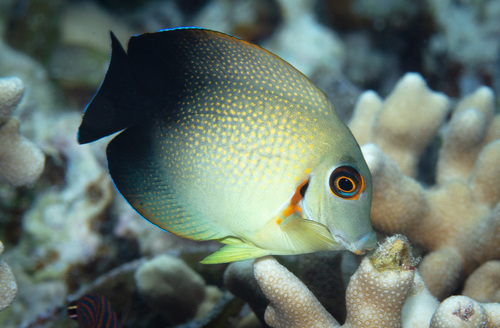
The Whitecheek Tang, Acanthurus nigricans, is a dark, gold-rimmed surgeonfish with a small horizontal white blotch below the eye, and it carries one of the most divided care records of any common tang. The original short entry in this database put the temperament first, and plainly: the reputation for aggression toward other tangs is completely earned, a keeper needs to plan around that before buying, introduction after the other tangs are settled still risks weeks of bullying, and the reward is the white cheek patch and the yellow spine on a fat, well-fed fish whose colours intensify when it is comfortable and healthy. The longer published record supports the aggression warning, and then argues about almost everything else. Temperament filings run from Peaceful in one species profile, through Semi-aggressive in most retail tables, through Aggressive as filed here, to one care account that calls this one of the most aggressive surgeonfish species of all. Hardiness filings divide even more sharply: a long-running expert archive files the true nigricans as a fish that rarely lives more than a few weeks to months in captivity and calls its survival history dismal, a species lexicon files it Delicate, several retailers file it Moderate or Intermediate and recommend it to intermediate and advanced keepers, and a quarantined-fish retailer tradition files it hardy and resilient — with a famous book-versus-archive disagreement about whether the hardy fish in this pair is nigricans or its look-alike relative japonicus sitting underneath the whole argument. Adult size is formally about 21 centimetres, commonly filed at 20 to 21.5 centimetres and 8 to 8.5 inches, with a 14-centimetre lexicon figure at the low end and a 12-to-14-inch retail template at the high end that does not match the formal record. Tank minimums run from 70 gallons, through 100, 120 and 125 gallons, to 700 litres in the lexicon. Lifespan filings run from 8 to 12 years and more in retail care, to a formal maximum reported age of 34 years. A keeper who reads those spreads whole gets the real fish: a wide-ranging, territorial, filamentous-algae grazer from the achilles species complex, beautiful and genuinely assertive, whose first weeks and whose correct identification decide most of the outcomes the reports describe.
Names, description, and the white cheek
Acanthurus nigricans was first formally described by Linnaeus in 1758, as Chaetodon nigricans, in the tenth edition of Systema Naturae. The type locality was given as the Red Sea, and later scholarship holds that the locality is in error and the material is thought to have come from Indonesia — a detail worth knowing because modern range accounts do not place established Red Sea populations in the way older retail copy, which repeats a Red Sea origin, assumes. Synonyms in the formal record include Acanthurus glaucopareius Cuvier, 1829 and Acanthurus aliala Lesson, 1831, and the older glaucopareius name still appears in expert archives and older books, sometimes attached to a different common name than the one a shop uses today. Common names in the record include Whitecheek Tang, Whitecheek Surgeonfish, White-cheeked Surgeonfish, Goldrim Surgeonfish, Gold-rimmed Surgeonfish, Gold Rim Tang, Velvet Surgeonfish, Yellowrimmed and Yellow-banded Surgeonfish, and Powder Gray Surgeonfish. The body is deep and oval, dark bluish brown to black over most of its length, fading a little lighter toward the rear in field accounts. Directly below the eye sits a horizontally elongate white blotch — the cheek mark of the name — and a smaller white mark near the lips is noted in the encyclopedia account. Gold to yellow bands run along the bases of the dorsal and anal fins and widen toward the tail base, giving the Goldrim name; the caudal peduncle socket and the sheath of the peduncular spine are edged yellow. The tail itself is white, sometimes washed very pale blue, with a yellow vertical band set before its rear edge. The outer edges of the median fins carry a fine blue border, the pectoral-fin base is black, and gill-raker counts and fin counts separate the species in formal keys: dorsal fin 9 spines and 28 to 31 soft rays, anal fin 3 spines and 26 to 28 soft rays. The single scalpel spine on each side of the tail base sits in a groove and can be erected by curving the tail; handling accounts warn that the spine is sharp enough to cause deep lacerations and can catch in nets. Juveniles are truncated-tailed, becoming slightly crescent-shaped with age, and small juveniles are shy, sheltering among large corals; the size at metamorphosis from the postlarval stage to the juvenile is recorded at 5.5 to 6 centimetres.
The Powder Brown confusion
No account of this fish is complete without the identification problem, because a large share of the care disagreement in print is really two species wearing each other's names. The close relative is Acanthurus japonicus, sold as Powder Brown Tang, Japanese Tang and White-faced Surgeonfish. The expert archive tradition is blunt about the tangle: japonicus is also sold as Gold-rimmed and Powder Brown, and is also sold in the trade as Whitecheek, while nigricans has itself been labelled Powder Brown — and one widely read archive exchange records a direct conflict between that archive and Scott W. Michael's Marine Fishes book over which of the pair is hardy and which carries the poor survival record, with the archive holding that the book's treatment is switched. Buyers should therefore separate the fish, not the label. The reliable separators repeated across the formal key, the archive and keeper identification threads are these. In nigricans the white mark is a small, horizontally elongate blotch or streak directly below the eye. In japonicus the white covers much more of the face, a large patch running between eye and mouth. Nigricans is the darker fish overall, ash black to dark bluish brown, with less yellow on the body. Japonicus is browner, carries a thicker yellow band toward the base of the tail, and carries a red to orange streak on the rear part of the dorsal fin — the formal key for nigricans states the negative directly: no orange band in the outer part of the dorsal fin. The tail helps as well: nigricans shows the whiter tail with its yellow band set toward the rear, while japonicus tails tend darker with the stronger yellow at the base. Keeper identification threads use exactly those points — small spot versus broad bar of white, presence or absence of the red dorsal line, tail colour and band position — and they warn that individual variation blurs any single character, so the set should be read together. A fish bought under the wrong name imports the wrong hardiness expectation with it, which is the practical reason this section sits near the top of the entry.
Range, reefs, and depth
The formal distribution is the widest in its complex. In the eastern Indian Ocean the species is known only from the Cocos-Keeling Islands and Christmas Island, with a later first record from the Chagos Archipelago in the central Indian Ocean. In the Pacific it runs from the Ryukyu Islands and the Great Barrier Reef to the Hawaiian Islands and French Polynesia, excluding Rapa, common throughout Micronesia, and it has crossed the Eastern Pacific Barrier — a crossing few reef fish manage — to the Revillagigedo Islands, Cocos Island, the Galapagos Islands and the Pacific coast of Mexico. Retail summaries that file the origin simply as Hawaii, as Western Pacific, as Indo-Pacific including the Maldives and Philippines, or as including the Red Sea and East Africa are compressing or copying older text; the Philippines and Ryukyu records belong firmly to the overlap zone with japonicus, and the Red Sea line traces back to the erroneous type locality discussed above. Habitat in the formal record is hard-substrate areas of clear lagoons and seaward reefs, from the lower surge zone to at least 67 metres, and the encyclopedia account gives the same fish in sunny shallow lagoons rich in filamentous algae, descending the outer reef beyond 60 metres. Retail habitat lines that place it on seaward slopes, channels and lagoons at 15 to 80 feet describe the shallow half of that record. Adults are solitary or found in groups in the formal summary, small schools in the encyclopedia account, and the species is recorded as territorial and monogamous. This database files swimming zone as Mid, and a fish that swims all day over hard substrate grazing film and filament, in surge-swept shallows and down outer slopes, fits a mid-water filing with constant contact with the rock it feeds from.
Size, sex, and social life
Formal maximum length is about 21 centimetres in the encyclopedia and FishBase-derived record, rarely exceeding 15 centimetres in the encyclopedia's field observation, and 22 centimetres in one retail profile. Trade filings cluster just under the formal figure: 8 inches in several profiles, 8.5 inches in the community care account, and maximum size 8 inches in a retailer listing. Against that cluster stand two outliers a buyer should recognise as outliers. A species lexicon files maximum length at 14 centimetres, well under the formal record and under most fish actually sold as adults. A quarantined-retailer template files adult size at 12 to 14 inches with a silver-gray body description that does not match this dark species at all — that text belongs to a template shared across several tang listings on the same sites, and planning a tank around a 14-inch nigricans would be planning around a copy error. The reconciled planning figure is a fish that commonly finishes in the 15-to-21-centimetre band, roughly 6 to 8.5 inches, which makes it one of the smaller Acanthurus and still a substantial, deep-bodied adult. Published weight in the formal record reaches 620 grams, and maximum reported age is 34 years — a wild longevity figure, addressed again under lifespan. The species is monogamous in the formal mating record, with both facultative and social monogamy reported, and it is territorial. No reliable external sexing is offered in the care sources used here, and no captive pair advice beyond the wild record should be read into the entry. The most distinctive life-history fact is the company it keeps on paper: nigricans forms a species complex with Acanthurus achilles, Acanthurus japonicus and Acanthurus leucosternon. Those three hold narrower, largely parapatric ranges inside the much wider range of nigricans, and nigricans frequently hybridises with all three where they meet — with japonicus in the Ryukyus and Philippines, with leucosternon around Bali where the two oceans mix, and with achilles eastward in Hawaii and the Micronesian chains. The Achilles cross is the one most often seen in the trade, sold as a hybrid tang in its own right.
Tank size — the spread in print
This database files tank size as Large. Published minimums spread across a wider range than the fish's modest adult length might suggest, because the disagreement is about swimming and temperament as much as body size. At the low end, a species profile files 70 gallons with water conditions for a medium-to-advanced keeper. A community care account sets a floor of 100 gallons, about 400 litres, and stresses open swimming space alongside caves. Retail listings file 100 gallons and 120 gallons. The most repeated formal floor is 125 gallons: a 475-litre minimum in the detailed profile tradition, a 125-gallon minimum in the quarantined-retailer tradition, a 125-gallon line in a tang survey, and keeper-forum advice treating 125 gallons as the size class this fish belongs in while a smaller Kole-class tang fits below it. Above that, the detailed profile allows 600 to 700 litres, roughly 150 to 185 gallons, as the ideal long-term housing, and the species lexicon files a minimum volume of 700 litres, about 185 gallons — the highest figure in the record. The reconciliation the detailed accounts support is that a 125-gallon-class system with real swimming length is the defensible adult floor for a single fish, the 70-gallon figure describes the smallest housing any profile will print rather than a long-term plan, and the lexicon's 700-litre figure prices in the territorial behaviour and the strong-flow, high-oxygen environment the species accounts keep demanding. A 180-gallon keeper report in the forum record, with heavy flow and a mixed tang group, shows the fish settling and eating on its first day while still drawing disease warnings from respondents — tank volume helped the behaviour half and settled nothing about the health half, which is the pattern across the whole record.
Rockwork, flow, and water quality
Every detailed account builds the same two-part aquascape: plenty of live rock, arranged with caves and overhangs for hiding and for individual sleeping areas, and open water in front of and above that rock for constant swimming. One account advises decorating so a healthy growth of marine algae is available for grazing between feedings, and the genus guidance in the lexicon adds that surgeonfish added together will establish a hierarchy and each prefers its own sleeping place, so hiding places are part of the aggression plan and not decoration alone. Flow and oxygen are stressed harder for this species than for most tangs of its size. The community account warns that the fish needs strong and rapid water movement and well-oxygenated water, becomes very sensitive when that need goes unmet, and needs water quality kept very high and stable. The profile tradition agrees: highly oxygenated, clean, stable water in a large established aquarium, for medium to advanced keepers. Retail equipment lists converge on an efficient protein skimmer, strong filtration, and regular water changes. A secure lid appears in the retail template lists; surgeonfish are not famous jumpers, but the lists file it and a covered tank costs nothing. The practical reading is that this fish comes from surge-zone shallows and outer slopes, and the accounts treat flow and oxygen as care requirements on the same level as food — a still, low-oxygen system is one of the settings the sensitive-half of the record blames for early losses.
Temperature and the other parameters
Temperature filings cluster in the low-to-upper 70s Fahrenheit: 72 to 79 degrees in the species profile, 72 to 78 degrees in the community and retailer accounts, 22 to 27 degrees Celsius, about 72 to 81 Fahrenheit, in the detailed profile, and 74 to 82 degrees in the retail template lists. Salinity filings run 1.020 to 1.025 in most tables and 1.023 to 1.025 in the template lists. pH is filed at 8.1 to 8.4 across the record, alkalinity at 8 to 12 dKH where given, and nitrate guidance in the template lists runs under 20 parts per million with ammonia and nitrite at zero. Nothing in the table is exotic. The conditions the accounts actually argue about are stability, oxygenation and maturity: an established aquarium, three months or more in the template wording, stable parameters held tightly, and the excellent filtration a constantly grazing, constantly swimming fish requires. Those emphases match the disease section below — the filings that call the fish delicate point at water and transport stress rather than at any single parameter being hard to hit.
Feeding — filamentous algae first
The formal wild diet is filamentous algae. The encyclopedia account widens the grazing picture in useful detail: the fish swims all day eating filamentous seaweeds and the film of microscopic algae and debris covering the bottom, and grazes more substantial benthic algae as well, naming genera that include Caulerpa, Cladophora, Codium, Dictyota, Gracilaria, Laurencia, Padina, Polysiphonia and Turbinaria. This database files diet as Herbivore, and almost every care table agrees. The one filing that sits oddly is the species lexicon's feed table, which recommends macroalgae and microalgae and then lists small crustaceans — krill, mysis, brine shrimp — under what the fish mostly eats; that reads as a genus-level template rather than a species finding, and it is recorded here as the outlier it is, against the formal filamentous-algae record. Captive practice beneath the labels is consistent. Offer dried seaweed, nori, on a clip or tied to a rock at least three times a week in the detailed profile, and daily access is the more common keeper pattern. Build the rest of the ration on spirulina and vegetable flakes and herbivore preparations, with leafy greens and vegetables such as zucchini, broccoli and leaf lettuce appearing in the community account, and add meaty foods — mysis, brine shrimp, finely chopped seafood — sparingly as protein supplement rather than as the staple. Feeding frequency matters more than any single item: the community account directs small meals three to four times a day and warns that feeding only once a day can seriously damage this fish's health, and the profile traditions tie the algae-rich diet directly to immune function, health and colour. A well-fed fish is also the reef-safety condition and, per the original entry, the fish whose white cheek and gold rims show at full strength. An aquarium with living algae growth on the rock lets the fish graze between meals in the pattern it follows all day in the wild, and the accounts treat that grazing access as part of feeding rather than enrichment.
Temperament — earned reputation, with limits
This database files aggression as Aggressive, the strongest filing available here, and the published spread explains both why the filing stands and where its limits are. At one end, a species profile files temperament as Peaceful. Most retail tables file Semi-aggressive, usually qualified as semi-aggressive toward other tangs or similarly shaped fish and generally peaceful toward unrelated species. The detailed profile tradition files semi-aggressive with a one-per-tank recommendation, simultaneous introduction in very large aquariums as the only multi-specimen route. The community care account goes further than this database: it calls the Whitecheek one of the most aggressive surgeonfish species, directs that only one be kept per aquarium unless the system is very large and all specimens go in at the same time, warns that the fish is very aggressive toward similarly shaped fish and should not be kept with other surgeons or tangs, and concludes it is best kept with other aggressive species. The lexicon files the narrower version — might be aggressive toward similar species — and its genus guidance adds the hierarchy rules: most aggressive species added last, sufficient hiding places, individual sleeping areas, and a warning that stacking multiple aggressive Acanthurus risks a death from stress. Keeper discussion lands between the tables: a tang-aggression thread voice allows that a White Cheek can be pretty aggressive, and the original entry's picture — a settled fish bullying tankmates for weeks if the introduction order goes wrong — matches the archive's add-last logic from the keeper's side. The reconciliation is directional. Toward unrelated, dissimilar fish, the record is mostly calm. Toward tangs, toward similar shapes, and toward food competitors, the record is consistently hard, and the original entry's advice stands with one refinement the wider record adds: plan the stocking order and the rockwork before purchase, because an established nigricans defending territory and sleeping sites is a different management problem from a new fish finding its place, and simultaneous introduction in a genuinely large system is the only multi-tang route the detailed accounts endorse.
Reef safety
This database files reef safe as Yes. The published filings agree in substance: Always reef safe in the species lexicon, Reef-safe and completely reef-safe in the retail traditions, will not harm corals or invertebrates in the quarantined-retailer account, and rarely irritates corals or invertebrates in the lexicon's genus account. One reservation appears in the community care account and deserves printing whole: a Whitecheek that is not fed often enough, or not fed enough in total, can pick at large polyp stony corals, while a well-fed fish will not be a problem, and invertebrates are not hurt in that account either. Read with the feeding section, the reservation is a feeding condition rather than a species verdict — the constant grazer that cannot find algae works down its list to fleshy coral polyps. No source in the record files the species as a coral eater by preference, and its grazing is credited in several accounts with helping control algae growth on the reef and in the aquarium. The practical reef plan is the filing itself: Yes, for a fed fish, with the LPS corner of a reef watched in the first weeks the way any new grazer should be watched.
Disease, ich, and the hardiness argument
This is the section where the record divides most sharply, and both sides are printed here without a winner being declared beyond what the sources themselves support. The hard side first. The expert archive tradition files Acanthurus nigricans, under its older name glaucopareius, as a bad Hawaiian Acanthurus choice, states that the very similar japonicus is a far better aquarium fish, and states that nigricans rarely lives for more than a few weeks to months in captivity. The same archive's identification exchange calls its survival history dismal, and argues that a well-known aquarium book switched the pair — crediting nigricans with the hardiness that belongs to japonicus and japonicus with the poor record that belongs to nigricans. The species lexicon files hardiness as Delicate and suitability as suitable with care. The community account, friendlier overall, still warns that the fish is prone to attract marine ich, is sensitive to poor water quality, can be hard to nurse back to health once it declines, and passes through a critical first few weeks after introduction, becoming less sensitive only once it is at home and eating properly. A keeper-forum reply on a newly added White Cheek is blunter still: pacing behaviour can worsen with ich, these fish are not like other tangs that can be kept in ich-management systems, an untreated ich history in the tank gives the fish a very poor chance, and the goldrim is more fragile than its powder brown cousin. The softer side is real as well. Several retailers file care level Moderate and recommend the species to intermediate and advanced keepers, the community account explicitly recommends it to intermediate and advanced marine keepers as one of the smaller and less demanding surgeons once the first weeks are passed, and the quarantined-retailer tradition files the fish as highly active and hardy, with captive-bred specimens said to adapt well — a claim no formal source in this record corroborates for this species, recorded here at retail weight. General Acanthurus keeper discussion adds the mechanism both sides can share: tangs of this genus are repeatedly singled out as the fish most likely to show ich in a managed system, stress in confinement and in bare quarantine is blamed for part of that, and feeding and stability are credited when fish pull through. Head and lateral line erosion appears in the tang care literature as a diet-and-water-quality risk for the family, prevented by excellent water and a rich, varied, algae-forward diet with vitamin supplementation. The reconciled planning position is procedural rather than verbal: buy a correctly identified fish, buy it eating, quarantine it, give it flow, oxygen, rock and algae from the first day, and treat the first weeks as the fragile window every tradition, hard and soft alike, actually describes.
Buying, quarantine, and acclimation
Buying advice in the sources converges on condition over price. Only buy a healthy fish, ask to see it eat before buying, and do not expect to nurse a declining specimen back — the community account states all three directly. Identification comes before condition: run the Powder Brown checks in the section above, because the name on the tank glass does not settle which species, and therefore which survival record, is actually in the bag. Occasional availability is noted in the community account, which observes that the Whitecheek is only occasionally available while the Powder Brown is much more common in the trade — one more reason mislabelled fish circulate. Trade sizes in the listings run from small fish around 2 to 4 inches upward, with prices in the sources used here ranging roughly from one hundred and thirty dollars to two hundred and eighty across sizes in one retailer snapshot, and one hundred and eighty-nine dollars in another — snapshots only, not a live market quote. Quarantine practice follows the disease record: a quarantined, treated fish from a specialist seller, or a home quarantine with rock, hiding places and algae available rather than a bare box, strong aeration and flow, dim introduction, and several small algae-forward feedings a day while the fish learns the captive routine. Acclimation accounts agree that the fish that starts grazing and eating prepared algae quickly is the fish whose record improves week by week; the fish that does not eat is the emergency, and the first-weeks warnings in every tradition should be read as instructions to act on feeding and water immediately rather than to wait.
Breeding, lifespan, and conservation
The IUCN files Acanthurus nigricans as Least Concern, and the species is present in the aquarium trade in the formal record. No captive-bred supply is established in the formal or specialist sources used here; the retail claim of captive-bred specimens adapting well, noted in the disease section, stands uncorroborated, and a buyer should expect a wild-caught fish and choose it by identification, condition and feeding. Spawning in home aquariums is not part of the care record; the wild mating system is monogamous pairing, and the hybridisation record with achilles, japonicus and leucosternon is a wild, range-overlap phenomenon that the trade occasionally collects rather than breeds. Lifespan filings spread as recorded in the introduction: 8 to 12 years and more in the retail care tradition, against a formal maximum reported age of 34 years from the fisheries record. Those numbers are not measuring the same thing — one is a retail planning figure for captive fish, the other is the oldest wild age on record — and the honest summary is that the species is built to be long-lived, that the archive tradition holds most captive fish never get the chance to show it, and that the keepers whose fish clear the early window in large, stable, algae-rich systems are the ones whose reports run to years. Growth to the 15-to-21-centimetre adult band is not usually the problem in those reports; arrival condition, correct identification, disease and territory are.
Field notes — what keepers report
Keeper reports, expert archives and the detailed trade accounts agree on the shape of this fish and divide on its hardiness, its numbers and its name, and both halves are printed here. On temperament, Aggressive here and a most-aggressive-surgeonfish verdict in one care account stand against a Peaceful species-profile filing and a wide Semi-aggressive retail centre qualified as aggression toward tangs and similar shapes; keeper voices land with the harder half for tang company and with the softer half for unrelated fish, and the original entry's bullying picture and the archive's add-last, individual-sleeping-places rules reconcile most of the spread by direction and by introduction order. On hardiness, the division is the deepest in this entry: an expert archive files a dismal survival history and a life measured in weeks to months, with a named book treatment accused of switching this species with japonicus, while a species lexicon files Delicate, several retailers file Moderate for intermediate and advanced keepers, a community account recommends the fish once its critical first weeks pass, and a quarantined-retailer tradition files it hardy — with its captive-bred claim uncorroborated in formal sources. Correct identification, witnessed feeding and the first-weeks protocol are the points every side's advice actually shares. On adult size, the formal 21-centimetre maximum and the encyclopedia observation that fish rarely exceed 15 centimetres stand against retail filings of 8 to 8.5 inches, a 14-centimetre lexicon minimum figure, and a 12-to-14-inch retail template that misdescribes the fish's colour as silver-gray and is recorded as a copy error; keepers plan for a 6-to-8.5-inch adult. On lifespan, retail filings of 8 to 12 years and more stand against a formal maximum reported age of 34 years, with the archive's weeks-to-months captive record as the counterweight at the other end; the spread is a wild-longevity figure, a retail planning figure and a survival warning measuring three different things. On tank size, the whole spread stands: 70 gallons in one profile, 100 gallons in a community account and a listing, 120 gallons in a retailer requirement, 125 gallons as the most repeated floor, 600 to 700 litres as a detailed profile's ideal, and 700 litres as a lexicon minimum. Swimming length, flow, oxygen and territory reconcile the argument better than gallons alone — the low numbers are print minimums, the 125-gallon class is the floor the detailed accounts defend for an adult kept singly. On disease, ich proneness is filed by friendly and hostile sources alike, a keeper-forum voice warns that this fish does not tolerate ich-management systems the way other tangs can, and genus-level discussion singles out Acanthurus as the fish most likely to show ich in a managed tank; quarantine, aeration and feeding discipline are the shared prescription, and a pacing new fish is treated in the reports as a symptom to investigate, not a personality trait. On identification, keeper threads and the expert archive agree on the working separators from Powder Brown japonicus — small white blotch below the eye against a large white face, no orange or red band in the outer dorsal fin, darker body, whiter tail with the yellow band toward its rear — and agree that trade names alone have mislabelled this pair for decades, in both directions. On reef safety, Always reef safe and completely reef-safe filings stand essentially unopposed, with a single well-fed condition recorded whole: a hungry, underfed fish may pick at large polyp stony corals, invertebrates are not hurt, and constant grazing is credited with algae control. On feeding, Herbivore filings here and in most tables stand against one lexicon feed table that lists small crustaceans as the main food, recorded as a genus-template outlier against the formal filamentous-algae diet; captive practice is uniform beneath the labels — nori and dried seaweed several times a week or daily, spirulina and herbivore preparations, small meals three to four times a day in the strictest account, meaty foods sparingly, and living algae on the rock for the all-day grazing the wild record describes. On captive breeding, no established captive-bred supply appears in formal sources and the retail captive-bred claim stands alone; the hybrid record with achilles, japonicus and leucosternon is wild and well documented, the achilles cross being the hybrid the trade actually sells.
Field Notes
Related species

Atlantic Blue Tang
Acanthurus coeruleus
Same genus

Clown Tang
Acanthurus lineatus
Same genus

Epaulette Surgeonfish
Acanthurus nigricauda
Same genus

Lavender Tang
Acanthurus nigrofuscus
Same genus

Lined Surgeonfish
Acanthurus lineatus
Same genus
Mimic Tang
Acanthurus pyroferus
Same genus

Orangebar Tang
Acanthurus olivaceus
Same genus

Powder Blue Tang
Acanthurus leucosternon
Same genus