African Flameback Angelfish
Centropyge acanthops
Reef Safe
With Caution

Gallery
The African flameback is the western Indian Ocean's answer to the flame angel: a pygmy angelfish barely three inches long that packs a golden-orange back, a blue-ringed eye and a near-black, purple-flecked belly into one of the smallest frames in the genus Centropyge. In the trade it travels as the African flameback, the orangeback angelfish and the African pygmy angelfish; in South Africa, where it is a familiar local fish, divers and collectors call it the Jumping Bean. It is one of the most affordable dwarf angels in the hobby, it has been cultured in captivity (ORA announced cultured African flamebacks in 2020), and it is rated Least Concern by the IUCN — common across a wide range and regularly collected without denting the population. What it is not is a generic "nano angel." It is a territorial rubble-zone grazer that lives in a ranked social group, defends a patch of reef, and makes its own decisions about which corals count as food. Kept on those terms it is hardy, bold once settled, and one of the best small-angelfish buys in the hobby. Kept as a decoration in a bare little box, it is the fish that bullies the tank and samples the LPS.
Reading the fish
The pattern is a two-tone split with the seam running diagonally. Head, upper flanks, dorsal fin and tail are golden yellow to orange — the "flame" on the back. The lower two-thirds of the body and the anal fin are black to deep blue-black, densely flecked with purple spots, and the eye is ringed in blue. The name acanthops means "spine-eye," for the rear-pointing spine under the eye that all angelfish carry at the edge of the gill cover — the reason this fish must never be moved in a fine net it can snag on (see Choosing and settling in).
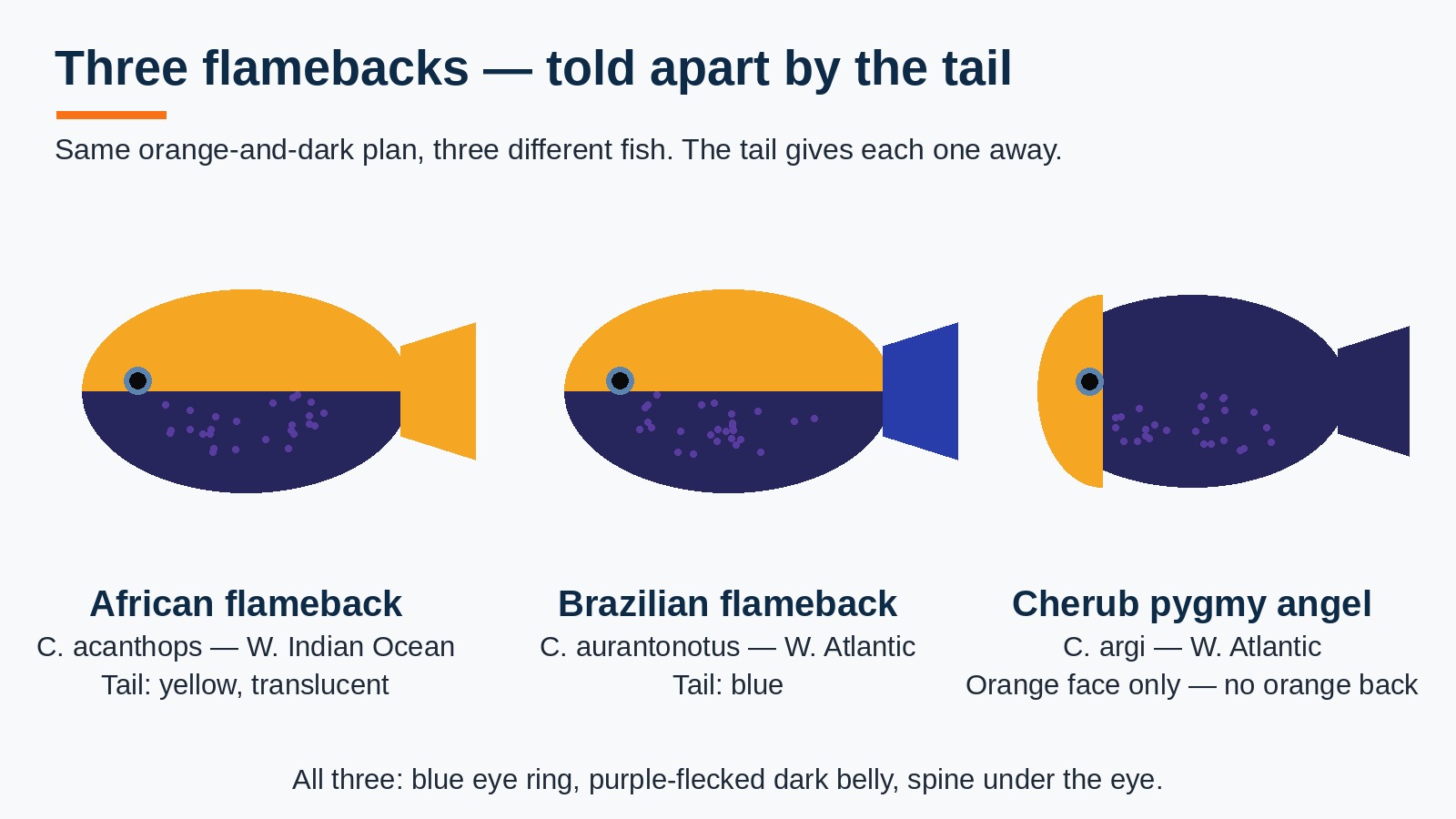
Three look-alikes cause most of the mislabelling in the trade, and the tail settles all three. The Brazilian flameback (Centropyge aurantonotus) is the same orange-over-dark plan from the western Atlantic, but its tail is blue where the African's is yellow and translucent. The cherub pygmy angel (Centropyge argi), also Atlantic, is blue-purple all over with an orange face but no orange back. The fisher's pygmy angel group (the "argi complex") all share the small size and the attitude; range is the giveaway — anything collected in the Indian Ocean is this fish, anything from the Caribbean side is not.
On sexing, the published guides and the keepers disagree, and the disagreement is recorded whole in the Field notes: the desk references say colour alone will not sex this fish and the larger animal is presumed male, while experienced keepers who have run harems of them say the sexes are readable at a glance. Both can be partly right — the difference is subtle enough that a shop tank under white light hides it.
Where it comes from
The range is the western Indian Ocean, end to end: the East African coast from Somalia south to East London in South Africa's Eastern Cape, plus Madagascar, the Seychelles, Comoros, Chagos and the Mascarenes offshore, and in Asia the Gulf of Aden and Arabian Sea coasts of Yemen (including Socotra) and Oman, and the Maldives. FishBase adds the Australian territory of the Cocos (Keeling) Islands at the range's eastern edge.
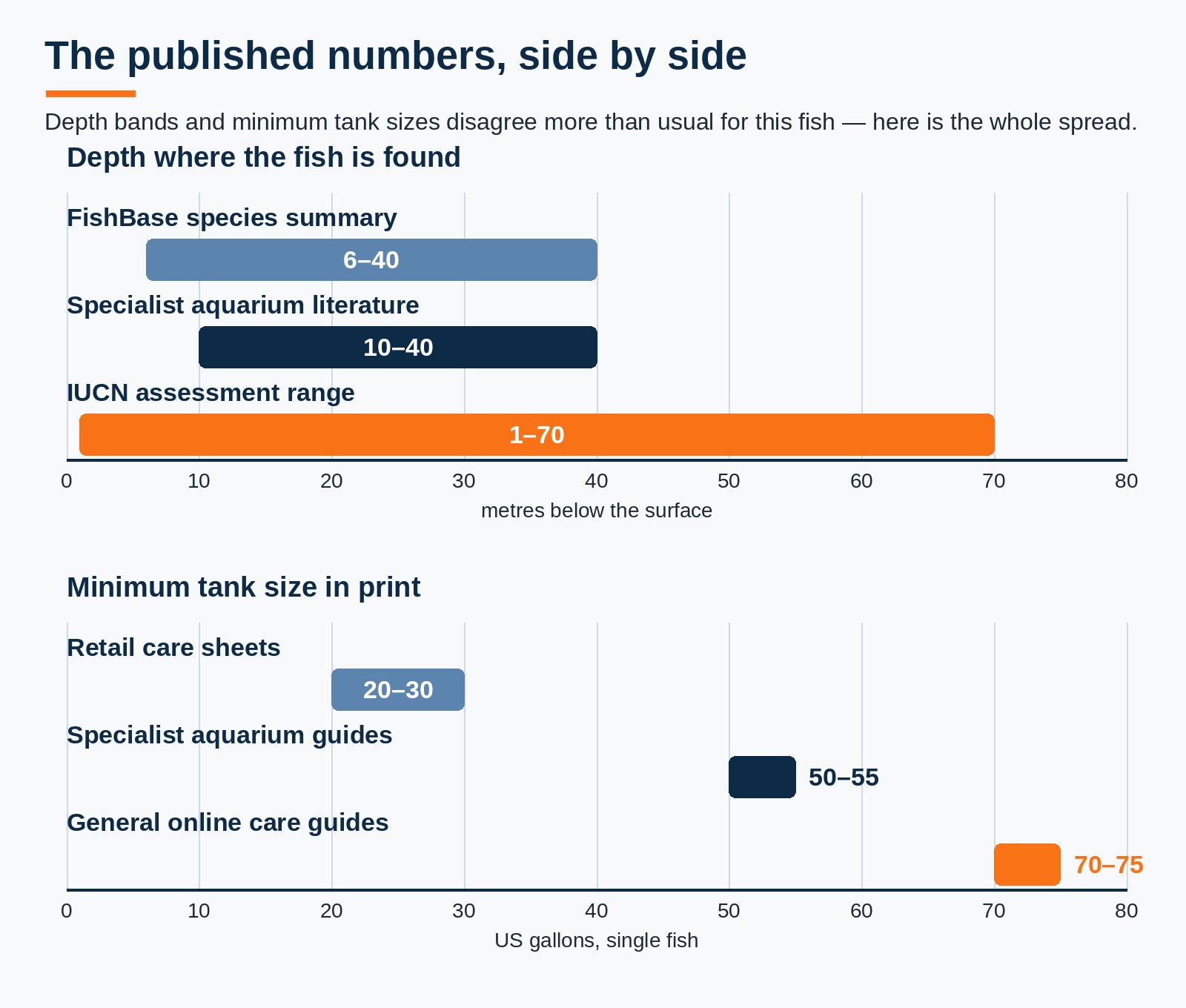
Habitat is coral rubble and reef with heavy algal growth — this is a fish of the broken, weedy edges rather than the coral heads. Published depth ranges disagree more than usual: FishBase gives 6–40 m, the specialist aquarium literature gives roughly 10–40 m, and the IUCN assessment behind the Wikipedia summary gives 1–70 m. The spread is drawn out in the numbers graphic below; what all sources share is the picture of a fish that hugs rubble, darts between hiding places, and grazes algae and small invertebrates as it goes.
Size and lifespan
FishBase records a maximum total length of 8.0 cm (about 3.1 in), and the species accounts describe most adults at roughly 6 cm — genuinely one of the smallest Centropyge, in the same size class as the cherub. One experienced keeper quoted in the Field notes reports aquarium fish reaching 3.5 in, past the book maximum; that is a keeper claim rather than a measured record, but it matches the general keeper experience that a well-fed dominant male runs larger than the species' reputation suggests. Budget for a 3-inch fish, and do not be shocked by a little more.
Published captive-lifespan estimates cluster at 5–7 years, and keeper reports of fish kept five-plus years and sold on still healthy line up with that band. There is no verified wild lifespan figure; like most small Centropyge it is presumably longer-lived in a stable aquarium than on a rubble slope full of predators. A flameback bought today is a half-decade commitment, not a season's decoration.
The tank it actually needs
This entry's care card files tank size as Nano, and that filing needs the honest unpacking every dwarf-angel entry owes its reader, because the printed minimums for this fish spread wider than for almost any other pygmy angel. Retail care sheets print 20–30 gallons. The specialist aquarium literature prints 50–55 gallons — Saltcorner's library entry says 50 and warns the species is "not suited for small nano style aquariums," and Tropical Fish Keeping prints 55 for the same reason. General online care guides run as high as 70–75 gallons. The full spread is in the ranges graphic above.
The disagreement is not really about gallons; it is about what the number is standing in for. A flameback needs three things a tank either provides or does not: enough mature rockwork to graze all day, enough broken sight-lines that a claimed territory has edges, and enough distance that tankmates can leave that territory. A rock-stacked 30-gallon with a light fish load can supply all three; a bare 55 with two rocks supplies none of them. This entry's working position: 30 gallons of mature, heavily rocked tank is the floor for a single fish with small, peaceful tankmates; the 50-gallon class is where the fish relaxes, the aggression reports fall away, and a pair becomes thinkable. Below 30 gallons the keeper reports converge — the fish gets more aggressive as the tank shrinks, and coral-nipping risk rises with it (see Field notes).
Water is standard reef: the FAQ target band of 77–79 °F, salinity around 1.023–1.025 (about 35 ppt), alkalinity 8–10 dKH. Published sheets spread wider (72–82 °F at the extremes) because the wild range is wide; stability inside the reef band matters more than the exact number. Flow wants to be moderate — this is a rubble-edge fish, not a surf-zone one.
Rockwork and territory
Everything about this fish's behaviour follows from one wild fact: it is social, ranked, and territorial in a small area. Wild groups run to about ten fish — typically one male, several females, and juveniles — holding a patch of rubble and algae. In a tank, a single flameback will claim the rockwork the same way, and it will patrol it. Give it a rock structure with caves at several heights, at least two escape routes from the main cave, and broken sight-lines across the tank so a chased fish can disappear instead of cornering. New arrivals are shy for the first days and hide in the rubble exactly as they would in the wild; a fish that has claimed its cave and begun grazing the rock in the open is a settled fish.
Add the flameback late in the stocking order, after timid fish have their territories established — the practical-fishkeeping guidance for this species is explicit on the point, and it matches the wider dwarf-angel rule. Added first to a small tank, it treats every later arrival as an intruder into owned rock.
Feeding
Wild diet is algae, the small invertebrates living in it, and detritus — a browser's diet, taken in small bites all day. The aquarium version that keeps colour, weight and manners: an angelfish or spirulina-based prepared food as the staple, frozen mysis and fortified brine shrimp, finely chopped seafood, and nori or another dried algae on a clip for grazing between meals. The library care sheets recommend two feedings a day at minimum, and the dedicated species guide goes to small amounts three or more times daily. Frequency matters more than volume for this genus: a flameback that grazes prepared food twice a day and algae in between is the flameback that leaves corals alone (see Reef safety).
Quarantine or at least a careful acclimation feed matters: pygmy angels newly arrived from collection can be slow to take prepared foods, and a fish already eating in the shop is worth more than a cheaper fish that is not. Ask to see it feed.
Reef safety
The care card says Caution, and Caution is the correct one-word answer — but it is not a coin flip, and the pattern in both the literature and the keeper reports is consistent enough to plan around. The published risk list is specific: clam mantles, sea anemones, large-polyp stony corals, and some soft corals including zoanthids, with the risk explicitly rising when the fish is underfed. Mobile invertebrates — shrimp, crabs, snails — are normally left alone, and non-sessile tankmates are not prey for a three-inch fish. The panel below draws the split.
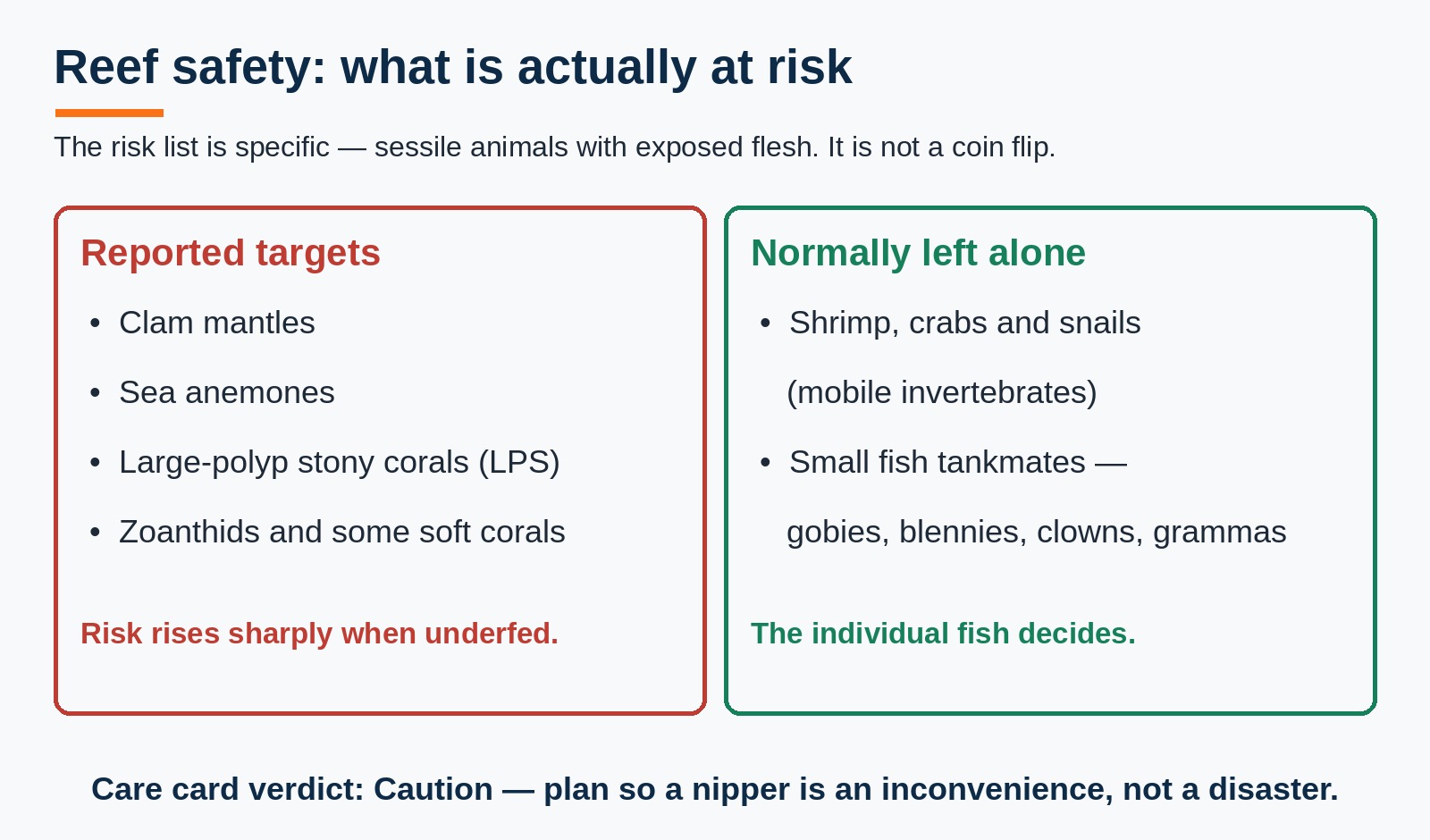
What the keeper record adds is that the individual decides. The same species produces years-long model citizens and fish that develop a taste for one particular LPS colony and ignore everything else. Feeding frequency, tank size and the individual fish are the three variables, in roughly that order of how much control the keeper has over them. There is no version of this fish that can be promised reef-safe, and no honest version that can be promised a coral-eater — plan the tank so that a nipper is an inconvenience, not a disaster: the prized fleshy LPS colony and the new three-inch angel are a gamble this entry will not bless.
Tankmates
The care card's Semi-aggressive is earned mostly against one category: other dwarf angels. One Centropyge per tank is the standing rule in the library literature, and the flameback enforces it — against its own species first, then against the other argi-complex fish it reads as the same animal, then against any dwarf angel in a small tank. Different-bodied dwarf angels in large tanks are the documented exception, not the plan.
Everything else is mostly peace. Small peaceful fish — gobies, blennies, firefish, cardinalfish, clownfish, royal gramma — are the classic companions, and dwarfs do not predate small fish, so even tiny gobies are physically safe. The two management rules are order and escape: timid fish in first with territories established, flameback after; and rockwork that lets a fish being chased break line of sight. Large angels, tangs and wrasses ignore or outrank it without issue. The fish it will not tolerate being bullied by is a genuinely aggressive damsel or dottyback in a small tank — semi-aggressive cuts both ways, and a flameback pinned in its cave by a bigger bully stops grazing and fades.
One, two, or a harem
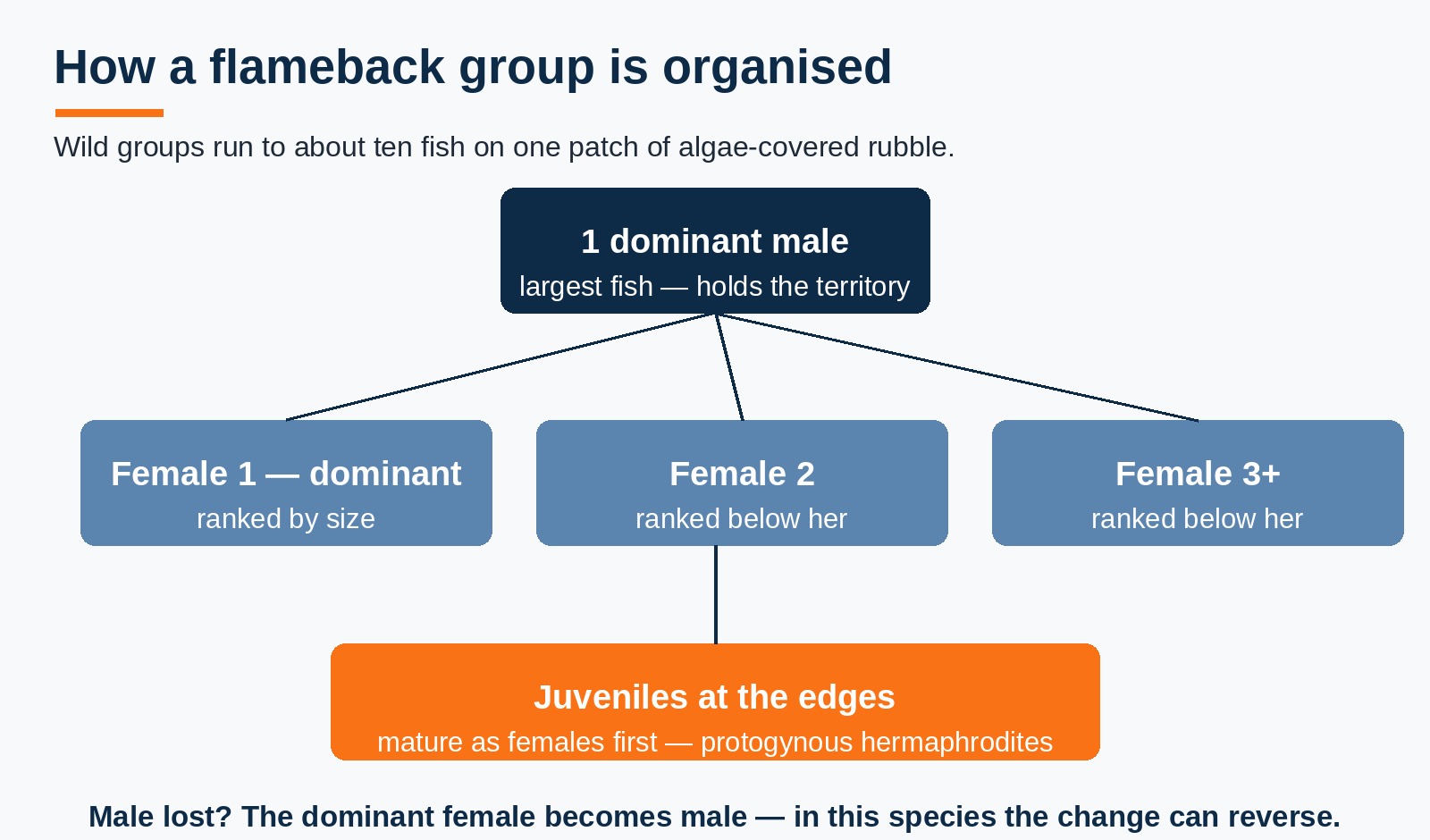
The wild social unit is a harem: one dominant male, several ranked females, juveniles at the edges. All Centropyge are protogynous hermaphrodites — fish mature as females, and the dominant female of a group becomes male. For this species the IUCN-backed account adds a wrinkle the genus does not always show: the change can reverse if dominance is lost.
In aquariums the honest summary is: singles always work; pairs work often enough to be a real project; harems are a large-tank experiment. Pairing works best from two small juveniles introduced together, or a known smaller female added to a male — never two males, and never a female larger than the resident male, which the pairing literature flags as the fight trigger. The harem accounts in the Field notes show both the ceiling (a three-fish harem settled, sexed and stable) and the general warning from the pairing guides that in all but the largest tanks a harem's aggression stack tends to knock off the smallest fish until a pair remains. Treat anything beyond a pair as a project with a spare tank ready, not a stocking plan.
Sex change and spawning
Spawning in the wild happens at dusk: the male courts and nips at the female's abdomen to stimulate egg release, the eggs are fertilised in the water column and left to drift on the current — broadcast spawning, no nest, no guarding. Aquarium spawning of pygmy angels is reported by hobbyists, and this species has been fully cultured in captivity (ORA's cultured African flamebacks, announced in 2020, closed the life cycle commercially), which makes it one of the few dwarf angels a keeper can buy without a wild-caught fish at all. A cultured fish is also the easiest version of this species to keep: raised on prepared foods, unbothered by tank life, and free of collection stress. Where a cultured flameback is available it is the version this entry recommends, and it aligns with how the species got its Least Concern rating — the wild population is not the constraint; collection quality is.
Choosing and settling in
Choose for appetite and condition: alert, grazing or investigating, fins intact, no pinched belly, and eating prepared food in front of you. Practical Fishkeeping's dwarf-angel guidance warns that many Centropyge arrive carrying parasites, and this species is regularly listed as ich-susceptible in the care literature — quarantine is the default, and a fish that has been in the shop eating for two weeks is a safer buy than this morning's arrival.
Handle it like an angelfish: the cheek spine under the eye snags in fine mesh, so move it in a container or a coarse net, never chase it around the tank with a small net at introduction. Expect the wild pattern on arrival — straight into the rubble, invisible for a day or three, then emerging to graze further from the cave each day. A flameback still hiding at two weeks is telling you something about tankmates or food, not about its own courage.
Field notes — what keepers report
Reef safety, both sides. One long Reef2Reef thread asking exactly this question — will it nip, and will it bully a watchman goby, pajama cardinals, clownfish and a royal gramma — drew answers from keepers whose flamebacks had never hurt anything: fed once or twice a day, a cherub-complex angel was described as leaving corals alone when kept fed, and one keeper reported a flameback kept at least five years, hand-feeding, friendly to every tankmate and swimming paired up with a yellow tang, with no coral problems at all — and another keeper in the same thread was choosing the flameback precisely because his 45-gallon tank was too small for a flame angel long-term. The opposing reports come from the same community: in a dwarf-angel comparison thread, experienced keepers warned that a 36-inch tank is too small for an African flameback — too aggressive, and the coral-eating risk grows as the tank shrinks — and advised a four-foot tank as the safer home. Both sides agree on the mechanism even when they disagree on the outcome: a fed fish in enough space mostly behaves; a hungry fish in a small box samples things.
Size, from the keepers. The same comparison thread put the African flameback's aquarium size at about 3.5 inches — above the 8 cm book maximum — with the coral beauty largest of the common dwarfs, then the flame, then the flameback. Keepers there also described the flameback as the more active, wider-swimming fish of the pygmy group for its size. Treat 3 inches as the plan and 3.5 as the possibility.
Sexing, both sides. The desk guides say colour will not sex this fish and larger individuals are presumed male. The keeper who documented a three-fish flameback harem on Reef2Reef says the opposite from direct experience: the species is clearly dimorphic, sexing is easy, and singleton flamebacks kept alone for two-plus years stayed female at large size — his reading being that a lone female does not turn male without another female present, and that the change, when it happens, can reverse. A separate pairing thread's experienced keeper adds the shape rule he uses across the argi complex: males are longer-bodied, females shorter and rounder, and he reports successfully pairing both cherubs and flamebacks by eye this way, with his cherub pair spawning regularly. The entry's position: sexing is possible for an experienced eye on a settled fish, unreliable for a buyer at a shop tank — buy two small juveniles and let the hierarchy do it.
Pairs and harems, both sides. The collected pairing guidance from dwarf-angel keepers is cautiously positive: almost any Centropyge can be paired, the reliable routes are a known male with a known female or two females with one transitioning (a change that can complete in as little as about 60 days), and the failure modes are two males or a female larger than the male. The same guidance warns against harems in anything but the largest tanks, where the aggression stack tends to remove the smallest fish until two remain. Set against that, the documented flameback harem — three fish introduced together at about 1.5 inches, ranked within weeks — shows the ceiling is real when size, timing and space all line up.
Temperament toward other fish. The consensus thread answer is that the flameback bothers nobody except other dwarf angels; it does not bother the classic small-fish list (gobies, cardinals, clowns, grammas). The caution that recurs is about the fish's first weeks and its stocking order, not its adult character: added late, to a tank where the timid fish already own their spots, it settles as a grazer with a patrol route. Added early to a small tank, it owns the whole rockwork and edits the stocking list itself.
Hardiness. Keepers rate the argi-complex fish among the hardiest dwarf angels once eating, and the cultured ORA fish removed the weakest link — the wild-caught juvenile that will not take prepared food. The recurring keeper failure is not disease in an established tank; it is a shy new arrival outcompeted at feeding time in a busy tank, which loops back to the same advice as everything else about this species: feed it deliberately, in its own territory, and it will do the rest itself.
Field Notes
Related species

Cherub Angelfish
Centropyge argi
Same genus

Coral Beauty Angelfish
Centropyge bispinosa
Same genus

Eibli Angelfish
Centropyge eibli
Same genus

Fisher's Angelfish
Centropyge fisheri
Same genus

Keyhole Angelfish
Centropyge tibicen
Same genus
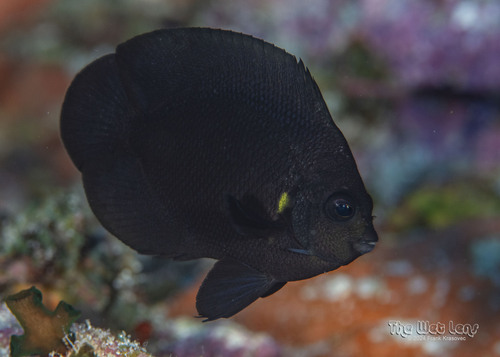
Midnight Angelfish
Centropyge nox
Same genus

Pearlscale Angelfish
Centropyge vrolikii
Same genus

Bicolor Angelfish
Centropyge bicolor
Same genus