Pearlscale Angelfish
Centropyge vrolikii
Reef Safe
With Caution

Gallery
The Pearlscale Angelfish, Centropyge vrolikii, is a dwarf angelfish of the Indo-West Pacific, sold just as often under its other trade name, the Half-Black Angelfish — a name that describes the fish at a glance. The front half is pale, pearly grey-white; the rear half darkens through grey to solid black at the tail. It was first described by Pieter Bleeker (as Holacanthus vrolikii) from Ambon Island in Indonesia, and the species name honours the Dutch anatomist Willem Vrolik. In the wild it is a fish of lagoons and seaward reefs, recorded from Christmas Island in the west to Vanuatu and the Marshall Islands in the east, north to Taiwan and Japan, and south to Lord Howe Island and the central New South Wales coast, in water from about a metre down to 25 metres. It is one of the hardiest and most available Centropyge in the trade, and one of the easiest to recognise — which does not stop it being confused with two other fish, for reasons this entry takes up below.
Identification
The pattern is a gradient, not a line down the middle. The head and front body are pale greyish to brownish, and every scale there carries a whitish centre — the pearl scaling that gives the fish its name and its sheen under reef lighting. Toward the rear the scale centres and then the whole body darken until the back third and tail base read as plain black. The finishing marks are consistent across sources: an orange ring around the eye, orange at the gill opening and the base of the pectoral fin, and a fine blue margin along the caudal fin and the rear parts of the dorsal and anal fins. Some descriptions add yellow to yellow-orange accents on the front fins, which is one reason photographs of this fish vary so much — the front half reads pearl-white in one light and warm-toned in another. Maximum size is 12 cm (about 4.7 inches), with 10 cm the common adult size; dominant males run slightly larger than females, and beyond size the sexes are effectively indistinguishable. Two separations matter. Against Eibli's Angelfish, its closest lookalike: vrolikii is essentially the same half-dark pattern without Eibli's orange striping, and most vrolikii carry a black spot at the upper edge of the gill cover that Eibli lacks. Against the juvenile Mimic Surgeonfish, Acanthurus pyroferus: where vrolikii is the local model — around Palau, for example — juvenile surgeonfish wear this exact light-front, dark-back dress, and the separator is the angelfish's prominent spine on the lower gill-cover margin, which no surgeonfish has.
Reading the care ratings
The entry rates this fish Beginner for care, semi-aggressive, omnivore, a medium tank, mid-water swimming, and reef safety Caution, and each label earns a sentence. Beginner reflects the settled fish: a healthy, feeding specimen in a stable tank is among the most forgiving dwarf angels a new keeper can choose, and it is routinely grouped with the Coral Beauty in beginner guidance. It does not erase the acclimation reports in the field notes — a minority of sources call the species difficult to settle, and one experienced keeper rated it a little more fragile than a Coral Beauty — so Beginner should be read as "hardy once eating," not "indestructible from the bag." Semi-aggressive is the genus average: an individual may be mellow for years or may decide it owns the rockwork, and the keeper reports below contain both fish. Omnivore is the captive working label; the wild diet underneath it is mostly plant and sponge, which shapes the feeding section. Medium tank is the database's middle band, and the published minimums for this species spread unusually wide — that spread gets its own section. Caution on reef safety is the honest summary of a genuinely divided record, also below.
In the wild
On the reef this is a bottom-oriented grazer of rich ground. Australian Museum's account puts it most commonly on rock and rubble bottoms of offshore reef slopes and lagoons, especially where the algal and sponge growth is rich; other accounts emphasise dense coral growth on lagoon and seaward reefs. The wild diet matches the address: largely herbivorous, feeding on filamentous algae, with sponges taken as the second staple. That sponge component is part of why angel-specific prepared foods — the formulas that include sponge material — suit this genus in captivity. Depth runs shallow, roughly 1 to 25 metres, and the fish lives the haremic social life typical of the genus, a male holding a small group of females over a defended patch of grazing ground.
Tank size
Published minimums for this one species run from 30 gallons at the very lowest — usually framed as a single juvenile in a mature tank — through 45 and 55 gallons in the middle of the range, up to 70 gallons at the top. A wholesale account that has handled the species in volume reports seeing it healthy and content in displays as small as 40 gallons, then recommends no smaller than 55 and 75 or more as better, especially with other fish. The pattern underneath the spread is the same one this database records for other wide-ranging grazers: the small numbers describe a lone juvenile in an aged tank with real algae growth to work, and the large numbers describe the adult the juvenile becomes — a 4-to-5-inch fish that grazes all day, holds a territory, and may share the tank with other angels. The database's Medium rating sits in the honest middle of that record. Plan for the adult, keep the rockwork mature before the fish arrives, and treat any multi-angel plan as a large-tank plan regardless of which single-fish minimum a listing quotes.
Feeding
Feeding translates the wild menu rather than replacing it. The base is algae: spirulina-rich prepared foods, marine algae sheets on a clip offered regularly, and whatever film and filamentous algae the tank itself grows — a mature tank is not a luxury for this fish, it is part of the diet. Onto that base go the omnivore's extras: quality angelfish preparations (the sponge-bearing formulas are the closest match to the wild record), mysis and brine shrimp, and finely chopped seafood. Retail and care guidance converge on small meals two to three times a day rather than one large one, which suits a fish built to graze continuously. The colour note from the original short entry stands and is worth keeping: the pearlescent sheen is diet-sensitive, and fish kept on a poor, algae-light diet dull visibly. A new arrival that picks without committing is a known pattern in the keeper reports; enriched or live foods are the usual bridge, and a fish established and eating is, by most accounts, an eager feeder thereafter.
Temperament
The genus reputation is territorial, and this species sits toward the milder end of it — trade and wholesaler summaries alike describe it as less aggressive than the average dwarf angel and more likely to behave among other residents, getting feisty mainly when crowded and aiming what aggression it has at its own species and similar-looking fish. That is the average, and the field notes carry the spread honestly: a keeper who kept two found them much more mellow than his Coral Beauty, and one who loved his fish's Aiptasia-eating still removed it twice for bullying. The working rules are the genus rules. One vrolikii per tank. Other Centropyge only in genuinely large systems, added with a plan — simultaneous introduction and a rockwork change are the tactics in the successful multi-angel reports — and never assume a peaceful first year settles the question, because maturing angels can turn territorial as they grow. Avoid very timid tankmates that cannot compete at feeding time, and expect a bullied individual of any species to go passive rather than fight back.
Reef safety
Caution is the correct rating, and it is worth being precise about what the caution covers. The named targets in the care and retailer record are fleshy LPS, brain corals, zoanthids, soft-coral polyps and clam mantles — the standard dwarf-angel menu — with adults more likely to start than juveniles, and SPS notably absent from the species-specific accusations in the sources read. The mechanism matters more than the list. This is a constant grazer whose wild life is picking at surfaces all day; a coral in a tank is one more surface, and an underfed grazer samples more widely than a fed one, which is why the well-fed-fish-nips-less claim recurs across the guidance. None of that makes any individual fish safe. The record contains model citizens kept for years and fish that developed the taste, and the keeper reports below show both. The practical position: keep this species in a reef only with corals you can afford to lose, feed it like the grazer it is, and judge the individual in front of you rather than the species average.
Sex change and spawning
Like the rest of its genus, this is a protogynous hermaphrodite: all fish mature first as females, and in a harem without a male the largest female changes sex. The change is fast by fish standards — in the classic Okinawa field experiments on this species, a largest female began behaving as a male the day the resident male was removed, was spawning with the harem females within one to three days, and produced fertile eggs once the gonadal change completed at around two weeks. Wild spawning is the angelfish pattern — paired rises into open water, pelagic eggs, and a long planktonic larval life, with a maximum larval duration of about 29 days recorded for the species. That larval month is why the species is not commercially bred and every fish in the trade is wild-caught. For the keeper the social biology reduces to the one-per-tank rule above: a lone fish is a female or a fish that will become male on its own, and it needs no partner to live a full life.
The mimic and the hybrids
Two pieces of natural history follow this fish into the trade and explain most of the confusion around it. The first is the mimicry: the juvenile Mimic Surgeonfish, Acanthurus pyroferus, wears the dress of whichever harmless Centropyge is local — Lemonpeel pattern in some places, Eibli's in others, and vrolikii's half-black pattern where vrolikii is the model, as around Palau — borrowing the angelfish's graze-in-peace reputation. A "pearlscale" that grows a surgeonfish's tail shape and face was never an angelfish. The second is hybridisation: where their ranges overlap, vrolikii crosses freely with Eibli's Angelfish and with the Lemonpeel, and the Christmas Island and Cocos-Keeling region is a recorded hybrid hotspot for all three. The Eibli cross in particular is reported as extremely common — in some shipments rivalling the pure fish — and the hybrids are usually duller than either parent, reading as vrolikii with faded orange striping invading the dark rear. A specimen whose black half carries ghost stripes is most likely exactly that, and it will behave and graze like this species in every way that matters to keeping it.
Choosing a specimen
Choose for appetite and condition. The fish to buy is alert, grazing or investigating the holding tank rather than parked in a corner, with clear eyes, an intact blue fin margin, and no damage around the mouth — the working end of a fish that picks at rock all day. Ask to see it feed, and treat prepared-food acceptance in the shop as the single best predictor of an easy acclimation, given the slow-start reports in the file. Check the gill-cover spot and the dark rear for the hybrid signs described above if a pure fish matters to you; many keepers happily keep the hybrids, which are hardy fish in their own right. Quarantine follows the genus pattern — observation, a sand-free but sheltered tank is acceptable for this non-burying species, and patience with a fish that may take days to feed with commitment. Longevity reports in the keeper record reach eight years in a home tank, and care sources put the potential lifespan well into double figures, so a well-chosen specimen is a long-term resident, not a trial fish.
Warning signs
The warnings worth acting on are a fish that goes off food after having fed well, rapid breathing or flashing that persists past the first days, a dulling and darkening of the pearl front half in a fish whose diet and water have not changed — in a grazer, condition shows in the sheen — and a settled fish that stops grazing its rounds. New-fish shyness, corner-sitting in the first days, and picking at rock and film rather than at offered food are the species settling in, and the keeper reports treat them as a phase to feed through, not an emergency.
Field notes — what keepers report
- Coral nipping divides the record cleanly, and both sides have real fish behind them. On the safe side: a keeper who kept two Half Blacks reported no problem with them eating coral — with the caveat he states himself, that he kept only soft corals — and juveniles are widely described as the safer life stage, with the risk rising in adults. On the other side: a retailer survey of dwarf-angel reef safety places this species in its high-risk, avoid-in-reefs group, naming LPS and soft corals as the likely targets; care profiles describe adults developing a taste for soft-coral polyps, brain corals, zoanthids and clam mantles; and one showcase profile calls it very prone to eating corals outright. A wholesaler's summary may be the most honest single line in the file: dwarf angels of pretty much every variety are seen as model citizens in a wide variety of reefs — until one day one decides a coral polyp looks tasty and starts to snack. Keepers weighing the risk should also note what the record does not contain: in the species-specific reports read, SPS corals are not singled out as a target for this fish.
- Temperament reports split the same way, and the split runs through multi-angel keeping in particular. The mild version is well attested: the two-fish keeper above found his Half Blacks a lot more mellow than his Coral Beauty, and one keeper ran a 125-gallon mix of three Coral Beauties, a Bicolor, a Half Black and a Singapore angel — a rough first two days after a simultaneous introduction with changed rockwork, then the group often swimming together without fights. The hard version exists too: a keeper who loved his Half Black — it ate his Aiptasia — still called it a complete jerk to the other fish, removed it, rebuilt the scape over eight months, re-added it to a 90-gallon, and banished it permanently after three days. And the victim's version exists: in a 180-gallon holding five dwarf angels and a Koran, all quarantine-raised together and peaceful for about a year, the fish began dying a month apart, the Half Black first, found with torn fins — the keeper never saw the aggression, and respondents blamed maturing angels turning territorial, with the Lemonpeel the prime suspect. Three outcomes, one species: disposition is individual, and maturity rewrites arrangements that worked when the fish were young.
- Hardiness reports carry the same both-sides shape, against the entry's Beginner rating. The supporting record is strong: beginner-fish guidance groups the species with the Coral Beauty as a hardy first angel, a wholesaler rates it very hardy and resistant to most common maladies in reasonable water, and one keeper's fish lived eight years. The counterweight is specific rather than vague: one showcase profile calls it a difficult fish to acclimatise; the keeper who kept two reports both of his caught ich — one died of it, the other lived for years until a powerhead killed it — and he judged the species a little more fragile than a Coral Beauty, while noting both of his ate like pigs once established. The two records reconcile the way the care section above frames it: hardy is the settled fish's reputation, acclimation is where the losses concentrate.
- Colour in person is the point keepers and the trade agree on most warmly. A wholesaler account says the species looks wildly better in person than it ever does in pictures — the pearlescent scale centres and the neon-blue fin outline come alive under modern LED lighting in a way photographs flatten. That same gap explains the front-half disagreement in print: descriptions variously give the front as pearl-white, pale grey, or yellow-orange toned, and a fish whose sheen shifts with the light over it will honestly earn all three descriptions from different tanks.
- Feeding reports run from easy to one instructive slow start. The general record is a ready feeder — prepared foods taken very easily, spirulina flakes, pellets, leafy greens and frozen mysis all accepted, two to three small feedings a day the common advice. Against that stands one documented new-fish case: a roughly three-inch Half Black in a six-foot 150-gallon spent its first days parked in a top corner, picked here and there without eating much, ignored clipped algae entirely, and ate a little the next morning — while a small tang darted at it and the angel simply did not respond. Keepers also repeat one feeding claim often enough to record with its hedge attached: a well-fed fish is less likely to start on corals — usually avoided, in one guide's phrasing, with no guarantees in any of them — and the corner-sitting fish that ignored its algae clip is the standing reminder that "well fed" first requires a fish willing to eat.
- Identity confusion is a keeper topic in its own right, separate from the mimicry above. The Eibli cross is reported as common enough in some shipments to rival the pure fish, and a hybrid one author raised from a Bali shipment developed grey striping that spread into the black rear half and the unpaired fins as it grew — a fish that looked less pure the longer he kept it, not more. The practical separator keepers and writers use is the black spot at the upper edge of the gill cover, present in the vast majority of pure vrolikii and absent in Eibli; in the Java Sea overlap zone, aberrant fish may simply be hybrids, and the trade's loose use of names — "Blacktail" gets attached to both species — does the rest of the confusing.
Field Notes
Related species

African Flameback Angelfish
Centropyge acanthops
Same genus

Cherub Angelfish
Centropyge argi
Same genus

Coral Beauty Angelfish
Centropyge bispinosa
Same genus

Eibli Angelfish
Centropyge eibli
Same genus

Fisher's Angelfish
Centropyge fisheri
Same genus

Keyhole Angelfish
Centropyge tibicen
Same genus
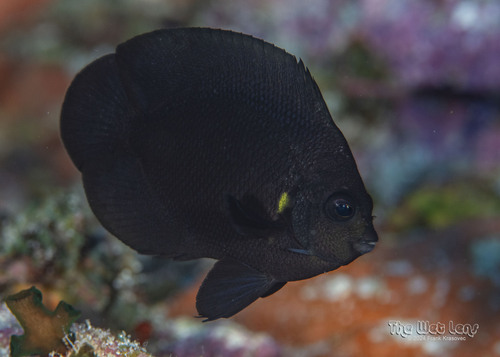
Midnight Angelfish
Centropyge nox
Same genus

Bicolor Angelfish
Centropyge bicolor
Same genus