Keyhole Angelfish
Centropyge tibicen
Reef Safe
With Caution

Gallery
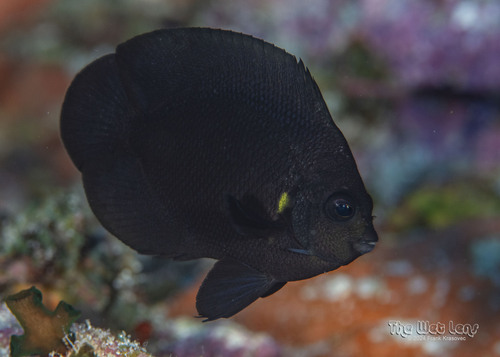
The Keyhole Angelfish, Centropyge tibicen, is the largest member of the dwarf-angelfish genus Centropyge, a mainly black fish carrying a single pale mark that gives it every one of its common names. A young fish shows a white vertical bar. An adult shows a central, elongated, highly variable white to cream blotch — the keyhole — set on the upper flank of a black to dark blue body, with yellow on much of the pelvic fin and the front of the anal fin and a thin blue line inside the margins of the dorsal, anal and tail fins. The original short entry in this database presented it as a no-drama beginner fish, good value for a first dwarf-angel experience, holding up better than many Centropyge to the fluctuations of a busy reef, with coral nipping named as the one caution. The longer published record supports parts of that picture and corrects other parts in ways a buyer needs before purchase. No other care source used here files the species Beginner. The consensus care level is Moderate, one quarantined-fish retailer files it Intermediate to Advanced and asks for careful acclimation, and the hardiness filings divide between Hardy and a wholesaler account that calls the fish very tough while warning, in the same paragraph, that most individuals are quite aggressive, do considerable damage to corals, or both. Reef-safety filings run the full scale, from Reef Compatible and With Caution through this database's Caution to flat Not reef safe listings naming soft and stony corals, sessile invertebrates and clam mantles. Adult size is formally 19 centimetres, average accounts put a typical fish nearer 15 centimetres, and retail tables round the fish to 8 inches. Tank minimums run from 40 gallons at the low outlier to 100 gallons or more preferred at the demanding end. Lifespan filings run from a formal maximum reported age of 6 years through 5 to 7 and up to 10 years in captivity to 10 to 15 years and more in the quarantined-fish trade. A keeper who reads those spreads whole gets a striking, hardy-in-the-main, algae-grazing fish for a larger, mature system, kept singly, fed well, and watched honestly in a reef. A keeper who buys it as a small beginner dwarf angel for a modest reef gets the surprises, and every one of them was in print beforehand.
Names, description, and the white keyhole
Centropyge tibicen was described by Cuvier in 1831, originally as Holacanthus tibicen. Synonyms in the record include Holacanthus leucopleura, and the misspellings Centriopyge tibicen and Centropyge tibicens appear in name lists. The trade uses Keyhole Angelfish most often, and also Tibicen Angelfish, Melas Angelfish, Black Angelfish, Whitespot Angelfish and Puller Angelfish — a buyer comparing listings under any of those names is looking at the same species unless a scientific name says otherwise. The body is deep and laterally compressed, body depth 1.8 to 2.0 in standard length, with 45 to 48 scales in the longitudinal series. The dorsal fin carries 14 spines and 15 to 16 soft rays; the anal fin carries 3 spines and 16 to 17 soft rays. Those counts, the black ground colour and the pale flank mark separate the species from other dark Centropyge, most helpfully from the Midnight Angelfish, Centropyge nox, which a major wholesaler names as the closest colour comparison — very dark blue to almost black, like the Keyhole — while lacking the white patch and the yellow pelvic and anal edging. The pale mark itself needs its variability printed, because buyers judge specimens against catalogue photographs. In small fish it is a white vertical bar. With growth the bar changes into a central blotch, and formal descriptions state plainly that the blotch varies greatly in shape and size between individuals. Some adults carry a near-oval spot, some a taller belt-like patch, and some a broken or reduced mark. That variation is normal for the species, and a fish whose keyhole differs from a photograph has shown nothing wrong. Colour beyond the mark also varies in the descriptions: mainly black in the formal accounts, dull blue to brownish-blue in several retail accounts, dark cobalt in a Pacific field guide, with mature fish developing an electric-blue rim on the unpaired fins in the wholesaler account. One care tradition adds a sex-linked colour claim — females usually overall black, males tending more dark blue — which the sexing section records with its limits.
The largest dwarf angel, and what that size changes
FishBase calls this species, in so many words, the largest member of the genus, and the trade repeats the point in nearly every profile: the largest Centropyge, the largest of the pygmy angels, one of the larger dwarf angelfish species. The formal maximum is 19.0 centimetres total length. Average-size accounts put a typical adult around 15 centimetres. Retail tables variously round the maximum to 7.5 inches, 7 to 8 inches, 8 inches, and in one datasheet 20.3 centimetres, just under 8 inches. The practical consequence is that the word dwarf misleads at purchase. Most Centropyge in the trade finish at 3 to 5 inches; this fish finishes at roughly double the length of the smallest of them, with the body depth and appetite to match. Trade size grades underline how small the fish starts: one long-running profile lists purchase sizes from Small at 1 to 1.75 inches through Medium and Large to Extra Large at 4.5 inches and larger, so a shop fish may have most of its growth still ahead of it. Every other decision in this entry — the tank figures, the single-angel rule, the weight given to the aggression and coral-damage reports — prices in the adult the juvenile becomes, and a stocking plan built on the bag size rather than the 15 to 19 centimetre adult repeats the most common planning error the record implies.
Reading the care ratings
This entry rates the Keyhole Angelfish Beginner for difficulty, Semi-aggressive for temperament, Omnivore for diet, Medium for tank size, Mid for swimming zone and Caution for reef safety, and each rating sits inside a divided record that the text supplies. Beginner stands alone. AquariumDomain, the fish datasheets and the wholesaler all file Moderate; a tropical-fish profile files Moderate care with Intermediate aquarist experience; the quarantined-fish retailer files Intermediate to Advanced and requires stable conditions and careful acclimation. The hardiness sub-record divides separately — Hardy in the tropical-fish profile, generally hardy in one care guide, very tough in the wholesaler account — and the reconciliation the full record supports is a hardy fish in a mature, stable system that still punishes a rushed start, which is a Moderate profile in practice whatever label a single table carries. Semi-aggressive matches this database and nearly every other table, flanked by generally peaceful in one care guide and quite peaceful in the wholesaler's first sentence — the same wholesaler paragraph that then warns most individuals are quite aggressive, a contradiction recorded whole in the temperament section. Omnivore matches this database and most care sheets; the wild record is algae-first, filed Herbivorous by FishBase and the field accounts, with sponges, tunicates and small invertebrates in the wider diet lists, so Omnivore should be read as a captive-menu label for an algae-led wild feeder. Medium is this database's tank-size filing inside a spread recorded whole in the tank section, from 40 gallons to 100 gallons or more preferred for an adult. Mid matches the field-sheet filing of a fish living at mid-depth and near the bottom, working rock and rubble rather than open water. Caution for reef safety sits in the middle of the widest spread in the entry, from Reef Compatible to Not reef safe, and the reef section prices each end.
In the wild
The species is an Indo-Pacific and western Pacific fish, ranging from Christmas Island in the eastern Indian Ocean and the northwestern coast of Australia through the Indo-Australian Archipelago to Fiji, Vanuatu and Tonga, north to Taiwan and southern Japan, and south to Scott Reef and Lord Howe Island. FishBase files it reef-associated and non-migratory at 4 to 55 metres, tropical, and uncommon around oceanic islands. Secondary accounts narrow the usual band to 4 to 35 metres, and one profile gives 13 to over 180 feet, which converts to roughly the same 4 to 55 metre envelope. Habitat is consistent across the formal sources: mixed coral and rubble areas of lagoon and seaward reefs, relatively uncommon, with caves, crevices and overhangs as the working structure. One quarantined-fish retailer's habitat text departs from that record and is recorded as an outlier rather than adopted: it places the fish on outer slopes and drop-offs at 50 to 200 feet, calls the species a deepwater fish requiring subdued lighting and careful decompression-style acclimation, and the same text appears word for word on a second retail site, which marks it as shared template copy rather than two independent observations. The formal depth range begins at 4 metres in lagoon rubble, and no formal source used here treats the species as a deepwater specialist, so ordinary reef lighting and ordinary acclimation follow the formal record, with the retailer's stability advice kept and its deepwater framing set aside. Socially, the fish lives alone or in harems of 3 to 7 individuals organised around a hierarchy, feeding mainly on algae, with tunicates, filamentous algae and diatoms named in the wider wild-diet lists. The species is assessed as Least Concern. FishBase also notes it is frequently exported through the aquarium trade, which matches its regular trade presence.
Feeding, and the algae-first record
Feed it as a grazing omnivore whose wild staple is algae and whose captive menu must carry both plant material and sponge-bearing angelfish foods. The wild filings divide by label and agree in substance: Herbivorous in FishBase and the field sheets, with algae dominating the diet; algae and small crustaceans in one profile; algae, sponges and small invertebrates in the care-guide tradition. Captive menus across the sources converge on the same build: filamentous algae and diatoms grazed from live rock, dried marine algae and seaweed sheets, spirulina, high-quality angelfish preparations — the formulations that include sponge material matter for Centropyge generally and are named in these profiles — plus mysis shrimp, enriched brine shrimp and finely chopped shrimp or clam as the meaty side. Frequency filings run two to three small feedings a day, with one retailer specifying three times daily, and the live-rock grazing between feedings is treated by several accounts as part of the diet rather than decoration, which is why a mature tank with natural algal growth appears in the requirements. Two feeding claims carry direct behavioural weight and both are recorded with their sources. The wholesaler states that keeping the fish well fed seems to reduce the coral-damage risk. A retailer tradition states the mechanism from the other side: a model citizen for a while may one day go after corals and clams, an underfed adult may try something new and find corals and clams to its taste, and buying the youngest specimen available is recommended in that account in the hope it learns the captive diet before it learns that lesson. Those accounts agree that feeding is a reef-safety variable for this species, and neither turns a well-fed fish into a guaranteed-safe one. Algae control should be claimed at its true size: profiles credit the fish with cleaning up problem filamentous algae and diatoms, and a constantly grazing adult earns that credit, while no source used here credits it with clearing established turf or hair-algae outbreaks or substitute duty for nutrient control.
Tank and water
Record the tank-size spread whole. This database files the species Medium. The published minimums run: 40 gallons in one retailer profile, the low outlier; about 50 gallons, as 200 litres, in one care guide; 55 gallons in AquariumDomain's table; 70 gallons in the datasheet, the tropical-fish profile and several retail accounts, the centre of the record; 75 gallons as a minimum with 100 gallons or more preferred in the quarantined-fish retailer; and 100 gallons or more for a pair or small harem in the tropical-fish tradition. Those figures price the same facts at different strictness — the largest Centropyge, formally 19 centimetres, territorial toward its own kind, and a continuous rock-grazing fish that needs both swimming room and a large grazing surface. The working centre is a mature 70-gallon-class system for one fish, with the 75-to-100-gallon advice standing as the demanding end a buyer with a full-grown adult in mind should know exists, and the 40- and 50-gallon figures read as juvenile housing rather than an adult plan. Structure matters as much as volume: abundant live rock arranged into caves, crevices and overhangs, multiple hiding places so the fish can hold a refuge without defending the whole tank, open swimming room alongside the rock, and a substrate and rock surface that carry natural film and filamentous growth. Maturity is a stated requirement in most accounts — a well-established aquarium, four to six months minimum in the quarantined-fish retailer's protocol — because stability and grazing growth arrive together. Water values are ordinary stable tropical marine, recorded as a combined range across sources: temperature about 72 to 79 degrees Fahrenheit, with most guides centring on 72 to 78; specific gravity 1.020 to 1.026, most tables 1.020 to 1.025; pH 8.1 to 8.4; alkalinity 8 to 12 dKH. Handling carries one genus warning worth printing: angelfish carry a cheek spine at the edge of the gill cover, so a net can snag the fish, and a container transfer is the safer capture method the general angelfish guidance recommends.
Temperament, harems, and other angels
The filings, stated whole, contradict each other more openly than for most dwarf angels, and a stocking plan should be built from the demanding end. The consensus table filing is Semi-aggressive, here and in nearly every profile, often with the qualifier especially toward other angelfish. AquariumDomain adds the comparative note that the species is a little more aggressive than other pygmy angels while remaining very suitable for a community aquarium. One care guide files it generally peaceful, semi-aggressive particularly toward other angelfish, and best introduced before more territorial species. The wholesaler account contains both ends inside one paragraph: the fish are quite peaceful, with care advised around much smaller or larger fish and other dwarf angels; the species is a very tough fish; and most individuals, unfortunately in that account's wording, are quite aggressive, do quite some damage to corals, or both, with a fish-only system and robust tankmates offered as the safe home. No reconciliation deletes either half of that paragraph. The working rule the full record supports is direction-specific. Toward unrelated community fish — the clownfish, damselfish, dottybacks, wrasses, anthias, gobies, blennies and tangs named across the published tankmate lists — the record is generally workable in a large enough system. Toward its own genus the record is unanimous in direction: do not house it with other Centropyge or similar pygmy angels as a default, aggression toward other angelfish is the named risk in every source, and similar size, shape and feeding behaviour raise it. The wild harem structure does not transfer casually. In nature a harem holds 3 to 7 fish under one male. In captivity the tropical-fish tradition allows a pair or small harem only in a larger aquarium of 100 gallons or more with plenty of live rock, and warns that two males will fight to the death — and because the species is protogynous, two maturing fish in a small system can manufacture the second male the warning is about. Single keeping is the default every retailer table assumes, listed as Solo in the care-guide social filing.
Reef safety, the sharpest split in the record
No section divides more widely, so every filing is stated with its weight. At the favourable end, AquariumDomain files the species Reef Compatible, and a retailer tradition allows Reef Ok with Caution. In the middle, this database files Caution, the datasheet files With Caution, and several profiles advise extreme caution in a reef while conceding that some generalisations call the species reef safe. At the demanding end, the care-guide tradition files Reefsafe No, the Saltwaterfish profile states the fish are not reef safe and will nip at soft and stony polyp corals, sessile invertebrates and clam mantles, the tropical-fish profile says the species is not considered reef safe for its penchant for nipping at stony and soft corals, decorative clam mantles and other sessile invertebrates, and the wholesaler warns that most individuals do quite some damage to corals. The target list is consistent wherever damage is described: fleshy stony-coral polyps, soft corals, zoanthid-type polyps in the general angelfish guidance, and clam mantles, with sessile invertebrates named broadly. What divides is frequency and certainty, not the menu. Individual variation is the one point the demanding sources themselves concede — behaviour can vary, careful monitoring is advisable — and the favourable sources concede the mirror point, that a fish may behave as a model citizen for a while and then begin. Priced whole, the entry's Caution stands as the honest centre with its conditions printed: this is among the higher-risk Centropyge for a reef by the weight of the trade record, the SPS-heavy end of a reef is the least-named target in the species-specific accounts, fleshy LPS, soft corals and clams carry the named risk, feeding well is credited with reducing the risk without removing it, and a keeper whose corals cannot be risked should follow the wholesaler's fish-only advice rather than the favourable tables.
Sexing, spawning, and captive breeding
The species is a protogynous hermaphrodite, like the other angelfish in its family: all fish begin as females, and when no male is present in a harem the largest, most dominant female changes sex to male. That mechanism is stated consistently across FishBase-derived, field-sheet and trade accounts, and it is the biological fact underneath the two-males warning in the temperament section. Visual sexing carries thinner support and is recorded at that weight. One profile tradition states that female Keyhole Angelfish are usually an overall black colour while males tend to be more dark blue, and a field sheet states that the adult male is bigger than the female. No formal source used here gives a fin-shape or marking character that reliably sexes a shop specimen, so a seller's confident sexing of a small fish should be heard as an estimate, with size and the dark-blue tendency as tendencies rather than tests. Spawning follows the broadcast pattern described for the species: at dusk, after a circling courtship in which the male hovers off the bottom tilted toward the female at about 45 degrees, a ready pair rises belly to belly toward the surface and releases clouds of gametes together for external fertilisation. The eggs are planktonic and drift with the current; the larvae hatch finless, live off the yolk sac until it is absorbed, then settle toward the reef and begin on small zooplankton. On captive breeding the sources agree: the care tables file Captive bred No, and the tropical-fish tradition states the species has not been bred in an aquarium environment. Plan on a wild-caught fish, with the quarantine consequences of the next sections, and value a quarantined, feeding specimen accordingly.
Choosing a specimen
Judge size first, because the purchase grades run from about an inch upward and the adult is the largest dwarf angel in the trade: the plan should be built on a 15 to 19 centimetre fish, not on the specimen in the bag. Condition checks follow the Centropyge standard and this species makes them legible: a fish out grazing and picking at rock rather than parked in a corner, a full belly line rather than a pinched look behind the head, fins intact with the blue marginal lines clean, the pale keyhole read for what it is — its shape varies normally, while fading of the whole fish is a stress signal rather than a marking variant — and, most valuable of all, the fish seen eating prepared food in the shop, since the algae-first wild diet means a specimen already taking angelfish preparations and mysis has crossed the main captive-feeding bridge. The youngest-specimen advice from the reef-safety record belongs here as a recorded position rather than a rule: one retailer tradition recommends buying the youngest specimen available so it settles on the captive diet early, while the counterweight is that very small Centropyge are the least buffered against a poor start, and a slightly larger juvenile already feeding well answers both concerns better than the smallest fish on the system. Acclimation should be unhurried and the first home a quarantine tank wherever the keeper can arrange one: the quarantined-fish trade exists for this species precisely because wild-caught angels reward a controlled start, feeding is established away from competitors there, and the general angelfish disease record — parasites and bacterial issues arriving with stressed, freshly shipped fish — is cheaper met in quarantine than in a display. Price appears in the record only as a dated snapshot and is recorded as such: one long-running profile listed large Indonesian specimens starting at around 89.99 dollars, a single-seller figure from that profile's era, useful as evidence the fish has historically sat above the cheapest dwarf angels rather than as a current price.
Warning signs
The healthy baseline is a fish working the rockwork: cruising between refuges, picking at film and filamentous algae through the day, taking offered food promptly, and holding its black ground colour with the blue fin lines and yellow pelvic wash showing. A new fish hiding for the first day or two is in character for a crevice fish in a strange tank. A fish still not feeding after several days in quarantine, breathing fast while parked, or showing a pinched belly is reporting a problem, and the checks run in the familiar order — water stability first, since the Moderate-to-demanding care filings make this a fish that registers a slipping system early, then feeding competition, then parasites. Colour is a usable gauge in this species because the normal palette is so dark and fixed: a washed-out, greyed fish held over days is a stress report, distinct from the normal individual variation in the white blotch, which does not change with mood. Behavioural warnings arrive on two schedules the record predicts. A resident Keyhole working over a newly added dwarf angel is the unanimous genus warning arriving as written, and it escalates rather than settling in a small system, so separation is the answer rather than patience. New coral nipping in a long-settled fish is the second scheduled event the retailer record describes — the model citizen that one day begins — and the first audit is feeding, quantity and sponge-bearing variety, before removal decisions, because the well-fed claim in the record is specifically about this behaviour. One size warning closes the section: the word dwarf on the label is the trap, and a keeper who houses this fish by dwarf-angel assumptions in a small reef has bought the largest Centropyge on a small-tank plan it will outgrow in body, territory and appetite together.
Field notes — what keepers report
On adult size, FishBase gives a maximum of 19.0 centimetres total length and calls the species the largest member of the genus; average-size accounts put a typical fish around 15 centimetres; retail tables give 7 to 8 inches, with one datasheet at 20.3 centimetres; and trade grades list fish for sale from about 1 inch to 4.5 inches and larger. Keepers plan on a 6 to 7.5 inch adult in most home systems, while respecting the formal maximum as the reason this dwarf angel is stocked like a mid-size fish. On lifespan, the published figures disagree widely and are recorded whole: a maximum reported age of 6 years in the formal FishBase record, 5 to 7 years as an average captive figure in one retailer profile, up to 10 years in the tropical-fish tradition, and 10 to 15 years and more with proper care in the quarantined-fish trade. No source used here reconciles those numbers. The honest planning figure is a multi-year fish in a mature system, with the formal 6-year record standing as the sourced floor of the argument rather than a captive promise in either direction. On tank size, the spread is recorded whole: 40 gallons at the low retailer end, about 50 gallons as 200 litres, 55 gallons, 70 gallons as the centre of the record, 75 gallons minimum with 100 or more preferred, Medium in this database, and 100 gallons or more for a pair or harem. Keeper practice reconciles the spread by life stage — the low figures house a juvenile, the centre houses one adult in a rock-rich system, and the high figures are the price of a second angel or a full-size fish with territory to spare. On difficulty and hardiness, Beginner in this database stands alone against Moderate in the datasheets, the wholesaler and AquariumDomain, Moderate care with Intermediate experience in the tropical-fish profile, and Intermediate to Advanced in the quarantined-fish trade. Hardiness filings divide separately, Hardy and generally hardy against the demanding acclimation advice, and the positions meet in sequence: a tough, adaptable fish once settled and feeding in a mature tank, and a poor candidate for a new tank, a rushed acclimation or a first-ever marine fish, which is where the Moderate consensus earns its weight. On temperament, Semi-aggressive here and in nearly every table stands between generally peaceful in one care guide and the wholesaler paragraph that calls the fish quite peaceful in one sentence and reports most individuals quite aggressive in the next. Keepers reconcile the file by direction rather than by label: toward unrelated community fish the record is generally workable, toward other Centropyge and similar angels every source warns, and toward much smaller or larger tankmates the wholesaler advises care — so the individual's tenure, the tank's size and the company decide which filing a given fish lives up to. On reef safety, Reef Compatible and Reef Ok with Caution at the favourable end stand against Caution here, With Caution in the datasheet, Not reef safe in the retailer and tropical-fish profiles with corals, sessile invertebrates and clam mantles named, and the wholesaler report that most individuals do quite some damage to corals. The demanding sources concede individual variation and the favourable sources concede that a model citizen may later begin nipping, so keeper reports treat this species as one of the higher-risk dwarf angels for a reef, with fleshy corals and clams at the named end of the risk. On feeding, Herbivorous in the formal wild record stands against Omnivore here and in most care sheets, and keeper practice is uniform despite the labels: algae and spirulina as the backbone, sponge-bearing angelfish preparations, seaweed sheets, and mysis and chopped seafood as the meaty side, fed two to three times a day with live-rock grazing between. The well-fed claim is reported from both directions — well-fed fish credited with reduced coral damage, underfed adults blamed for discovering corals and clams — and no account presents feeding as a guarantee. On colour and the keyhole, the formal description states the juvenile white bar changes to a central blotch that varies greatly in shape and size, and the trade descriptions divide between mainly black, dull blue to brownish-blue and dark cobalt for the ground colour, with yellow pelvic and anal accents and blue fin lines agreed, and an electric-blue rim on the unpaired fins reported for mature fish by the wholesaler. Keepers therefore judge a specimen by condition and feeding rather than by how closely its blotch matches a photograph, and one profile tradition's colour-sexing claim — females blacker, males bluer — is reported as a tendency, not a test. On algae control, profiles credit the fish with cleaning up problem filamentous algae and diatoms, the wild diet is algae-led, and a settled adult grazes rock through the day. No source used here credits it with clearing established outbreaks or replacing nutrient control, and the useful claim is recorded at its grazing size. On pairs and harems, the wild record is harems of 3 to 7 under one male with protogynous sex change filling a vacant male role, the captive tradition allows a pair or small harem only at 100 gallons or more with abundant rock, and the same tradition warns two males will fight to the death. Keeper practice in ordinary systems is a single fish, and the harem reports come from systems built for them. On the deepwater claim, one retailer's template text places the species at 50 to 200 feet as a deepwater fish needing subdued light, against the formal record of 4 to 55 metres in lagoon and seaward mixed coral and rubble. The template text appears identically on a second retail site, and keepers following the formal record house the fish under ordinary reef lighting without issue in the wider accounts; the claim is recorded as an outlier so a buyer meeting it in a listing recognises it. On captive breeding, the care tables file Captive bred No and the tropical-fish tradition states the species has not been bred in an aquarium environment. Those wordings agree in substance: a buyer should expect a wild-caught fish and should value a quarantined, feeding specimen accordingly.
Field Notes
Related species

African Flameback Angelfish
Centropyge acanthops
Same genus

Cherub Angelfish
Centropyge argi
Same genus

Coral Beauty Angelfish
Centropyge bispinosa
Same genus

Eibli Angelfish
Centropyge eibli
Same genus

Fisher's Angelfish
Centropyge fisheri
Same genus
Midnight Angelfish
Centropyge nox
Same genus

Pearlscale Angelfish
Centropyge vrolikii
Same genus

Bicolor Angelfish
Centropyge bicolor
Same genus